
CONTROL LINE RACING
Dave McDonald, Box 384, Daleville IN 47334 E-mail: DMcD143@aol.com
Slow Rat
So you want to get started in Slow Rat, but have questions and nowhere to turn? Hopefully we can answer some of those questions.
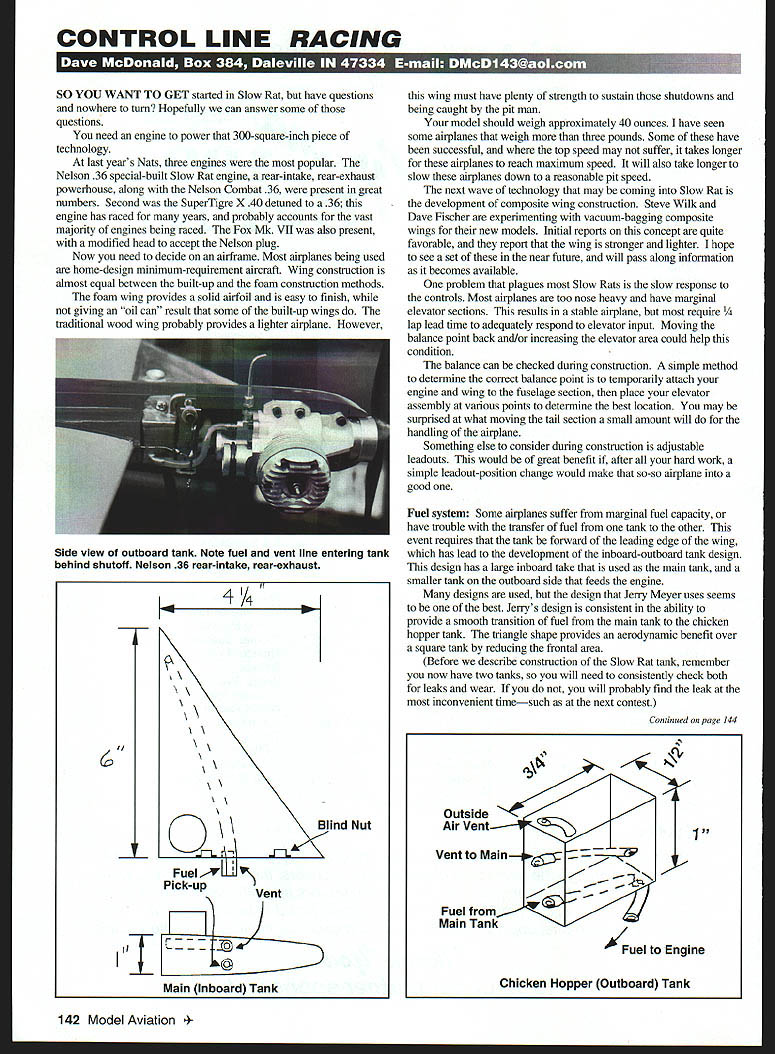
You need an engine to power that 300-square-inch piece of technology. At last year's Nats, three engines were the most popular: the Nelson .36 special-built Slow Rat engine (a rear-intake, rear-exhaust powerhouse) and the Nelson Combat .36 were present in great numbers. Second was the Super Tigre X .40 detuned to a .36; this engine has raced for many years and probably accounts for the vast majority of engines being raced. The Fox Mk. VII was also present, with a modified head to accept the Nelson plug.
Now you need to decide on an airframe. Most airplanes being used are home-designed minimum-requirement aircraft. Wing construction is almost equal between built-up and foam construction methods. The foam wing provides a solid airfoil and is easy to finish, while not giving an "oil can" result that some built-up wings do. The traditional wood wing probably provides a lighter airplane. However, wing construction must have plenty of strength to sustain those shutdowns and being caught by the pit man.
Your model should weigh approximately 40 ounces. I have seen some airplanes that weigh more than three pounds. Some of these have been successful, and while top speed may not suffer, it takes longer for these airplanes to reach maximum speed and longer to slow down to a reasonable pit speed.
The next wave of technology that may be coming into Slow Rat is the development of composite wing construction. Steve Wilk and Dave Fischer are experimenting with vacuum-bagged composite wings for their new models. Initial reports are favorable: the wing is stronger and lighter. I hope to see a set of these in the near future and will pass along information as it becomes available.
One problem that plagues most Slow Rats is the slow response to the controls. Most airplanes are too nose-heavy and have marginal elevator sections. This results in a stable airplane, but most require 1/4 to 1/2 lap lead time to adequately respond to elevator input. Moving the balance point back and/or increasing the elevator area could help this condition.
The balance can be checked during construction. A simple method to determine the correct balance point is to temporarily attach your engine and wing to the fuselage section, then place your tail assembly at various points to determine the best location. You may be surprised at what moving the tail section a small amount will do for the handling of the airplane.
Something else to consider during construction is adjustable leadouts. This would be of great benefit if, after all your hard work, a simple leadout-position change would make that so-so airplane into a good one.
Fuel System
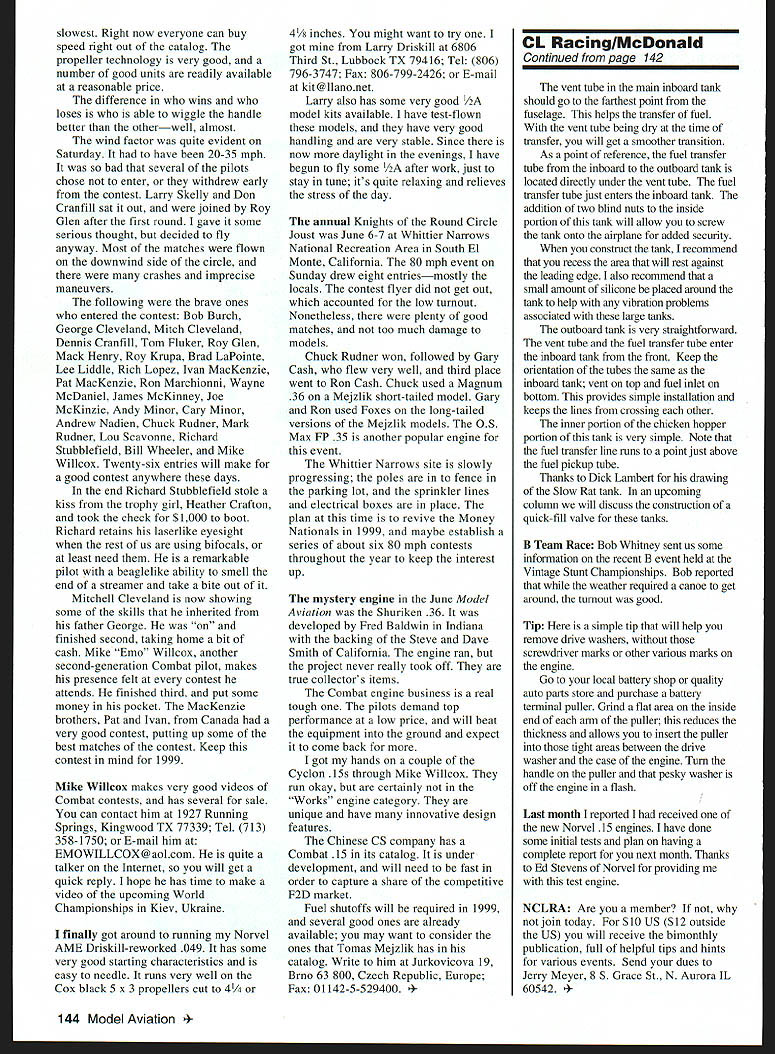
Some airplanes suffer from marginal fuel capacity or have trouble with the transfer of fuel from one tank to the other. This event requires that the tank be forward of the leading edge of the wing, which has led to the development of the inboard-outboard tank design. This design has a large inboard tank that is used as the main tank and a smaller outboard tank (chicken hopper) that feeds the engine.
Many designs are used, but the design that Jerry Meyer uses seems to be one of the best. Jerry's design is consistent in its ability to provide a smooth transition of fuel from the main tank to the chicken hopper tank. The triangular shape provides an aerodynamic benefit over a square tank by reducing frontal area.
Before we describe construction of the Slow Rat tank, remember you now have two tanks, so you will need to consistently check both for leaks and wear. If you do not, you will probably find the leak at the most inconvenient time—such as at the next contest.
Slow Rat Tank Construction
- The vent tube in the main inboard tank should go to the farthest point from the fuselage. This helps the transfer of fuel. With the vent tube being dry at the time of transfer, you will get a smoother transition.
- As a point of reference, the fuel transfer tube from the inboard to the outboard tank is located directly under the vent tube. The fuel transfer tube just enters the inboard tank.
- The addition of two drill bits to the inside portion of this tank will allow you to screw the tank onto the airplane for added security.
- When you construct the tank, recess the area that will rest against the leading edge. Place a small amount of silicone around the tank to help with any vibration problems associated with these large tanks.
The outboard tank is straightforward. The vent tube and the fuel transfer tube enter the outboard tank from the front. Keep the orientation of the tubes the same as the inboard tank—vent on top and fuel inlet on bottom. This provides simple installation and keeps the lines from crossing.
The inner portion of the chicken hopper is simple: the fuel transfer line runs to a point just above the fuel pick-up tube.
Thanks to Dick Lambert for his drawing of the Slow Rat tank. In an upcoming column we will discuss the construction of a quick-fill valve for these tanks.
Propellers and Speed
Right now everyone can buy speed right out of the catalog. Propeller technology is very good, and a number of good units are readily available at a reasonable price. The difference in who wins and who loses is who is able to wiggle the handle better than the other—well, almost.
Contest Report: Windy Conditions
The wind factor was quite evident on Saturday. It had to have been 20–35 mph. It was so bad that several of the pilots chose not to enter, or they withdrew early from the contest. Larry Skelly and Don Cranfill sat it out and were joined by Roy Glen after the first round. I gave it serious thought but decided to fly anyway. Most matches were flown on the downwind side of the circle; there were many crashes and imprecise maneuvers.
The following were the brave ones who entered the contest (26 entries):
- Bob Burch
- George Cleveland
- Mitch Cleveland
- Dennis Cranfill
- Tom Fluker
- Roy Glen
- Mack Henry
- Roy Krupa
- Brad LaPointe
- Lee Liddle
- Rich Lopez
- Ivan MacKenzie
- Pat MacKenzie
- Ron Marchionni
- Wayne McDaniel
- James McKinney
- Joe McKinzie
- Andy Minor
- Cary Minor
- Andrew Nadien
- Chuck Rudner
- Mark Rudner
- Lou Scavonne
- Richard Stubblefield
- Bill Wheeler
- Mike Willcox
In the end Richard Stubblefield won, taking the check for $1,000. Richard retains his laser-like eyesight when the rest of us are using bifocals or at least need them. He is a remarkable pilot with a beagle-like ability to smell the end of a streamer and take a bite out of it.
Mitchell Cleveland is now showing some of the skills he inherited from his father, George; he finished second and took home a bit of cash. Mike "Emo" Willcox, another second-generation Combat pilot, finished third. The MacKenzie brothers, Pat and Ivan, from Canada had a very good contest, putting up some of the best matches of the day. Keep this contest in mind for 1999.
Mike Willcox makes very good videos of Combat contests and has several for sale. Contact him at 1927 Running Springs, Kingwood TX 77339; Tel: (713) 358-1750; E-mail: EMOWILLCOX@aol.com.
Equipment Notes
I finally got around to running my Norvel AME Driskill-reworked .049. It has very good starting characteristics and is fairly easy to needle. It runs well on the Cox Black 5 x 3 propellers cut to 4 or 4¼ inches. You might want to try one. I got mine from Larry Driskill at 6806 Third St., Lubbock TX 79416; Tel: (806) 796-3747; Fax: (806) 799-2426; E-mail: kit@lano.net.
Larry also has some very good 1/2A model kits available. I have test-flown these models; they have very good handling and are very stable. Since there is more daylight in the evenings, I have begun to fly some 1/2A after work to stay in tune; it's quite relaxing and relieves the stress of the day.
Knights of the Round Circle Joust
The annual Knights of the Round Circle joust was June 6–7 at Whittier Narrows National Recreation Area in South El Monte, California. The 80 mph event on Sunday drew eight entries—mostly locals. The contest flyer did not get out, which accounted for the low turnout. Nonetheless, there were plenty of good matches and not too much damage to models.
Winners:
- Chuck Rudner
- Gary Cash
- Ron Cash
Chuck used a Magnum .36 on a Mejzlik short-tailed model. Gary and Ron used Foxes on long-tailed Mejzlik models. The O.S. Max FP .35 is another popular engine for this event.
The Whittier Narrows site is slowly progressing: poles are in to fence the parking lot, and sprinklers and electrical boxes are in place. The plan is to revive the Money Nationals in 1999 and maybe establish a series of about six 80 mph contests throughout the year to keep interest up.
Industry and Engines
The mystery engine in the June Model Aviation was the Shuriken .36. It was developed by Fred Baldwin in Indiana with backing from Steve and Dave Smith of California. The engine ran, but the project never really took off. They are true collector's items.
The Combat engine business is tough. Pilots demand top performance at a low price, and will beat the equipment into the ground and expect it to come back for more.
I got my hands on a couple of the Cyclon .15s through Mike Willcox. They run okay, but are certainly not in the "Works" engine category. They are unique and have many innovative design features.
The Chinese CS company has a Combat .15 in its catalog. It is under development and will need to be fast to capture a share of the competitive F2D market.
Fuel shutoffs will be required in 1999, and several good ones are already available. You may want to consider the ones that Tomas Mejzlik has in his catalog. Write to him at Jurkovicova 19, Brno 63 800, Czech Republic; Fax: 01142-5-529400.
B Team Race
Bob Whitney sent information on the recent B event held at the Vintage Stunt Championships. Bob reported that while the weather required a canoe to get around, the turnout was good.
Tip
Here is a simple tip to help you remove drive washers without leaving washer marks on the engine:
Go to your local battery shop or quality auto parts store and purchase a battery terminal puller. Grind a flat area on the inside end of each arm of the puller; this reduces the thickness and allows you to insert the puller into tight areas between the drive washer and the engine case. Turn the handle on the puller and that pesky washer is off the engine in a flash.
Norvel .15
Last month I reported I had received one of the new Norvel .15 engines. I have done some initial tests and plan to have a complete report next month. Thanks to Ed Stevens of Norvel for providing the test engine.
NCLRA
Are you a member? If not, why not join today. For $10 US ($12 outside the US) you will receive the bi-monthly publication, full of helpful tips for various events. Send your dues to Jerry Meyer, 8 S. Grace St., N. Aurora IL 60542.
Transcribed from original scans by AI. Minor OCR errors may remain.

