
Control Line: Racing
Bill Lee
IN MY LAST COLUMN, I copied the first part of an article which has appeared in the Gazette, the FAI Control Line Society newsletter. The article "Flying Tactics, Flying Rules, and Race Performance" is just one example why you should join that group. You will need to refer to my June column while reading what follows.
"From Fig. 6 (June) you can see that the 'normal' flying position is somewhere between point 1 and point 4, and the flier is losing a little speed compared to what he could do flying from a pylon. To make up for the speed lost by flying in a larger radius than in a pylon, the pilot must lead the plane. As can be visualized in Figs. 5 and 6, 'position 5' flying (which isn't whipping much) requires that peculiar crab-like walk pilots do while looking over their shoulder. Getting on the other side of the center of rotation, over towards position 2, really helps a lot. If you want an excellent example of something close to this position, see the picture of Peterson of Denmark on the way to a 3:56.7 time on page 584 of the October, 1976, Aeromodeller. It's worth 1000 extra rpm. (Just watch Dougy Harris fly at any Goodyear meet—W.R.L.) You might argue that the rule book outlaws position 2, but the jury has to call it. (Remember, this is written for FAI TR—W.R.L.)
"In the first part of this article, flying alone in steady-state conditions was discussed. The end of the flying alone section will consider unsteady effects, namely: acceleration, wind, change of flying radius, pull-ups, and high flying.
"Wind has an effect on speed as does acceleration and deceleration. For the world class racer used in previous examples (1-lb. weight, .4 thrust hp, 100 mph when flown from a pylon), assuming that the racer accelerates to its terminal velocity while being flown from a pylon, it takes about .7 seconds to go from 90 to 95, and .7 seconds to go from 95 to 97.5, and so on. In other words, near terminal velocity takes .7 seconds to get halfway to steady-state speed from whatever speed you start, and that goes for whether you're speeding up or slowing down. Now, of course, this slow creep up to racing speed is not good and most pilots will give a little tug, or pull the flying radius in right at the end, to hurry up the process. When flying speed is disturbed in a race it always takes time to build it back up again, which is the reason to avoid sharp pull-ups which will drag the speed down.
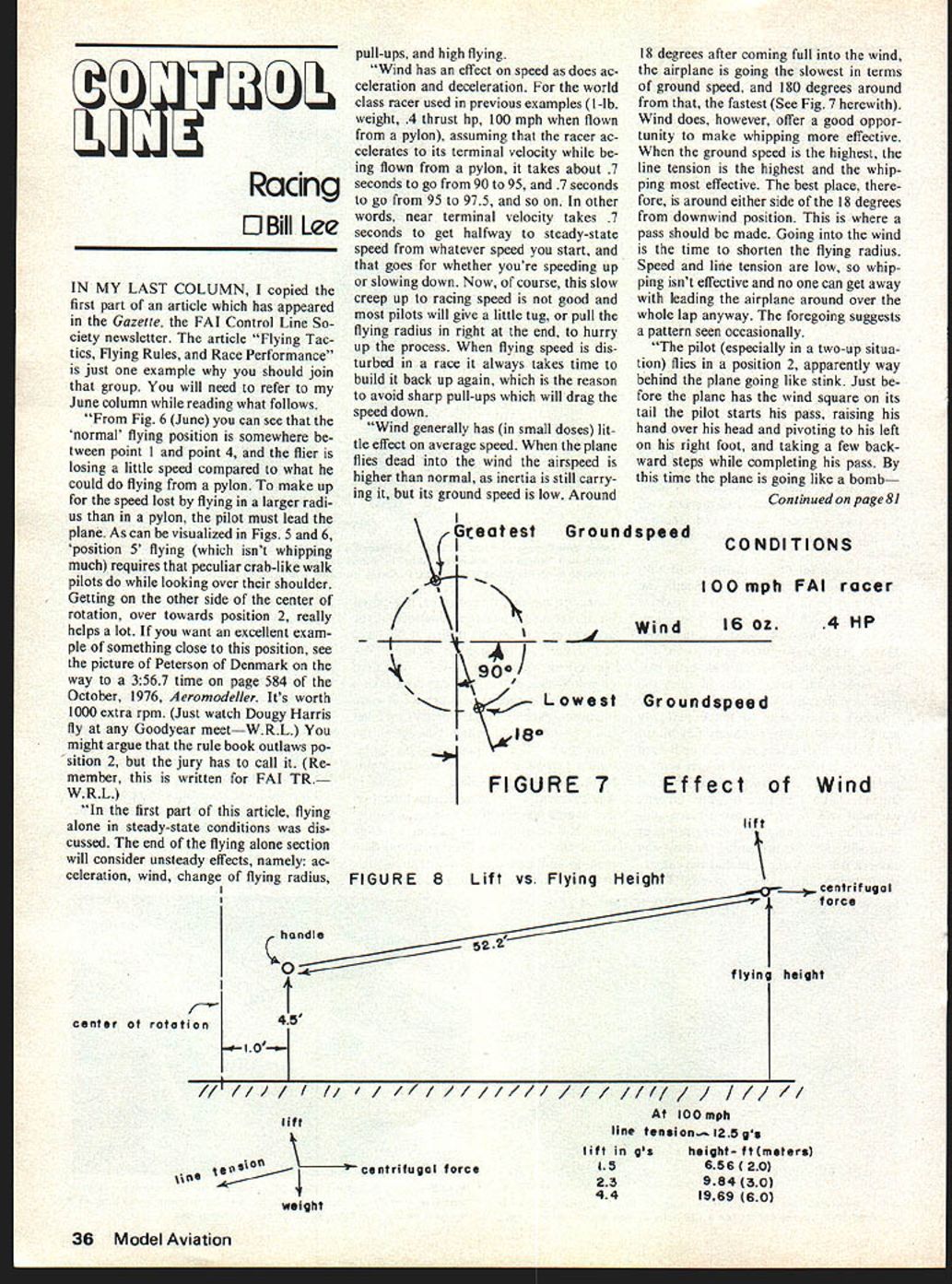
"Wind generally has (in small doses) little effect on average speed. When the plane flies dead into the wind the airspeed is higher than normal, as inertia is still carrying it, but its ground speed is low. Around 18 degrees after coming full into the wind, the airplane is going the slowest in terms of ground speed, and 180 degrees around from that, the fastest (See Fig. 7 herewith). Wind does, however, offer a good opportunity to make whipping more effective. When the ground speed is the highest, the line tension is the highest and the whipping most effective. The best place, therefore, is around either side of the 18 degrees from downwind position. This is where a pass should be made. Going into the wind is the time to shorten the flying radius. Speed and line tension are low, so whipping isn't effective and no one can get away with leading the airplane around over the whole lap anyway. The foregoing suggests a pattern seen occasionally.
"The pilot (especially in a two-up situation) flies in a position 2, apparently way behind the plane going like stink. Just before the plane has the wind square on its tail the pilot starts his pass, raising his hand over his head and pivoting to his left on his right foot, and taking a few backward steps while completing his pass. By this time the plane is going like a bomb."
CL Racing/Lee
about 5 or 10 mph over speed from whipping. Joe Turkey, whom he just passed flying in position 4, is losing 5 mph, so he's wondering where the hot dog's 10–15 mph speed advantage came from. About now, the faster plane is coming into the wind, the jury is scowling and thinking of calling a foul when the pilot stops the whip, turns around and starts flying lines off the left shoulder again. In two more laps he will be ready for another pass at this rate.
The foregoing discussion briefly touched on the effects of acceleration and wind. The next to last effect to be considered is the 'yo-yo.' Since angular momen- tum is conserved, if the flying radius is shortened very rapidly, the speed has to go up. The time per lap goes down even faster than the speed increase would indicate as the flying radius is also shortened. Of course, the speed immediately begins to die down to the steady-state speed, but for a second or so it helps, possibly just enough to make a pass. The instantaneous apparent speed goes up as the square of the ratio of the old and the new flying radii. After takeoff, for example, as the pilot spirals inward toward the center, this effect really helps. If the example racer is doing 90-mph airspeed at a 55-ft. flying radius, the apparent speed is 85.4 mph. By suddenly pulling the radius in to 53 ft. it jumps to about 92.0. The biggest increase in speed is when the airplane is going fast, so this spiraling into the center should not be done right after takeoff. Probably the best place is right at the end of the first lap, the pilot taking advantage of the "hand off chest for two laps after takeoff" rule.
Another way this effect was used was when the arm could be extended during a pass. After drawing even with his opponent, the pilot would pull his arm in and take a step backward to help things along. This same phenomenon is used in Sunday flying to great effect when doing loops downwind. After the engine quits, the pilot can whip and pull in on the bottom of the loop and then coast up to the top, putting enough energy in to keep the plane flying for long periods.
In all the discussion to date, not enough attention has been paid to the subject of the load put on the engine and the setting. If the mechanic has tuned the engine to run its best at a given speed and load, and the pilot then changes the conditions from which the setting is best, things can get worse rapidly. Flying in positions 1 and 2 does not change the load on the engine perceptibly, even though there is a slight change in line drag. Leading the plane, coming into the wind, and having the flying radius reduced suddenly, all unload the engine and the reverse loads it up. In addition to these causes, increasing the G-loading on the plane will increase its drag and also load up the engine. With light airplanes all of these loading-up effects are minimized and the high aspect ratios employed on most team racers helps to reduce the drag increase effects.
Now those G-loading effects will be touched on in a moment, but the worst effect is that from the pilot lagging the plane, perhaps because of being stuck behind a skillful, slower opponent, perhaps because of inexperience, or lack of knowledge. This continual lap after lap running at lower airspeed leads to overheating and, if the engine doesn't cook up and stop, it may not restart easily and the airplane will eventually slow down and lose its speed advantage, thus nullifying a superior airplane. The only way to fight back is to lead the plane and run the risk of being fouled out, or to adjust the engine before the race for a loaded-up condition which requires a richer and under-compressed setting, and give up laps and speed. To this, add the fact that a common mistake is to tune the airplane to run best while leading more (or lagging less) than normal flying circumstances will permit. In the 1970's this is a recognized mistake, even though it doesn't make for good practice times, and it is not made nearly so often as it was in the previous decade. As one can see, the pilot must make every effort to pass at the first opportunity. This will unload the engine and cool it down and, more importantly, establish in the jury's mind his superior speed and right to pass (italic mine—W.R.L.). If the pilot gets blocked for five laps or so, and then in desperation decides to tow a little and pass, the jury will think his plane is matched in speed and he is "applying physical effort" to pass when he could not do so fairly.
Returning to the effect of G-loading, note that high flying demands far more lift from the wings than just the weight of the airplane. Continuous high flying requires wing lift to support some of the centrifugal force (see Fig. 8). Assuming the 100-mph pylon speed racer and the handle circling in a one-ft. radius circle about the center of rotation ("center spot" as the FAI Sporting Code calls it), the following calculations should illustrate the problem:
Handle against the chest held 4.50 ft. above the ground level, airplane flown continuously at the minimum/maximum normal flying height (6.56 ft./9.84 ft.), the wing lift must be 1.5/2.3 times the weight. Only if the plane could be flown at 4.5 ft. altitude would the lift equal the weight, and this is against the rules.
Handle above head at 6.00 ft. above ground level and the airplane flying at maximum height permitted during passes (19.69 ft.), the lift must be 4.41 times weight. Very few people realize that flying at a constant altitude like this put such a load on the plane—no wonder the wings flex!
This additional lift will certainly reduce the airspeed of the aircraft since the drag must be higher. However, since the flying radius is shortened, the effective speed or timed speed may not go down at all; for most high aspect ratio racers just the opposite may occur, and high flying may pay off if you can get away with it. with two meters, shortens the radius less than one-tenth of one percent. The increased load for pulling a continuous 2.3 G's can hardly be worth it, so the best position is down low. Few juries foul pilots for flying below the two-meter limit and "it's done all the time" so this encourages a lot of real low flying. Normal flying isn't the problem. The question is, when passing—passing two at a time for instance—how high should one fly? The best solution is to time a few laps while flying high (six meters) and, if the speed timed is increasing, then consider using the maximum height allowed during a pass. This reduces radius about 3.5 percent. Also, the dive down to normal height or lower after the pass will help gain speed when passing the fastest people.
(To be continued.)
W. R. Lee, 3522 Tamarisk Lane, Missouri City, TX 77459
Transcribed from original scans by AI. Minor OCR errors may remain.

