
CONTROL LINE RACING
Dave McDonald Box 384, Daleville IN 47334 E-mail: DMcD143@aol.com
The 1998 Control Line (CL) Racing Nationals (Nats) are in the book. Good weather, good friends, good food, and great racing made it a memorable event, and Racing posted an 11% increase in competitors.
This year's Nats was a testing ground for equipment improvements to make CL Racing better. A large clock, a public-address system, and a jury tower made the event run smoother than in past years. Make plans to attend the 1999 Nats and experience some great racing.
Slow Rat
Slow Rat day was Monday, July 13. The team of John Ballard and Richard Lambert came out of a self-imposed hiatus to do battle in this very competitive category.
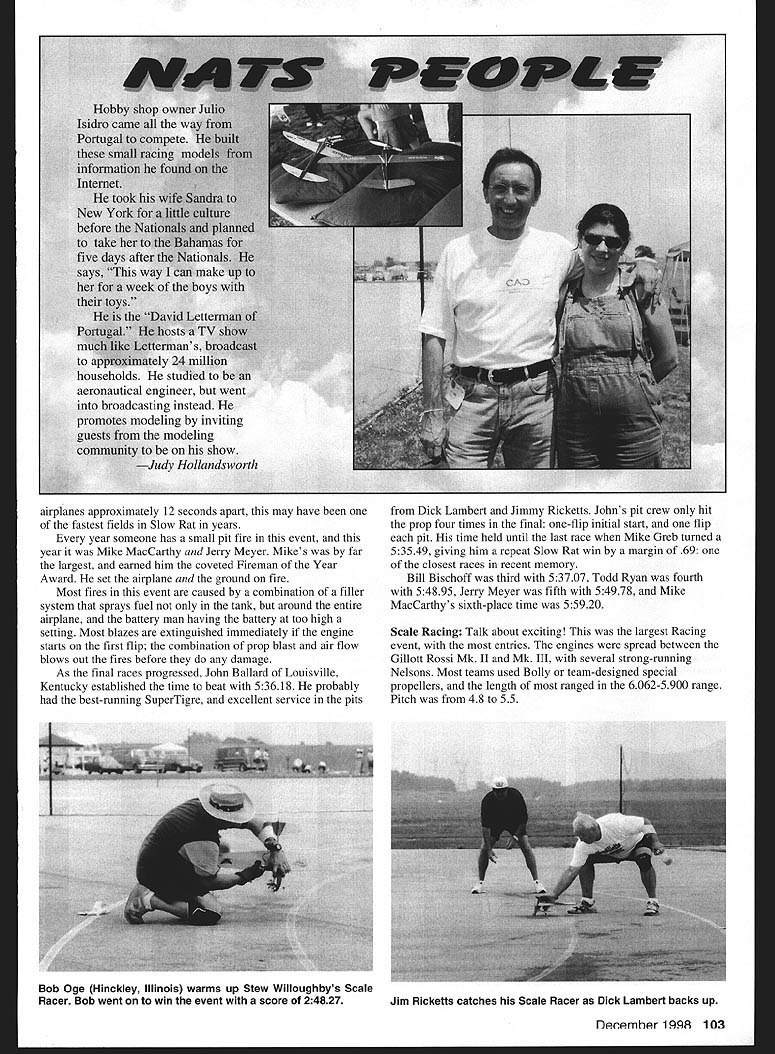
The Nelson .36 engine is slowly taking control of this horsepower event. Only a couple of Super Tigres had enough under the hood to gain a place in the finals. Most props were approximately 8-1/2 inches in length and divided between fiberglass and carbon-fiber materials. Almost all teams prepared their own props. The Backatit team of Northern California used an 8-1/4 x 6-1/4 Bolly prop; the team's proto speed was about the same as everyone else's, but the prop probably unloaded more than most.
In the heats, Bill Bischoff established an early time to beat with 2:42.22 (which secured him second place); Mike Greb posted 2:38.66; and Jerry Meyer secured the sixth and final transfer spot with 2:52.63.
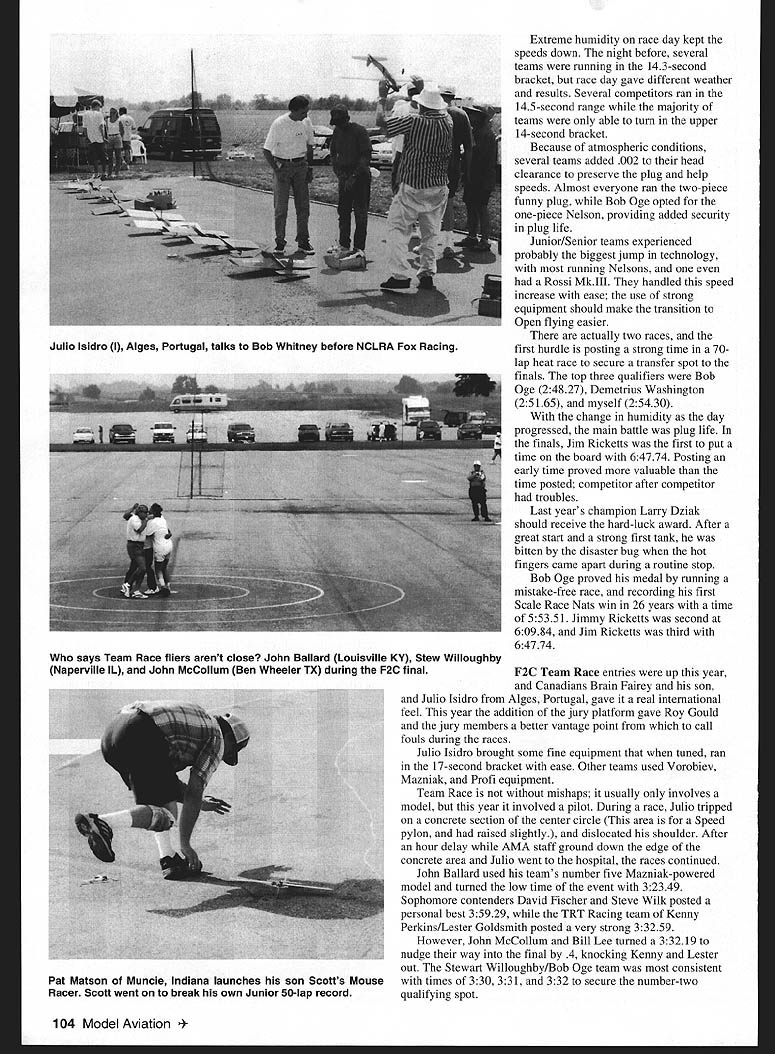
In the finals John Ballard (Louisville, KY) established an early target with 5:36.18. Excellent pit service by Dick Lambert and Jimmy Ricketts helped John. Mike Greb turned a 5:35.49 to claim a repeat Slow Rat win by a margin of 0.69 seconds — one of the closest races in recent memory. Final results:
- 1st Mike Greb — 5:35.49
- 2nd John Ballard — 5:36.18
- 3rd Bill Bischoff — 5:37.07
- 4th Todd Ryan — 5:48.95
- 5th Jerry Meyer — 5:49.78
- 6th Mike MacCarthy — 5:59.20
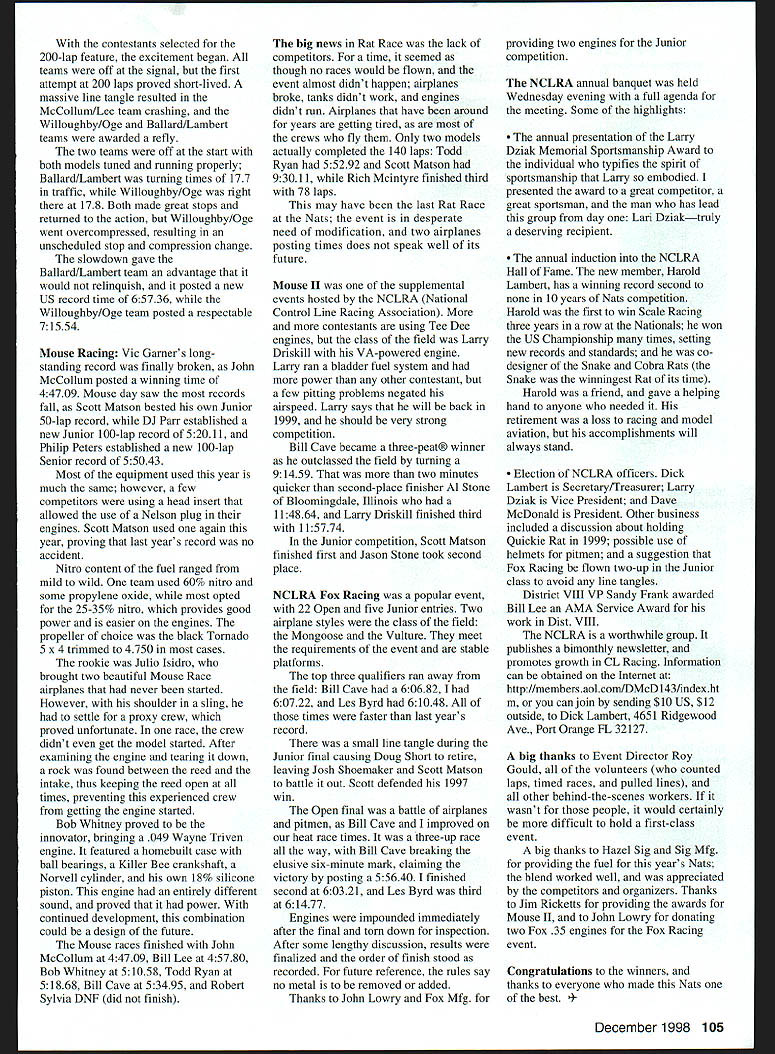
Every year someone has a small pit fire in this event; this year it was Mike MacCarthy and Jerry Meyer. Mike's was by far the largest and earned him the coveted Fireman of the Year Award. Most fires in this event are caused by a combination of fuel-filler systems that spray fuel around the airplane and the battery man having the battery set too high. If the engine starts on the first flip, prop blast and airflow usually extinguish the blaze quickly.
Scale Racing
Talk about exciting — this was the largest Racing event. Engines were split among Gillott, Rossi Mk II, Rossi Mk III, and several strong-running Nelsons. Most teams used Bolly or team-designed special propellers; lengths ranged roughly 5.9–6.2 inches with pitches around .48–.55.
Extreme humidity on race day kept speeds down. The night before, several teams were running in the low 14-second bracket; on race day, many ran in the 14.5-second range and the majority were upper-14-second times. Because of atmospheric conditions, several teams added .002" head clearance to preserve plug life and help speeds. Almost everyone ran two-piece "funny" plugs; Bob Oge opted for a one-piece Nelson plug for added plug-life security.
Junior/Senior teams experienced a significant technology jump running Nelsons. The Rossi Mk III handled the speed increase well, and strong equipment should ease the transition to Open flying. The first hurdle was posting a strong time in the 70-lap heat to secure a transfer spot. Top three qualifiers were:
- Bob Oge — 24.827
- Demetrius Washington — 25.165
- Dave McDonald (author) — 25.430
As humidity changed during the day, the main battle in the finals became plug life. Jim Ricketts was first to post a finals time, 64.774. Posting an early time proved valuable as many competitors ran into plug troubles. Last year's champion Larry Dziak earned the hard-luck award: after a great start and a strong first tank, he suffered a failure when the hot fingers came apart during a routine stop.
Bob Oge ran a mistake-free race to record his first Scale Race Nats win in 26 years with a time of 5:53.51. Jimmy Ricketts was second at 6:09.84, and Jim Ricketts was third with 6:47.74.
F2C Team Race
F2C Team Race entries were up this year, giving the event an international flavor. Canadians Brian Fairey and his son and Julio Isidro from Alges, Portugal, added to the field. The addition of the jury platform gave Roy Gould and the jury a better vantage point to call fouls during races.
Julio Isidro brought fine equipment that, when tuned, ran consistently in the 17-second bracket. Other teams used Vorobiev, Mazniak, and Profi equipment. Team Race is not without mishaps; during one race Julio tripped on a slightly raised concrete section of the center circle (an area used for a Speed pylon) and dislocated his shoulder. After a short delay while AMA staff ground down the edge and Julio went to the hospital, the races continued.
Qualifying highlights: John Ballard used his team’s number-five Mazniak-powered model to turn the low qualifying time of 3:23.49. Sophomores David Fischer and Steve Wilk posted a personal best 3:59.29. The TRT Racing team of Kenny Perkins/Lester Goldsmith posted a strong 3:32.59, but John McCollum and Bill Lee recorded 3:32.19 to nudge into the final by 0.4 seconds, knocking Kenny and Lester out. The Stewart Willoughby/Bob Oge team was most consistent with times of 3:30, 3:31, and 3:32 to secure the number-two qualifying spot.
With contestants selected for the 200-lap feature, excitement peaked. The first attempt at 200 laps ended shortly after the start when a massive line tangle resulted in the McCollum/Lee team crashing; Willoughby/Oge and Ballard/Lambert were awarded a refly. On the refly both teams ran well: Ballard/Lambert turned times of 17.7 in traffic while Willoughby/Oge ran 17.8. Willoughby/Oge went overcompressed and needed an unscheduled stop to change compression, which gave Ballard/Lambert the advantage they would not relinquish. Final results:
- Ballard/Lambert — new US record 6:57.36
- Willoughby/Oge — 7:15.54
Mouse Racing
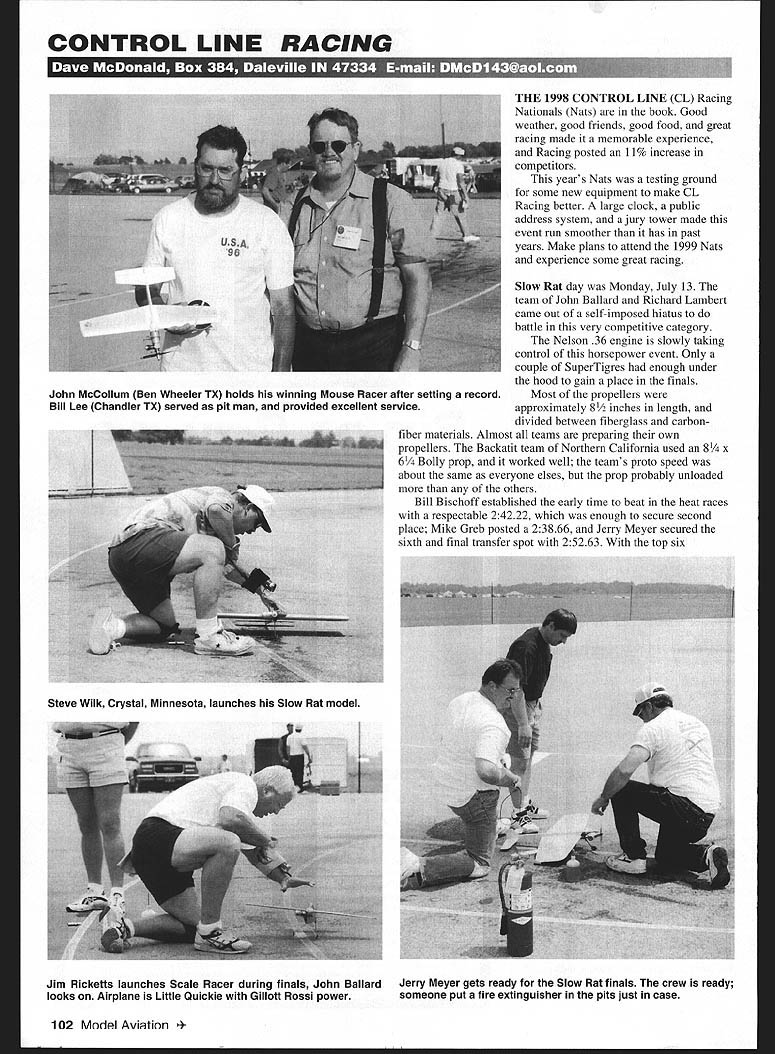
Vic Garner's long-standing record was finally broken when John McCollum posted a winning time of 4:47.09. Mouse day saw several records fall: Scott Matson bettered his own Junior 50-lap record; DJ Parr established a new Junior 100-lap record of 5:20.11; and Philip Peters set a new Senior 100-lap record of 5:50.43.
Most equipment was similar to past years, though a few competitors used a head insert that allowed a Nelson plug in their engines; Scott Matson used one again this year, proving last year's record was no accident.
Fuel nitro content ranged from mild to wild. One team used 60% nitro and some propylene oxide, while most opted for 25–35% nitro, which provides good power and is easier on engines. The propeller of choice was the black Tornado 5 x 4 trimmed to about 4.750 in most cases.
Rookie Julio Isidro brought two beautiful Mouse Race airplanes that had never been started. With his shoulder in a sling he had to rely on a proxy crew; in one race the crew couldn't get the model started. After tearing the engine down they found a rock between the reed and the intake, keeping the reed open and preventing a start.
Bob Whitby proved to be an innovator, bringing a .049 Wayne Triven engine with a homebuilt case with ball bearings, a Killee Bee crankshaft, a Novar cylinder, and his own 18% silicone piston. The engine had a distinct sound and showed promising power; with continued development this combination could be significant.
Mouse race finishing order:
- 1st John McCollum — 4:47.09
- 2nd Bill Lee — 4:57.80
- 3rd Bob Whitby — 5:10.58
- 4th Todd Ryan — 5:18.68
- 5th Bill Cave — 5:34.95
- Robert Sylvia — DNF
Rat Race
The big news in Rat Race was the lack of competitors. For a time it seemed as though no races would be flown: airplanes broke, tanks didn't work, and engines wouldn't run. Airplanes that have been around for years are getting tired, as are many of the crews. Only two models completed the 140 laps: Todd Ryan — 5:52.92 and Scott Matson — 9:30.11. Rich McIntyre finished third with 78 laps. The low turnout and few finishes raise concerns about the future of this event and suggest the class is in need of modification.
Mouse II (NCLRA supplemental)
Mouse II was one of the supplemental events hosted by the NCLRA (National Control Line Racing Association). More contestants are using Tee Dees, but the class winner was Larry Driskill with his VA-powered engine. Larry ran a blinder fuel system and had more power than most, though a few fitting problems hurt his airspeed. He plans to return in 1999.
Bill Cave became a three-peat winner, outclassing the field with a 9:14.59. Second was Al Stone (Bloomingdale, IL) with 11:48.64, and Larry Driskill was third with 11:57.74. In the Junior competition Scott Matson finished first and Jason Stone took second.
NCLRA Fox Racing
Fox Racing was popular, with 22 Open and five Junior entries. Two airplane styles — the Mongoose and the Vulture — were the class of the field and proved to be stable platforms.
Top three qualifiers (Open):
- Bill Cave — 6:06.82
- Dave McDonald (author) — 6:07.22
- Les Byrd — 6:10.48
There was a small line tangle during the Junior final causing Doug Short to retire, leaving Josh Shoemaker and Scott Matson to battle. Scott defended his 1997 Junior title.
The Open final was a three-up battle. Bill Cave broke the elusive six-minute mark to claim victory with 5:56.40. The final standings:
- 1st Bill Cave — 5:56.40
- 2nd Dave McDonald — 6:03.21
- 3rd Les Byrd — 6:14.77
Engines were impounded immediately after the final and torn down for inspection. After discussion the results stood as recorded. For future reference, the rules prohibit removing or adding nitro during impound. Thanks to John Lowry and Fox Mfg. for providing two engines for the Junior competition.
NCLRA Banquet and Awards
The NCLRA annual banquet was held Wednesday evening with a full agenda. Highlights included:
- The Larry Dziak Memorial Sportsmanship Award presentation. I presented the award to a great competitor and sportsman who has led this group from day one: Larry Dziak — a deserving recipient.
- Induction into the NCLRA Hall of Fame: Harold Lambert. Harold has an outstanding record at the Nats, including three consecutive Scale Racing wins, many U.S. championships and records, and co-design of the Snake and Cobra Rats.
- Election of NCLRA officers: Dick Lambert — Secretary/Treasurer; Larry Dziak — Vice President; Dave McDonald — President. Other business included discussion of holding Quickie Rat in 1999, possible use of helmets for pitmen, and a suggestion that Fox Racing move up in the Junior class to avoid line tangles.
- District VIII VP Sandy Frank awarded Bill Lee an AMA Service Award for his work in District VIII.
Thanks and Contact
The NCLRA is a worthwhile group. It publishes a bimonthly newsletter and promotes growth in CL Racing. Information is available online at http://members.aol.com/DMcD143/index.html, or you can join by sending $10 US ($12 outside US) to: Dick Lambert, 4651 Ridgewood Ave., Port Orange FL 32127.
Special thanks to Event Director Roy Gould, all the volunteers who counted laps, timed races, and pulled lines, and all other behind-the-scenes workers. If it wasn't for those people, it would be far more difficult to hold a first-class event.
Thanks to Hazel Sigl and Sigl Mfg. for providing the fuel for this year's Nats; the blend worked well and was appreciated by competitors and organizers. Thanks to Jim Ricketts for providing the awards for Mouse II, and to John Lowry for donating two Fox .35 engines for the Fox Racing event.
Congratulations to the winners, and thanks to everyone who made this Nats one of the best.
Transcribed from original scans by AI. Minor OCR errors may remain.

