
CONTROL LINE: RACING
Dave McDonald
Box 384, Daleville IN 47334 E-mail: DMcD143@aol.com
Event summary
I attended the 1998 Open International De Cascais Worldcup in Cascais, Portugal, October 4–6, as the guest of Julio Isidro. Julio organized an excellent event, hosting a banquet for 128 guests and a dinner at the Casino Estoril, both first-class evenings with fine service and entertainment.
The Worldcup ran alongside an airshow/exposition that displayed more than 50 full-scale aircraft and featured flight demonstrations by the Swedish Air Force. Organizers estimated 20,000–25,000 people passed through the gates over the three days.
- Sponsors: Continental Airlines; Petrogal (oil company); Casino Estoril; Tranquilidade (insurance); Banco Espírito Santo.
- Approximately 100 contestants registered.
- Large contingents attended from the United Kingdom, France, the Netherlands, Spain, Ukraine, Russia, and Portugal.
Classes contested
The event featured all Control Line F2 classes plus additional racing:
- Vintage A, Vintage B, and 1/2A Team Racing
- F2C National (profile F2C models using older steel piston/sleeve engines)
- British Goodyear, Mini-Goodyear, Phantom racing
- Demonstration of US Mouse Racing
F2C (International) — equipment and general performance
Equipment varied: Mazniak, Vorobiev, Titov, several homebuilts, and other manufacturers. Practice speeds for leading teams were in the 17.5–17.7 second range; most teams ran 18.1–18.5.
Notable teams and performances:
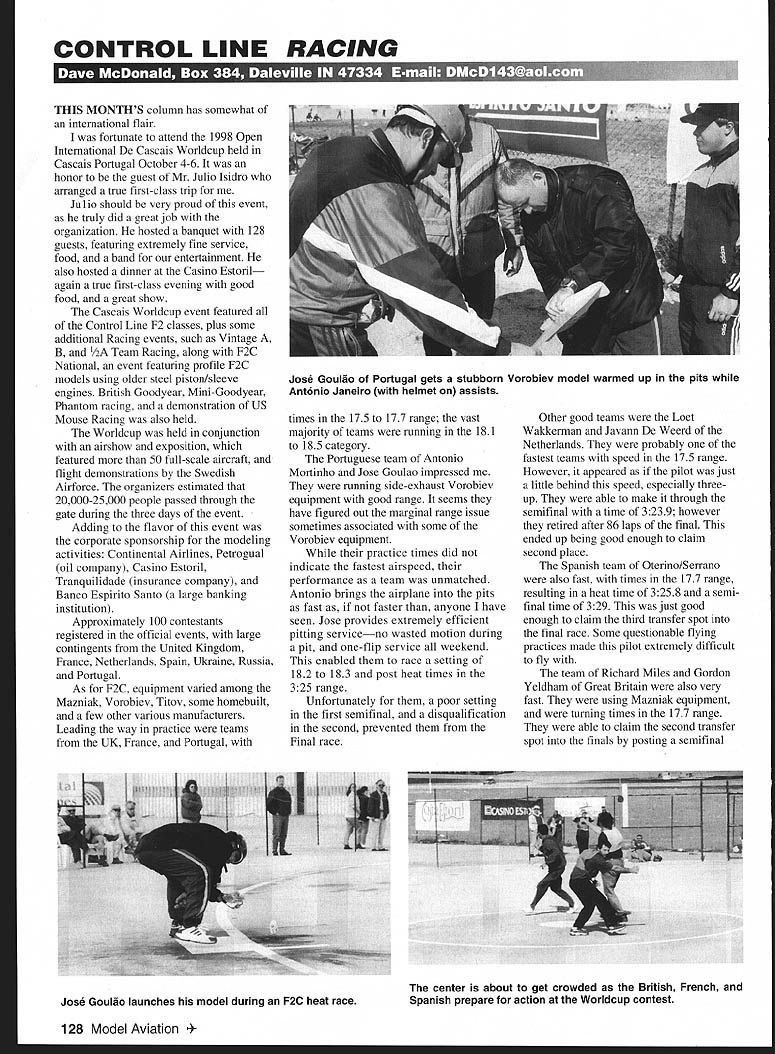
- Portugal — Antonio Mortinho & Jose Goulao: running side-exhaust Vorobiev equipment with improved range. Their pit work was extremely efficient (very fast pilot and one-flip pitting), allowing them to race at settings around 18.2–18.3 and post heat times near 3:25. A poor setting in the first semifinal and a disqualification in the second kept them out of the final.
- Netherlands — Loet Wakkerman & Javan De Weerd: among the fastest, with practice speed in the 17.5 range. They posted a semifinal 3:23.9, retired after 86 laps in the final, and finished second overall.
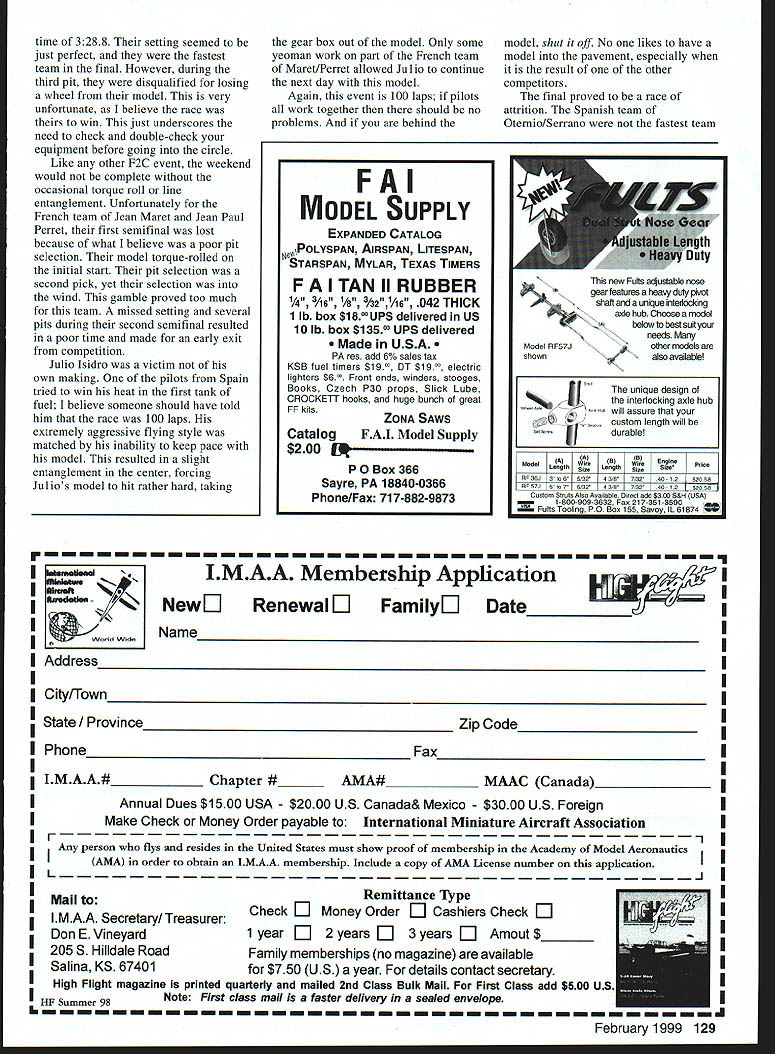
- Spain — Oterino & Serrano: fast (about 17.7), heat time 3:25.8, semifinal 3:29 to claim the final transfer spot; the pilot’s flying style made handling difficult for other flyers.
- Great Britain — Richard Miles & Gordon Yeldham: using Mazniak gear, turning 17.7 times; semifinal 3:28 to transfer to the final. During the final they were disqualified after losing a wheel in a pit.
- France — Jean Maret & Jean Paul Perret: suffered a lost semifinal due to poor pit selection and a torque-roll on the initial start; a bad second pick in the wind caused missed pits and elimination.
Race incidents and observations:
- The final was a race of attrition. Retirements and disqualifications reshaped the placings; the Spanish team (Oterino/Serrano) ultimately benefited and claimed the win.
- Mechanical failures and lost wheels underline the importance of checking equipment thoroughly before entering the circle.
- Torque-rolls and line entanglements are occasional hazards in F2C and can cost teams dearly.
- Julio Isidro’s model suffered gearbox damage after an entanglement caused during aggressive flying by another pilot; the French team Maret/Perret performed repairs that allowed Julio to continue the next day. The incident reinforces the point: when you are behind the model, shut it off — collisions into pavement are costly for everyone.
Other races and classes
Vintage B Team Race
- Generated a lot of interest and discussion. Dennis Ward and Roger Reese (Great Britain) are considering attending the 1999 U.S. Nationals.
- Their engines were extensively reworked (Dennis works in the tooling industry and has produced new piston/sleeve combinations).
- Vintage rules used by some entrants include unlimited fuel and bans on glass, carbon, Kevlar™, or other resin-bonded props.
F2C National (profile F2C with older steel piston/sleeve engines)
- Allowed profile wings or conventional models with old-style steel piston/sleeve engines; diesel tanks limited to 15cc, glow tanks to 30cc.
- Common engines: early Nelson or Rossi (some MVVS).
- Typical times: 20–21 seconds; racing was flown three-up.
- This class is excellent training for diesel operation, three-up flying, and F2C pit/flying procedures. Several F2C teams and many newcomers flew this event.
- At the end of the meet, Julio Isidro and Antonio Mortinho topped the podium in this class.
Junior/Senior competition
- No age separation — everyone flies together.
- Younger competitors tended to fly in 1/2A events. Note: in Europe an .09 engine is often referred to as a 1/2A and is flown on similar wire length to 1/2A U.S. events; the extra power reduces wind sensitivity and improves handling.
1999 Nats and contact information
Two new events are likely to be added to the 1999 Nationals program, but official confirmation was pending at the time of writing. For updates and rules:
- NCLRA Web site: http://members.aol.com/DMcD143
- If you do not have Internet access, send an SASE (include 55¢ postage to cover size of documents) to Dave McDonald at the address above and he will mail the schedule and rules.
NCLRA membership
- To join the NCLRA: send $10 US ($12 outside US) to Dick Lambert, 4651 Ridgewood Ave., Port Orange FL 32127.
- The NCLRA promotes and supports Control Line Racing. Comments and contributions are solicited and appreciated.
Transcribed from original scans by AI. Minor OCR errors may remain.

