
Control Line: Racing
By Dave McDonald
Dave McDonald, Box 384, Daleville IN 47334 E-mail: DMcD143@aol.com
Event and location
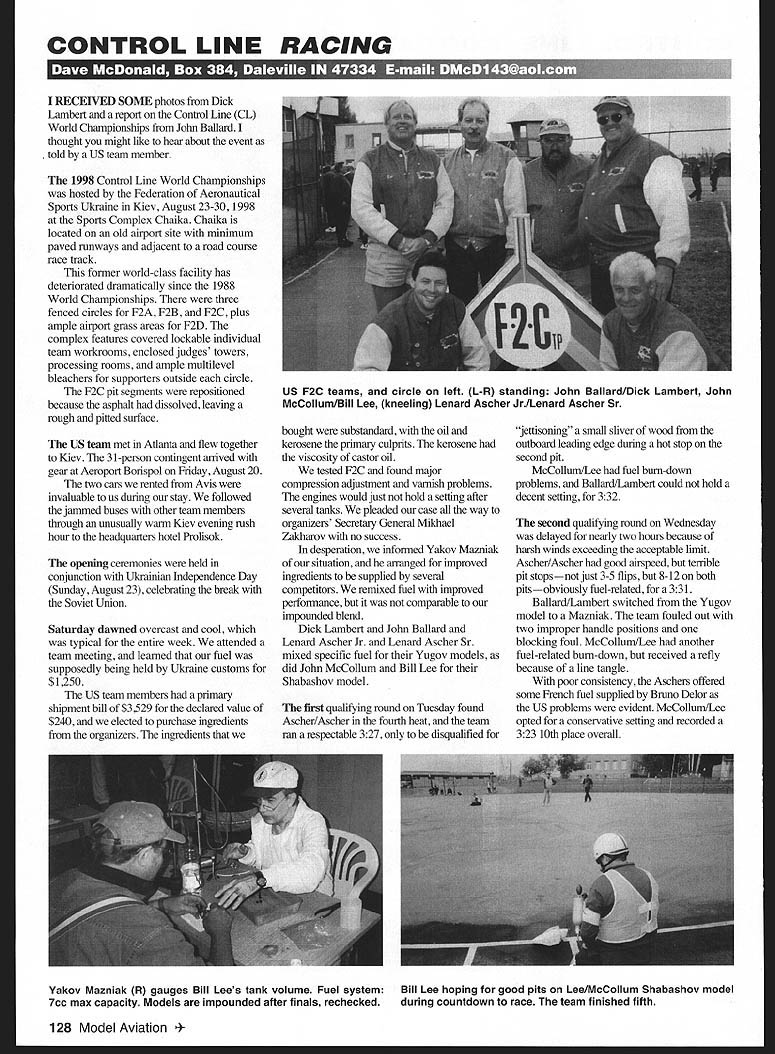
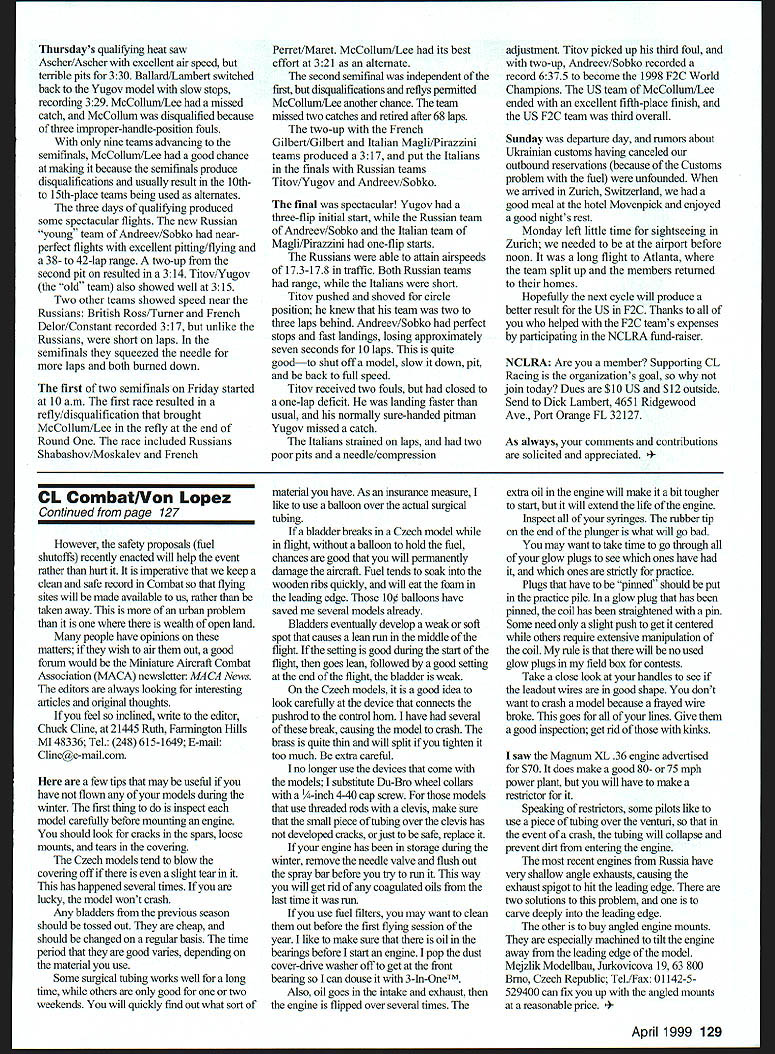
I received some photos from Dick Lambert and a report on the Control Line (CL) World Championships from John Ballard. I thought you might like to hear about the event as told by a US team member.
The 1998 Control Line World Championships was hosted by the Federation of Aeronautical Sports Ukraine in Kiev, August 23–30, 1998, at the Sports Complex Chaika. Chaika is located on an old airport site with minimal paved runways and is adjacent to a road-course race track. This former world-class facility has deteriorated dramatically since the 1988 World Championships.
There were three fenced circles for F2A, F2B, and F2C, plus ample airport grass areas for F2D. The complex featured:
- covered lockable individual team workrooms
- enclosed judges' towers
- processing rooms
- multilevel bleachers for supporters outside each circle
The F2C pit segments were repositioned because the asphalt had dissolved, leaving a rough and pitted surface.
Team and logistics
The US team met in Atlanta and flew together to Kiev. The 31-person contingent arrived with gear at Aeroport Borispol on Friday, August 20. The two cars we rented from Avis were invaluable during our stay. We followed the jammed buses with other team members through an unusually warm Kiev evening rush hour to the headquarters hotel Prolisok.
The opening ceremonies were held in conjunction with Ukrainian Independence Day (Sunday, August 23), celebrating the break with the Soviet Union. Saturday dawned overcast and cool, which was typical for the entire week. We attended a team meeting and learned that our fuel was supposedly being held by Ukraine customs for $1,250.
The US team had a primary shipment bill of $3,529 for the declared value of $240 and we elected to purchase ingredients from the organizers.
Fuel problems and remedy
The ingredients we bought were substandard, with the oil and kerosene the primary culprits. The kerosene had the viscosity of castor oil. We tested F2C and found major compression, adjustment, and varnish problems. The engines would not hold a setting after several tanks. We pleaded our case all the way to the organizers' Secretary General Mikhael Zakharov with no success.
In desperation we informed Yakov Mazniak of our situation, and he arranged for improved ingredients to be supplied by several competitors. We remixed fuel with improved performance, but it was not comparable to our impounded blend.
Those who mixed specific fuel included:
- Dick Lambert, John Ballard, Lenard Ascher Jr., and Lenard Ascher Sr. for their Yugov models
- John McCollum and Bill Lee for their Shabashov model
Qualifying rounds
The first qualifying round on Tuesday found Ascher/Ascher in the fourth heat. The team ran a respectable 3:27, only to be disqualified for "jettisoning" a small sliver of wood from the outboard leading edge during a hot stop on the second pit. McCollum/Lee had fuel burn-down problems, and Ballard/Lambert could not hold a decent setting, recording 3:32.
The second qualifying round on Wednesday was delayed for nearly two hours because of harsh winds exceeding the acceptable limit. Ascher/Ascher had good airspeed but terrible pit stops—rather than 3–5 flips, they had 8–12 in both pits—obviously fuel-related, 3:31. Ballard/Lambert switched Yugov model to a Mazniak. The team fouled out with two improper handle-position fouls and one blocking foul. McCollum/Lee had another fuel-related burn-down, but received a refly because of a line tangle.
With poor consistency, the Aschers accepted some French fuel supplied by Bruno Delor as US problems were evident. McCollum/Lee opted for a conservative setting and recorded a 3:23, good for 10th place overall.
Thursday's qualifying heat saw Ascher/Ascher with excellent airspeed but terrible pits, 3:30. Ballard/Lambert switched back to the Yugov model, with slow stops recording 3:29. McCollum/Lee missed a catch; McCollum was disqualified because of three improper-handle-position fouls. Nine teams advanced to the semifinals. McCollum/Lee had a good chance of making the semis because disqualifications there usually allow 10th–15th place teams to be used as alternates.
Three days of qualifying produced some spectacular flights. New Russian young team Andreev/Sobko had near-perfect flights, excellent pitting/flying, and a 38–42-lap range; a two-up second pit resulted in 3:14. Titov/Yugov, an experienced team, also showed well with 3:15. Two other teams showed speed near the Russians: British Ross/Turner and French Delor/Constant recorded 3:17. Unlike the Russians' short laps, semifinals squeezed needle laps; both burned down in the first two semifinals on Friday.
Semifinals and finals
The first of two semifinals on Friday started at 10 a.m. The first race resulted in a refly; a disqualification brought McCollum/Lee into the refly at the end of Round One. The race included Russians Shabashov/Moskalev and French Perret/Maret. McCollum/Lee had its best effort at 3:21 as an alternate.
The second semifinal was independent of the first, but disqualifications and reflys permitted McCollum/Lee another chance. The team missed two catches and retired after 68 laps.
A two-up with the French Gilbert/Gilbert and Italian Magli/Pirazzini teams produced a 3:17 and put the Italians in the finals with Russian teams Titov/Yugov and Andreev/Sobko.
The final was spectacular. Yugov had a three-flip initial start, while the Russian team of Andreev/Sobko and the Italian team of Magli/Pirazzini had one-flip starts. The Russians were able to attain airspeed of 7.3–7.8 in traffic. Both Russian teams had range, while the Italians were short.
Titov pushed and shoved for circle position; he knew his team was two to three laps behind. Andreev/Sobko had perfect stops and fast landings, losing approximately seven seconds for 10 laps. This is impressive—to shut off a model, slow it down, pit, and be back to full speed.
Titov received two fouls but had closed to a one-lap deficit. He was landing faster than usual, and his normally sure-handed pitman Yugov missed a catch. The Italians strained on laps and had two poor pits and a needle/compression adjustment. Titov picked up his third foul, and with two-up, Andreev/Sobko recorded a record 6:37.5 to become the 1998 F2C World Champions. The US team of McCollum/Lee finished an excellent fifth place, and the US F2C team was third overall.
Departure
Sunday was departure day. Rumors that Ukrainian customs had canceled our outbound reservations (because of the customs problem with the fuel) were unfounded. When we arrived in Zurich, Switzerland, we had a good meal at the Hotel Movenpick and enjoyed a good night's rest. Monday left little time for sightseeing in Zurich; we needed to be at the airport before noon. It was a long flight to Atlanta, where the team split up and the members returned to their homes.
Hopefully the next cycle will produce a better result for the US in F2C. Thanks to all who helped with the F2C team's expenses by participating in the NCLRA fund-raiser.
NCLRA
Are you a member? Supporting CL Racing is the organization's goal, so why not join today?
- Dues: $10 US and $12 outside the US
- Send to: Dick Lambert, 4651 Ridgewood Ave., Port Orange FL 32127
As always, your comments and contributions are solicited and appreciated.
Transcribed from original scans by AI. Minor OCR errors may remain.

