
CONTROL LINE RACING
Dave McDonald Box 384, Daleville IN 47334 E-mail: DMcD143@aol.com
HERE IS AN EXCERPT from a letter that I received:
"My son and I attended the 1998 AMA Nationals in Muncie. We are thinking about flying some Racing events, and would like some information on Scale Racing and Fox Racing. Would you please provide some information on obtaining equipment, and hints that may help us? Also information on the best airplanes used. Are they available in kit form?"
Thanks to the author of the letter; I appreciate his comments and input. I am always glad to hear of a father and son getting into Racing; modeling can and does provide many hours of enjoyment, and provides a good base for a long and lasting father-son/parent-child relationship.
The two events mentioned in the letter, Fox Racing and Scale Racing, provide different challenges and require different skills to be competitive.
Fox Racing
Fox Racing provides a good foundation for learning to build and fly Control Line (CL) Racing airplanes. You will develop good piloting skills with the three-up format. Speeds are slow enough to allow the young and old to participate against each other with relative ease and safety.
Fox Racing is also fairly low-cost; by that I mean no trick equipment, fancy props, or high-tech engines. "Box stock" Stunt Fox .35 engines are used for the event. Almost any hobby shop carries them, many are available at swap meets, or you can buy them directly from Fox.
If you purchase an engine from a swap meet, check it carefully. You do not want to buy one that is worn out or has been internally modified. No modifications are allowed in Fox Racing.
One of the secrets of a good Fox .35 is the quality of fuel used. These are not modern-designed engines; I have seen more than one good Fox .35 ruined by using synthetic lubricant fuel. You will be surprised at the speed and range difference if you use 20% (minimum) castor-oil-based fuel.
Airplanes for Fox Racing, according to NCLRA (National Control Line Racing Association) rules, must be 300 square inches minimum in wing area. They must also be a kit or from kit plans.
At the 1998 Nationals, most of the field was flying the Mongoose Fox Racer. There are other choices out there, such as the Sky-Ray, Shoestring, Flite Streak, etc., and some designs are faster than others. You will want one that is fast and stable. Look around and see what others are using; there must be a reason for their choices.
With the engine/airplane combination, you will need a good fuel tank. The best one I have used is a design that John Ballard first reported on in this column in January 1993. I suggest building this tank with approximately a 1-1/2-ounce capacity, which should provide 40–48 laps of racing.
If you get that many laps, you may have to short-tank on one of the pit stops, but this design gives good performance with a short fuel load and provides a constant needle setting; you will not have those lean engine runs at the back of the tank.
Scale Racing
Scale Racing is not difficult, but some participants make it harder than it needs to be.
You will probably be using one of two engines: the Nelson .15 or the Gillott/Rossi .15, the Scale Racing engines of choice. You will also be using some of the so-called "trick" equipment: hot fingers, shutoffs, fast-fills, etc., but do not let this scare you; there is really nothing trick about any of these items.
Hot fingers are nothing more than two pieces of brass or copper sheet, with a separate wire running from each to the positive and negative sides of your battery.
Shutoffs get many pilots into trouble. The main cause of problems is underestimating the amount of stress placed on shutoffs during a race. Most shutoff failures are caused by poor construction, poor design, or poor maintenance.
There are different ways to make a shutoff, and some have been discussed in this column. Look at what some of the guys are using; you will want to watch for a couple of characteristics and functionality. Does the shutoff work every time? Is it sturdy enough not to break? Also consider ease of operation for the pilot and the pitman.
Fast-fills, mechanical or rubber, are the options. If you opt for mechanical, it should be easy to operate, provide adequate fuel transfer volume, and be easy to maintain.
Rubber fast-fills have been around for some time. Something to watch for is the quality of the slot in the bottom. Are the wall thicknesses equal? If you are using a rubber fill, it is important that your filler bulb has a smooth, round tip so as not to tear the rubber, resulting in a loss of tank pressure.
For a Scale Racing airplane design, consider the Lil' Quickie, which was featured in the December 1982 Model Aviation. If you choose it, build it identical to the plans; it is a proven contender. This airplane provides good geometry for tanks and shutoffs, and is fast and responsive.
Practice and Teamwork
Hint for success: practice. It does not take long at a contest to sort out those who practice and those who do not.
You can learn something from everyone; it may be something you do not want to do, or it may be something that you see as positive. There are many good competitors out there, and for the most part, they are doing the same thing. Do not try to reinvent the wheel.
Watching and asking questions will give you a good base from which to start. There is not a single racing team that will not answer your questions or provide a helping hand.
You should practice with a purpose. Develop a routine. Start this routine every time you go to fly, whether it's at a contest or a Sunday practice session. If you start the engine with the same technique every time, you will have fewer starting problems.
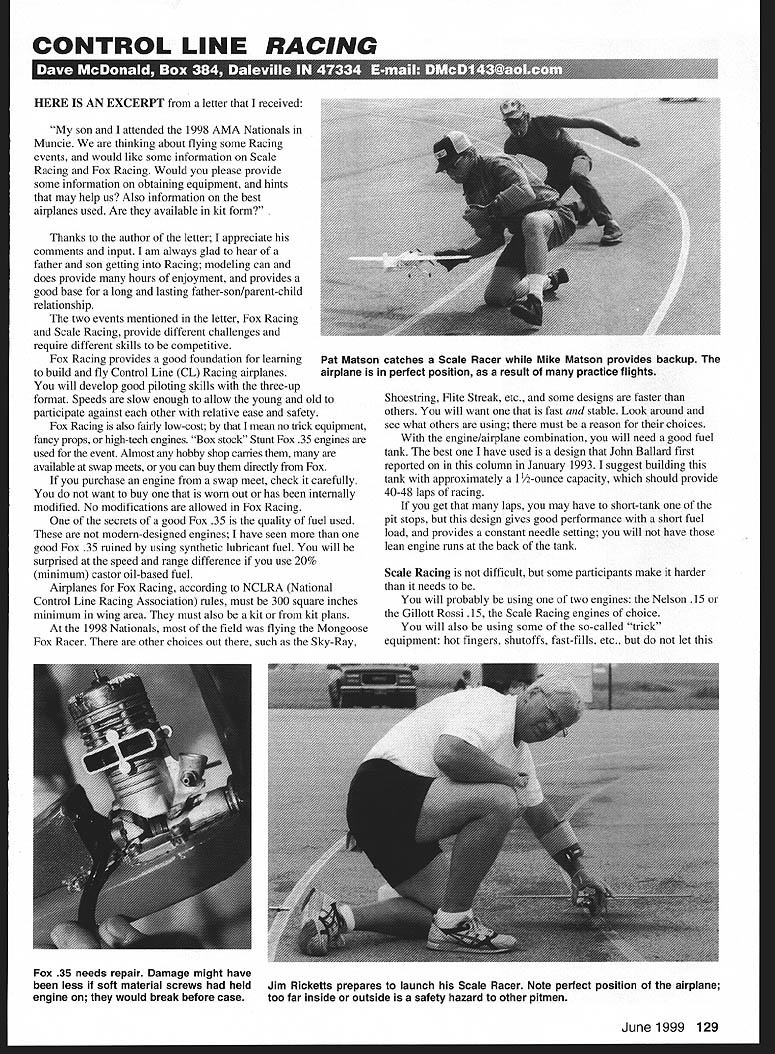
If you practice your pit stops, you will make faster pits in a race. The goal is for the pilot and pitman to become one. The pitman should know that his pilot is going to land the airplane at approximately the same speed every time—that it will be on the pitting line, not too far inside or outside.
The pilot must know that his pitman will catch the airplane, refuel, restart, and launch with the same degree of expediency. One must know exactly what the other is thinking or going to do prior to doing it, and the only way to accomplish this is through practice. You must spend time at the flying circle doing nothing but practicing pit stops.
I like to run approximately 15–20 laps and make a pit. We may do this seven or eight times prior to taking a break. We may fly 700–1,000 laps during practice. It is not uncommon to burn a gallon of fuel during a practice session. No problem will arise in a race that will not arise in practice, if you practice long enough.
Do not be afraid to try new things in a practice session. Take notes on how the engine responds to certain changes, be it props, head clearance, type of plug, temperature, humidity, altitude, etc. Keep the notes in a safe place; they will become your guide to optimizing performance at various locations and in various conditions.
Remember that only through practice can we attempt to achieve perfection.
New Events
The 1999 Nationals will feature two new supplemental events: Vintage "B" Team Race and Quickie Rat "B" Team Race. These will be flown following F2C on Wednesday afternoon, while Quickie Rat will fly on Friday. Rules for both events may be obtained at the NCLRA Web site at http://members.aol.com/DMcD143/index.htm, or by sending an SASE to the address at the top of the column. Vintage "B" Team Race is sponsored by Muncie Model & Hobby. K&B has provided three K&B 4011 engines as awards for Quickie Rat.
NCLRA
Are you a member? A bimonthly newsletter is full of tips and information. Dues are $10 US or $12 outside. Send to:
Dick Lambert 4651 Ridgewood Ave. Port Orange, FL 32127
As always, your comments are solicited and appreciated.
Racing Equipment
- Nelson Competition Engines
121 Pebble Creek Lane Zelienople, PA 16063 (724) 538-5282
- Tim Gillott — Scale Race engines
1063 Harding St. Salinas, CA 93906 (408) 449-2052
- Fox Manufacturing, Inc.
5305 Towson Ave. Fort Smith, AR 72901 (501) 646-1656
- Mongoose Fox Racer — Pat Matson
9609 S. Olive Muncie, IN 47302 (765) 741-9483
- Muncie Model & Hobby — Lines, shutoffs, many racing items
2645 S. Co. Rd. 400 E. Muncie, IN 47302 (765) 289-5856
Transcribed from original scans by AI. Minor OCR errors may remain.

