
Control Line: Racing
Once again, Control Line Racing at the Nats was an outstanding success. Entries were up and the excitement level was high because of close racing. Pit crews and pilots are learning the workings of the airplanes; one‑flip starts and strong pit performance are becoming the norm. While many teams are using plastic props (Master Airscrew, APC), several records were established using wooden props.
Fox Racing (NCLRA)
Julio Isidro of Portugal provided a technological advance with take‑apart construction to ease transporting airplanes as luggage. Most of the Portuguese entries were the Mongoose Fox Racer, with a few Vultures and other models. Tim Stone brought a flying‑wing called the Foxbat; it drew a protest and was ruled not to be in the spirit of the event. Tim’s backup airplane, however, was faster and performed very well in the final.
Junior/Senior
- Fast qualifier: Jason Stone (McHenry, IL) — 6:13.55. Jason began competing last year and has shown marked improvement.
- Second qualifier: Scott Matson — 6:14.30.
- Third qualifier: Doug Short (Muncie, IN); his father Greg handled pit duties.
Final results (Jr./Sr.)
- Scott Matson — 5:57.11 (first Junior to break the six‑minute mark; third straight Fox Racing win)
- Jason Stone — 6:05.86
- Doug Short — 6:35.69
Open
- Julio Isidro — 6:33.97 (pitted by Jose Correia; Carlos Costa provided backup)
- Bob Whitney recorded a 6:20.46 in heat competition but later encountered a lean setting and retired after 75 laps.
- Tim Stone — 5:49.05
- Team Matson–McDonald set a record 5:37.63 in the first part of the final and backed it up with a 5:37.41 in the finals.
Postrace inspection
- At the conclusion, airplanes were impounded for mandatory engine teardown handled by John Lowry and Dick Lambert.
- One Junior entry (Bob Whitney) was ruled illegal because some chrome work inside the engine had shifted; Vic Garner received the third spot in that class.
- Special thanks to John Lowry and the folks at Fox Manufacturing for providing support.
Slow Rat
Now a pure horsepower event, Slow Rat produces serious ground‑shaking thunder when airplanes perform to potential. Improved filling systems and strong pit crews resulted in no fires this year. The Nelson engine is becoming the powerplant of choice; for the first time more competitors used Nelsons than any other engine.
Props and equipment
- Notable props included Bolly variants and the Eliminator series (Steve Wilk). The APC 8x7 was also mentioned as effective.
- Steve Wilk (Crystal, MN) ran a very light, fast airplane and was among the few to run in the low‑13 or high‑13 bracket using a Nelson .36 with a slightly modified venturi.
Qualifying and finals
- Only 10 seconds separated the top six qualifiers: fast time 2:39.80; sixth 2:49.78.
- Final results:
- Bill Bischoff — 5:35.00
- John Ballard (Louisville, KY) — 5:39.34
- Mike Greb — 5:41.11
- Todd Ryan — 5:48.75 (moved into final after Dick Lambert withdrew)
- Steve Wilk — (had a long pit stop)
- Jerry Meyer
Junior Slow Rat
- Scott Matson — 8:29.70 (first)
- Jason Stone — 10:38.30 (second)
- Doug Short — 10:53.82 (third)
Scale Racing
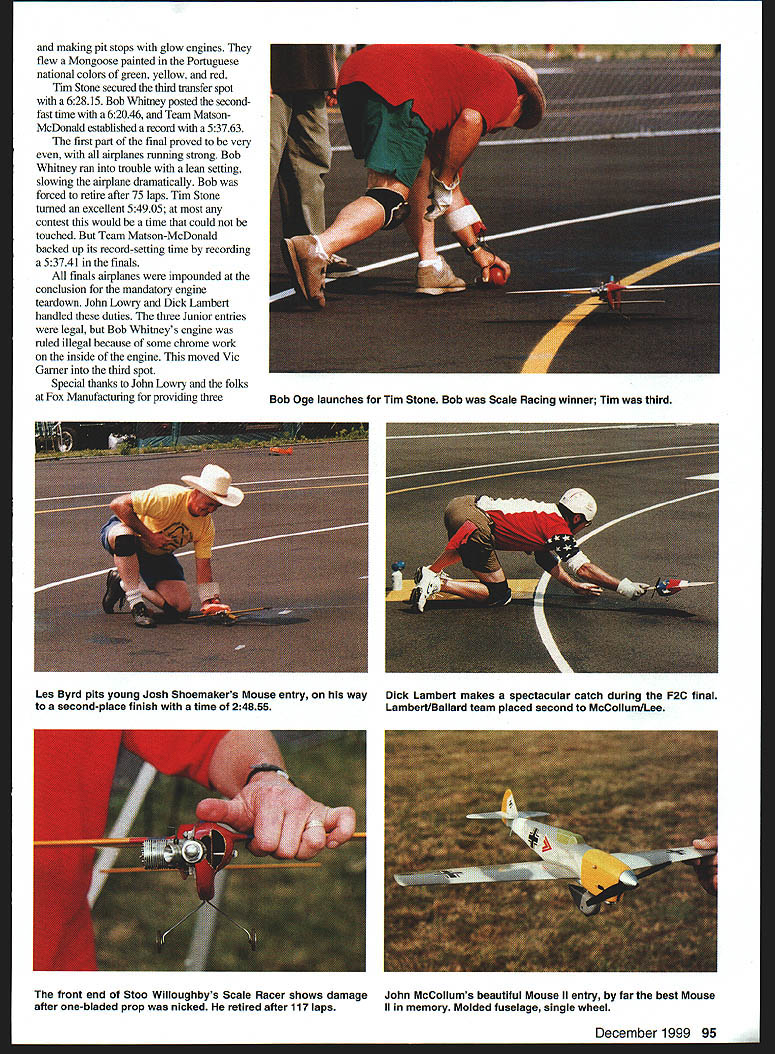
Common equipment: Little Quickie airframe; engines—Gillott Rossi and Nelson .15. The Nelson .15 is appearing more often, likely due to availability and cost.
Innovations and notes
- Single‑blade props (used by Bob Oge and Stoo Willoughby, adapted from Team Race props) showed promise; performance was about the same or slightly better than standard two‑blade props.
- Many teams solved 1998 plug problems by adjusting head clearance for more predictable plug life.
Junior/Senior
- With four Jr./Sr. entries, a final‑only format was used.
- Results (Jr./Sr.):
- Krystal King — (first)
- Doug Short — 8:30.67 (second; fastest Scale Racer but hindered by needle and a lengthy pit)
- Scott Matson — 9:30.30 (third; disappointed due to a late setting and an unscheduled stop)
Open heats and final
- A slow 3:07 was enough to transfer to the final in one heat (typically under three minutes is required).
- Closest heat: Larry Dziak and Tim Stone (pitted by Dave McDonald and Bob Oge) — 2:56.32 and 2:58.70.
- Fastest heat time: Stoo Willoughby — 2:40.51 (slightly off his record).
- Final: Stoo Willoughby suffered a prop nick on takeoff; an out‑of‑balance prop damaged the nose and retired after 117 laps.
- Final results (Open):
- Bob Oge — 5:38.90
- Larry Dziak — (second)
- Tim Stone — (third)
- Mike McCarthy — (fourth)
- Jim W. Ricketts — (fifth)
F2C
F2C field was the largest in some years, with most teams using Mazniak equipment (some Vorobiev). Speeds clustered in the 18.0–18.5 range; pitting performance was decisive.
Incidents
- A hectic pit sequence early in the day caused lines to snag and one airplane to be pulled into the circle; later Todd Ryan hit the damaged airplane’s wing while pitting, destroying the wing and ending its race. This incident served as a wake‑up call; subsequent heats were uneventful.
Qualifying
- McCollum/Lee — 3:24.25 (first transfer spot)
- Ballard/Lambert — 3:25.40
- Willoughby/Oge — 3:39.37
Final
- Stoo Willoughby retired shortly after the first stop.
- McCollum/Lee had perfect settings and excellent pitting; Ballard/Lambert were soft early but improved.
- Final results:
- McCollum/Lee — 7:00.81
- Ballard/Lambert — 7:37.75
- Willoughby/Oge
Vintage B Team Race
Held for the first time in many years; turnout was small (four entries). The Portuguese team (Julio Isidro, Carlos Costa, Jose Correia) had the fastest equipment. Paul Haley (U.K.) had the second‑fastest equipment but a tank leak prevented finishes.
Results
- Julio Isidro — 7:49.31
- Bob Whitney — 10:14.25
- Dave Betz — 11:53.59
Mouse II
Weather was hot and so was the competition. Juniors and Seniors provided exciting flying and strong pit performances.
Jr./Sr. highlights
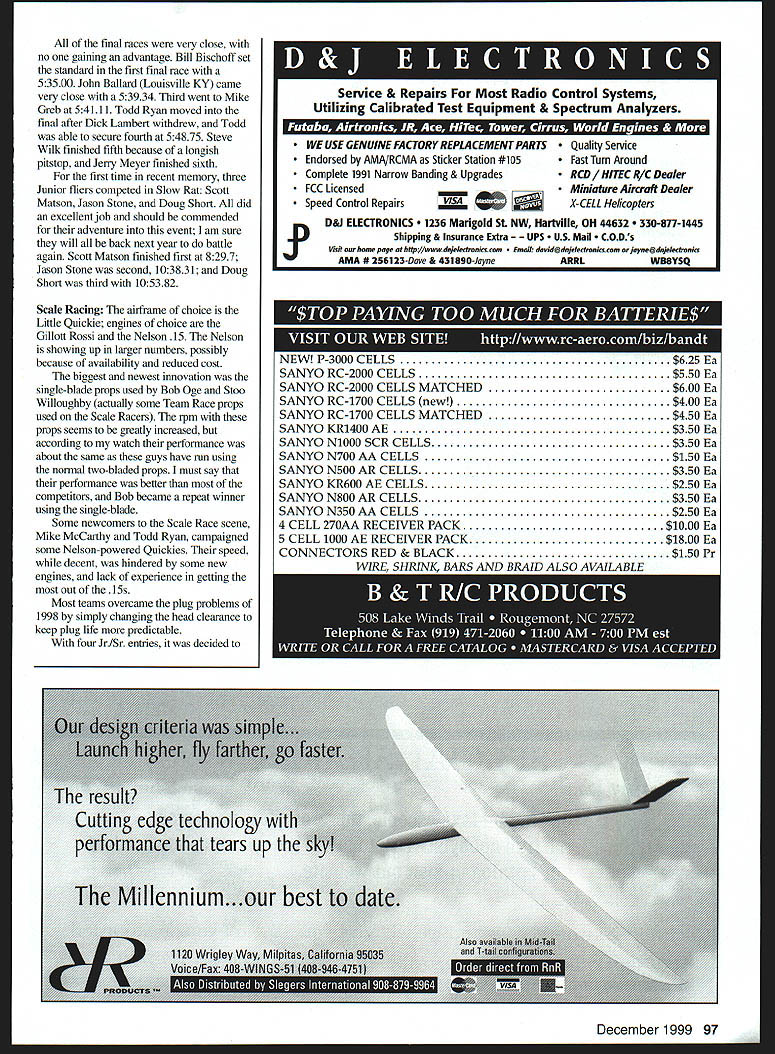
- Scott Matson set new heat and final records while running on 10% nitro fuel (improvements include a Bob Oge chromed sleeve and a Nelson plug head by Dave McDonald).
- Heat time: 2:37.57 (well below his previous record)
- Final: 5:57.11 — first Junior to break six minutes and winner of the Jr./Sr. final.
- David Rolley (Senior) heat record: 2:44.68; final: 6:30.79.
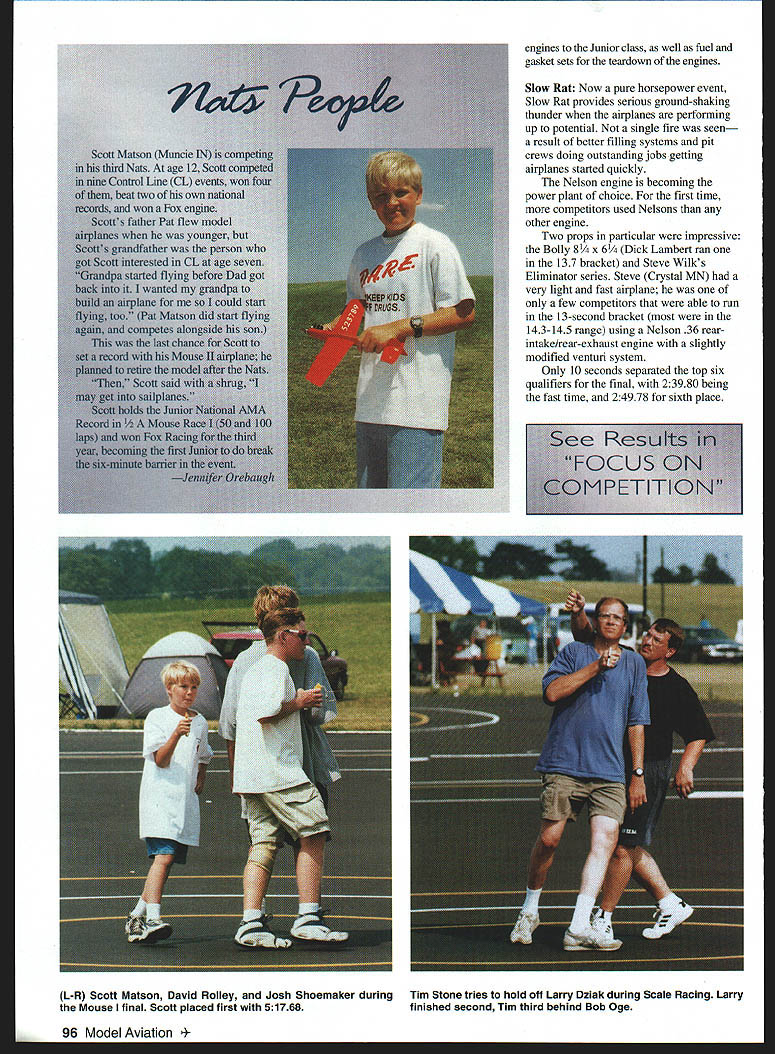
- Josh Shoemaker had excellent speed with a 2:48.55 heat.
Open Mouse II notes
- V‑tail designs, Shurikens, and a fast handmade engine from Wayne Trivin produced very fast airplanes.
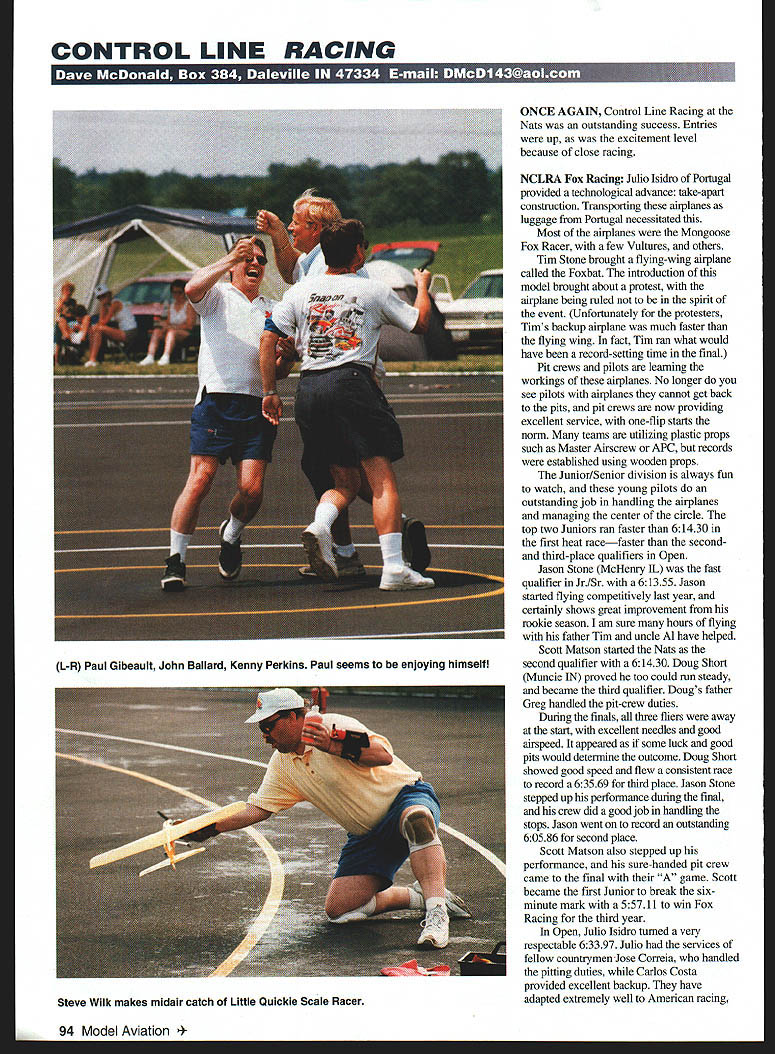
- Paul Gibeault’s Shuriken was extremely fast but suffered a restart issue on a bet.
- Bob Whitney (flying with Wayne Trivin) showcased a homemade Mouse II engine with both speed and consistency en route to first place in his class.
- John McCollum built a museum‑quality Me 109 with a molded fuselage and a one‑wheeled design for the drop tank; it may be the finest Mouse II campaigned.
Quickie Rat
Quickie Rat replaced Fast Rat this year and showed good turnout.
Equipment
- Engines: K&B .049s and .40s.
- Props: APC, Bolly (8x7 to 8x8 ranges).
- Airframe types: Sea Rat, Barracuda, and various homebuilt designs.
Results
- John McCollum (ran a rent‑a‑plane from Vic Garner) — 6:29.63
- Wayne Trivin — 7:00.28
- Todd Ryan — 7:33.81
NCLRA Banquet
- Henry Nelson was inducted into the Hall of Fame.
- Larry Dziak Sportsmanship Award: John Ballard.
- Dubious Fireman of the Year Award: Mike McCarthy (1998 winner; with no fires this year, he retained the award).
Thanks and acknowledgements
- Roy Gould — Event Director (excellent job).
- Sponsors and supporters: Sig (fuel for official events), Fox (sponsored NCLRA Fox Racing and provided fuel for B Team Race and Quickie Rat), K&B (provided three engines for Quickie Rat awards), Muncie Model & Hobby (Vintage B Team Race awards).
- Special thanks to all volunteers who worked diligently throughout the week.
Transcribed from original scans by AI. Minor OCR errors may remain.

