
Control Line: Racing
Bill Lee
MY LAST TWO columns have been devoted to an article that appeared in the Gazette, the publication of the FAI Control Line Society. We'll finish it this time and then present similar information that applies to Rat and Goodyear. O.K., here's Marion Gofast:
Section II: Flying With Others
"So far, all of the things affecting speed that the pilot can contribute to have been discussed, but mainly as if the pilot were out there flying all by himself. In competition, the presence of others in the circle won't change these facts, but it will change what the pilot has the opportunity to accomplish. The discussion of these problems is necessarily much more qualitative. It is impossible to estimate the speed loss due to getting your lines caught in the competition's hair, for instance.
"Flying with other people presents a number of problems, not the least of which is passing, even when you have the faster airplane. The Soviet Union proposed a 'hand off the chest for three laps' rule to provide a longer time in which to pass. Just how much faster you have to fly to pass while obeying the flying rules is an interesting thing. Consider two cases (both airplanes flying at a constant speed): the faster airplane having to gain (a), 1/8 of a lap and (b), 1/4 of a lap while covering no more than two laps. The tables (Table 3) show the fastest opponent you can pass.
TABLE 3 PASS IN TWO LAPS
Laps Gained your speed-mph 90 100 110
1/8 84.4 93.8 103.1
1/4 78.8 87.5 96.3
PASS IN THREE LAPS
Laps Gained your speed-mph 90 100 110
1/8 86.3 95.8 105.4
1/4 82.5 91.7 100.8
"As is plain to see, under present conditions and a strict interpretation of the rules, you have to have a terrific speed margin to do any good. A 100-mph racer can't even squeak by a 94-mph racer in two laps. As we will soon see, blocking makes it even worse. Getting into the semis may depend on being lucky enough not to have to fly against a good slow team. That is, one that won't retire, will fly for the best possible race outcome, and makes rapid pits. The Russian proposal will help some, as you can see from Table 3.
"Even if you have the speed advantage necessary to pass, the presence of another pilot in the circle can take it away. Taking the simplest case first, one big problem is presented when one pilot occupies the center, just twirling around on his heels. He is probably some gorilla who should be a defensive lineman in the NFL and who can also lean back with an alarming spinal curvature. Worst of all, he can't speak English so you can't tell him how you feel. Since the British rule proposal isn't formal yet, you can't fly with your lines over his shoulder unless you are taller than he is, so, for practical purposes, the space he blocks out—space that your lines can't pass through and space you can't occupy—is approximately a rectangle two ft. by one ft.
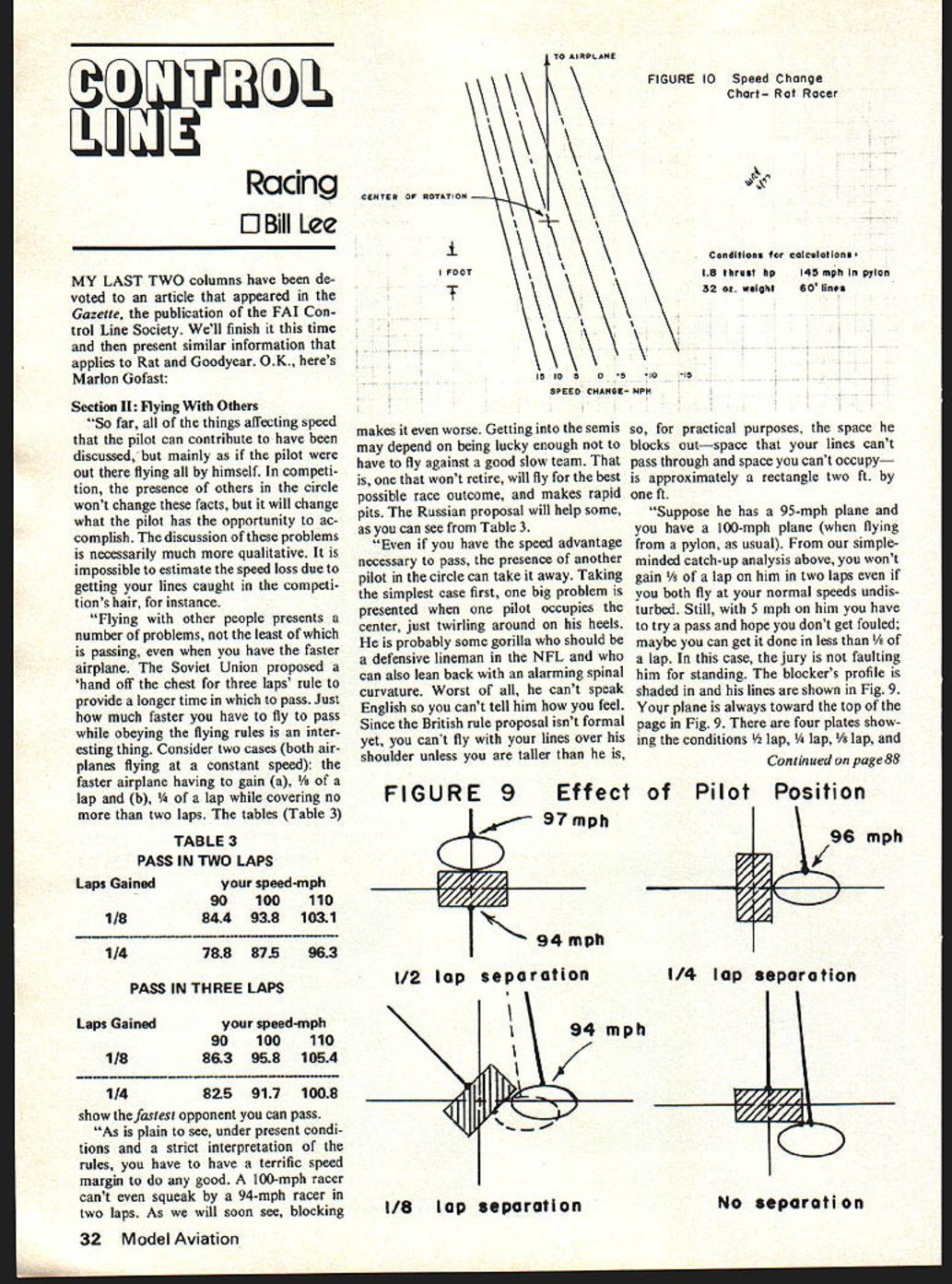
"Suppose he has a 95-mph plane and you have a 100-mph plane (when flying from a pylon, as usual). From our simple-minded catch-up analysis above, you won't gain 1/8 of a lap on him in two laps even if you both fly at your normal speeds undisturbed. Still, with 5 mph on him you have to try a pass and hope you don't get fouled; maybe you can get it done in less than 1/8 of a lap. In this case, the jury is not faulting him for standing. The blocker's profile is shaded in and his lines are shown in Fig. 9. Your plane is always toward the top of the page in Fig. 9. There are four plates showing the conditions 1/2 lap, 1/4 lap, 1/8 lap, and no separation. Last column I talked about using a speed course to test planes and the skill of the pilot. Howard Shenton sent me a copy of a proposed course and basic rules that could be adapted for use at a contest. The basic maneuvers are as follows: 1) One acceleration lap, 2) Seven level laps at a maximum altitude of 25 feet, 3) Three inside loops with an additional half loop to inverted flight, 4) Seven level inverted laps at a maximum altitude of 25 feet, 5) Two overhead eights, 6) Refuel and restart.
Howard's system would measure all phases of performance, including engine, plane, pilot, and pit crew. The timing would include everything from the initial launch to the end of the figure-eights. Timing would again resume when the engine cut, and continue as the pit crew refueled and restarted the engine, the watch being stopped as the model was released. This is an oversimplification of what Howard had in mind, so I'm hoping that the full details will be published in the MACA Newsletter.
To test basic performance of a model it might be easier to time for 10 laps from the moment of launch and require the pilot to do three insides, three outsides, or whatever number you think proves something. Here's a chance for some of you to enter your 130-mph "work bench" in open competition.
Bill Allen's Combat Specialties is another performance company offering everything from spools of flying lines to 4-oz. syringes and Fireball plugs with the special sealant BR-22. Bill is located at 418 Fairmont Dr., DeKalb, IL 60115. Write these guys for more information if you want to get the latest trick items for your combat ships.
Richard Wilkens reports the largest crowd in history to watch a combat match. It happened in Wembley during the warmup to the British Football Championships. There were over 100,000 in attendance. The roar was deafening when that crowd called the cuts. The crowd and promoters liked the modelers better than any other act and will ask them back next year.
More excuses for us old timers: The usual excuse when a younger person beats you is that he had an unfair advantage because he was younger and hence had better reactions. A typical reaction time to a given stimulus might be 1/10th of a second (your opponent pulls in front of you, giving you a perfect shot at his streamer if you make the right decision). Even if you're 50 or 60 years old your reaction time won't be much different from an 18-year-old's, it's just how you react that matters. The older you get the more cluttered your mind becomes and the more things your brain has to analyze to make the right decision. The answer is to blank out your mind. Some people are born that way while others must learn. You don't need a Guru to help you clear your mind of all unnecessary thoughts. Worry only about which way to turn and not about losing a plane or car payments or whether your engine will blow up.
Even, with him. Half a lap apart he has you pushed out a little, so you do 97 and he does 94 because of the increased flying radius. In all the other plates his effective speed is 94. Note how yours is brought down the closer you get. The flying speed differences are calculated from Fig. 6.
By the time you get close enough to pass he has forced you into a large walking circle and all the speed differential is lost. Clearly, if the jury doesn't call him he will ruin your time and improve his own, and this kind of conduct is the jury's first duty to stop. From the standpoint of jury psychology, what is crucial (as pointed out earlier) is to get behind him and whip if possible to pass him right away and establish in the jury's mind your superior speed and right to pass. If you get fouled on the first attempt you can always cool it and take your lumps later.
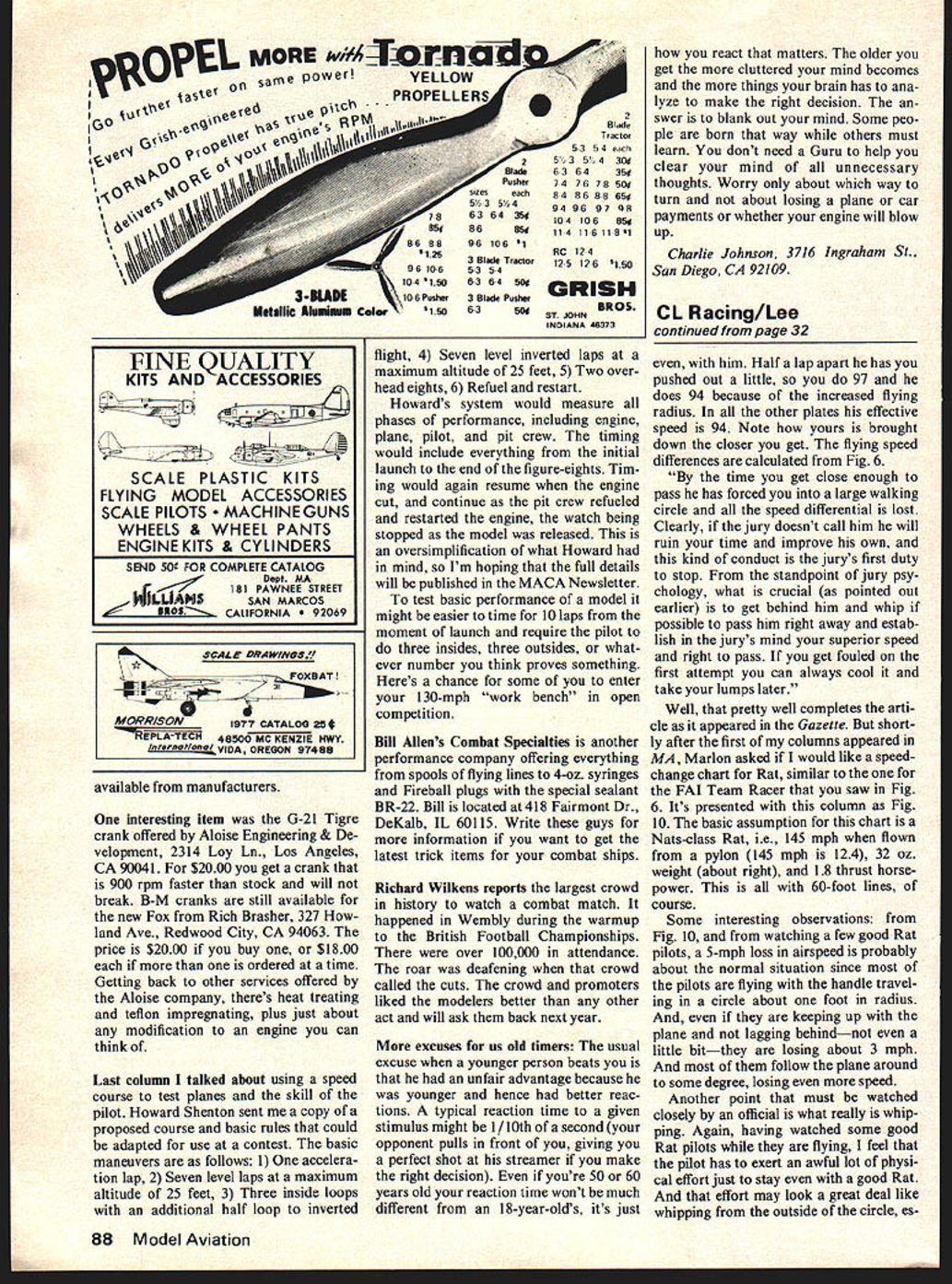
Well, that pretty well completes the article as it appeared in the Gazette. But shortly after the first of my columns appeared in MA, Marion asked if I would like a speed-change chart for Rat, similar to the one for the FAI Team Racer that you saw in Fig. 6. It's presented with this column as Fig. 10. The basic assumption for this chart is a Nats-class Rat, i.e., .145 mph when flown from a pylon (145 mph is 12.4), 32 oz. weight (about right), and 1.8 thrust horsepower. This is all with 60-foot lines, of course.
Some interesting observations: from Fig. 10, and from watching a few good Rat pilots, a 5-mph loss in airspeed is probably about the normal situation since most of the pilots are flying with the handle traveling in a circle about one foot in radius. And, even if they are keeping up with the plane and not lagging behind—not even a little bit—they are losing about 3 mph. And most of them follow the plane around to some degree, losing even more speed.
Another point that must be watched closely by an official is what really is whipping. Again, having watched some good Rat pilots while they are flying, I feel that the pilot has to exert an awful lot of physical effort just to stay even with a good Rat. And that effort may look a great deal like whipping from the outside of the circle, es- pecially if you don't know what whipping really is. You have to watch the pilot, establish from your point of view just what his center of rotation is, and then see where he is in relation to the center of rotation and the airplane. If, as you are looking at the pilot, the handle goes past the center of rotation before the plane goes past you on the edge of the circle, then he is whipping! If the plane and handle go past the center of rotation together, then he is not whipping! And if the plane goes by before the handle he is definitely slowing down the plane.
I can produce these speed-change charts rather easily. If there is interest, I'll draw up a couple more, one for Goodyear and one for Slow Rat. Another approach might be a monograph which takes all the variables into account directly. Interested? If so, write me.
W. R. Lee, 3522 Tamarisk Lane, Missouri City, TX 77459.
Transcribed from original scans by AI. Minor OCR errors may remain.

