
Control Line: Racing
Bill Lee
NEW RACING RULES: The final results from the Control Line Contest Board were published just recently (as I write this), and there are a few quite significant changes that we all should be aware in preparing for the 1978 season. I'll comment on a few of the more important changes.
First off, the entire section on Control Line Racing in the rules book has been re-written. We now have a general set of racing rules, called the Unified Control Line Racing Rules, that govern all of the AMA Racing events. If you will go back a few years you will find that, at one time, all the events referred to the Rat Race rules for the general rules. Obviously, this was because Rat was the first of the racing events, following the demise of AMA Class B Team Racing a number of years ago, and all the events since then merely added some new dimension to create the new event. But a few years ago, there was a subtle but significant change in the book; the ties to Rat were broken for Goodyear. This caused some problems that were overcome in later years by gradually getting all of the general rules spelled out in Goodyear. Then along came Slow Rat. Again, the event tied itself back to Rat. The real problem here is that, when Rat changed, it changed all the events that linked to it, whether that change was intended or not, and whether that change was even proper or not. It became obvious a couple of years ago that Control Line Racing had matured enough that the rules needed to be re-written in order to more easily handle the current events, and any new ones that might be added in the future. Hence, along came the Unified Rules, and a corresponding restructuring of the rules for each of the Racing events.
Until the new book is published, you'll have to satisfy yourself with the few scraps you can get yourself. I would strongly suggest you go back to the December 1976 issue of Model Aviation and read the original proposal CL-78-13 (RAC) and -14 (RAC). This is the nearest thing to the book that is available, until the '78-'79 book comes out. Read the proposal closely. There are some very subtle changes that might not meet the eye on first reading. Some of them we'll talk about below.
There have been some penalties spelled out that were just "understood" before. There is now a 3-lap penalty for starting your engine before the starting signal is given.
Under the old rules there was no penalty, although the contest directors' guide did say disqualification. Now the book spells out black-and-white penalties. The old book already listed penalties for whipping, improper passing, etc., and has retained that section. The Rat Race proposal in the December '76 issue of Model Aviation inadvertently left out paragraphs indicating no model restrictions (wing area, etc.), and also two-part model construction (follow CL Speed section method of construction) have been restored.
A significant change in the new book will affect events: diameters of marked circles define pitting/piloting limits. What the new circles provide is a little better margin of safety, allowing events to utilize a common set of circles marked on the ground and also allow a slightly smaller total area needed. The largest circle is 76 ft radius rather than 80. The outer circle for Rat could be 75 ft radius rather than 80' as in the past. In a pinch, the Outer Circle for Rat could be at 75' radius rather than at 76', if a particular meet required it. Our local site had only 150' in which to put a circle. (This would have helped a lot in Oshkosh at the Nats in '73, where we were forced to fly on 150' runways.) The center circle, now called the "Pilot's Circle" is still at 5' radius. The big change is the next circle, called the "Pitting Circle" which is at 15' radius, rather than 20' as before. From there on out, each event has its own set of circle radii, but they form a set where the Outer Circle for one event becomes the Inner Circle for another, thus minimizing the number of circles that you have to paint or mark for the Racing events. The circle radii are 5', 15', 48', 58', 68', and 76'.
Probably, one of the most significant changes is to allow only constant-diameter exhaust extension in the racing events (except for Slow Rat, where the use of an exhaust extension is prohibited). This eliminates the megaphones in Goodyear, which should help the event. I don't believe the pipe really helps the vast majority of the Goodyears they're run on anyhow. True, there are a few that really go, but most are worth nothing more than noise and unreliability. Good riddance. Now let's see if the minipipe will help. Running only open-face will bring some of the racers back to Goodyear that left when the noise of the megaphone scared them off.
Another change that is going to make a lot of people unhappy is the engine restriction in Slow Rat. Basically, the change says that the engine must have been produced as a .36 or smaller, and that all the significant parts have to be as produced. This excludes the head, bolts, needle valve, venturi, prop washer and nut, etc., but includes the "complete crankcase (including the front end, back end, and the upper or lower portion if detachable or split, but excluding ball bearings if applicable to the engine), crankshaft, cylinder (sleeve), and piston." This is about how the rule will appear in the book. What the rule does not say (and which the CLCB will have to define) is what constitutes the "original manufacturer" of an engine. Or better yet, what defines a "production" engine? I look around at at least a couple of sources of what you might call "homebuilt" engines that use at least a few parts from a similar engine of a different manufacturer. These are going to be legal or illegal? I don't know, but I sure would hate to see the small guy driven off by this rule.
Goodyear has had a couple of important changes. First, the hand-on-chest rule for flying is gone. Second, the semi-final/final system is also gone. No longer do you fly 80-lap semi-finals and then take only the three best to one final race where you really would know who had the best flight. No, now we're back to 12 in the finals, where the top runner in a turkey trot heat gets the win, and everyone can go home and grumble that "If I'd just had the good heat I'd have won!" Oh, well, can't win 'em all.
Rat Race and Slow Rat Race (since they were tied together) benefited by one change which affects races as well as construction techniques. The final race in Rat and Slow Rat now has three pit stops in the 140 laps, rather than two as previously. What this means is that race times next year will be longer than this year by about 10-15 seconds. Also, you don't have to set up your Rats differently now for the qualifying heats, than for the finals. With three stops, the 140-lap final race will be four 35-lap segments, rather than three 47-lap pieces as previously. The nice part of this is that the qualifying heats are two 35-lap segments, and you can set up your plane for 35 laps per tank for the entire event, rather than have to allow for the longer segments that we used to have to run.
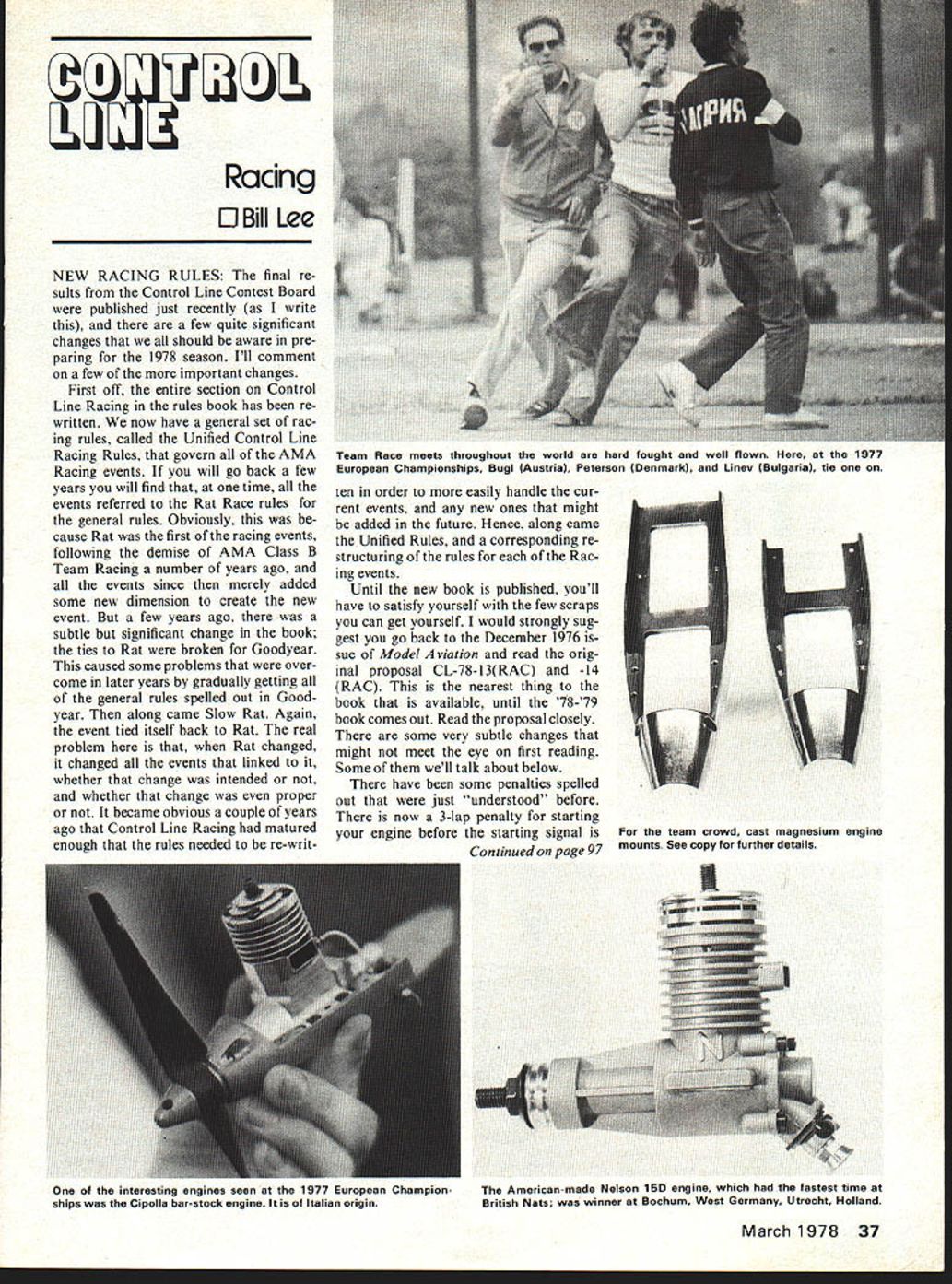
Nelson Competition Products: Just received a note from Henry Nelson (Nelson Competition Engines, 729 Valentown Dr., Verona, PA, 15147) with current information on two of the real quality products that he produces for the FAI Team Race crowd, the Nelson 15D engine and cast magnesium engine mounts. Let me quote a little from Henry: "...the best advertising has been the Metkmeijers. They had the fastest heat time at the British Nats—they had to leave to catch a boat and didn't fly the finals. Then they won at Bochum, West Germany, and at Utrecht, Holland. Just shows what a really good team can do with a dead stock engine."
Handy Hint: A friend of a friend of mine is a piano tuner by trade. And, of course, he uses piano wire quite regularly. He made a good suggestion that I tried. When you make up your next set of control lines out of piano wire, sprinkle a little talcum powder on the wire after you roll the lines onto a reel. This keeps the lines from rusting while in storage. After you unroll the lines for use, wipe them with a clean rag, then redust them after you roll them back up.
W. R. Lee 3522 Tamarisk Lane, Missouri City, TX 77459
Transcribed from original scans by AI. Minor OCR errors may remain.

