
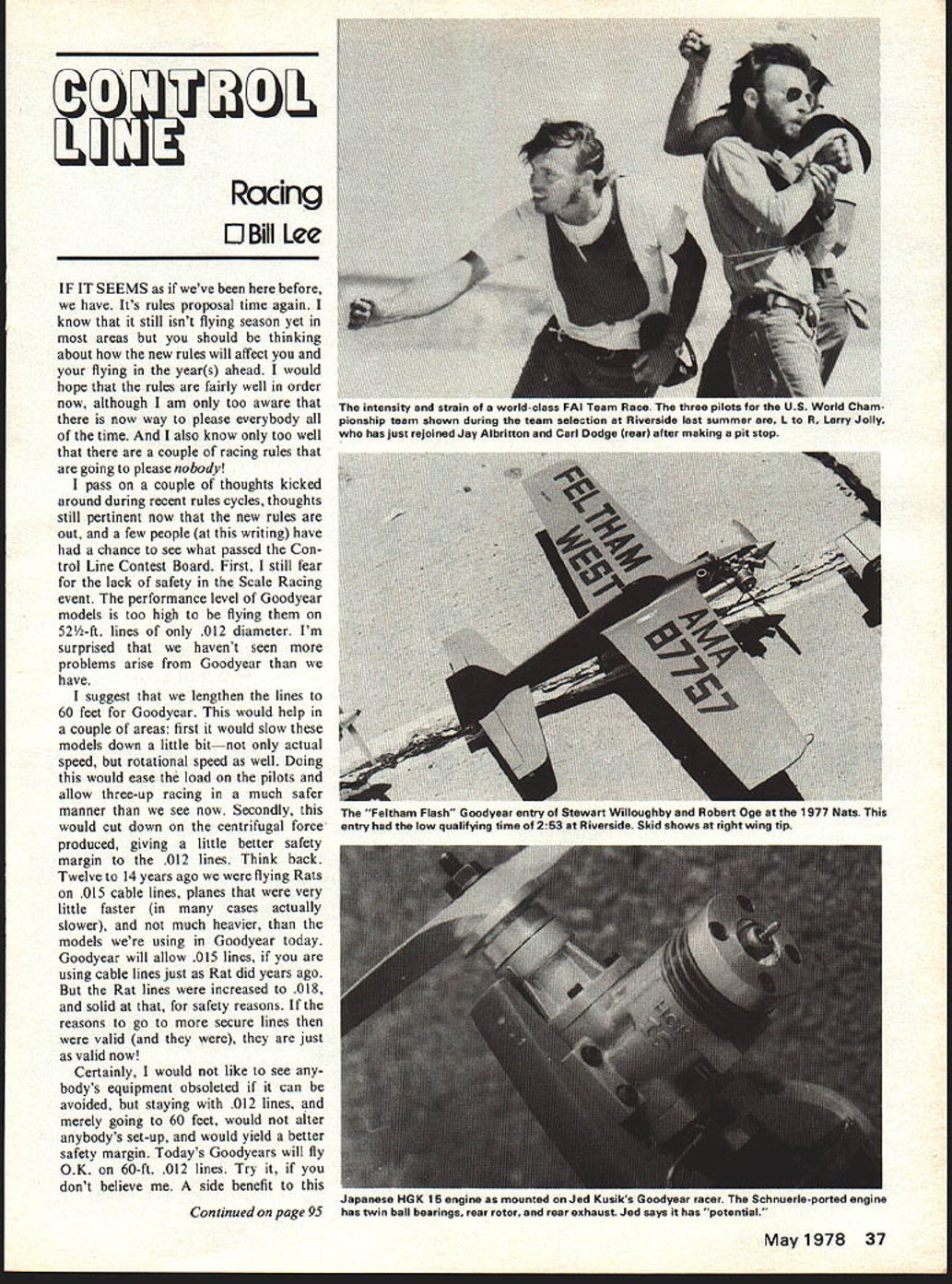
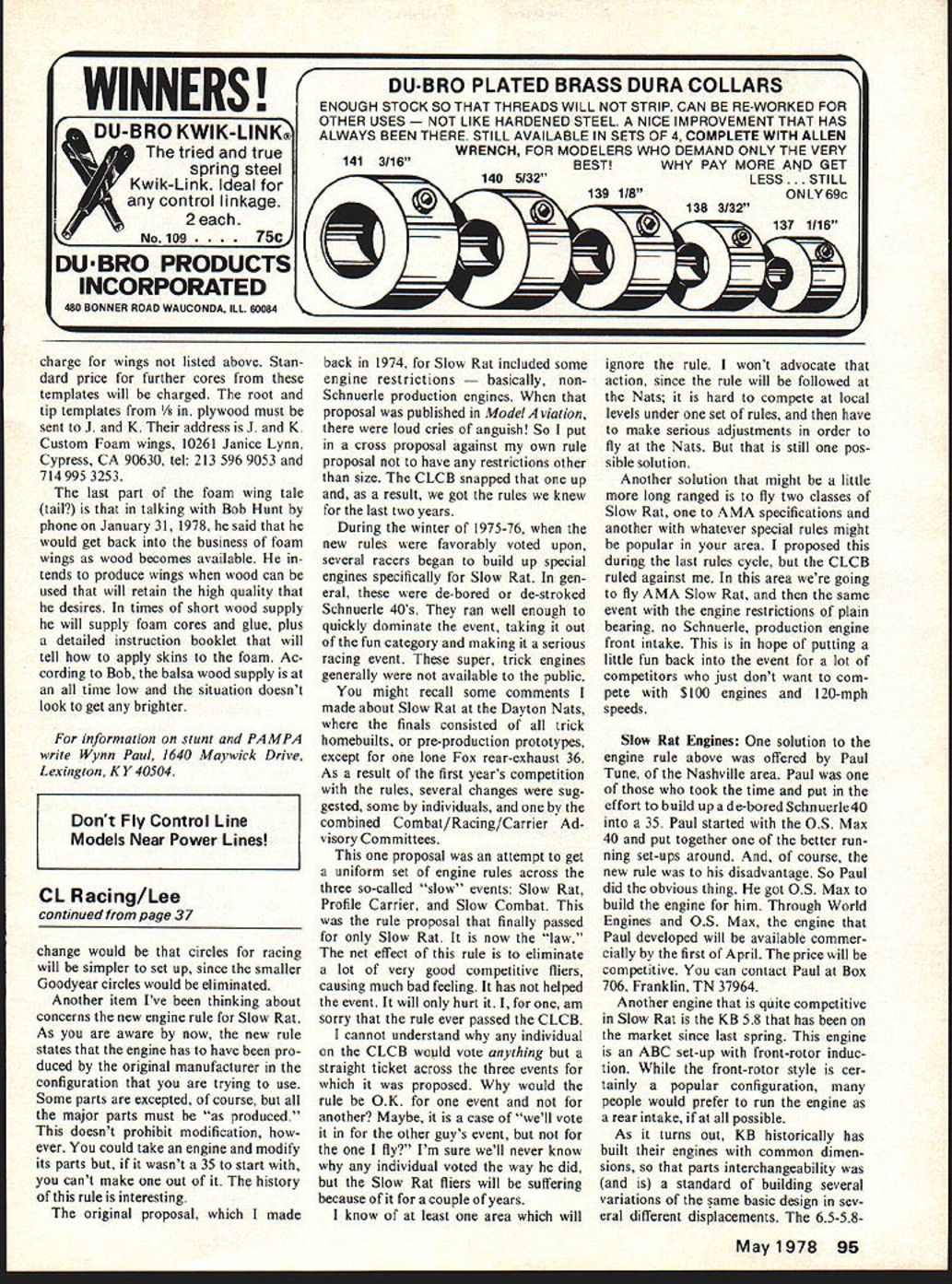
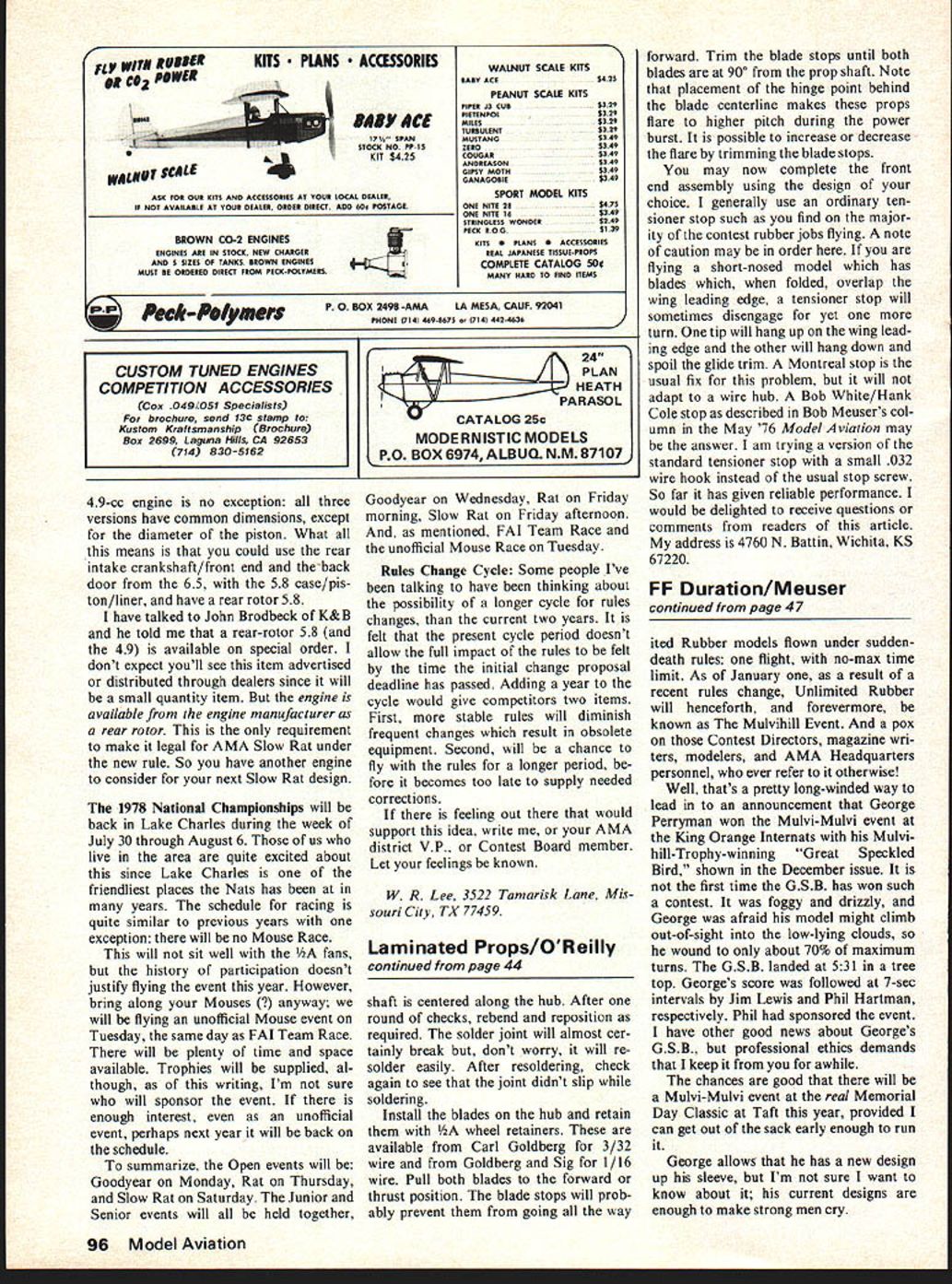
Control Line: Racing
Bill Lee
IF IT SEEMS as if we've been here before, we have. It's rules proposal time again. I know that it still isn't flying season yet in most areas but you should be thinking about how the new rules will affect you and your flying in the year(s) ahead. I would hope that the rules are fairly well in order now, although I am only too aware that there is no way to please everybody all of the time. And I also know only too well that there are a couple of racing rules that are going to please nobody!
I pass on a couple of thoughts kicked around during recent rules cycles, thoughts still pertinent now that the new rules are out, and a few people (at this writing) have had a chance to see what passed the Control Line Contest Board. First, I still fear for the lack of safety in the Scale Racing event. The performance level of Goodyear models is too high to be flying them on 52½-ft. lines of only .012 diameter. I'm surprised that we haven't seen more problems arise from Goodyear than we have.
I suggest that we lengthen the lines to 60 feet for Goodyear. This would help in a couple of areas; first it would slow these models down a little bit—not only actual speed, but rotational speed as well. Doing this would ease the load on the pilots and allow three-up racing in a much safer manner than we see now. Secondly, this would cut down on the centrifugal force produced, giving a little better safety margin to the .012 lines. Think back. Twelve to 14 years ago we were flying Rats on .015 cable lines, planes that were very little faster (in many cases actually slower), and not much heavier, than the models we're using in Goodyear today. Goodyear will allow .015 lines, if you are using cable lines just as Rat did years ago. But the Rat lines were increased to .018, and solid at that, for safety reasons. If the reasons to go to more secure lines then were valid (and they were), they are just as valid now!
Certainly, I would not like to see anybody's equipment obsoleted if it can be avoided, but staying with .012 lines, and merely going to 60 feet, would not alter anybody's set-up, and would yield a better safety margin. Today's Goodyears will fly O.K. on 60-ft. .012 lines. Try it, if you don't believe me. A side benefit to this change would be that circles for racing will be simpler to set up, since the smaller Goodyear circles would be eliminated.
Another item I've been thinking about concerns the new engine rule for Slow Rat. As you are aware by now, the new rule states that the engine has to have been produced by the original manufacturer in the configuration that you are trying to use. Some parts are excepted, of course, but all the major parts must be "as produced." This doesn't prohibit modification, however. You could take an engine and modify its parts but, if it wasn't a 35 to start with, you can't make one out of it. The history of this rule is interesting.
The original proposal, which I made back in 1974, for Slow Rat included some engine restrictions — basically, non-Schnuerle production engines. When that proposal was published in Model Aviation, there were loud cries of anguish! So I put in a cross proposal against my own rule proposal not to have any restrictions other than size. The CLCB snapped that one up and, as a result, we got the rules we knew for the last two years.
During the winter of 1975-76, when the new rules were favorably voted upon, several racers began to build up special engines specifically for Slow Rat. In general, these were de-bored or de-stroked Schnuerle 40's. They ran well enough to quickly dominate the event, taking it out of the fun category and making it a serious racing event. These super trick engines generally were not available to the public.
You might recall some comments I made about Slow Rat at the Dayton Nats, where the finals consisted of all trick homebuilts, or pre-production prototypes, except for one lone Fox rear-exhaust 36. As a result of the first year's competition with the rules, several changes were suggested, some by individuals, and one by the combined Combat/Racing/Carrier Advisory Committees.
This one proposal was an attempt to get a uniform set of engine rules across the three so-called "slow" events: Slow Rat, Profile Carrier, and Slow Combat. This was the rule proposal that finally passed for only Slow Rat. It is now the "law." The net effect of this rule is to eliminate a lot of very good competitive fliers, causing much bad feeling. It has not helped the event. It will only hurt it. I, for one, am sorry that the rule ever passed the CLCB.
I cannot understand why any individual on the CLCB would vote anything but a straight ticket across the three events for which it was proposed. Why would the rule be O.K. for one event and not for another? Maybe, it is a case of "we'll vote it in for the other guy's event, but not for the one I fly?" I'm sure we'll never know why any individual voted the way he did, but the Slow Rat fliers will be suffering because of it for a couple of years.
I know of at least one area which will ignore the rule. I won't advocate that action, since the rule will be followed at the Nats; it is hard to compete at local levels under one set of rules, and then have to make serious adjustments in order to fly at the Nats. But that is still one possible solution.
Another solution that might be a little more long ranged is to fly two classes of Slow Rat, one to AMA specifications and another with whatever special rules might be popular in your area. I proposed this during the last rules cycle, but the CLCB ruled against me. In this area we're going to fly AMA Slow Rat, and then the same event with the engine restrictions of plain-bearing, no Schnuerle, production engine front intake. This is in hope of putting a little fun back into the event for a lot of competitors who just don't want to compete with $100 engines and 120-mph speeds.
Slow Rat Engines:
One solution to the engine rule above was offered by Paul Tune, of the Nashville area. Paul was one of those who took the time and put in the effort to build up a de-bored Schnuerle 40 into a 35. Paul started with the O.S. Max 40 and put together one of the better running set-ups around. And, of course, the new rule was to his disadvantage. So Paul did the obvious thing. He got O.S. Max to build the engine for him. Through World Engines and O.S. Max, the engine that Paul developed will be available commercially by the first of April. The price will be competitive. You can contact Paul at Box 706, Franklin, TN 37064.
Another engine that is quite competitive in Slow Rat is the KB 5.8 that has been on the market since last spring. This engine is an ABC set-up with front-rotor induction. While the front-rotor style is certainly a popular configuration, many people would prefer to run the engine as a rear intake, if at all possible.
As it turns out, KB historically has built their engines with common dimensions, so that parts interchangeability was (and is) a standard of building several variations of the same basic design in several different displacements. The 6.5-5.8- 4.9-cc engine is no exception: all three versions have common dimensions, except for the diameter of the piston. What all this means is that you could use the rear intake crankshaft/front end and the back door from the 6.5, with the 5.8 case/piston/liner, and have a rear rotor 5.8.
I have talked to John Brodbeck of K&B and he told me that a rear-rotor 5.8 (and the 4.9) is available on special order. I don't expect you'll see this item advertised or distributed through dealers since it will be a small quantity item. But the engine is available from the engine manufacturer as a rear rotor. This is the only requirement to make it legal for AMA Slow Rat under the new rule. So you have another engine to consider for your next Slow Rat design.
The 1978 National Championships will be back in Lake Charles during the week of July 30 through August 6. Those of us who live in the area are quite excited about this since Lake Charles is one of the friendliest places the Nats has been at in many years. The schedule for racing is quite similar to previous years with one exception: there will be no Mouse Race.
This will not sit well with the 1/2A fans, but the history of participation doesn't justify flying the event this year. However, bring along your Mouse (?) anyway; we will be flying an unofficial Mouse event on Tuesday, the same day as FAI Team Race. There will be plenty of time and space available. Trophies will be supplied, although, as of this writing, I'm not sure who will sponsor the event. If there is enough interest, even as an unofficial event, perhaps next year it will be back on the schedule.
To summarize, the Open events will be: Goodyear on Monday, Rat on Thursday, and Slow Rat on Saturday. The Junior and Senior events will all be held together, Goodyear on Wednesday, Rat on Friday morning, Slow Rat on Friday afternoon. And, as mentioned, FAI Team Race and the unofficial Mouse Race on Tuesday.
Rules Change Cycle: Some people I've been talking to have been thinking about the possibility of a longer cycle for rules changes, than the current two years. It is felt that the present cycle period doesn't allow the full impact of the rules to be felt by the time the initial change proposal deadline has passed. Adding a year to the cycle would give competitors two items. First, more stable rules will diminish frequent changes which result in obsolete equipment. Second, will be a chance to fly with the rules for a longer period, before it becomes too late to supply needed corrections.
If there is feeling out there that would support this idea, write me, or your AMA district V.P., or Contest Board member. Let your feelings be known.
W. R. Lee, 3522 Tamarisk Lane, Missouri City, TX 77459.
Transcribed from original scans by AI. Minor OCR errors may remain.

