
Control Line: Racing
Bill Lee
THE LAST few years have seen a lot of words spent on the topic of Control Line Racing rules, events, etc. The King of racing still lives, Rat is still alive and well, contrary to the dire predictions of some (this author, for one). Admittedly, it isn't the event today that it was ten, fifteen or more, years ago. But then, Rat is as strong today as it was three or four years ago. And this is not unexpected. We have seen a lot of events, control line and otherwise, that have burst upon the scene, enjoying immense popularity for a rather brief period of time, and then die. Or apparently die.
What is there about our events that makes them all seem to go through this cycle? And is this bad? We've seen Rat over the years be the big event that seemed to draw many, many entrants only to drop down to a very low level, low enough so that it isn't even flown in many areas of the country. And who is it that you find flying Rat?
Look around at the next contest you go to. I think you'll find that the Rat fliers, in general, are the long-term competitors, the ones who have been around for a long time. That is to say, there are a number of competitors who fly Rat, they probably have been flying Rat for a long time, and they form the majority of the people you'll find flying the event today. There just isn't very much new blood in Rat today, but what blood there is left is of a very high quality. With all the experience exhibited by what's left of the Rat fliers, the quality is there.
How about Goodyear? I think you'll find that very much the same cycle has affected Goodyear as has affected Rat, the initial burst of enthusiasm where the event was the big drawing card at your local contest, followed by the gradual decline down to some level where again the interest becomes low enough that the event isn't flown in many places. And who do you find flying Goodyear today? Again, look around at the next contest you go to. You'll find that those few who are flying Goodyear today have, in general, been flying the event for a long time, some even before it first became an official event. And many of the same people who are the nucleus for Rat are the nucleus for Goodyear. Sure, not all of the remaining Goodyear fliers are Rat fliers, too, but enough to indicate something.
Our latest event to go through this cycle is Slow Rat. This event grew out of, and was a response to, the decline in fast Rat. Rat had become too fast, too complicated for a lot of people and the need for an easier, less complex event was satisfied by various forms of what is now Slow Rat.
Slow Rat was intended to be the easy event that a relative newcomer could get into without a great deal of effort, and still be competitive. And, as long as the event was a local event, this is what it was.
Of course, there were efforts here and there to get complicated, but these, in general, were thwarted by local word-of-mouth, obviously unofficial "rules." A good example was right here in Texas. Before the Slow Rat rules were incorporated in the AMA rule book, we flew the event much along the same lines as flown in many other places. One year, one of the local engine builders produced a .35 version of an OPS and proceeded to very nearly blow everyone else out. The immediate response (and one that only took a couple of contests to sort out) was that we wanted no Schnuerle-ported engines in Slow Rat. We all could see the handwriting on the wall if the horsepower race was allowed to descend upon the event. And, in fact, this is what was originally proposed to AMA for Slow Rat.
Well, we got the horsepower race anyhow and now Slow Rat is in the same kind of cycle that all the other events have previously been through. A burst of enthusiasm followed by a general decline in participation. Now I know I'll get at least one, and maybe two, irate letters from someone with the message that I'm all wet, that what I say isn't true because right here in East Podunk we've got the best racing ever. I'll answer right now, good! I only hope that East Podunk can say that next year. Because, if East Podunk is like everywhere else, pretty soon there will be two or three of the really good fliers that will start to dominate the event in East Podunk and all the also-rans will be left out in the cold and not flying the event.
What this whole thing boils down to can be summarized as follows. Local events can be controlled to meet a particular need; national events will become the plaything of the "pros" after a brief sorting-out period. And, we all know who the pros are. Look at the lists of winners from previous Nats and some of the bigger local contests. You begin to see the same set of names appearing over and over again, the names of the people who are willing to go that little extra bit to be a better racer than the next guy. Please don't get me wrong. I'm not saying that the guys who work harder and get better shouldn't win, only that to expect that this can be legislated against on a national level is pure folly! The wheels of power that control our events at a national level grind too slowly and serve too many masters to allow them to meet local problems. Local events that change as the local needs change is very nearly the only mechanism that will keep racing alive and well in the future.
A case in point. This past weekend saw one of the most successful racing days ever in Texas. The AAA contest held in Houston was the scene. We had the usual "Big Three" events, Rat, Goodyear, and Slow Rat, but in addition, we had three "fun" equivalents. We set up a set of rules and called an event "Slow Slow Rat." The rules were similar to events in other parts of the country, Sport Race, Northwest Sport Race, etc. And the results were quite good, drawing as many entrants as regular Slow Rat, many entrants who would not have flown otherwise.
Another event we called "Sport Goodyear," regular Goodyear rules but with the additional restriction of no Schnuerle engines. Again, the event drew as strongly as regular Goodyear, but with many of the entrants merely digging out their old Tiger G-15's and putting them on their normal Goodyears. There were several others, though, who flew the Sport event solely.
Our third fun event was "Quicky Rat," an event I described in this column a couple of years ago. Profile planes, 35's, front intake engines, no Schnuerles, externally mounted controls, the rest according to normal Rat rules. And this event out-drew Fast Rat, with most of the entrants being distinct from those who entered regular Rat. All day long, the racing was fast and furious. We started flying at 10 a.m. and didn't finish until after 8 that evening. A total of over 65 event-entrants. All in all, a very successful day of racing with the local events really adding a needed dimension that brought into racing a lot of people who otherwise would not have flown.
Handy Hint:
I picked up a little item this weekend from Larry Miller, of Corpus Christi. Larry uses internally connected lines on his Slow Rats as do most of the fliers in this area. And Larry has suffered through enough of my tirades about safety in general, and the evils of internally connected lines in particular, to have come up with a simple and yet effective way to ease the strain on the control lines where they exit the wing tip. Larry takes a three- or four-inch length of the very small diameter Teflon tube that you can buy for dispensing Hot Stuff, and slips the control lines through before he makes up the line ends for connection inside the plane. The Teflon tubing then is adjusted so that it covers the control lines where they emerge from the wing tip, thus protecting them from abrasion against the tip guide and also making them very much harder to kink at that very vulnerable spot. Larry relates that getting the .018" lines through the Teflon Hot Stuff tubing takes a little care, but the results in terms of smoother, safer controls are worth the effort.
More on Fuel Tanks:
My last column was dedicated to the analysis of fuel tank systems, why they work the way they do, and what to expect from a particular type system. A couple of additional points need to be made. First, a uniflow style tank will exhibit its normal characteristics even with a pressure fuel system. In my discussion in the last column, I talked about tanks vented to atmospheric pressure, but in reality, the thing that is important is pressure differences. In fact, I see no reason why a chicken-hopper arrangement would not work in a pressure fuel system, although I have never tried a system of this type. Second, while I show the hopper tank in the chicken-hopper style set-up to be a normally vented tank, I also see no reason that this couldn't be a small uniflow tank, too. However, I don't think this would gain you very much since the fuel level in the hopper is going to remain very near the level of the bottom of the bleed tube once the tank pressures get to equilibrium.
So far, I have had several comments from fliers who have read my last column. In general they have all been quite complimentary. But one comment really hurt. Last weekend at our Houston contest, one of the speed fliers came over and said he had enjoyed the column. He said that even though this was all old, well-known information, he felt that it was good to get it in print every once in a while. Oh, my, but that hurt! It may have been old stuff to him but I'll guarantee you that I didn't know all this stuff before I started to do the research for that column. Oh, well, I guess a left-handed compliment is better than no compliment at all! All these years of building and flying and competing and all that old, well-known information just completely passed me by.
Another point. Go back to the June issue of Model Aviation and re-read the column by Don Jehlick on fuel tanks. Somebody tell me why the famous (infamous?) Stockton "Chicken Hopper" tank is a chicken hopper and not merely a uniflow tank.
And still another point. In a racing model, and even more so in a speed plane, the vertical placement of the air bleed in the tank in a uniflow tank is of virtually no significance. This is contrary to popular opinion that the air bleed must be as near to the fuel pickup as possible. But if you stop to think of the forces in operation on flight, you find that the centrifugal force is so very much greater than the force of gravity, like by a factor of 12 or 15 or 20, that the only real critical consideration is the placement of the bleed in and out; that is, where it is in relation to the needle valve hole along a line perpendicular to the flight path. Additionally, the placement front-to-back in the tank is of no consequence since there is no acceleration in this direction once the plane has accelerated to speed. Again, the only significant consideration is where the bleed is located relative to flight path.
Something else to consider. Where should the fuel pickup be placed in the tank? Why do we insist on placing the pickup clear in the back of the tank even when that may not be the outermost point on the tank while in flight? I immediately think of the long, tapered cylindrical tanks in use in so very many Rats where the pickup is in the back of the tank. If you look at those tanks and imagine where the outermost point of that tank is while the Rat is in flight, you'll see that the outermost point is probably right at the front of the tank where the diameter is on the order of an inch and a quarter, not at the back of the tank where the diameter may be only a half inch or so. Maybe someone can tell me why these tanks work (if they really do). Maybe this is why the need for 6- and 7-ounce fuel tanks comes from, even though the largest tank you should ever need for Rat is five ounces, even for that monstrous fuel glutton, the K/B 6.5.
Services:
One problem that comes up on occasion is where to get some special engine work done. One service that is particularly difficult to obtain is the chroming and honing of cylinders. Recently, I had the need for some rechromed K/B 5.8 liners and I availed myself of a couple of local speed fliers who have set up this fa- Lars Giertz and David Layman have formed a small concern called Speed and Racing Specialties. They do custom engine rework, chroming and honing, and have a very interesting line of accessories that are applicable to racing as well as speed. Speaking from my own experience, the quality of their work is top notch. The address is Box 35458, Houston, Texas, 77035. I'm sure if you'll drop Lars and David a note they will send you a listing of what they have available as accessories in addition to prices for their custom work.
Southern Calif:
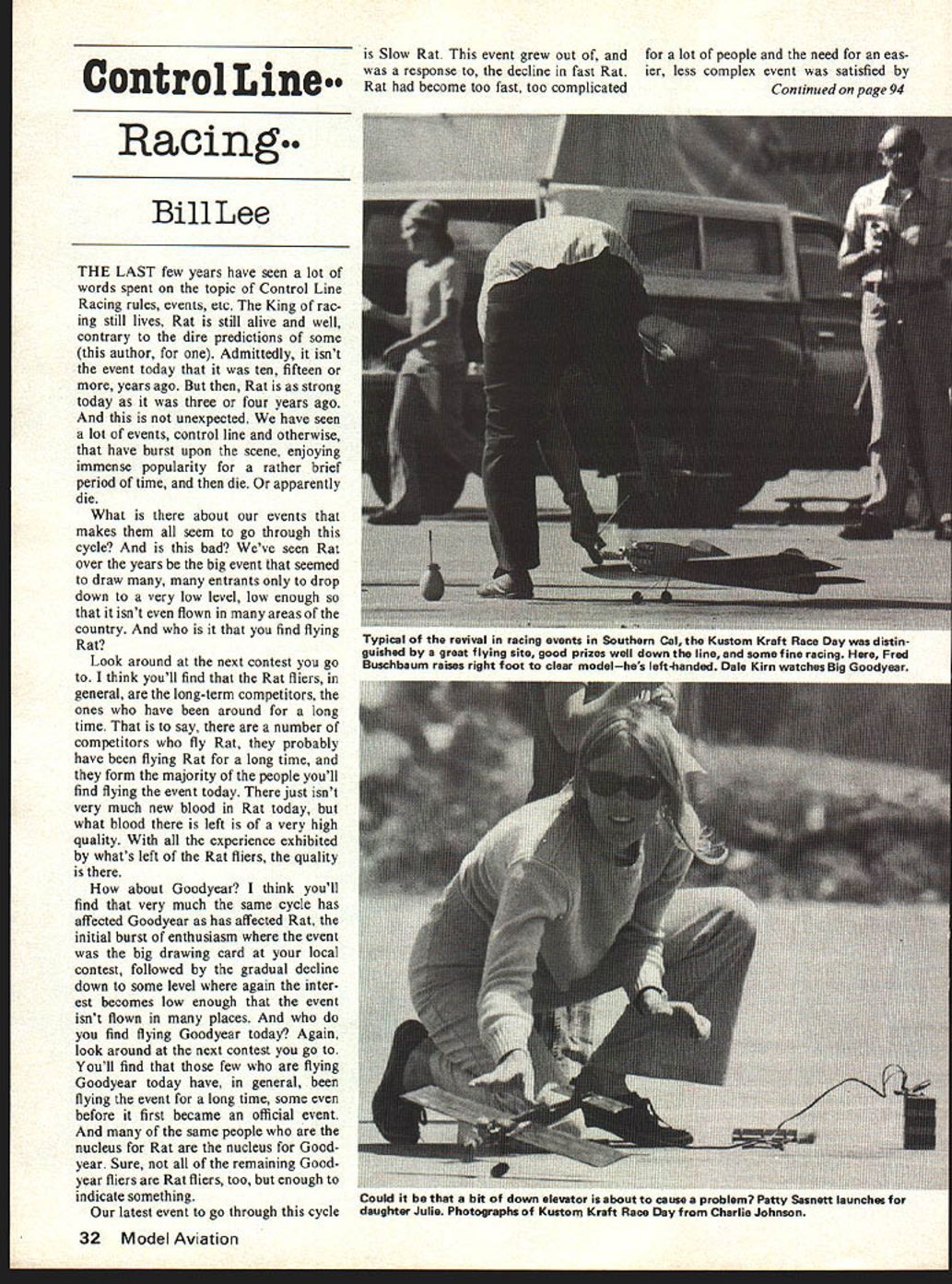
The following is from Charlie Johnson concerning racing activity in the Southern California area. "Racing is getting started again in So. Calif. after a long layoff. The hardcore oldtimers are back out in force, which is a good sign. Joe Klause did an excellent job with his KK Race Day. Must have given out 200-300 dollars worth of goodies, even heat winners received prizes! A real beautiful site behind the Cox plant in Santa Ana. We acquired another good race site in San Diego after giving up on the old El Cajon Model Airport because of terrible conditions; hard to believe it was one of the best in the county at one time, oh well." Pictures are from Charlie, taken at Joe's Kustom Kraft Race Day.
Bill Lee, 3522 Tamarisk Lane, Missouri City, TX 77459.
Transcribed from original scans by AI. Minor OCR errors may remain.

