
Control Line: Racing
Bill Lee
RACING is fun! After all, isn't that the real reason that we are all in this sport — to have fun? Why would anyone take the time necessary to race, doing something that is not required by Big Brother or someone else, if it wasn't for fun? And yet I see a lot of people who seem to lose sight of that as the real reason we're here.
You know who I'm talking about. They are the ones who are at the contest griping about this or that, always with sour expressions on their faces, always bad-mouthing officials, rules, sites, etc. You've heard them, too: "Why don't they do something about the rules?" "The AMA (or CLCB, or the club, or anybody else) really screwed this up!" On and on and on. You wonder why they are even on the field if they are having such a rotten time. Well, friends, it's time for each of us to reflect on why we fly model airplanes, what we see in this sport, why we spend our money and consume our free time.
My thing is competition. I have always enjoyed doing things with my hands, building things, repairing things — in a word, understanding. I guess that is why I have one of the best jobs possible for me: a systems analyst working with computers. This is a profession that allows me to build things (computer systems), take them apart and repair them, and also an environment that is so constantly changing you had better not allow yourself to sit still for a while or your skill and understanding will become obsolete.
What does this all have to do with model airplanes? Competition for me is the place where I can measure the excellence of my efforts. In my work, the degree of acceptance by the user community of the systems I produce is my personal measure. In my college work, the results show up in grades assigned by a professor. In model airplanes, it is the results of head-to-head competition. Yet the portion of all AMA members who are active competition fliers is relatively small. So perhaps this column and the majority of AMA emphasis should be directed toward the non-competition members. But is that really true? Let's ask a few questions.
Why does a kid (or any non-flier) get into model airplanes? Certainly it isn't because of the potential competition. No — it's probably because it looks "neat" (to a kid) or is a challenge to the skills for an adult. Maybe it's because someone else, a friend or an acquaintance, is into the hobby and it appears to be a fun thing to do. (There's that word, again!) But whatever the reason an individual gets into flying, once the initial learning curve has been climbed, it's quite possible for boredom to set in. Once you can do something adequately and there is no reason to try to improve, just doing the same thing over and over again can become very boring indeed. For many people, doing a single thing to the best of their ability is real satisfaction, even time after time. But for most people, it is human nature to become bored in that kind of environment.
This is where competition comes into play, even for those who don't claim to be interested in competition flying. The Sunday fliers with their Ringmasters and Fox 35s will try to see who can do the best pattern, who can go 100 laps the fastest, or who can fly the longest on a small amount of fuel. Competition, even informally structured between friends flying on the local schoolyard, is the core around which this hobby is built. Competition is the force that drives the technology forward, producing ever-better products and performance. Would many of the products we enjoy today be around if there had been no need for them? I seriously doubt that the Rossi .15 would have been developed into the dominant .15 in the world if there had been no speed competition event. And where would the .40s be today without the Formula I Pylon event? No, competition is the force that directs this hobby, even though only a minority of AMA members profess to be competition fliers.
More Racing Events
I got into a discussion with Jerry Deneau and Russ Brown from Colorado at the Nats in Lake Charles. They are trying to get an event together in their area with a unique twist — one which says something about control line in general, and CL racing in particular. I'll copy here part of a newsletter that Jerry wrote recently.
"At our last meeting we discussed the concept of a new event — Formula I Racing. This event would consist of models which are replicas of full-size Formula I racing aircraft. These models would have contoured fuselages, clear canopies with a pilot head inside.
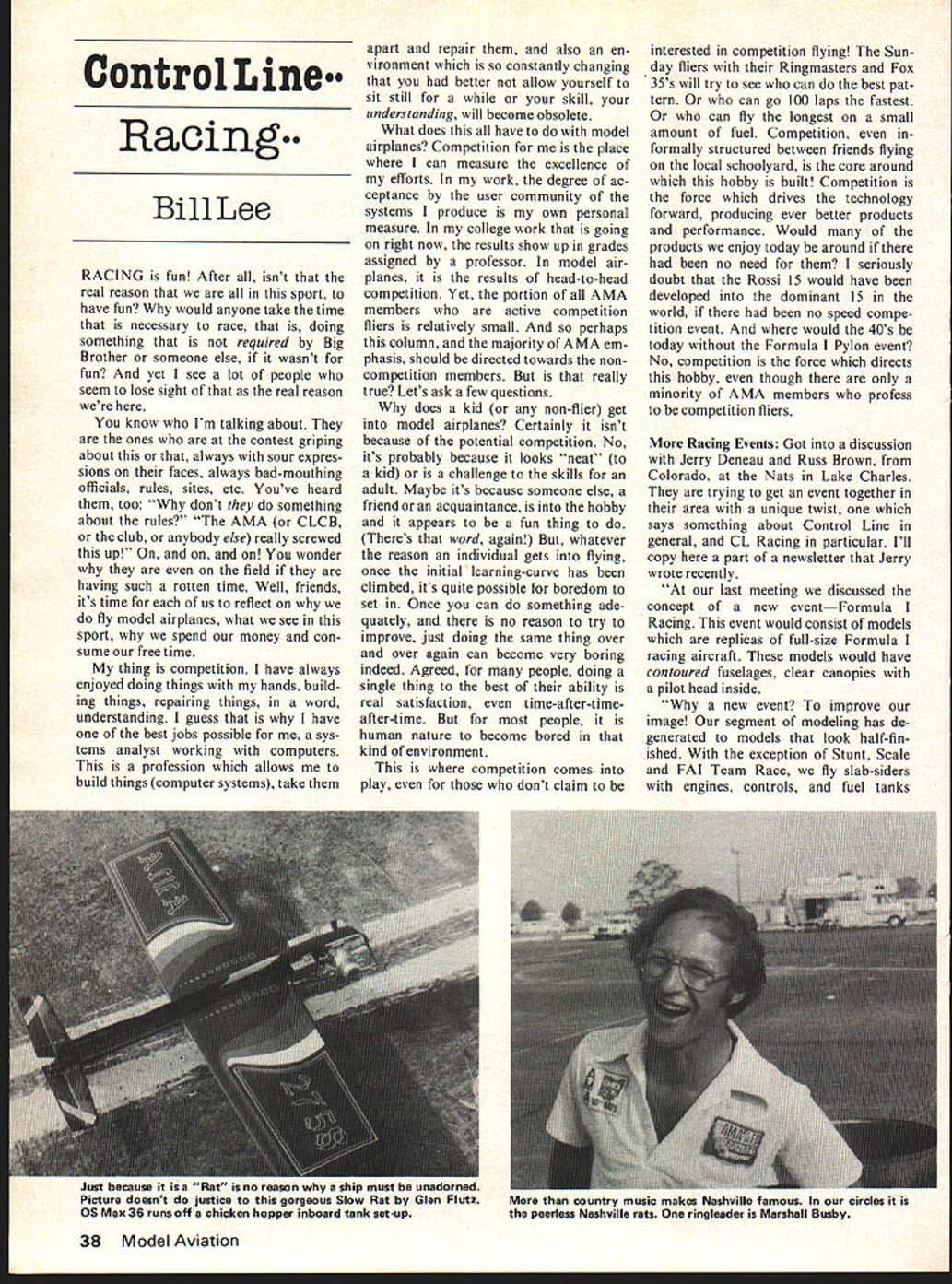
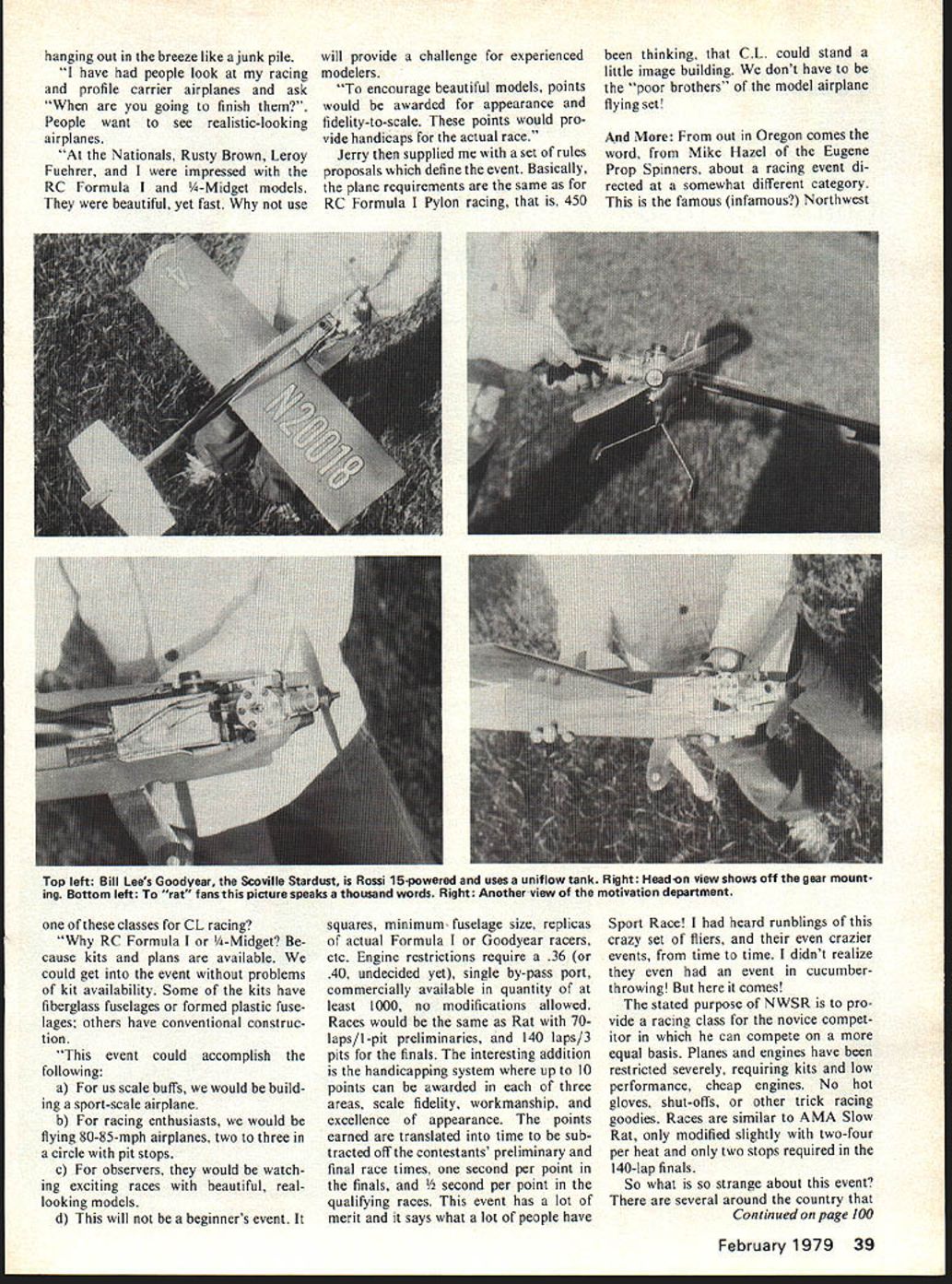
"Why a new event? To improve our image! Our segment of modeling has degenerated to models that look half-finished. With the exception of Stunt, Scale and FAI Team Race, we fly slab-siders with engines, controls, and fuel tanks. Just because Rat is a racing ship is no reason the ship must be unadorned. Pictures don't do justice to the gorgeous Slow Rat. Glen Flutz's OS Max .36 runs off a chicken-hopper inboard tank set-up. Country music makes Nashville famous; the peerless Nashville rats' ringleader Marshall Busby hangs out in the breeze like a junk pile.
"I have had people look at my racing and profile carrier airplanes and ask, 'When are you going to finish them?' People want to see realistic-looking airplanes.
"At the Nationals, Rusty Brown, Leroy Fuehrer, and I were impressed with the RC Formula I and 1/4-Midget models. They were beautiful, yet fast. Why not use one of these classes for CL racing?
"Why RC Formula I or 1/4-Midget? Because kits and plans are available. We could get into the event without problems of kit availability. Some of the kits have fiberglass fuselages or formed plastic fuselages; others have conventional construction."
This event could accomplish the following:
- For us scale buffs, we would be building a sport-scale airplane.
- For racing enthusiasts, we would be flying 80–85 mph airplanes, two to three in a circle with pit stops.
- For observers, they would be watching exciting races with beautiful, real-looking models.
- This will not be a beginner's event. It will provide a challenge for experienced modelers.
"To encourage beautiful models, points would be awarded for appearance and fidelity to scale. These points would provide handicaps for the actual race."
Jerry then supplied me with a set of rules proposals which define the event. Basically, the plane requirements are the same as for RC Formula I pylon racing: .450 squares, minimum fuselage size, replicas of actual Formula I or Goodyear racers, etc. Engine restrictions require a .36 (or .40, undecided yet), single bypass port, commercially available in quantity of at least 1,000; no modifications allowed. Races would be the same as Rat with 70-lap/1-pit preliminaries and 140-lap/3-pit finals. The interesting addition is the handicapping system where up to 10 points can be awarded in each of three areas: scale fidelity, workmanship, and excellence of appearance. The points earned are translated into time to be subtracted from the contestants' preliminary and final race times — one second per point in the finals, and one-half second per point in the qualifying races. This event has a lot of merit and it says what a lot of people have been thinking: C.L. could stand a little image building. We don't have to be the "poor brothers" of the model airplane flying set!
And More
From out in Oregon comes word from Mike Hazel of the Eugene Prop Spinners about a racing event directed at a somewhat different category: the famous (infamous?) Northwest Sport Race. I had heard rumblings of this crazy set of fliers and their even crazier events from time to time. I didn't realize they even had an event in cucumber-throwing! But here it comes.
The stated purpose of NWSR is to provide a racing class for the novice competitor in which he can compete on a more equal basis. Planes and engines have been restricted severely, requiring kits and low-performance, cheap engines. No hot gloves, shut-offs, or other trick racing goodies. Races are similar to AMA Slow Rat, only modified slightly with two to four per heat and only two stops required in the 140-lap finals.
So what is so strange about this event? There are several around the country that sound just like this one. Well, let me copy the last rule:
"It is assumed that the usual sportsmanship conduct of Northwest competitors will prevail in the running of this event. The event director may disqualify any entrant that he feels is not competing within the intent or spirit of this event."
Sound good? Here's part of the note Mike added when he wrote me with the newsletter: "Note unique rule #8 (above). At the '77 NW Regionals, where I was Racing Events Director, Sport Race entrants were threatened with disqualification if they appeared to be 'competing too seriously.' Further, it was highly suggested that they smile a lot to show everybody what fun they were having. I'm serious!"
Again, a group of racing fliers poking at "what ails us" — the compete-at-any-cost syndrome that seems to make competitors forget that we're only here because we want to be, and that we're here to have fun.
Fast Goodyears
I have had a pretty good year competing in Scale Race. Of course, most of my flying has been done here in District 8, but I did get a chance to compete at Winston-Salem at Bill Pardue's AAAA contest. I was lucky enough to win there with a not-great time of 6:06. However, the times were to get better as the season wore on. I turned a 6:00 flat at a contest in New Orleans, and then nearly wrecked the good plane at Ft. Worth when I had a solder joint in the control system come loose, causing a pancake and some repairable damage. I didn't fly at the Nats since I was the CL Category Director. Later on, I went to the Southwestern Control Line Championships at Dallas on Labor Day and turned a real good 5:42. Competition at Dallas is very good, especially in Goodyear, with Bud and Doug Harris, Kerry Turner, Mike Wheeler, and Jim Ong in attendance — all having placed in the top five or six in Open or Senior Goodyear at the Lake Charles Nats.
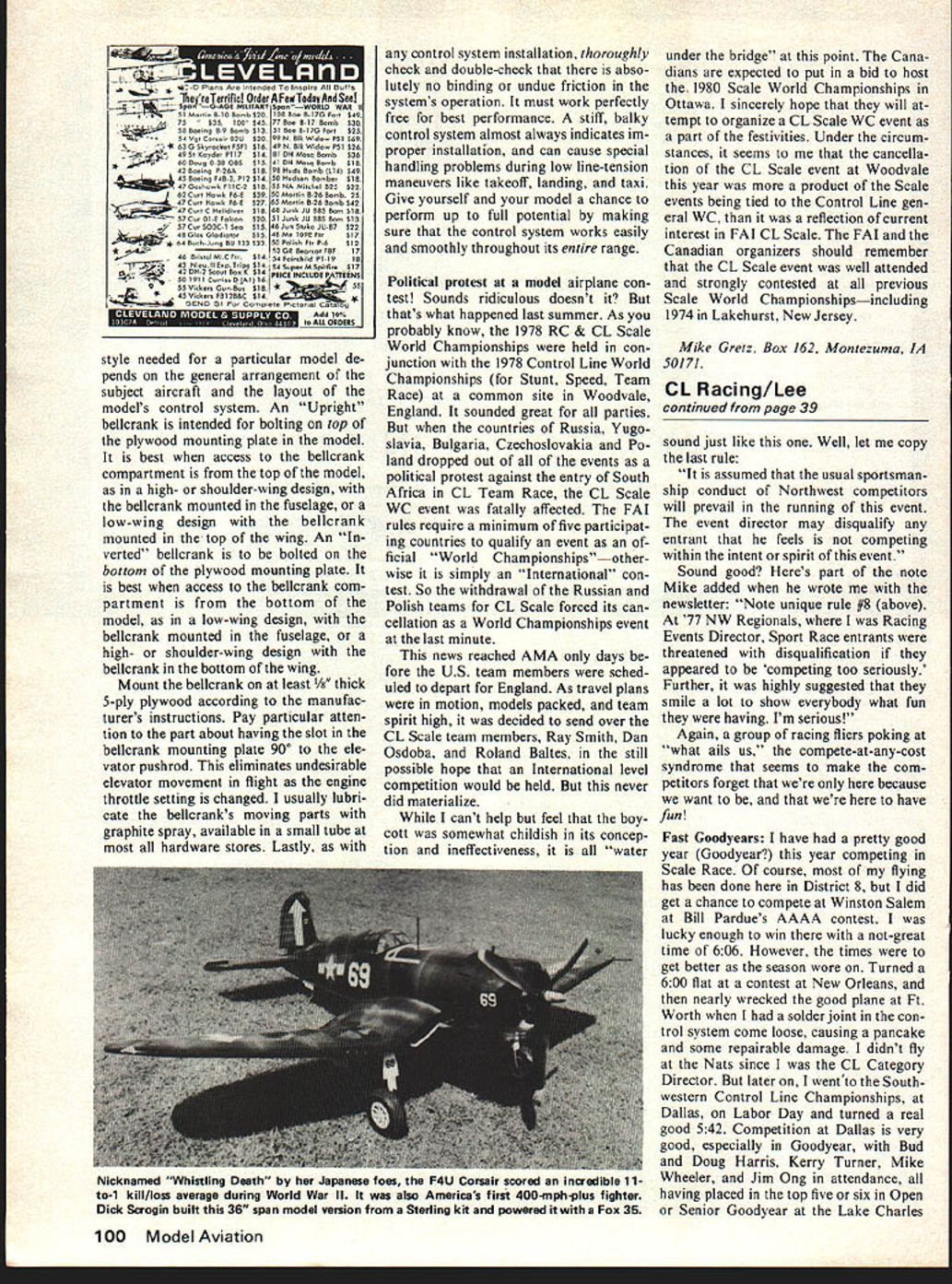
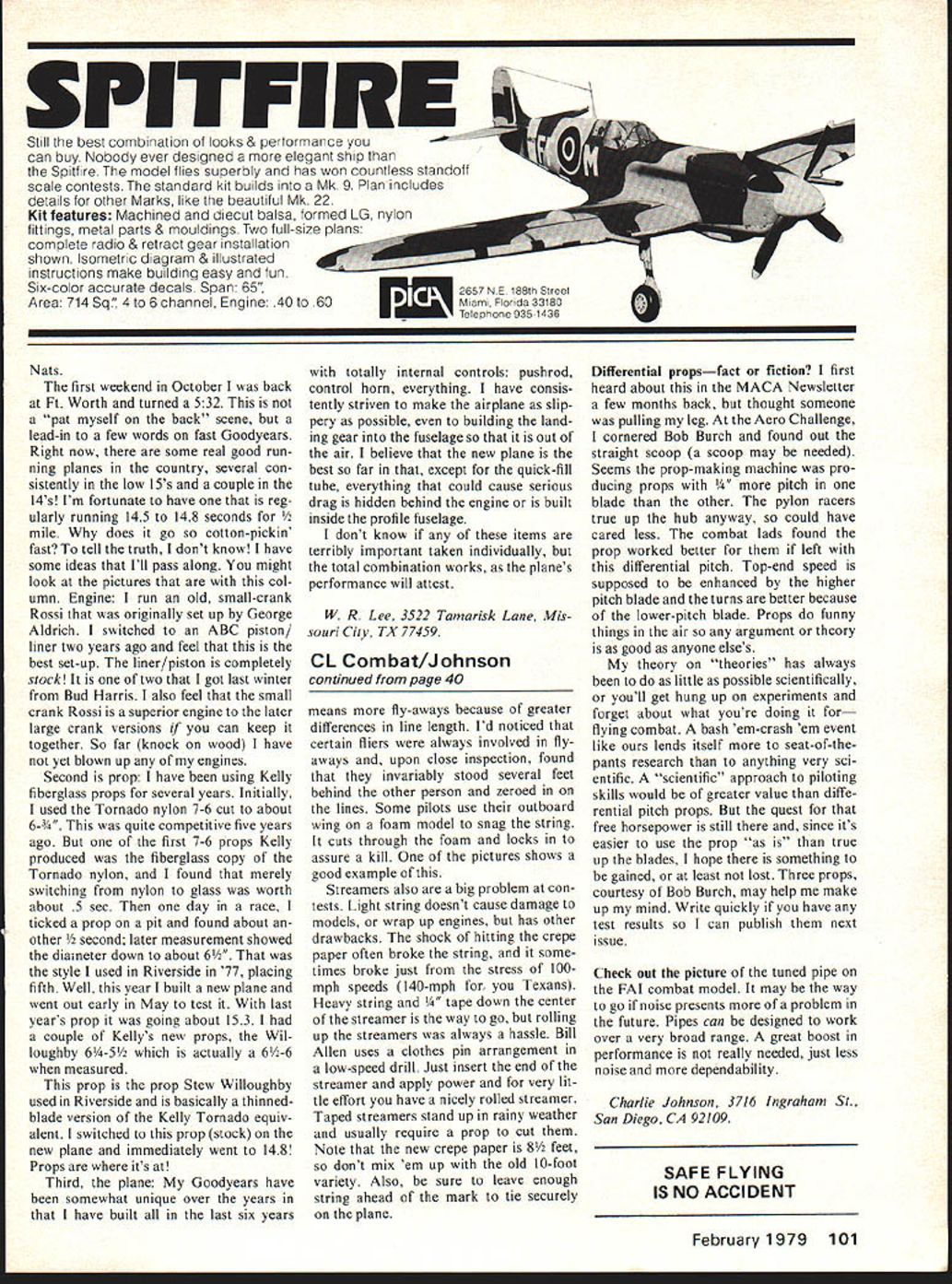
The first weekend in October I was back at Ft. Worth and turned a 5:32. This is not a "pat myself on the back" scene, but a lead-in to a few words on fast Goodyears. Right now there are some real good running planes in the country, several consistently in the low 15s and a couple in the 14s! I'm fortunate to have one that is regularly running 14.5 to 14.8 seconds for the half-mile. Why does it go so cotton-pickin' fast? To tell the truth, I don't know! I have some ideas that I'll pass along. You might look at the pictures that are with this column.
- Engine: I run an old, small-crank Rossi that was originally set up by George Aldrich. I switched to an ABC piston/liner two years ago and feel that this is the best setup. The liner/piston is completely stock — it is one of two that I got last winter from Bud Harris. I also feel that the small-crank Rossi is a superior engine to the later large-crank versions if you can keep it together. So far (knock on wood) I have not yet blown up any of my engines.
- Prop: I have been using Kelly fiberglass props for several years. Initially I used the Tornado nylon 7-6 cut to about 6-3/4". This was quite competitive five years ago. But one of the first 7-6 props Kelly produced was the fiberglass copy of the Tornado nylon, and I found that merely switching from nylon to glass was worth about 0.5 second. Then one day in a race I ticked a prop on a pit and found another 0.5 second; later measurement showed the diameter down to about 6-1/2". That was the style I used in Riverside in '77, placing fifth. This year I built a new plane and went out early in May to test it. With last year's prop it was going about 15.3. I had a couple of Kelly's new props, the Willoughby 6-3/4-5/2 which measures actually about 6-1/2". This prop is the one Stew Willoughby used in Riverside and is basically a thinned-blade version of the Kelly Tornado equivalent. I switched to this prop (stock) on the new plane and immediately went to 14.8! Props are where it's at.
- Plane: My Goodyears have been somewhat unique over the years in that I have built all of them in the last six years with totally internal controls: pushrod, control horn — everything. I have consistently striven to make the airplane as slippery as possible, even building the landing gear into the fuselage so that it is out of the air. I believe the new plane is the best so far in that, except for the quick-fill tube, everything that could cause serious drag is hidden behind the engine or is built inside the profile fuselage.
I don't know if any of these items are terribly important taken individually, but the total combination works, as the plane's performance will attest.
W. R. Lee 3522 Tamarisk Lane Missouri City, TX 77459
Transcribed from original scans by AI. Minor OCR errors may remain.

