
Control Line: Racing
Bill Lee
More on the death of Rat:
I think I really stirred up a hornet's nest with the column on the imminent death of Rat Race!
I have received quite a number of letters from all over the U.S. on the subject, about equally split in agreement and disagreement with me. But, even though there are those who agree that Rat is in trouble and something ought to be done, there are many, many fliers out there who feel that Rat is the king of our racing events because of its speed and complexity; and that, to be competitive in Rat Race, is the ultimate of all possible achievements in Control Line Racing. To do anything to limit the event would be to destroy the very reason it exists: unlimited, all-out racing!
Listen to a letter from Arnold Kosby from Scottsdale, Ariz. Arn, along with his father Dick, has been flying Rat for five years and has "been to the Nats the last three years and has utterly bombed out!" So why continue? Maybe because there's something in Rat Race that no other event has. Maybe it's the speed or the time it takes to build a ship, or the pull, or the expense, or the sweat or the relief when you know you can turn in a good time. I cannot be sure, but something about the event is exciting. I don't think there could be a much better statement of why people fly Rat.
But the question still has to be answered. For every area where Rat is flourishing, there are two or three where it is dead! And that is not the sign of a healthy event. Yes, Rat was one of the largest Control Line events at the recent Nats. But outside of a few isolated areas of intensive activity and interest, Rat is no longer flown. Will Rat become a Nationals-only event? Do we need an event for the racer who wants to go fast but not that fast?
Formula 40 Scale Race:
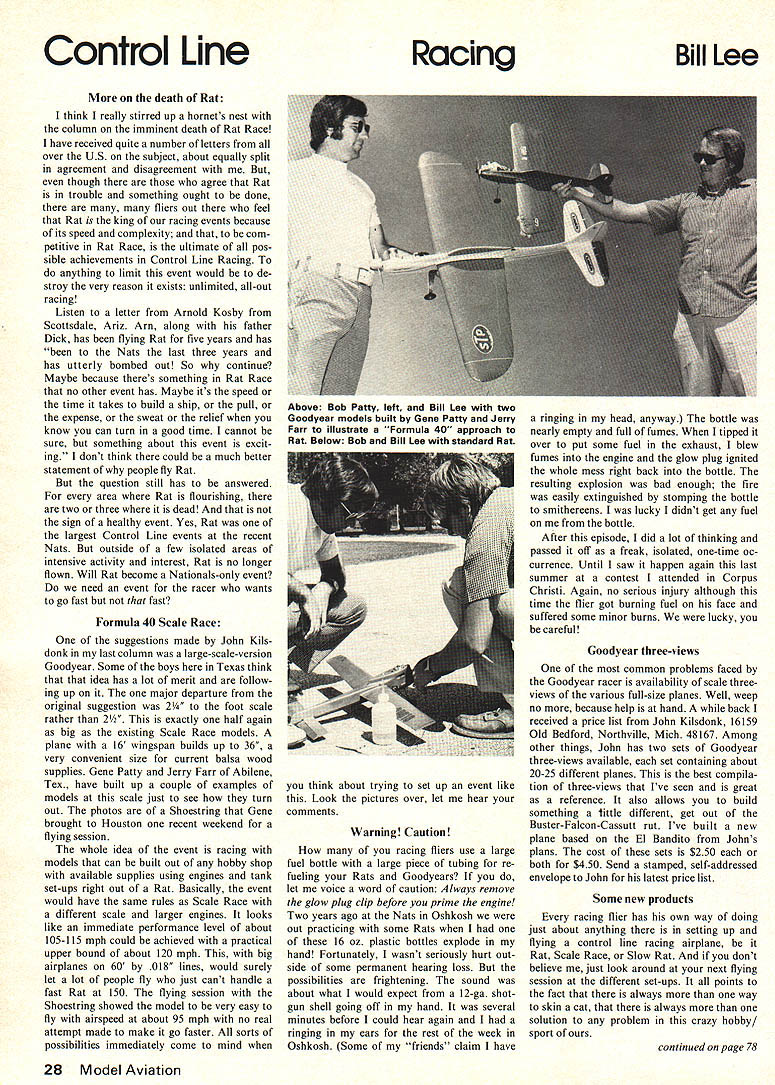
One of the suggestions made by John Kilsdonk in my last column was a large-scale-version Goodyear. Some of the boys here in Texas think that that idea has a lot of merit and are following up on it. The one major departure from the original suggestion was 2 1/4" to the foot scale rather than 1 1/2" to the foot scale. This is exactly one half again as big as the existing Scale Race models. A plane with a 16" wingspan builds up to 36", a very convenient size for current balsa wood supplies. Gene Patty and Jerry Farr of Abilene, Tex., have built up a couple of examples of models at this scale just to see how they turn out. The photos are of a Shoestring that Gene brought to Houston one recent weekend for a flying session.
The whole idea of the event is racing with models that can be built out of any hobby shop with available supplies using engines and tank set-ups right out of a Rat. Basically, the event would have the same rules as Scale Race with a different scale and larger engines. It looks like an immediate performance level of about 105-115 mph could be achieved with a practical upper bound of about 120 mph. This, with big airplanes on 60' by .018" lines, would surely let a lot of people fly that just can't handle a fast Rat at 150. The flying session with the Shoestring showed the model to be very easy to fly with an airspeed at about 95 mph with no real attempt made to make it go faster. All sorts of possibilities immediately come to mind when you think about trying to set up an event like this. Look the pictures over, let me hear your comments.
Warning! Caution
How many of you racing fliers use a large fuel bottle with a large piece of tubing for refueling your Rats and Goodyears? If you do, let me voice a word of caution: Always remove the glow plug clip before you prime the engine!
Two years ago at the Nats in Oshkosh we were out practicing with some Rats when I had one of these 16 oz. plastic bottles explode in my hand! Fortunately, I wasn't seriously hurt outside of some permanent hearing loss. But the possibilities are frightening. The sound was about what I would expect from a 12-ga. shotgun shell going off in my hand. It was several minutes before I could hear again and I had a ringing in my ears for the rest of the week in Oshkosh. (Some of my "friends" claim I have a ringing in my head, anyway.) The bottle was nearly empty and full of fumes. When I tipped it over to put some fuel in the exhaust, I blew fumes into the engine and the glow plug ignited the whole mess right back into the bottle. The resulting explosion was bad enough; the fire was easily extinguished by stomping the bottle to smithereens. I was lucky I didn't get any fuel on me from the bottle.
After this episode, I did a lot of thinking and passed it off as a freak, isolated, one-time occurrence. Until I saw it happen again this last summer at a contest I attended in Corpus Christi. Again, no serious injury although this time the flier got burning fuel on his face and suffered some minor burns. We were lucky; be careful!
Goodyear three-views
One of the most common problems faced by the Goodyear racer is availability of scale three-views of the various full-size planes. Well, weep no more, because help is at hand. A while back I received a price list from John Kilsdonk, 16159 Old Bedford, Northville, Mich. 48167. Among other things, John has two sets of Goodyear three-views available, each set containing about 20-25 different planes. This is the best compilation of three-views I've seen and is great as a reference. It also allows you to build something a little different, get out of the Buster-Falcon-Cassutt rut. I've built a new plane based on El Bandito from John's plans. The cost of the sets is $2.50 each or both for $4.50. Send a stamped, self-addressed envelope to John for his latest price list.
Some new products
Every racing flier has his own way of doing just about anything there is in setting up and flying a control line racing airplane, be it Rat, Scale Race, or Slow Rat. And if you don't believe me, just look around at your next flying session at the different set-ups. It all points to the fact that there is always more than one way to skin a cat; that there is always more than one solution to any problem in this crazy hobby/sport of ours.
(continued on page 78) Fuel systems are a good case in point. Square tanks, round tanks, tall, skinny tanks, short fat tanks. You name it and chances are you can find someone, somewhere, that is using it and championing it as "the only way to go." I claim no immunity from this affliction. I have my way of doing things that I find works best for me. But I have the distinct advantage of being on the "hunt-n-peck" end of the typewriter so you're going to have to listen to my way of doing things until you decide to send me your way.
O.K., here's one way. Some people (many, in fact) run both their fuel and pressure lines through the shut-off. The obvious reason is to prevent the pressure in the fuel tank from blowing back through the pressure line and flooding the engine with fumes and/or raw fuel during shut-off. Another way of solving this problem (and the way I do it) is to run only the fuel line through the shut-off and use a ball-check in the pressure line. The ball-check will allow pressure to flow from the engine to the tank but prevents fuel and/or fumes from flowing back to the engine. One big problem with using ball-checks is availability. If you want to get hold of some really well made ball-checks, I have two sources you.
The first is Arn Kosby, Technamics Corporation, Box 1665, Scottsdale, Ariz., 85252. Arn's ball-check is a single piece of aluminum tubing with a small ball seated in one end and the tubing crimped with a special tool on the other. The whole thing is about 3/16" long and 1/8" in diameter and fits inside a piece of fuel tubing used for a pressure line.
A second source is Bob Wilder, Wilder's Model Machine Works, 2010 Boston Street, Irving, Tex., 75061. Bob's ball-check is a piece of brass tubing with a small ball seated in one end but the other end is threaded to accept a small Allen set screw. The end of the screw is slotted and a hole is drilled lengthwise through the screw to allow pressure to pass. This arrangement allows you to take the ball-check apart periodically for inspection and cleaning. Bob even supplies a small Allen wrench with each ball-check for that purpose. I've used both of these products and can attest to their quality and effectiveness.
Another product available from Arn Kosby is a slick new fuel shut-off. It is machined out of steel rod and tubing, spring loaded to pin off a single line (there goes that ball-check again) with a neat trip wire that will trip the thing with almost any kind of motion. Arn has two versions available, one for Rat and one for the Goodyears. Send a stamped, self-addressed envelope to the address listed above for the price list on all of Arn's latest goodies.
Another Set of Rat Plans:
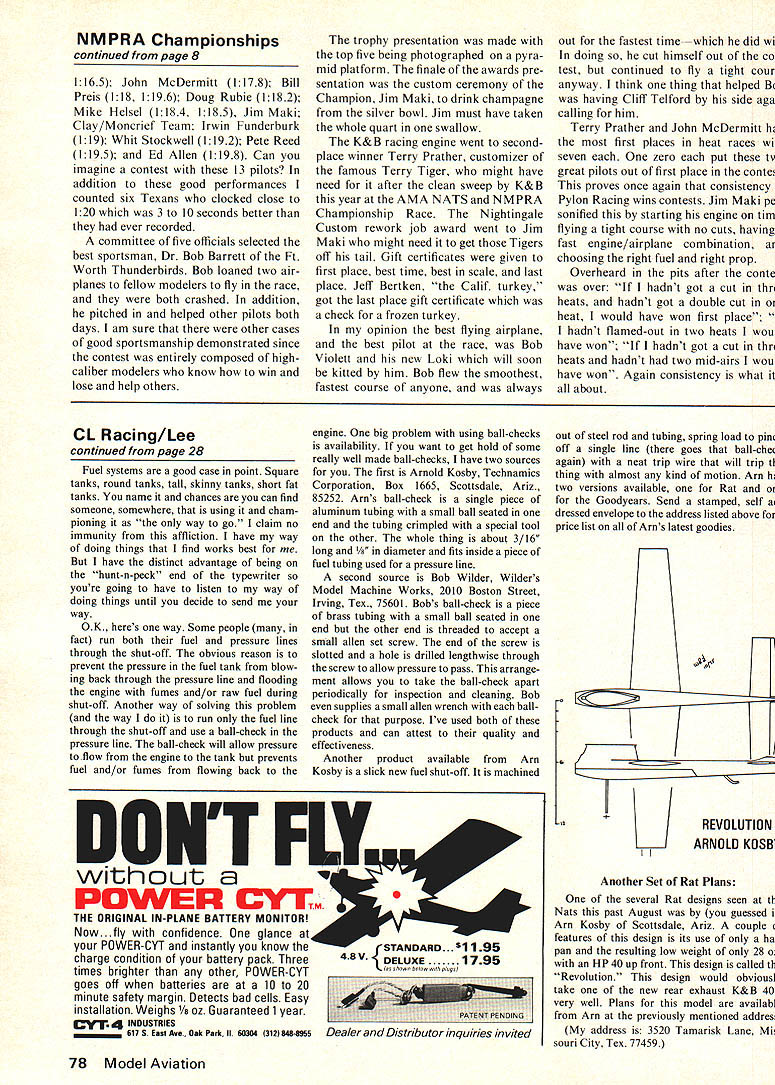
One of the several Rat designs seen at the Nats this past August was by (you guessed it) Arn Kosby of Scottsdale, Ariz. A couple of the features of this design are its use of only a half-span wing and the use of only an .40 up front. This design is called "Revolution." This one design would take one of the new rear-exhaust K&B 40s very well. Plans for this model are available from Arn at the previously mentioned address. (My address is: 3520 Tamarisk Lane, Mission City, Tex. 77459.)
Transcribed from original scans by AI. Minor OCR errors may remain.

