
CONTROL LINE RACING
Dave McDonald Box 384, Daleville IN 47334 E-mail: DMcD143@aol.com
I have received many letters and questions regarding a previous column about the DuPont ChromaSystem paint and its ability to withstand model fuel.
I have learned from a local boat racer that the paint does handle high-nitromethane fuel very well, provided you apply two coats of clear instead of the normal one coat. This should provide ample protection for as much as 70% nitro.
F2C Thoughts
F2C models are usually purchased from the former Soviet bloc countries. Rest assured that just buying the model is no guarantee of success. When the airplane arrives, fine-tuning is needed to get it race-ready.
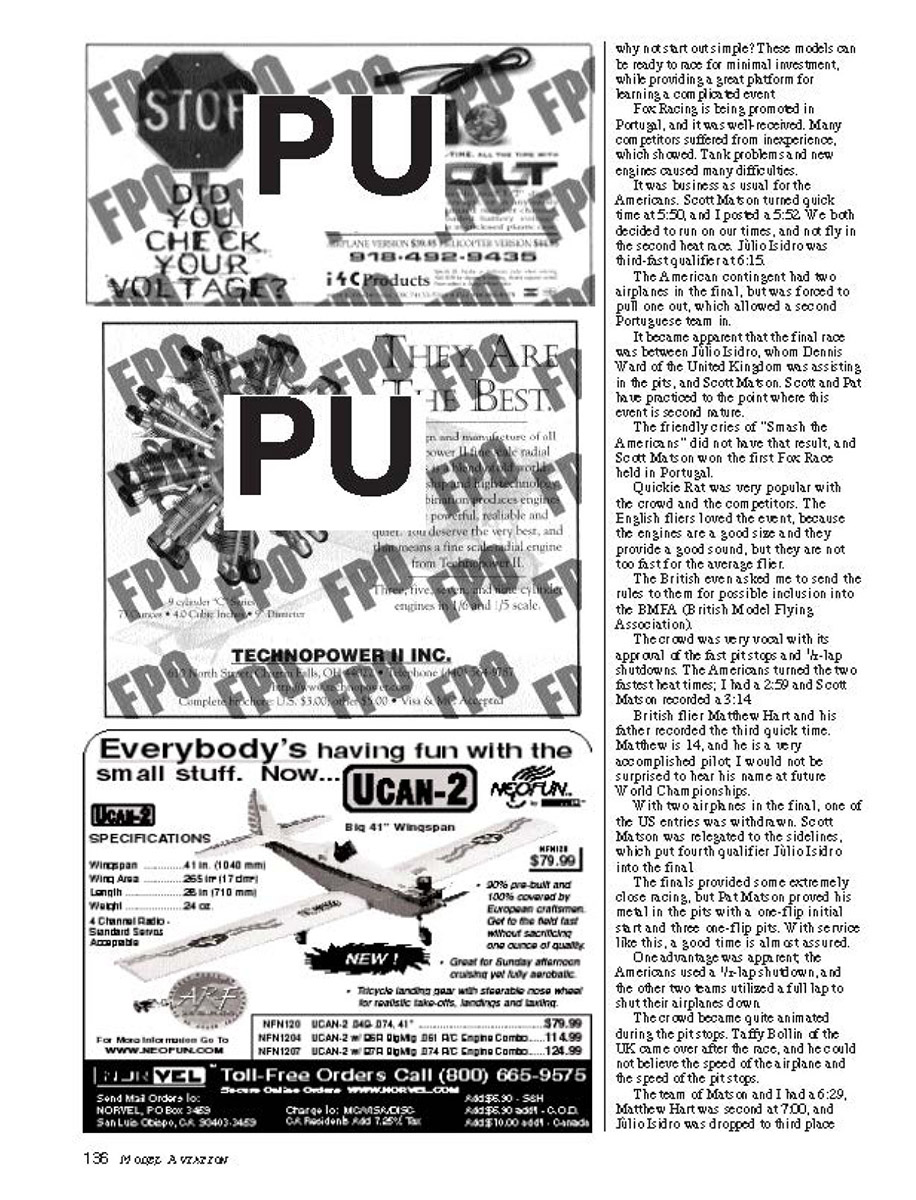
For those who choose not to buy a model, one option is to build it yourself. Kenny Perkins recently completed a new F2C aircraft; he has built several and sent photos of the latest.
The model was built with a Vorobiev wing covered in Kevlar, which makes the wing extremely stiff. The fuselage is from a Walt Perkins kit, which are available through me.
Kenny makes a front crutch from hardwood that provides a good base on which to mount the engine and keeps vibration to a minimum. It not only gives a good place to mount the engine, but it also helps stabilize the wing. This is a must-have for success in making a good-performing model.
Kenny used an identical model to record a good time of 3:26 at the 2000 Nationals.
You can have an F2C model for a minimal investment. Although it may not be state of the art, it will certainly be a good model to practice with and to compete with in the United States.
Racing in Portugal
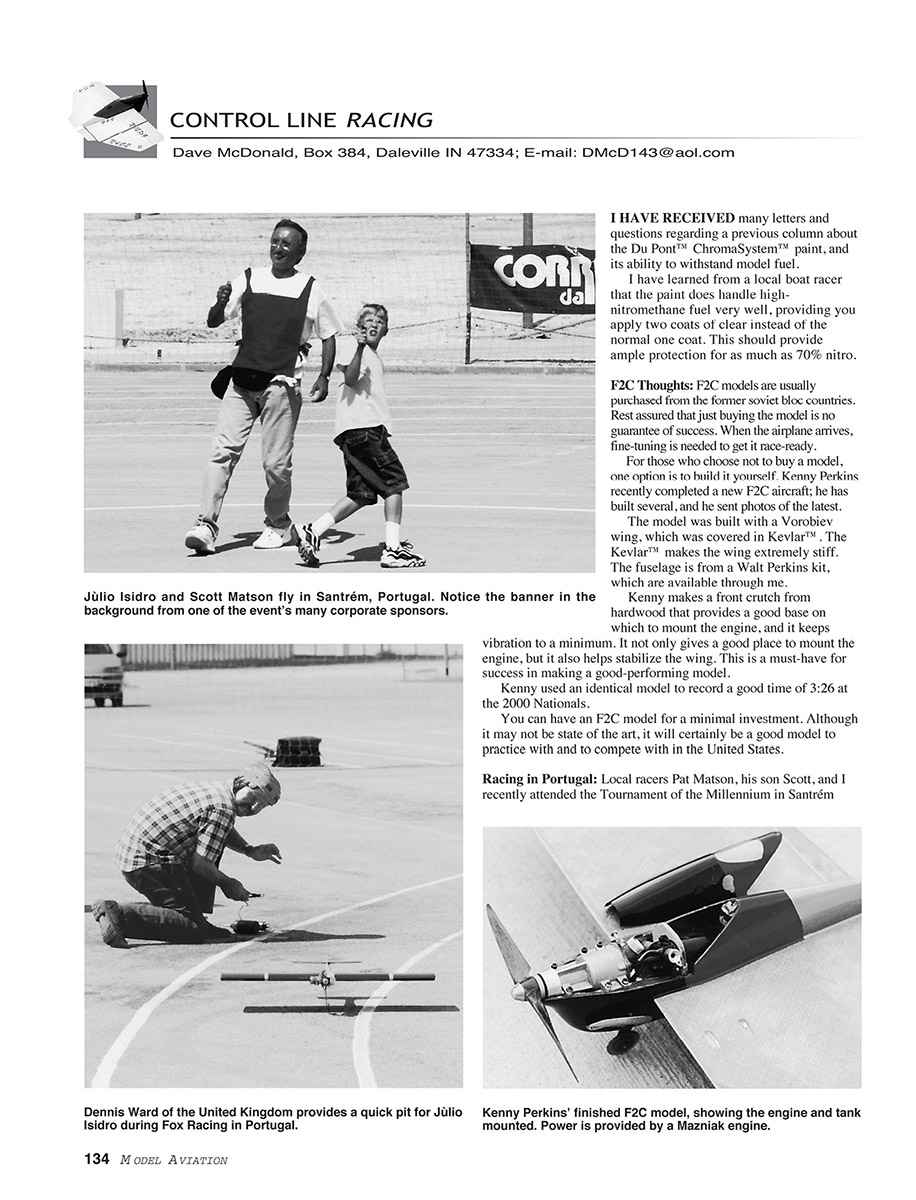
Local racers Pat Matson, his son Scott, and I recently attended the Tournament of the Millennium in Santarém, Portugal. If you have ever thought of going to a contest overseas, this one is a must-do. Portugal has some marvelous people who are very friendly and supportive of aeromodeling. It is a beautiful country. We spent most evenings talking with our friends from the United Kingdom about modeling and general hangar flying. You will not find friendlier people anywhere.
The event was flown over three days. One round of heat races was flown on each of the first two days, and the finals were on the third day. The contest featured many events. The Americans would like Fox Racing and Quickie Rat. Other divisions included B Team Race and F2C National, which I thought had merit when I first saw it two years ago. F2C National aircraft are profile F2C models and must use older engines with steel piston/liner assemblies. Airspeeds are generally in the upper-19-second bracket. This event provides an excellent and relatively inexpensive way for those interested in F2C to learn. It’s an excellent starting point to learn about diesels and how to fly an F2C model. No trick-filling equipment is needed; most competitors use a fuel bottle and some sort of fast-fill. The dominant engines are the older Nelson Team Race variety, but some Rossis also proved extremely good. F2C National models can be purchased as kits from Thomas Mejzlik; they come with a tank and all the hardware and only require the wing to be glued into the fuselage before they are ready to fly. These models fly extremely well; I purchased one a couple of years ago and can attest to it.
Since there is a wave of interest in F2C, Fox Racing is being promoted in Portugal and was well received. Many competitors suffered from inexperience, which showed. Tank problems and new engines caused many difficulties.
It was business as usual for the Americans. Scott Matson turned quick time at 5:50, and I posted a 5:52. We both decided to run on our times and not fly in the second heat race. Júlio Isidro was third-fast qualifier at 6:15.
The American contingent had two airplanes in the final but was forced to pull one out, which allowed a second Portuguese team in.
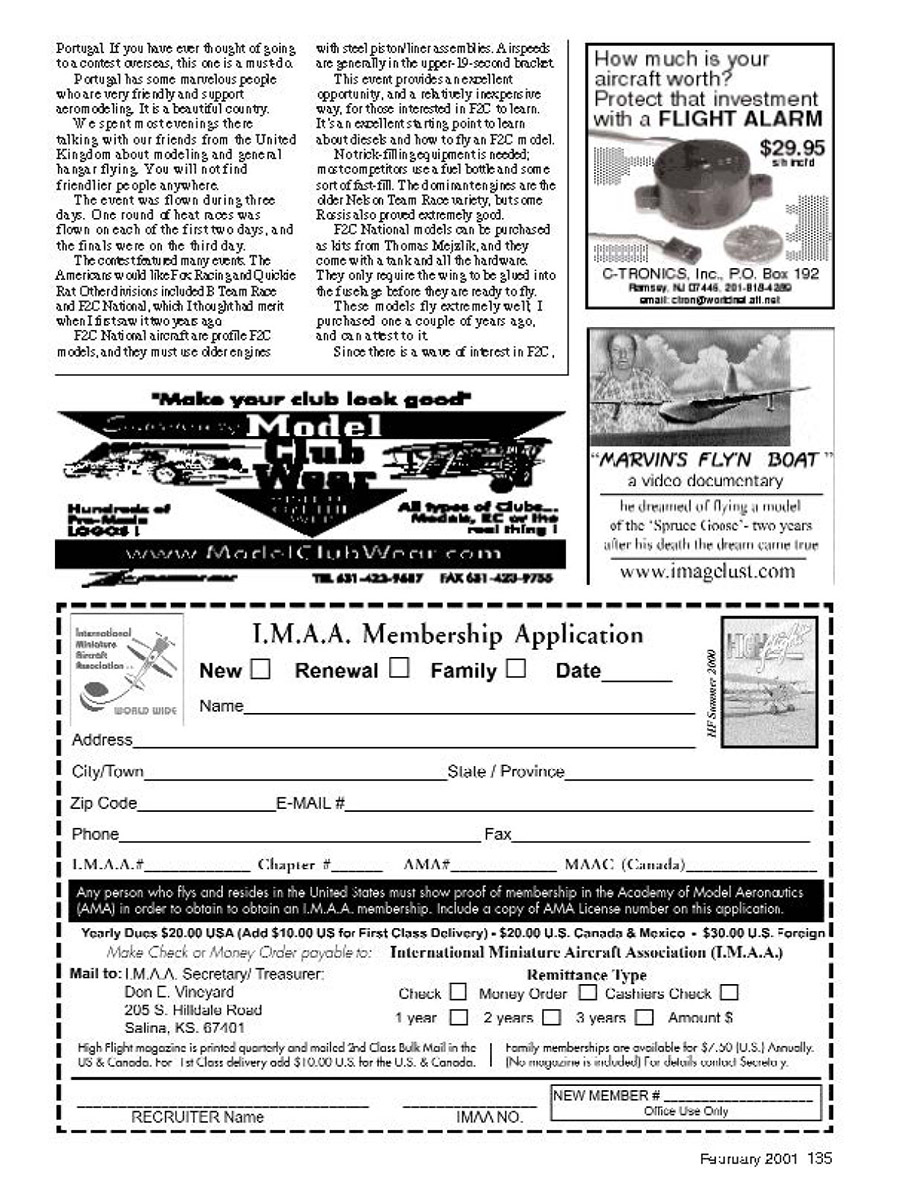
It became apparent that the final race was between Júlio Isidro, whom Dennis Ward of the United Kingdom was assisting in the pits, and Scott Matson. Scott and Pat have practiced to the point where this event is second nature.
The friendly cries of "Smash the Americans" did not have that result, and Scott Matson won the first Fox Race held in Portugal.
Quickie Rat was very popular with the crowd and the competitors. The English fliers loved the event because the engines are a good size and provide a good sound, but they are not too fast for the average flier.
The British even asked me to send the rules to them for possible inclusion into the BMFA (British Model Flying Association).
The crowd was very vocal with its approval of the fast pit stops and "half-lap" shutdowns. The Americans turned the two fastest heat times: I had a 2:59 and Scott Matson recorded a 3:14.
British flier Matthew Hart and his father recorded the third quick time. Matthew is 14 and a very accomplished pilot; I would not be surprised to hear his name at future World Championships.
With two airplanes in the final, one of the US entries was withdrawn. Scott Matson was relegated to the sidelines, which put fourth qualifier Júlio Isidro into the final.
The finals provided some extremely close racing, but Pat Matson proved his mettle in the pits with a one-flip initial start and three one-flip pits. With service like this, a good time is almost assured.
One disadvantage was apparent: the Americans used half-lap shutdowns, while the other two teams utilized a full lap to shut their airplanes down.
The crowd became quite animated during the pit stops. Taffy Bolin of the UK came over after the race and could not believe the speed of the airplane and the speed of the pit stops.
The team of Matson and I had a 6:29, Matthew Hart was at 7:00, and Júlio Isidro was dropped to third place after a postrace inspection showed a problem with the lines.
There was much talk about the current US rules for B Team Race. Without exception, the competitors think we are doing the right thing with the event to get people involved; an old-design model has no sentimental value to most people. As the Brits said, it may not be vintage, but it is the way to get new people interested in the event and it should make the event better.
I believe it was Taffy Bolin who had a beautiful take-apart Veco Redskin, which made it easier to transport to modeling events. The wings were bolted on, the top of the fuselage came off, and the tail could be removed. Although this made the airplane heavier, it was a great piece of innovation and workmanship.
Goodyear Propellers
Steve Eichenberger (2102 W. Western Dr., Chandler AZ 85224) sent me a Goodyear propeller and a 5/8A propeller he is making. They are both good quality.
The Goodyear prop measures 4.9 inches in pitch; at approximately six inches in length, it should work well on most engines.
Steve has other propellers available.
Mouse II
The Cyclone engine made its first appearance en masse at the 2000 Nationals. Since then, many questions have arisen regarding the exhaust length and the use of spike starters.
According to the officers of the National Control Line Racing Association (NCLRA), exhaust lengths will be measured at the 2001 Nationals.
Review the Mouse II rules and make sure your model's exhaust length is correct. The current rule allows for a 0.5-inch exhaust length when measured from the face of the piston.
Don't be concerned about the loss of power from cutting the exhaust. Vic Garnet and others have reported trimming their exhausts with no ill effects on performance.
Join up
Are you an NCLRA member? If you're not and you would like to be, dues are:
- $10 US
- $12 outside the US
Send dues to: Dick Lambert, 4651 Ridgewood Ave., Port Orange, FL 32127.
I would love to share modeling events from your area; all you have to do is send photos, i.e., people flying and airplanes being pitted. Please make sure the pictures are on glossy paper and have no writing on the back.
If you have a special project or information about a new event, send that to me. Remember, this is your column; help make it better.
As always, your comments are solicited and appreciated.
DMcD
Transcribed from original scans by AI. Minor OCR errors may remain.

