
CONTROL LINE RACING - 2003/02
Dave McDonald Box 384, Daleville IN 47334 E-mail: DMcD143@aol.com
2002 Tournament of the New Millennium (Santarém, Portugal)
The 2002 Tournament of the New Millennium was a tremendous success. Julio Isidro rolled out the red carpet and welcomed competitors from eight countries to Portugal for three days of superb competition and wonderful memories.
Activities included a guided tour of the city featuring a fresh-air market, several churches dating back to the 1500s, and part of a castle overlooking the river and city. A tour of the Cintra Brewery followed, where we were treated to excellent libations and a banquet that started with lobster for everyone. This tour and banquet were courtesy of brewery owner Mr. Jose Cintra.
Cintra and Coke had a pavilion at the flying site providing free refreshments to competitors throughout the contest. Other corporate sponsors included:
- Continental Airlines
- Mary Kay Cosmetics
- Black & Decker
- Coca-Cola
The town of Santarém is exceptionally friendly and supportive. I suggest you make plans to attend one of these events—you will not be treated any better anywhere in the world.
U.S. Contingent and Event Format
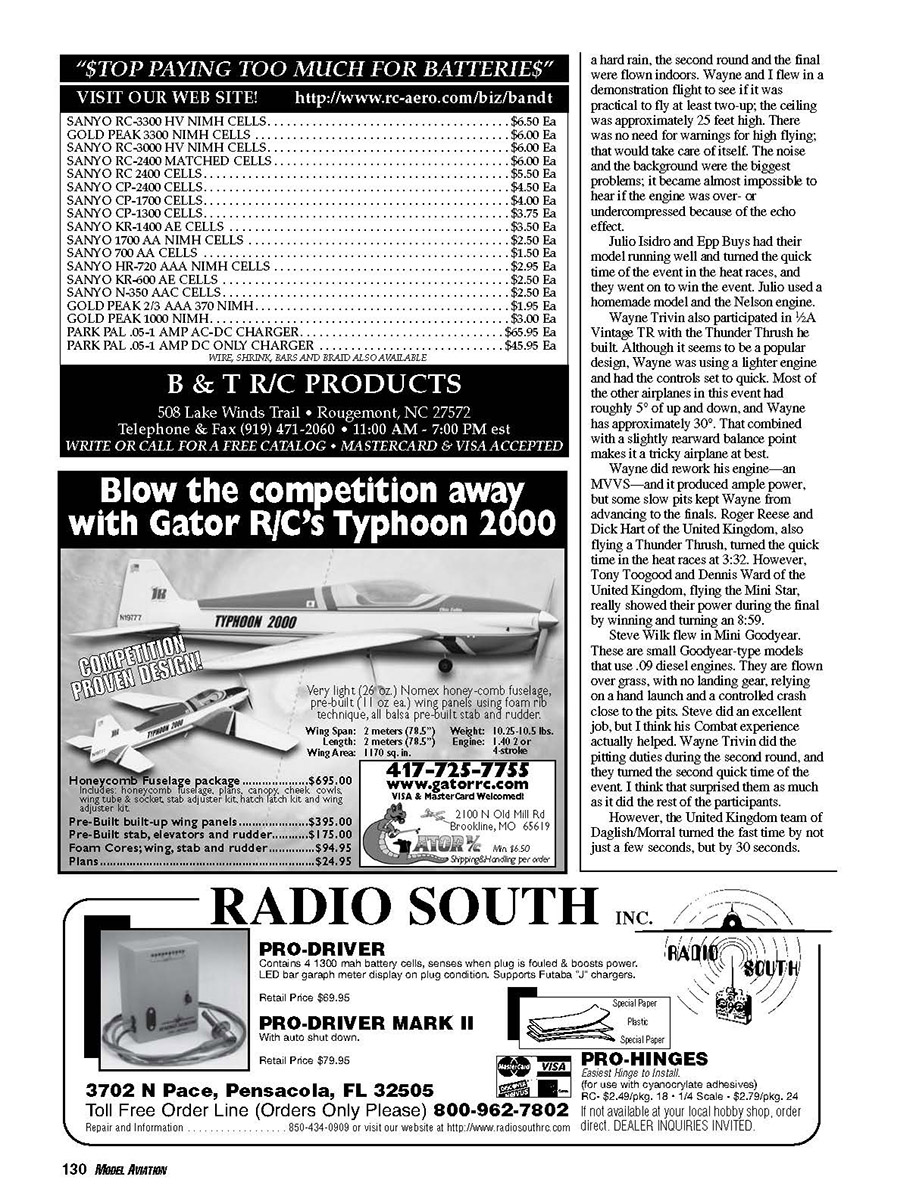
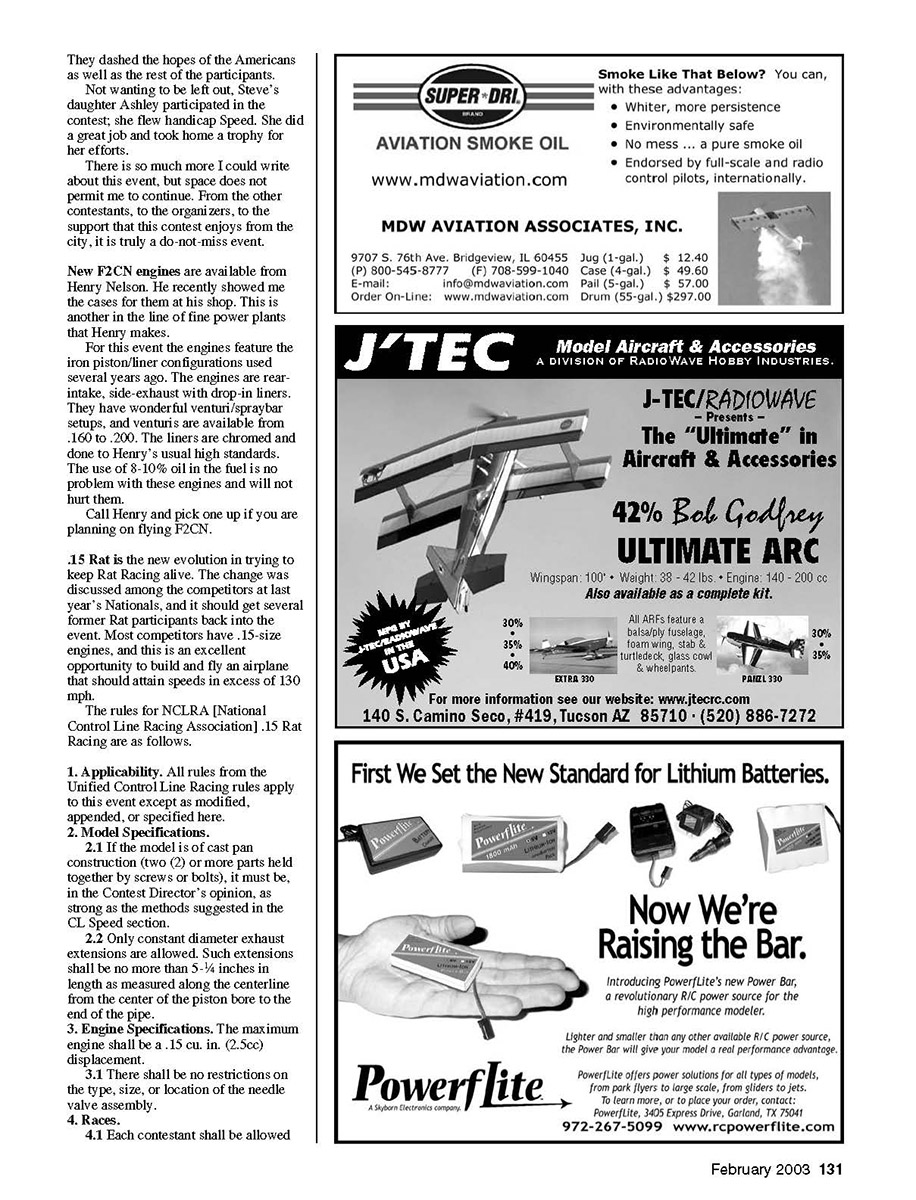
The U.S. contingent (myself, Steve Wilk, Tom Wilk, Ashley Wilk, Wayne Trivin, and David Wallick) entered several European and U.S. events. Space does not permit a complete rundown, so I’ll give a flavor of a few classes the U.S. fliers contested: F2C National (F2CN), Mini Goodyear, 1/2A Vintage Team Race (TR), Fox Racing, and Quickie Rat.
The Europeans fly one round of each event each day, then finals on the last day. Americans were at a slight disadvantage since we are not used to flying every event each day—this requires being 100% prepared for every event with no time to tweak models between rounds. For the most part it worked out well.
F2CN
F2CN is a great introductory Team Racing event when kept simple: any iron engine, a profile airplane, and a squeeze bulb filler. Engines used included Rossi, SuperTigre, Nelson, and MVVS. The Nelson is a popular choice because it is a known commodity with available parts. Henry Nelson has new iron rear-induction engines available for F2CN.
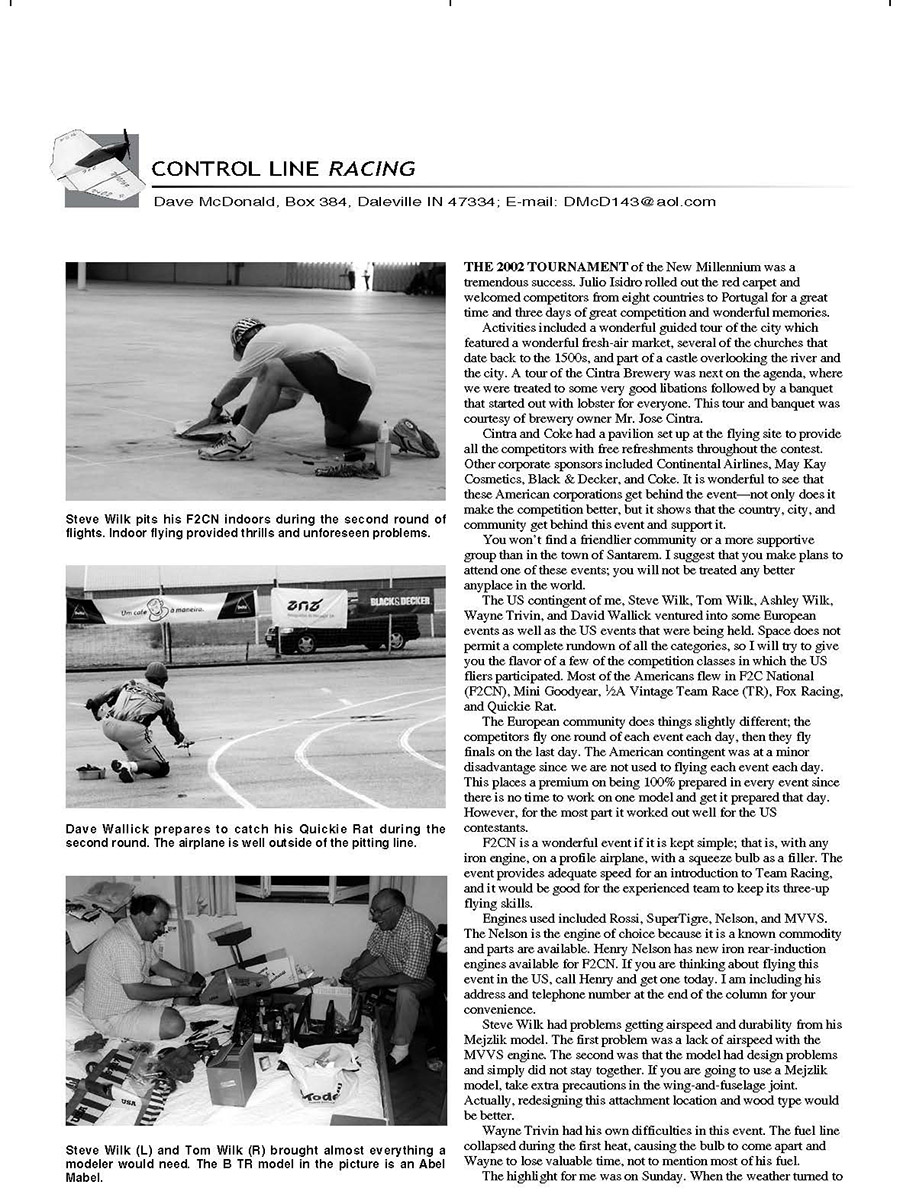
Steve Wilk had problems getting airspeed and durability from his Mejzlik model. The MVVS lacked speed, and the airframe had design problems that caused structural failure. If you use a Mejzlik, take extra precautions at the wing-to-fuselage joint—redesigning that joint and wood selection is advisable.
Wayne Trivin suffered a collapsed fuel line during a heat, causing the squeeze bulb to come apart and costing him time and fuel.
A highlight occurred on Sunday when heavy rain forced the second round and final indoors. Wayne and I flew a demonstration two-up in a venue with about a 25-foot ceiling. High flying wasn’t a concern; the echo and noise made it nearly impossible to hear engine over- or under-compression.
Julio Isidro and Epp Buys ran well and posted the event’s quick time in the heats, going on to win. Julio used a homemade model with a Nelson engine.
1/2A Vintage Team Race
Wayne Trivin flew a Thunder Thrush he built. While a popular design, Wayne used a lighter engine and very aggressive control throws (about 30° up/down vs. the more common ~5°). Combined with a slightly rearward balance point, this made the airplane tricky to handle. After reworking his MVVS engine to produce more power, slow pits kept Wayne from reaching the finals.
Roger Reese and Dick Hart (UK), also flying a Thunder Thrush, posted the quick time in the heats at 3:32. Tony Toogood and Dennis Ward (UK), flying the Mini Star, won the final with an 8:59.
Mini Goodyear
Steve Wilk competed in Mini Goodyear, a small Goodyear-style class using .09 diesel engines. These models are flown over grass with no landing gear—hand-launched and expected to have controlled crashes near the pits. Steve did an excellent job; his Combat experience helped with performance. Wayne handled pitting duties in round two, and they recorded the second quick time of the event.
The UK team Daglish/Morral posted the fastest time, beating others by about 30 seconds and dashing American hopes.
Other Notes
Steve’s daughter Ashley flew handicap Speed and earned a trophy for her efforts.
There is much more that could be written about this event, from contestants to organizers to the local support—it truly is a do-not-miss event.
New F2CN Engines from Henry Nelson
Henry Nelson is producing new F2CN engines featuring iron piston/liner configurations, rear-intake with side-exhaust, and drop-in liners. Key points:
- Venturi/spraybar setups with venturis available from .160 to .200.
- Chromed liners finished to Nelson’s standards.
- Use of 8–10% oil in fuel is acceptable and will not harm the engines.
If you plan to fly F2CN, consider contacting Henry to pick one up.
.15 Rat (NCLRA) — Rules Summary
.15 Rat was introduced to keep Rat Racing active and to attract former Rat participants. Most competitors have .15-size engines; these models should achieve speeds in excess of 130 mph.
NCLRA .15 Rat Racing rules (summary):
- Applicability
- All rules from the Unified Control Line Racing rules apply except as modified here.
- Model Specifications
2.1 If the model is of cast pan construction (two or more parts held together by screws or bolts), it must be, in the Contest Director’s opinion, as strong as methods suggested in the CL Speed section. 2.2 Only constant-diameter exhaust extensions are allowed. Such extensions shall be no more than 5-1/4 inches in length as measured along the centerline from the center of the piston to the end of the pipe.
- Engine Specifications
- Maximum engine displacement: .15 cu. in. (2.5 cc).
3.1 No restrictions on the type, size, or location of the needle valve assembly.
- Races
4.1 Each contestant is allowed two timed flights in the preliminary rounds. The engine must be started at the pit line. A line measurement will be used and each flight will consist of four laps. Finals consist of five flights per contestant; handicaps are determined by best preliminary times. Weight and fuel limits follow the Unified rules unless otherwise stated. 4.2 Final races shall be 140 laps with three mandatory refueling stops.
- Flying Regulations
5.1 All flying shall be done between six and twenty feet altitude.
- Field Layout
6.1 Inner Circle radius: 68 feet. 6.2 Outer Circle radius: 76 feet.
- Lines
- For the .15 engine, lines are to be .014" solid.
7.1 Lines shall be 60' ± 6".
Steve Wilk has tops and equipment that will work for this event; contact info is at the end. I hope to have more information about planes and equipment in the next column. If you have questions or are looking for pans, shutoffs, etc., let me know and I’ll try to help.
Contributions are solicited and appreciated.
—Dave McDonald
Sources / Contacts
Henry Nelson 121 Pebble Creek Ln. Zelienople, PA 16063 (724) 538-5282
Steve Wilk 3257 Welcome Ave. N. Crystal, MN 55422 (763) 531-0604
Transcribed from original scans by AI. Minor OCR errors may remain.

