
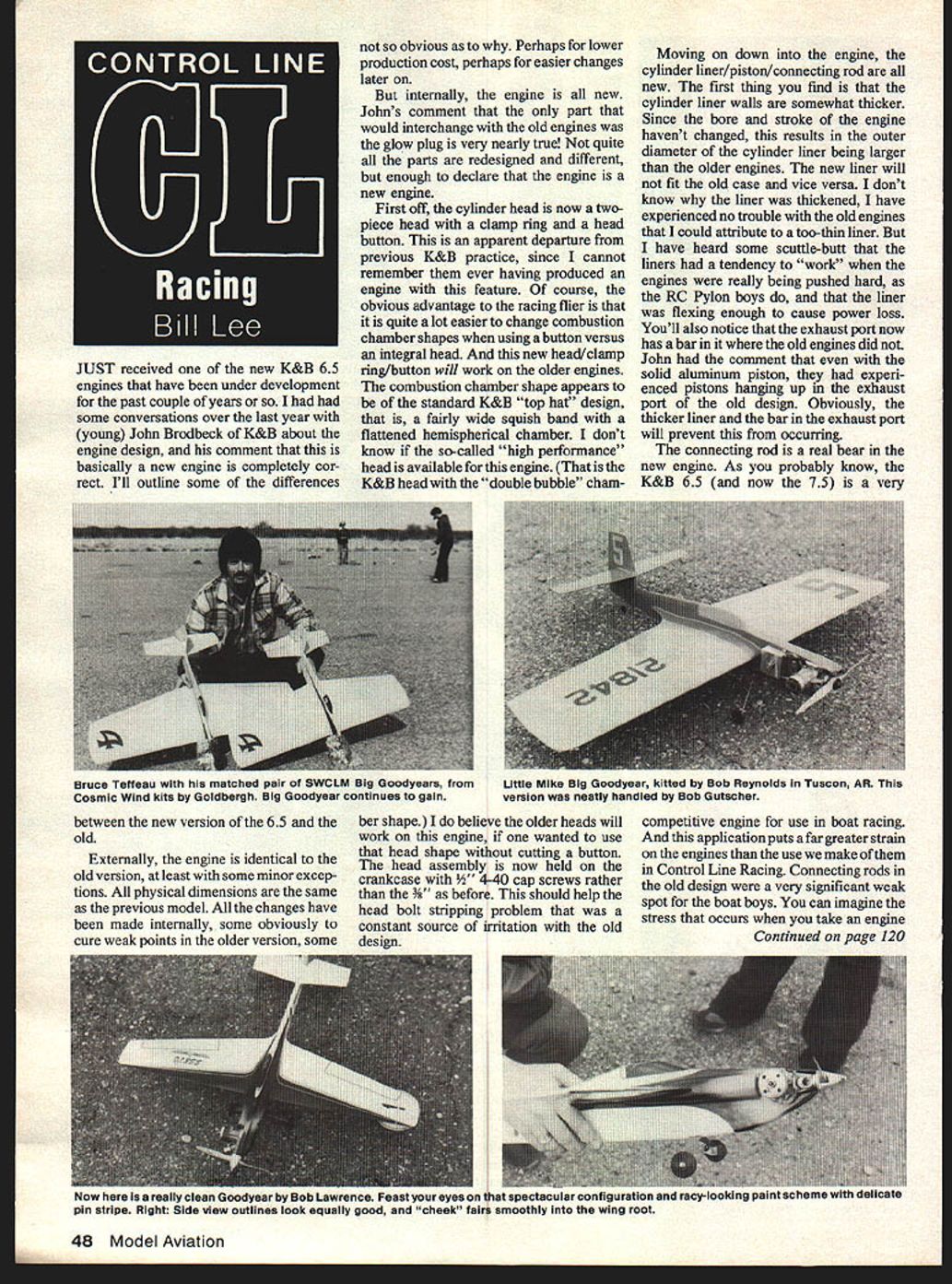
CONTROL LINE: Racing
Bill Lee
I just received one of the new K&B .049 6.5 engines that have been under development for the past couple of years or so. I had had some conversations over the last year with (young) John Brodbeck of K&B about the engine design, and his comment that this is basically a new engine is completely correct. I'll outline some of the differences between the new version of the 6.5 and the old.
Externally, the engine is identical to the old version, at least with some minor exceptions. All physical dimensions are the same as the previous model. All the changes have been made internally, some obviously to cure weak points in the older version, some not so obvious as to why. Perhaps for lower production cost, perhaps for easier changes later on.
But internally, the engine is all new. John's comment that the only part that would interchange with the old engines was the glow plug is very nearly true. Not all the parts are redesigned and different, but enough to declare that the engine is a new engine.
First off, the cylinder head is now a two-piece head with a clamp ring and a head button. This is an apparent departure from previous K&B practice, since I cannot remember them ever having produced an engine with this feature. Of course, the obvious advantage to the racing flier is that it is quite a lot easier to change combustion chamber shapes when using a button versus an integral head. This new head/clamp ring/button will work on the older engines. The combustion chamber shape appears to be of the standard K&B "top hat" design, that is, a fairly wide squish band with a flattened hemispherical chamber. I don't know if the so-called "high performance" head is available for this engine (that is the K&B head with the "double bubble" chamber shape). I do believe the older heads will work on this engine if one wanted to use that head shape without cutting a button.
The head assembly is now held on the crankcase with 1/4-40 cap screws rather than the 3/16" screws used before. This should help the head-bolt stripping problem that was a constant source of irritation with the old design.
Moving on down into the engine, the cylinder liner, piston, and connecting rod are all new. The first thing you find is that the cylinder liner walls are somewhat thicker. Since the bore and stroke of the engine haven't changed, the result is the outer diameter of the cylinder liner being larger than the older engines. The new liner will not fit the old case and vice versa. I don't know why the liner was thickened; I have experienced no trouble with the old engines that I could attribute to a too-thin liner. But I have heard some scuttlebutt that the liners had a tendency to "work" when the engines were really being pushed hard, as the RC pylon boys do, and that the liner was flexing enough to cause power loss. You'll also notice that the exhaust port now has a bar in it where the old engines did not. John commented that even with the solid aluminum piston they had experienced pistons hanging up in the exhaust port of the old design. Obviously, the thicker liner and the bar in the exhaust port will prevent this from occurring.
The connecting rod is a real bear in the new engine. As you probably know, the K&B 6.5 (and now the 7.5) is a very competitive engine for use in boat racing. This application puts a far greater strain on the engines than the use we make of them in control line racing. Connecting rods in the old design were a very significant weak spot for the boat boys. You can imagine the stress that occurs when you take an engine running well over 25,000 rpm and dump it in the water! Instant destruction. The new rod is much stronger than the old one. It is machined out of 7075-T6 aluminum and has very nearly double the cross-sectional area of the old rod. And it's longer between centers than the old rod, too—right at 0.050". What this means is that the case has had to have some milling done in the ports on each side of the engine so that the rod will clear. And the longer rod means that the piston wrist pin is placed closer to the top of the piston. All this means that the engine with the longer rod has less side thrust on the piston as it is running, as well as a lower piston speed for the same rpm. This has to translate into more horsepower, even if only slightly.
One of the few places in the old engine where I experienced any problem was the rear rotor assembly. The old engine had an aluminum rotor running on a steel rotor pin against a chromed aluminum backplate. The rotor was milled out on the back side for balance purposes so that only a small portion of it actually rubbed against the backplate. Due to the pressure fluctuations in the crankcase the rotor was pressed tightly against the backplate only during a portion of the rotation, during the remaining portion being allowed to basically float free. When it was pressed tightly against the backplate, it would wear on the side opposite from the intake cut-out. Usually this wear was slight and didn't seem to affect engine performance until it suddenly stopped working all at once, usually in the middle of the finals somewhere. You had to keep a close eye on the backplate/rotor assemblies in the old engines.
The new engine appears to have fixed that problem. The rotor is steel and is chrome plated, running against the aluminum backplate. This should effectively stop the wear experienced in the old engines. The nice part is this assembly will work in the old engines.
The crankshaft and front end are modified, too. The crank has been enlarged from just behind the front bearing clear to the back. Where before it was a nominal 0.375", it is now 0.467". This will obviously make the crank virtually unbreakable, although this is not a problem I have encountered with the older versions of the engine.
The front end housing has been modified slightly with a flat spot milled on the top of the rear bearing housing, and an oil hole drilled from there through into the area immediately in front of the rear bearing. Improved lubrication is the reason. The new front end and crankshaft will fit the older engines, but ONLY as a complete assembly.
My initial impressions of the new engine are that a very good engine has been made even better. I've been running K&B engines in my Rats ever since I've been flying and the new 6.5 is where I'll be in the future!
Mouse Race at the NATS:
All the Mouse racers who are planning on being at the Nats in Lincoln this summer should plan on bringing their equipment along to fly. Even though Mouse is one of the most popular events in many parts of the country, it is still a provisional event and isn't flown officially at the Nats. But this year, as last, an unofficial Class I Mouse will be flown on Tuesday of Nats' week. It is being sponsored by the Orbiting Eagles of Omaha, Nebraska, with trophies and possibly some merchandise coming from Cox. All this information comes from Vince Mankowski, Vice President of District IX and this year's Nats Control Line Category Director. So all the Mousers should come prepared for the event; perhaps a good showing will convince the Nats officialdom to reinstate this event.
And TR at the NATS:
Bill Wright will be running TR at this year's Nats as he did last year in Lake Charles. Only this year he is working up a new model description form that is somewhat different than previously. He is trying to get it available to be sent to the TR entrants, along with their Nats entry packet. But as we all know, the red tape flows slowly, and this might not be possible. If you are going to try TR at the Nats, you might want to contact Bill at:
Bill Wright 2712 Seminole Dr. Independence, MO 64057
Bill Lee 3522 Tamarisk Lane Missouri City, TX 77459
Transcribed from original scans by AI. Minor OCR errors may remain.

