
Control Line: RACING
Bill Lee
WELL, first off, there is this badly sunburned nose. And then the lips that are so chapped you really do want to keep your mouth shut (no mean feat!). And all this just from a simple weekend of flying model airplanes. Yup, flying in January! In Arizona! At Buckeye, the Southwestern Regionals, where else? I had the chance to go again this year. And it was, as last year, one of the most enjoyable meets around.
This year the competition was even better than last in nearly all the events with a lot better AMA event competition. This meet is of such stature that it is attracting many of the big-name fliers: Gillott, Ballard, and Garner to name three that are really into AMA events, plus those who live in the area who you would expect to be in Buckeye — Shew/Pardue from Albuquerque, Klause and Charlie Johnson from So. California, Russ Brown and Mike Gale from Colorado. Of course, there were a couple of Texas fliers that “showed up,” too.
Saturday — AMA racing events
Saturday was the day that all of the AMA racing events were flown. It was cold! Must have been in the low forties in the early morning. Last year it was cold, too, and I spent a miserable half hour trying to start my ABC engines the first time to get them warm before the racing started. This year, I was smart! On the way from the motel to the field, I put the Rat Racer up on the engine cover inside the van and let the heater blow on it. When I got to the field, the engine was toasty warm and it gave instant starts.
Rat was first off, so it was a good thing I did warm it up, since I was scheduled in the first heat. Ballard was flying for me and we proceeded to turn in a 4:58 or so. Not a terribly good time, but one that was to stand up for a win when all the others broke or had strange misfortune befall them. Ballard put up a practice flight only to lose an elevator on landing due to the poor flying surface and no tail skid. Tim Gillott had the roll pin in the front end of his K&B slide out, contacting the pan, and feeding a steady diet of shaved magnesium to his motor. Instant plug burn-out. And so on. The Texans got lucky in that one.
Next off was Goodyear. Tim Gillott got up in a real quick race against Les Pardue’s Cox-powered entry. Both were running in the mid-15s, quite surprising since Tim had been running 15-flat or below just a few minutes earlier in practice. When the race was over, Tim called me over to show me what the problem was. It seems a large splinter of the balsa wood stick Tim uses to start his motor had flown off during the start and had lodged in the venturi, seriously limiting the engine’s breathing. Damn, the racing luck! I’ll bet he couldn’t do that again in a hundred years.
I was up in a later heat and was running quite strong, having the luck of a single flight when Vic Garner couldn’t get his Rossi-powered Stardust to run right. I was using a new engine for Buckeye, an “AD” engine. This is the engine that is being produced in very limited quantities in Italy and was the engine that powered the winning FAI free flight model at the last FF World Champs in Taft this past fall. Al Kelly (of prop fame) had one that he wanted to try out in some high-nitro, long-duration event, such as Goodyear, so he lent me the engine to use. It was running very well, but at lap 138, it just quit, like the shutoff had been tripped. Ballard, who was flying for me, tried to get the last two laps on his own, but came up 1½ lap short. I had to go carry the model for the last 1½ laps. Needless to say, it was not a very spectacular time.
As it turned out, the engine had eaten the rear bearing retainer, enough metal going through the engine to completely strip all of the plug element out of the engine and causing it to quit abruptly two laps from the end of the race. Oh, well, my share of bad racing luck.
Ballard was up in the final heat, ably pitted by a pick-up crew from Texas. He did good enough to get a win at something like a 6:05 time.
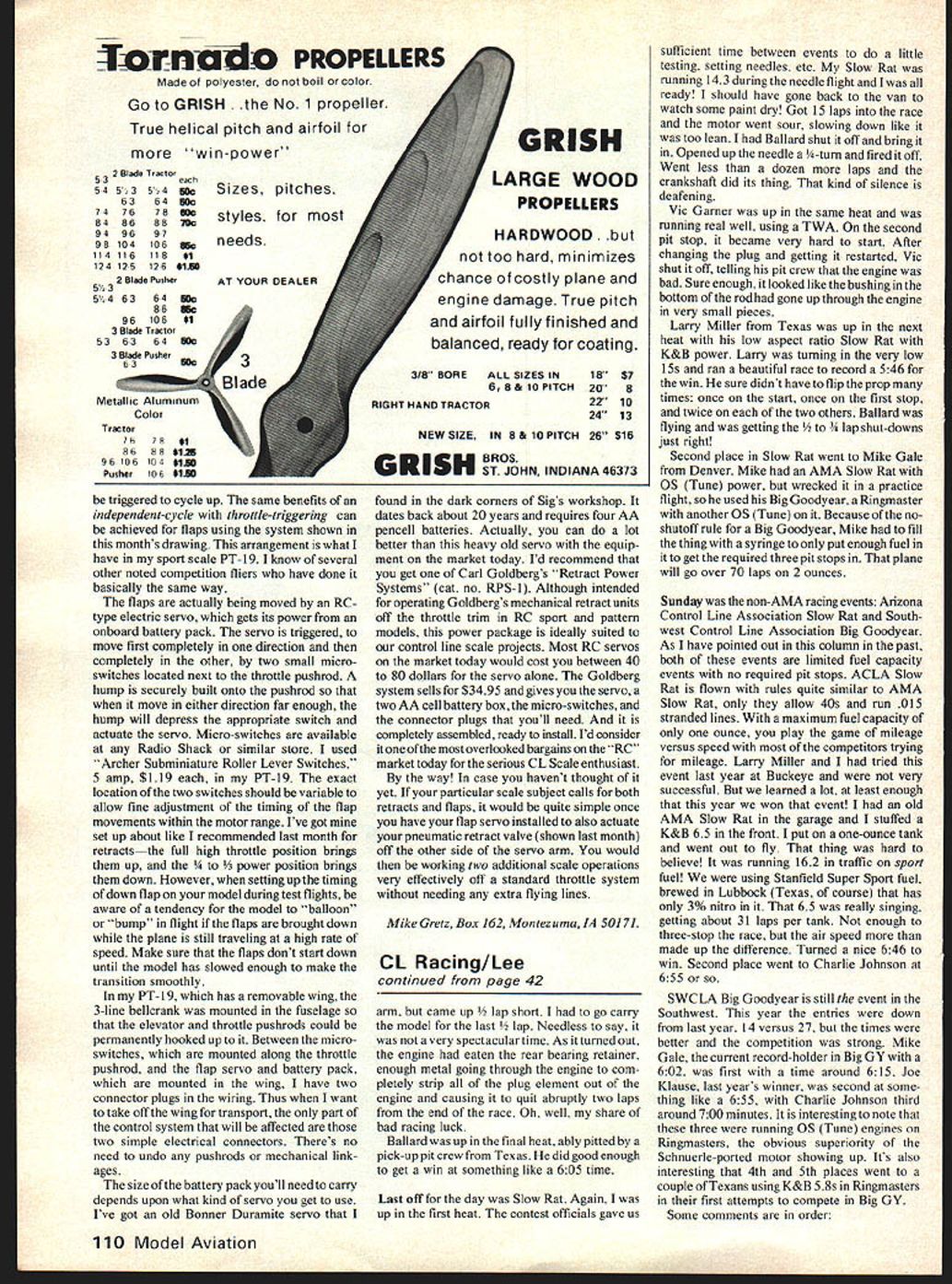
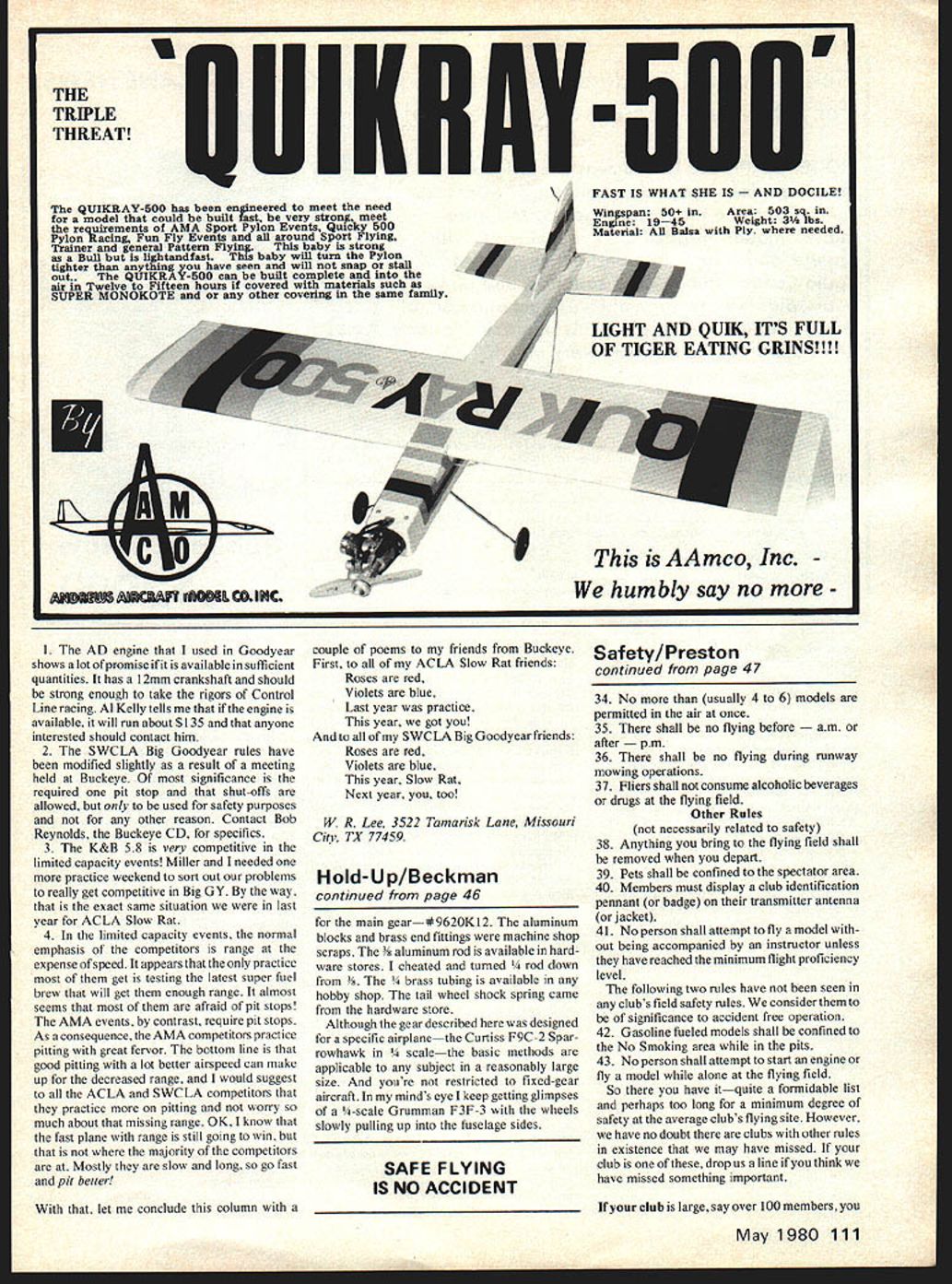
Last off for the day was Slow Rat. Again, I was up in the first heat. The contest officials gave us sufficient time between events to do a little testing, setting needles, etc. My Slow Rat was running 14.3 during the needle flight and I was all ready! I should have gone back to the van to watch some paint dry! Got 15 laps into the race and the motor went sour, slowing down like it was too lean. I had Ballard shut it off and bring it in. Opened up the needle 1/4-turn and fired it off. Went less than a dozen more laps and the crankshaft did its thing. That kind of silence is deafening.
Vic Garner was up in the same heat and was running real well, using a TWA. On the second pit stop, it became very hard to start. After changing the plug and getting it restarted, Vic shut it off, telling his pit crew that the engine was bad. Sure enough, it looked like the bushing in the bottom of the rod had gone up through the engine in very small pieces.
Larry Miller from Texas was up in the next heat with his low aspect ratio Slow Rat with K&B power. Larry was turning in the very low 15s and ran a beautiful race to record a 5:46 for the win. He sure didn't have to flip the prop many times: once on the start, once on the first stop, and twice on each of the two others. Ballard was flying and was getting the 1/2 to 3/4 lap shut-downs just right!
Second place in Slow Rat went to Mike Gale from Denver. Mike had an AMA Slow Rat with OS (Tune) power, but wrecked it in a practice flight, so he used his Big Goodyear — a Ringmaster with another OS (Tune) on it. Because of the no-shutoff rule for a Big Goodyear, Mike had to fill the thing with a syringe to only put enough fuel in it to get the required three pit stops in. That plane will go over 70 laps on 2 ounces.
Sunday — Non-AMA racing events
Sunday was the non-AMA racing events: Arizona Control Line Association (ACLA) Slow Rat and Southwest Control Line Association (SWCLA) Big Goodyear. As I have pointed out in this column in the past, both of these events are limited-fuel-capacity events with no required pit stops. ACLA Slow Rat is flown with rules quite similar to AMA Slow Rat, only they allow .040s and run .015 stranded lines. With a maximum fuel capacity of only one ounce, you play the game of mileage versus speed with most of the competitors trying for mileage.
Larry Miller and I had tried this event last year at Buckeye and were not very successful. But we learned a lot, and with less fuel this year we won that event! I had an old AMA Slow Rat in the garage and I stuffed a K&B .6 in the front. I put on a one-ounce tank and went out to fly. That thing was hard to get going! I was running 16.2 in the traffic for speed fuel! We were using Stanfield Super Sport fuel, only 3% nitro in it. That .6 was really singing. I got about 31 laps per tank. Not enough to three-stop the race, but the air speed made up for the lack of laps. It was an interesting race. I ran a time of 6:46 to win. Second place went to Charlie Johnson at 6:55 or so.
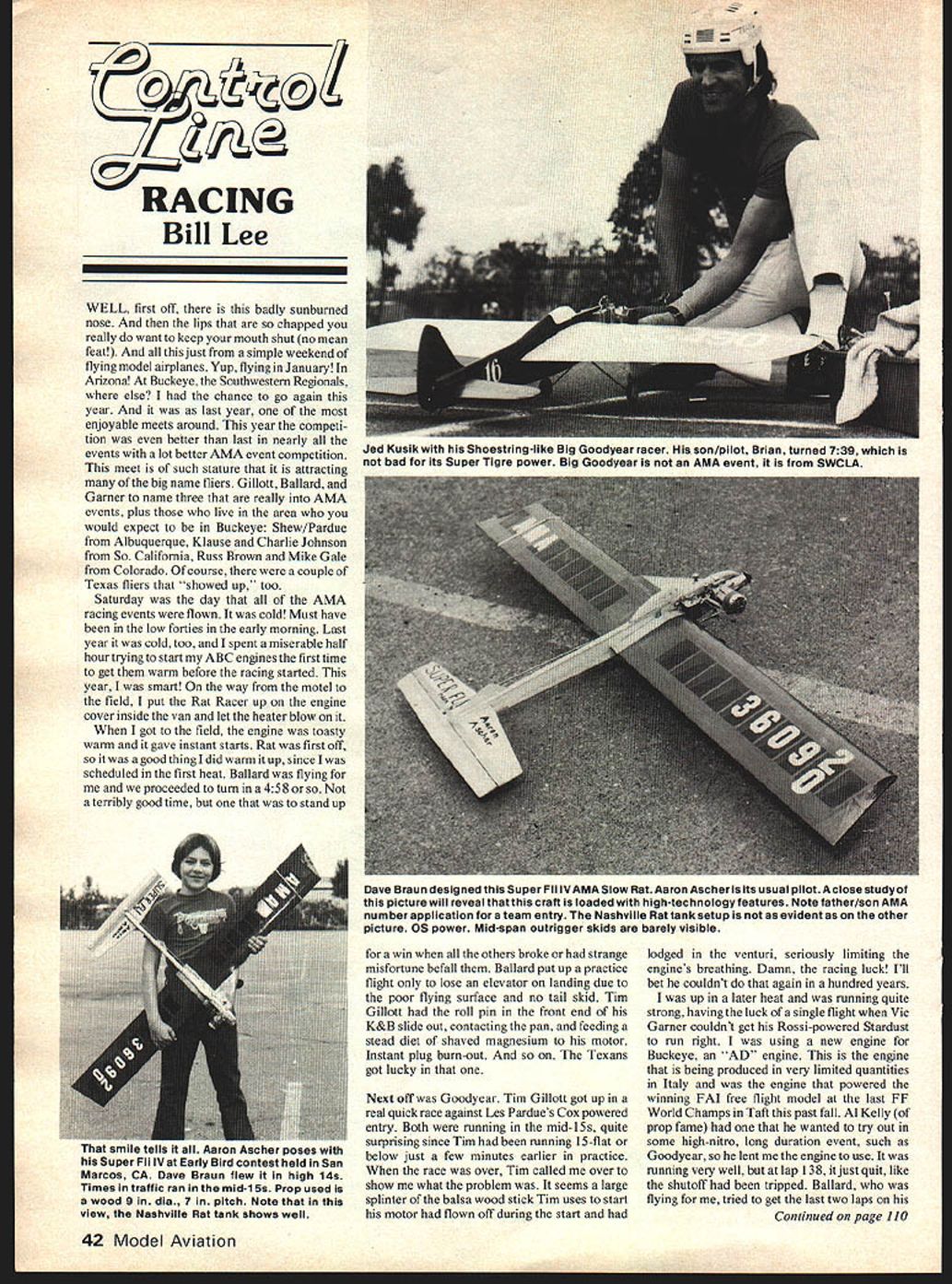
SWCLA Big Goodyear is still the event in the Southwest. This year the entries were down a little from last year, 14 versus 27, but the competition was better and the times were faster than in the past. Mike Gale, the current record-holder in Big GY with a 6:02, was first with a time around 6:15. Joe Klause, last year's winner, was second at something like a 6:35, with Charlie Johnson third at around 7:00 minutes. It is interesting to note that three of the top five finishers were running OS (Tune) engines on Ringmasters. The obvious superiority of the Schnuerle-port rotary valve on these little engines is apparent. Also interesting that 4th and 5th places went to a couple of Texans using K&B 5.8s in Ringmasters in their first attempts to compete in Big GY.
Notes and comments
- The AD engine that I used in Goodyear shows a lot of promise if it is available in sufficient quantities. It has a 12mm crankshaft and should be strong enough to take the rigors of Control Line racing. Al Kelly tells me that if the engine is available, it will run about $135 and that anyone interested should contact him.
- The SWCLA Big Goodyear rules have been modified slightly as a result of a meeting held at Buckeye. Of most significance is the required one pit stop and that shut-offs are allowed, but only to be used for safety purposes and not for any other reason. Contact Bob Reynolds, the Buckeye CD, for specifics.
- The K&B 5.8 is very competitive in the limited-capacity events! Miller and I needed one more practice weekend to sort out our problems to really get competitive in Big GY. By the way, that is the exact same situation we were in last year for ACLA Slow Rat.
- In the limited-capacity events, the normal emphasis of the competitors is range at the expense of speed. It appears that the only practice most of them get is testing the latest super-fuel brew that will get them enough range. It almost seems that most of them are afraid of pit stops! The AMA events, by contrast, require pit stops. As a consequence, the AMA competitors practice pitting with great fervor. The bottom line is that good pitting with a lot better airspeed can make up for the decreased range, and I would suggest to all the ACLA and SWCLA competitors that they practice more on pitting and not worry so much about that missing range. OK, I know that a fast plane with range is still going to win, but that is not where the majority of the competitors are at. Mostly they are slow and long, so go fast and pit better!
Poems
First, to all of my ACLA Slow Rat friends: Roses are red, Violets are blue, Last year was practice, This year, we got you!
And to all of my SWCLA Big Goodyear friends: Roses are red, Violets are blue, This year, Slow Rat, Next year, you, too!
W. R. Lee, 3522 Tamarisk Lane, Missouri City, TX 77459.
Transcribed from original scans by AI. Minor OCR errors may remain.

