
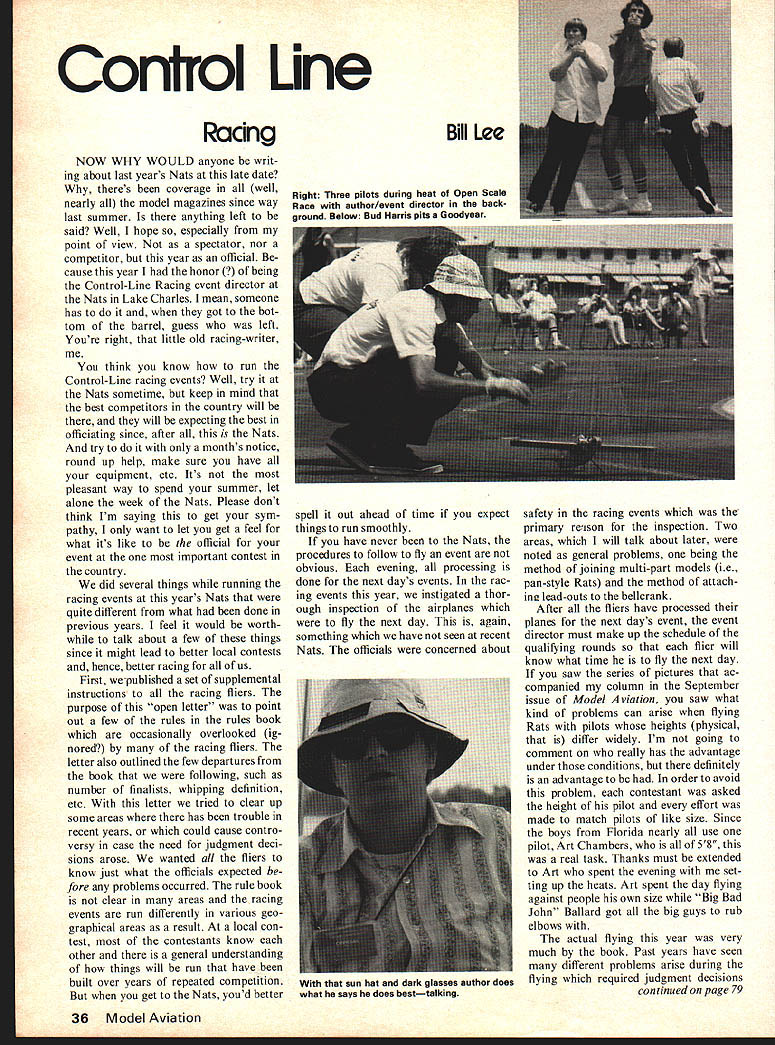
Control Line: Racing
Bill Lee
NOW WHY WOULD anyone be writing about last year's Nats at this late date? Why, there's been coverage in all (well, nearly all) the model magazines since way last summer. Is there anything left to be said? Well, I hope so, especially from my point of view. Not as a spectator, nor a competitor, but this year as an official. Because this year I had the honor (?) of being the Control-Line Racing event director at the Nats in Lake Charles. I mean, someone has to do it and, when they got to the bottom of the barrel, guess who was left. You're right, that little old racing-writer, me.
You think you know how to run the Control-Line racing events? Well, try it at the Nats sometime, but keep in mind that the best competitors in the country will be there, and they will be expecting the best in officiating since, after all, this is the Nats. And try to do it with only a month's notice, round up help, make sure you have all your equipment, etc. It's not the most pleasant way to spend your summer, let alone the week of the Nats. Please don't think I'm saying this to get your sympathy. I only want to let you get a feel for what it's like to be the official for your event at the most important contest in the country.
We did several things while running the racing events at this year's Nats that were quite different from what had been done in previous years. I feel it would be worthwhile to talk about a few of these things since it might lead to better local contests and, hence, better racing for all of us.
First, we published a set of supplemental instructions in the racing fliers. The purpose of this "open letter" was to point out a few of the rules in the rule book which are occasionally overlooked (ignored?) by many of the racing fliers. The letter also outlined the few departures from the book that we were following, such as number of finalists, whipping definition, etc. With this letter we tried to clear up some areas where there has been trouble in recent years, or which could cause controversy in case the need for judgment decisions arose. We wanted all the fliers to know just what the officials expected before any problems occurred. The rule book is not clear in many areas and the racing events are run differently in various geographical areas as a result. At a local contest, most of the contestants know each other and there is a general understanding of how things will be run that have been built over years of repeated competition. But when you get to the Nats, you'd better spell it out ahead of time if you expect things to run smoothly.
If you have never been to the Nats, the procedures to follow to fly an event are not obvious. Each evening, all processing is done for the next day's events. In the racing events this year, we instigated a thorough inspection of the airplanes which were to fly the next day. This is, again, something which we have not seen at recent Nats. The officials were concerned about safety in the racing events which was the primary reason for the inspection. Two areas, which I will talk about later, were noted as general problems, one being the method of joining multi-part models (i.e., pan-style Rats) and the method of attaching lead-outs to the bellcrank.
After all the fliers have processed their planes for the next day's event, the event director must make up the schedule of the qualifying rounds so that each flier will know what time he is to fly the next day. If you saw the series of pictures that accompanied my column in the September issue of Model Aviation, you saw what kind of problems can arise when flying Rats with pilots whose heights (physical, that is) differ widely. I'm not going to comment on who really has the advantage under those conditions, but there definitely is an advantage to be had. In order to avoid this problem, each contestant was asked the height of his pilot and every effort was made to match pilots of like size. Since the boys from Florida nearly all use one pilot, Art Chambers, who is all of 5'8", this was a real task. Thanks must be extended to Art who spent the evening with me setting up the heats. Art spent the day flying against people his own size while "Big Bad John" Ballard got all the big guys to rub elbows with.
The actual flying this year was very much by the book. Past years have seen many different problems arise during the flying which required judgment decisions. Inherent in any judgment decision is the big gray area where the official has to make his call. If you don't agree with the decision, you may be entirely correct because of the very nature of a judgment; it can't be black-and-white. Fortunately, many of the problems of previous years can be overcome with a little advance planning.
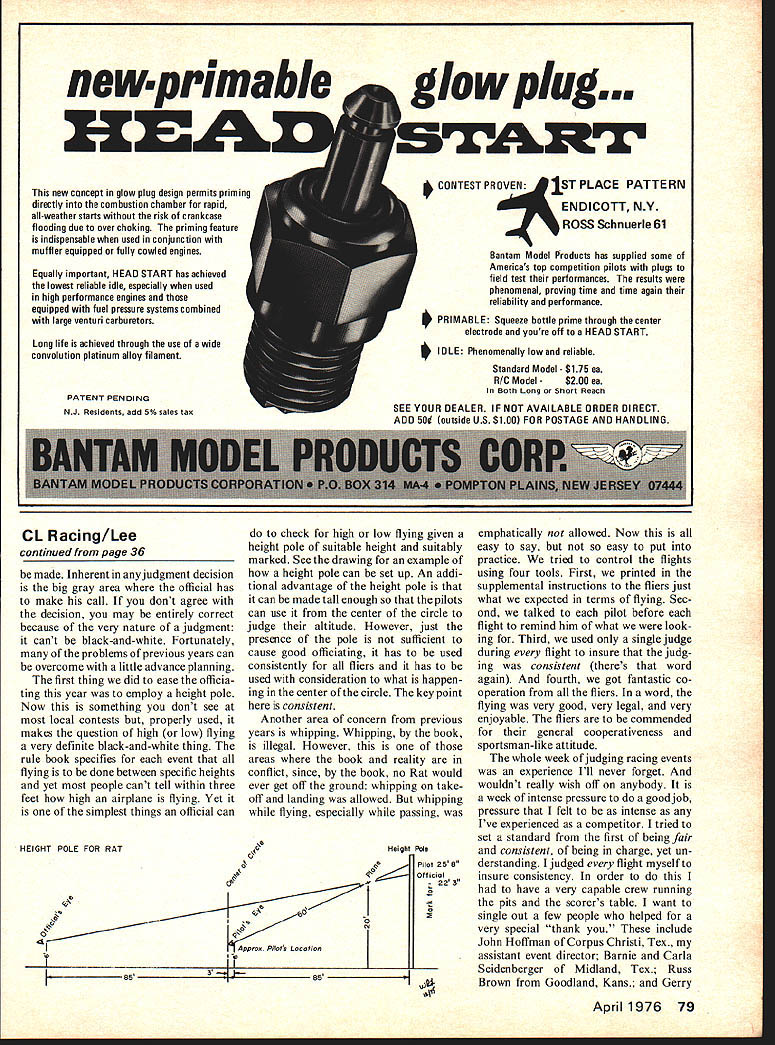
The first thing we did to ease the officiating this year was to employ a height pole. Now this is something you don't see at most local contests but, properly used, it makes the question of high (or low) flying a very definite black-and-white thing. The rule book specifies for each event that all flying is to be done between specific heights and yet most people can't tell within three feet whether or not an airplane is flying. Yet it is one of the simplest things an official can do to check for high or low flying given a height pole of suitable height and suitably marked. See the drawing for an example of how a height pole can be set up. An additional advantage of the height pole is that it can be made tall enough so that the pilots can use it from the center of the circle to judge their altitude. However, just the presence of the pole is not sufficient to cause good officiating; it has to be used consistently for all fliers and it has to be used with consideration to what is happening in the center of the circle. The key point here is consistent.
Another area of concern from previous years is whipping. Whipping, by the book, is illegal. However, this is one of those areas where the book and reality are in conflict, since, by the book, no Rat would ever get off the ground: whipping on takeoff and landing was allowed. But whipping while flying, especially while passing, was emphatically not allowed. Now this is all easy to say, but not so easy to put into practice. We tried to control the flights using four tools. First, we printed in the supplemental instructions to the fliers just what we expected in terms of flying. Second, we talked to each pilot before each flight to remind him of what we were looking for. Third, we used only a single judge during every flight to insure that the judging was consistent (there's that word again). And fourth, we got fantastic cooperation from all the fliers. In a word, the flying was very good, very legal, and very enjoyable. The fliers are to be commended for their general cooperativeness and sportsman-like attitude.
The whole week of judging racing events was an experience I'll never forget. And I wouldn't really wish it off on anybody. It is a week of intense pressure to do a good job, pressure that I felt to be as intense as any I've experienced as a competitor. I tried to set a standard from the first of being fair and consistent. In order to do this I had to have a very capable crew running the pits and the scorer's table. I want to single out a few people who were very special "thank you." These include John Hoffman of Corpus Christi, Tex.; my assistant event director; Barnie and Carla Seidenberger of Midland, Tex.; Russ Brown from Goodland, Kans.; and Gerry Deneau from Denver, Colo.
Safety Inspection Problems: The AMA rules book is quite explicit with regard to the method of joining multi-part (pan-style) models. Yet, there were several Rats presented for processing which needed modification before they were allowed to compete. When you bolt together a pan-type Rat the bolts must pass through a reinforced section of both the pan and the top and the bolts must be supported for their entire length. This means you must not allow the bolts to flop around loose inside the top; they have to run through a reinforced section which can be wood, heavily fiberglassed brass tubing, something! This one item seems so obvious to me, I really don't understand why a Rat would be built without proper hold-down bolt installation. There isn't any good excuse for not doing it right. Look in the rules book in the speed section for some examples of how to build this portion of your model.
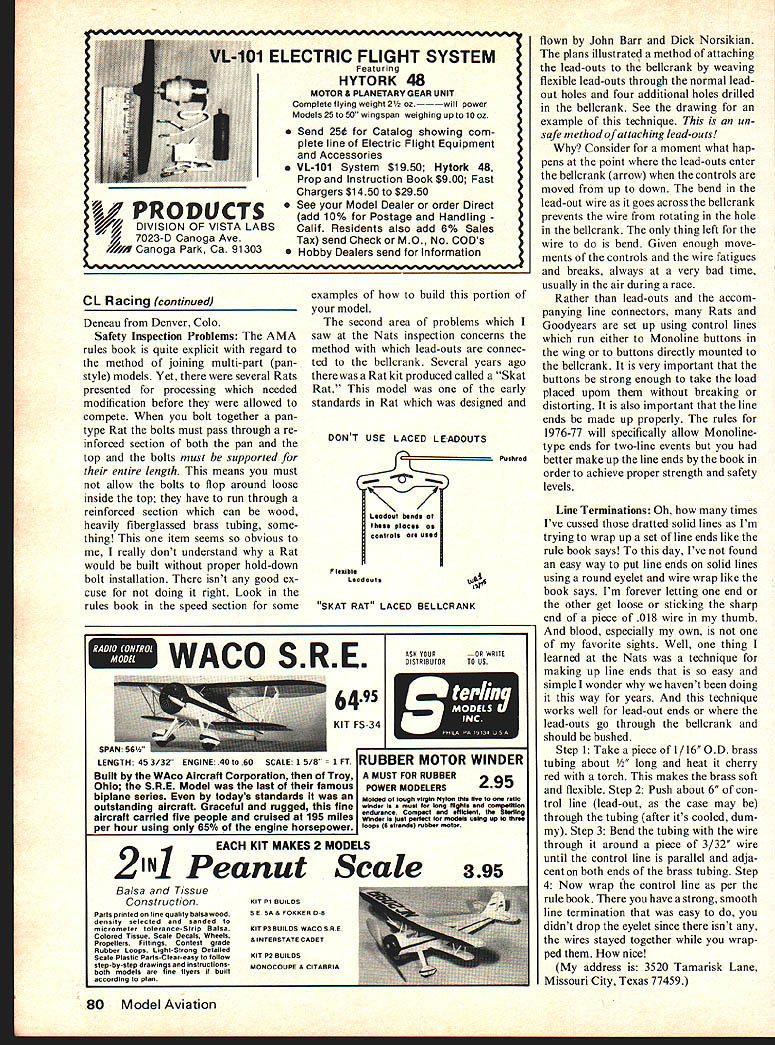
The second area of problems which I saw at the Nats inspection concerns the method with which lead-outs are connected to the bellcrank. Several years ago there was a Rat kit produced called a "Skat Rat." This model was one of the early standards in Rat which was designed and flown by John Barr and Dick Norsikian. The plans illustrated a method of attaching the lead-outs to the bellcrank by weaving flexible lead-outs through the normal lead-out holes and four additional holes drilled in the bellcrank. See the drawing for an example of this technique. This is an unsafe method of attaching lead-outs!
Why? Consider for a moment what happens at the point where the lead-outs enter the bellcrank (arrow) when the controls are moved from up to down. The bend in the lead-out wire as it goes across the bellcrank prevents the wire from rotating in the hole in the bellcrank. The only thing left for the wire to do is bend. Given enough movement of the controls and the wire fatigues and breaks, always at a very bad time, usually in the air during a race.
Rather than lead-outs and the accompanying liner connectors, many Rats and Goodyears are set up using control lines which run either to Monoline buttons in the wing or to buttons directly mounted to the bellcrank. It is very important that the buttons be strong enough to take the load placed upon them without breaking or distorting. It is also important that the line ends be made up properly. The rules for 1976-77 will specifically allow Monoline-type ends for two-line events but you had better make up the line ends by the book in order to achieve proper strength and safety levels.
Line Terminations: Oh, how many times I've cussed those darned solid lines as I'm trying to wrap up a set of line ends like the rule book says! To this day, I've not found an easy way to put line ends on solid lines using a round eyelet and wire wrap like the book says. I'm forever letting one end of the other get loose or sticking the sharp end of a piece of .018 wire in my thumb. And blood, especially my own, is not one of my favorite sights. Well, one thing I learned at the Nats was a technique for making up line ends that is so easy and simple I wonder why we haven't been doing it this way for years. And this technique works well for lead-out ends or where the lead-outs go through the bellcrank and should be bushed.
Step 1: Take a piece of 1/16" O.D. brass tubing about 1/8" long and heat it cherry red with a torch. This makes the brass soft and flexible.
Step 2: Push about 6" of control line (lead-out, as the case may be) through the tubing (after it's cooled, dummy).
Step 3: Bend the tubing with the wire through it around a piece of 3/32" wire until the control line is parallel and adjacent on both ends of the brass tubing.
Step 4: Now wrap the control line as per the rule book. Then finish as the book says.
Transcribed from original scans by AI. Minor OCR errors may remain.

