
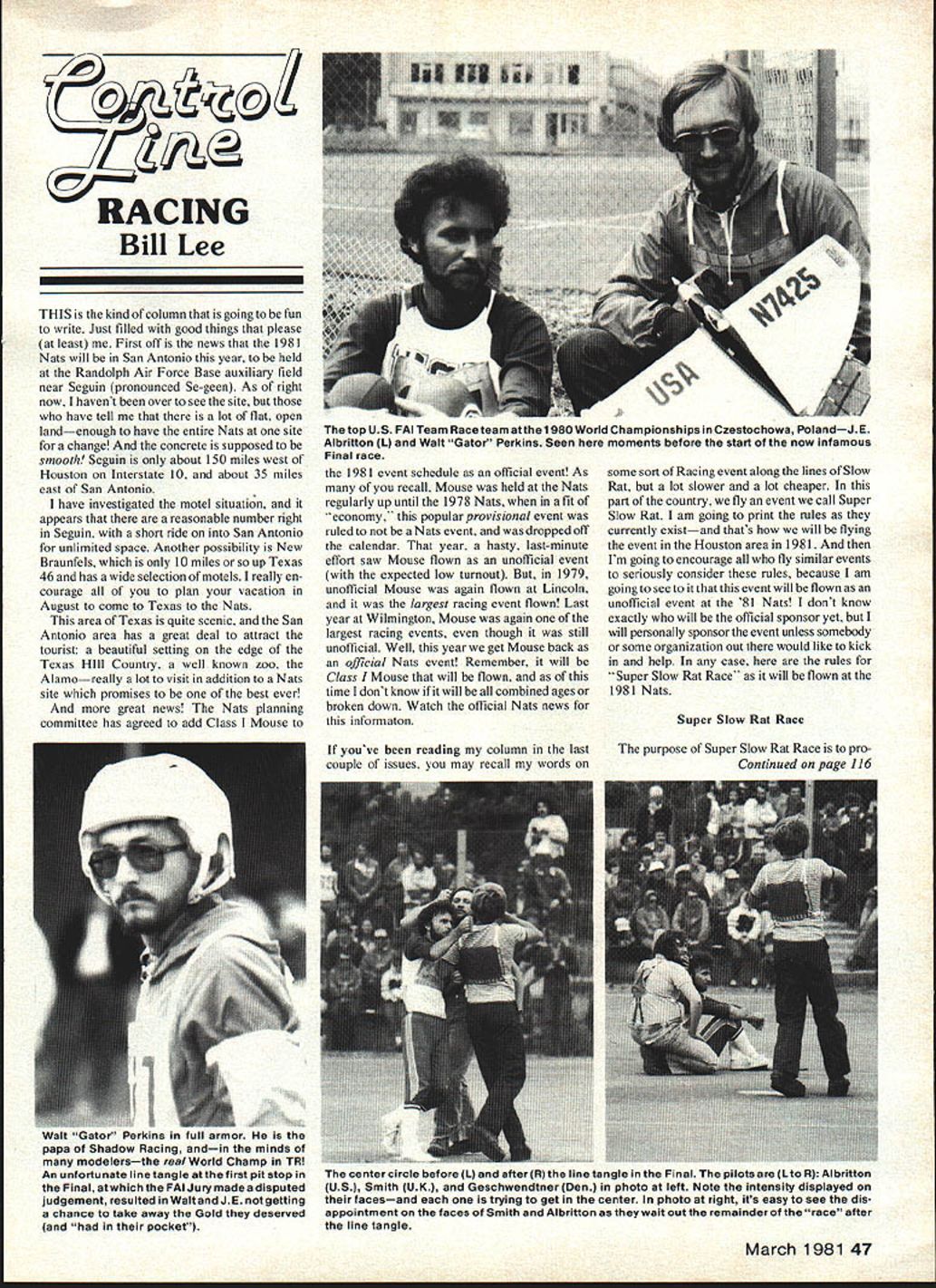
Control Line: Racing
Bill Lee
This is the kind of column that is going to be fun to write — just filled with good things that please (at least) me. First off is the news that the 1981 Nats will be in San Antonio this year, to be held at the Randolph Air Force Base auxiliary field near Seguin (pronounced Se-geen). As of right now, I haven't been over to see the site, but those who have tell me that there is a lot of flat, open land—enough to have the entire Nats at one site for a change! And the concrete is supposed to be smooth! Seguin is only about 150 miles west of Houston on Interstate 10, and about 35 miles east of San Antonio.
I have investigated the motel situation, and it appears that there are a reasonable number right in Seguin, with a short ride on into San Antonio for unlimited space. Another possibility is New Braunfels, which is only 10 miles or so up Texas 46 and has a wide selection of motels. I really encourage all of you to plan your vacation in August to come to Texas to the Nats.
This area of Texas is quite scenic, and the San Antonio area has a great deal to attract the tourist: a beautiful setting on the edge of the Texas Hill Country, a well-known zoo, the Alamo—really a lot to visit in addition to a Nats site which promises to be one of the best ever!
And more great news! The Nats planning committee has agreed to add Class I Mouse to the 1981 event schedule as an official event. As many of you recall, Mouse was held at the Nats regularly up until the 1978 Nats, when in a fit of "economy," this popular provisional event was ruled to not be a Nats event and was dropped off the calendar. That year, a hasty, last-minute effort saw Mouse flown as an unofficial event (with the expected low turnout). But, in 1979, unofficial Mouse was again flown at Lincoln, and it was the largest racing event flown! Last year at Wilmington, Mouse was again one of the largest racing events, even though it was still unofficial. Well, this year we get Mouse back as an official Nats event! Remember, it will be Class I Mouse that will be flown, and as of this time I don't know if it will be all combined ages or broken down. Watch the official Nats news for this information.
If you've been reading my column in the last couple of issues, you may recall my words on some sort of racing event along the lines of Slow Rat, but a lot slower and a lot cheaper. In this part of the country, we fly an event we call Super Slow Rat. I am going to print the rules as they currently exist—and that's how we will be flying the event in the Houston area in 1981. Then I'm going to encourage all who fly similar events to seriously consider these rules, because I am going to see to it that this event will be flown as an unofficial event at the '81 Nats! I don't know exactly who will be the official sponsor yet, but I will personally sponsor the event unless somebody or some organization out there would like to kick in and help. In any case, here are the rules for "Super Slow Rat Race" as it will be flown at the 1981 Nats.
Super Slow Rat Race
The purpose of Super Slow Rat Race is to provide a competitive racing event that is at a level of performance that can be reached without great expenditures of time and money.
The event shall be as defined in the AMA Slow Rat Race event with the following additional restrictions:
- The fuel tank will be totally outboard of the center line of the crankshaft.
- No variable-area carburetors allowed.
- Engines shall be limited to .36 cu. in. maximum displacement and must be of the fixed-intake configuration. Only single-bypass-port engines allowed, no Schnuerles, but PDP OK. The engine, as used, shall be, or have been, available through normal U.S. retail outlets in quantities of 100 or more. Modifications shall be limited to catalog-listed parts produced in quantities greater than 100 and available to anyone from the manufacturer of the engine being altered. Engines may be modified only by removing parts or material from parts. The "engine" is defined as the complete unit, ready to run, needing only prop, fuel and starting ignition, except that the glow plug, venturi and/or restrictor, gaskets, bolts, nuts, washers, needle valve and/or assembly, shims, piston rings (if used), and ball bearings (if used) need not be considered as part of the production unit. These parts are not subject to the rules regarding quantity or source. The purpose and intent of this rule is to keep the engine from becoming a home-built, one-of-a-kind engine that is not available to the casual competitor. It is intended to disallow creating engines—even if stock parts are used—that are not generally available to the public. However, it does allow the substitution of later (or earlier, as the case may be) model components, as long as the basic configuration is not changed. The substitution of components on the engine that require any form of machining to make fit is specifically disallowed.
- Control lines shall be .018-in. stranded.
- The fuel for the event shall be supplied by the contest organizer and shall contain no more than 10% nitromethane.
One thing happening now that will be of interest to racing competitors is the combining of several of the CL newsletters into a single publication. This will be put together under the editorial supervision of Doc Jackson and will include the current publications from PAMPA, MACA, CL-RPM, Hi-Lo Landings and Da Gaz. Doc indicates (and surely all other newsletter editors must agree) that the time has come when only one publication is required to keep the growing sport informed and up to date, and that duplication of effort is neither necessary nor productive. After a certain time of being a newsletter, some editors get the urge to "productize" and to start a "magazine" and then you have a proliferation of publications that none can fully support.
Doc has approached the other special interest groups and found a willingness to throw in together for publication purposes. This federated group will be called the "National Control Line Coalition," and the publication will be called Control Line Gazette. The Gazette will be comprised of copy from each of the previously mentioned groups and will be sent to any member of one of those organizations. If you are interested, stick with your current special interest group: PAMPA, CL-RPM, MACA, and the Carrier Society. If you need access to the new publication, Doc's address is:
Dr. Laird Jackson 2322 Wilson Avenue Bristol, PA 19007
W. R. Lee 3522 Tamarisk Lane Missouri City, TX 77549
Transcribed from original scans by AI. Minor OCR errors may remain.

