
Control Line: Racing
Bill Lee
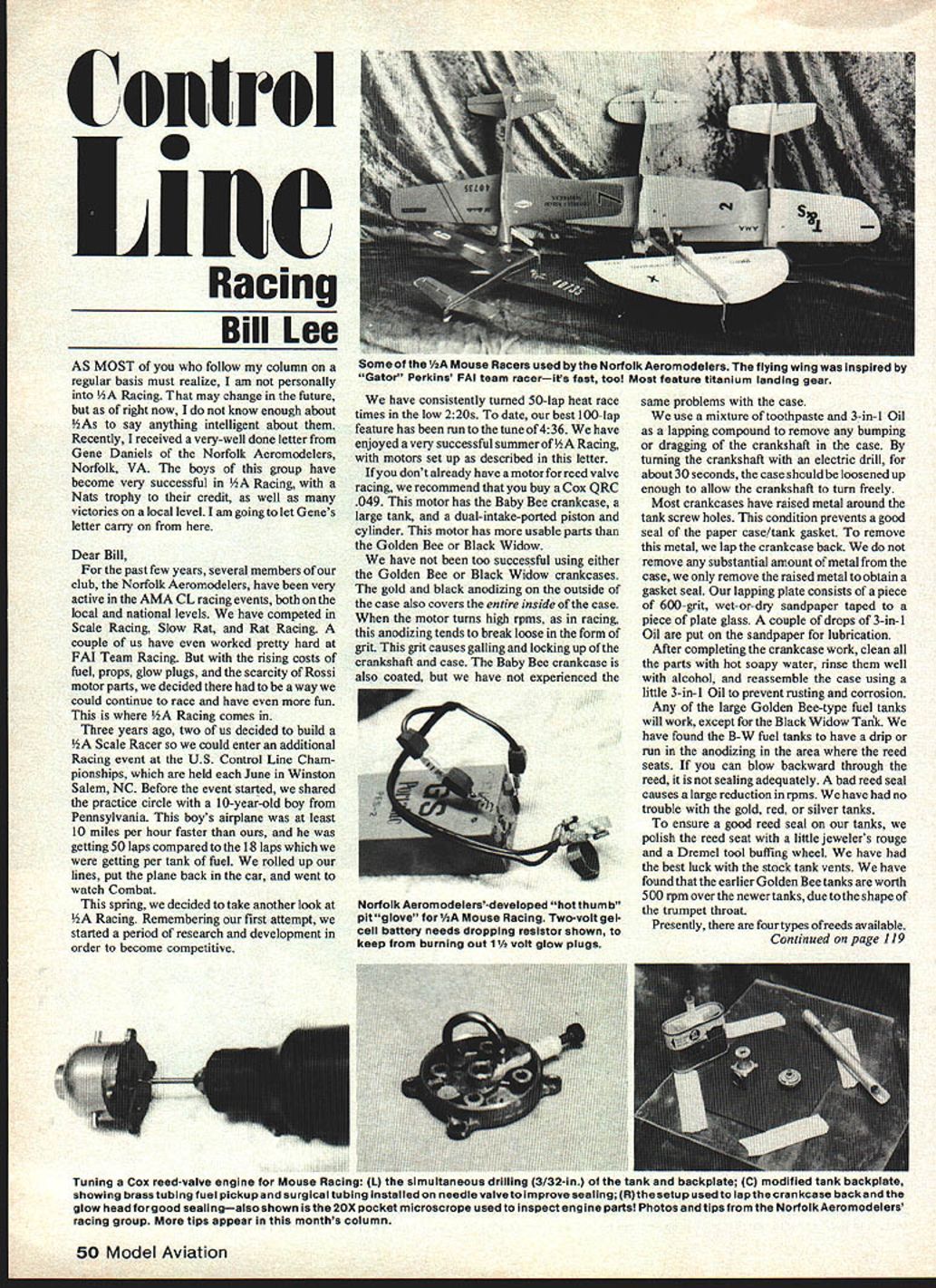
As most of you who follow my column on a regular basis must realize, I am not personally into 1/2A racing. That may change in the future, but as of right now I do not know enough about 1/2A to say anything intelligent about them. Recently I received a very well-done letter from Gene Daniels of the Norfolk Aeromodelers, Norfolk, VA. The boys of this group have become very successful in 1/2A racing, with a Nats trophy to their credit, as well as many victories on a local level. I am going to let Gene's letter carry on from here.
Letter from Gene Daniels
Dear Bill,
For the past few years several members of our club, the Norfolk Aeromodelers, have been very active in the AMA C/L racing events, both on the local and national levels. We have competed in Scale Racing, Slow Rat, and Rat Racing. A couple of us have even worked pretty hard at FAI Team Racing. But with the rising costs of fuel, props, glow plugs, and the scarcity of Rossi motor parts, we decided there had to be a way we could continue to race and have even more fun. This is where 1/2A racing comes in.
Three years ago two of us decided to build a 1/2A scale racer so we could enter an additional racing event at the U.S. Control Line Championships, held each June in Winston-Salem, N.C. Before the event started we shared the practice circle with a 10-year-old boy from Pennsylvania. This boy's airplane was at least 10 mph faster than ours, and he was getting 50 laps compared to the 18 laps we were getting per tank of fuel. We rolled up our lines, put the plane back in the car, and went to watch Combat.
This spring we decided to take another look at 1/2A racing. Remembering our first attempt, we started a period of research and development in order to become competitive.
We have consistently turned 50-lap heat race times in the low 2:20s. To date our best 100-lap feature has been run in 4:36. We have enjoyed a very successful summer of 1/2A racing, with motors set up as described below.
Motor recommendation and crankcase work
If you don't already have a motor for reed-valve racing, we recommend that you buy a Cox QRC .049. This motor has the Baby Bee crankcase, a large tank, and a dual-intake-ported piston and cylinder. This motor has more usable parts than the Golden Bee or Black Widow.
We have not been too successful using either the Golden Bee or Black Widow crankcases. The gold and black anodizing on the outside of the case also covers the entire inside of the case. When the motor turns high RPMs, as in racing, this anodizing tends to break loose in the form of grit. This grit causes galling and locking up of the crankshaft in the case. The Baby Bee crankcase is also coated, but we have not experienced the same problems with that case.
We use a mixture of toothpaste and 3-in-One oil as a lapping compound to remove any bumping or dragging of the crankshaft in the case. By turning the crankshaft with an electric drill for about 30 seconds, the case should be loosened up enough to allow the crankshaft to turn freely.
Most crankcases have raised metal around the tank screw holes. This condition prevents a good seal of the paper case/tank gasket. To remove this metal we lap the crankcase back. We do not remove any substantial amount of metal from the case; we only remove the raised metal to obtain a gasket seal. Our lapping plate consists of a piece of 600-grit wet-or-dry sandpaper taped to a piece of plate glass. A couple of drops of 3-in-One oil are put on the sandpaper for lubrication.
After completing the crankcase work, clean all the parts with hot soapy water, rinse them well with alcohol, and reassemble the case using a little 3-in-One oil to prevent rusting and corrosion.
Tanks and reed seating
Any of the large Golden Bee–type fuel tanks will work, except for the Black Widow tank. We have found the Black Widow tanks to have a drip or run in the anodizing in the area where the reed seats are. If you can blow backward through the reed, it is not sealing adequately. A bad reed seal causes a large reduction in RPMs. We have had no trouble with the gold, red, or silver tanks.
To ensure a good reed seal on our tanks, we polish the reed seat with a little jeweler's rouge and a Dremel tool buffing wheel. We have found the best luck with the stock tank vents. We have found that the earlier Golden Bee tanks are worth about 500 RPM over the newer tanks, due to the shape of the trumpet throat.
Presently there are four types of reeds available. The two that we have been successful with are the Cox mylar reeds. One is a four-petal reed which looks like the old brass reed. The other reed is sort of oval-shaped and comes in the new RC Bee motors. For us they have worked equally well. We have not tried the Davis Diesel Teflon reed. The brass reeds would not work for us, as the motor tended to outrun the reed, causing the motor to miss. We also tried to double the brass reeds—without success.
Intake and venturi
For a large increase in RPM, we drill the venturi to 3/32 inch. After removing the reed, reed retainer, and the wire screen in the backplate (if it has one), we hold the backplate and tank together and drill through both pieces at the same time. If you are using an older backplate, we recommend that you replace the wire screen to keep rocks and trash out of the motor.
One of the biggest problems with reed-valve motors is that the fuel pickup tube tends to get knocked out of position. To prevent this from happening, we bend a replacement pickup out of 3/32-inch brass tubing. This tube is attached to the backplate nipple by using a 1/4-inch piece of small Perfect brand fuel tubing as a coupler. An alternative to the metal pickup tube would be the use of a plastic one which is already fuel-hardened, with the internal spring removed.
The gasket seal between the backplate and tank is important. Compression tends to flatten the black rubber gasket. This gasket should be replaced frequently.
Piston, cylinder, and break-in
A dual-intake-ported piston and cylinder is a must for 1/2A racing. We have used the No. 1 (Black Widow) and No. 4 (Tee Dee) cylinders on our motors. The No. 4 seems to be slightly faster than the No. 1. We have had much better luck with our motors when the piston and cylinder are run-in rather than lapped. We run about 10 tanks of fuel in the motor prior to flying. Then, after 10 to 15 flights, the motor is usually broken in well enough to race. Some motors have needed more or less break-in, but the numbers quoted are average for us. We have also tried porting and timing changes on our motors, but have not yet been able to improve on the stock setup.
Glow plugs and gaskets
We run from three to five plug gaskets in our motors. We run no fewer than three gaskets in order to obtain a decent needle valve setting and for ease of starting. We add a gasket or two as required to prevent blowing glow plugs.
We have used the Cox Tee Dee and the Glo Bee racing plugs. The Glo Bee plug is worth about 1,000 RPM over the Tee Dee plug, but the needle valve settings are not reliable. If we want to go for broke, we use the Glo Bee. Otherwise, we use the Tee Dee plug for consistency.
Regardless of which glow plug brand we use, we lap the seating surface of our plugs to obtain a good head seal.
We have tried running our motors with the cylinder turned sideways to reduce wind resistance and improve the looks of our airplane, but our motors tend to run much better with the cylinders turned upright. Another advantage to the upright cylinder is that it saves needle valves during bad landings.
Propellers
The best propeller that we have found for even motor runs is the Top Flite 5-1/4 × 4 nylon. We've tried almost every 1/2A propeller on the market; some have been a little faster, but they required much more work and were not nearly as consistent on needle valve settings.
Fuel
We mix our own fuel with the following ingredients:
- 50% nitromethane
- 10% castor oil
- 10% Klotz synthetic oil
- 30% alcohol
We have used from 40% to 65% nitro, and various propellers.
Racing tips
The keys to winning in any racing event are consistency and practice. The fastest airplane won't win races if the pit stops are poor or the motor won't run for the entire race. Work on the practice circle will pay off well on race day. During practice, the problems which could cause trouble can often be eliminated before the contest. Also, the pilot can become familiar with the airplane so that he can fly a good race. The pitman can perfect his pitting efforts and learn how best to operate the motor.
The things we have talked about in this letter have worked well for us and should work for you. At least, maybe we have stirred some interest and some ideas of your own. Just don't be afraid to try something new. If it doesn't work, you can go back to where you were. But if it does work, you are that much ahead. Also, share your knowledge and ideas. Close competition is more fun than runaway races.
Sources and contacts
Some sources of 1/4A parts and racing goodies are:
- Kustom Kraftsmanship, Joe Klause, P.O. Box 2699, Laguna Hills, CA 92653
- Chops Products, Inc., Box 316, Yardley, PA 19067
- Hubschmidt's Hobby Center, RD 1, Box 318, Ewan Aura Rd., Glassboro, NJ 08028
Our group can be contacted by writing to:
- Gene Daniels, Secretary, Norfolk Aeromodelers, 5761 Townley Ave., Norfolk, VA 23518. Please send a SASE for quick replies.
If you haven't tried 1/4A racing, give it a try. We bet you'll like it! Good luck.
Gene Daniels Jim Welch John Tate Robert Swindell Scott Jenkins Mark Barrows Joey Matheson Bob Ward Doug Lee
Many thanks to this fine group of modelers! I'd hate to guess the dollar value of the free advice they've just handed to all of us. It's letters like this, and the opportunity to print them in the AMA's magazine, which make this truly an Academy.
W.R. Lee 3522 Tamarisk Lane Missouri City, TX 77549
Transcribed from original scans by AI. Minor OCR errors may remain.

