
Control Line: Racing
Bill Lee
The 1981 NATS is rapidly approaching — only a couple of months away. A couple of columns back I indicated we would fly one of our "fun" events from the Texas area, Super Slow Rat Race, as an unofficial event. Now word comes that the Rocky Mountain Aeromodelers of Denver have requested that another event, Big Goodyear, also be flown as an unofficial event.
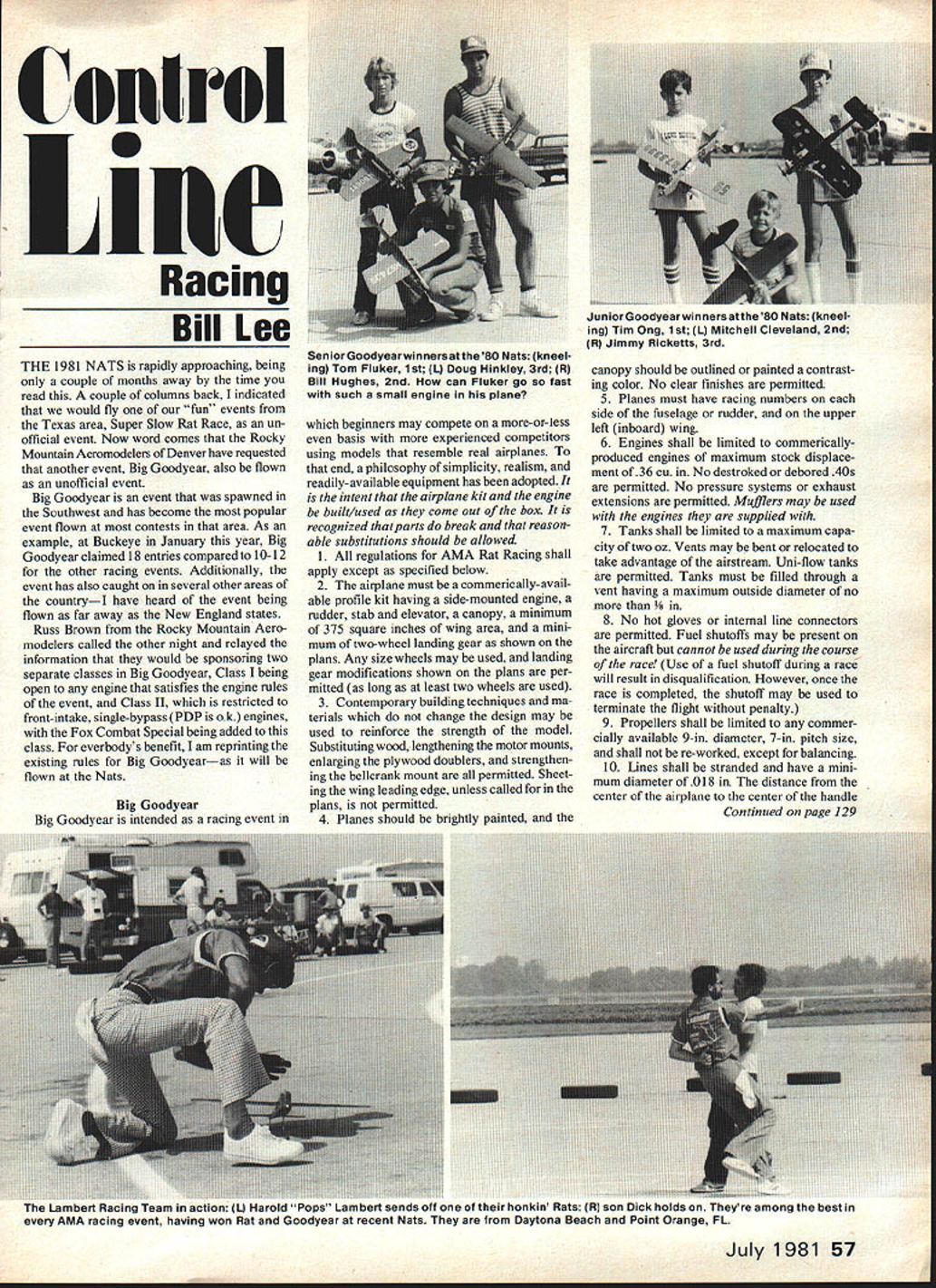
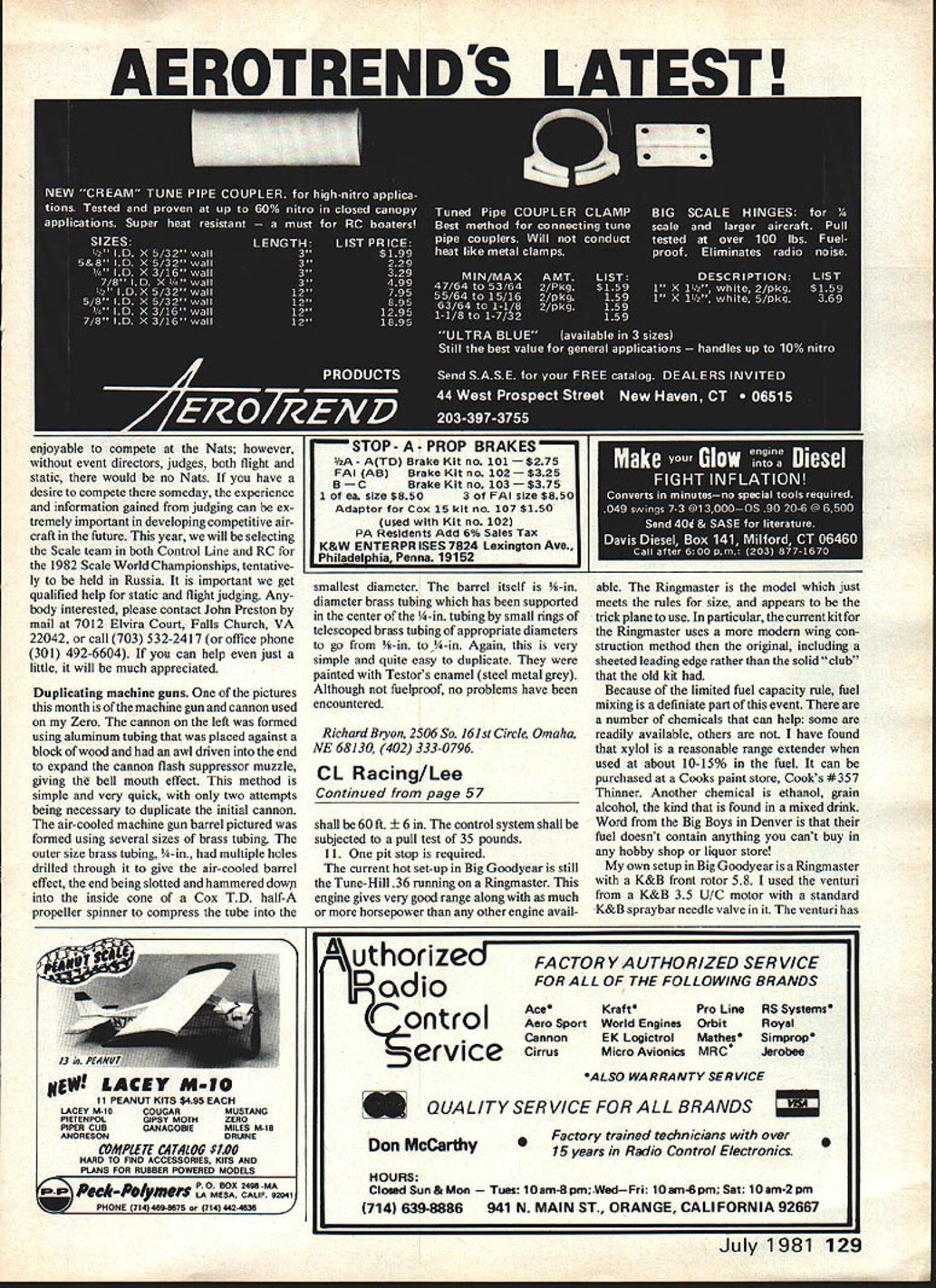
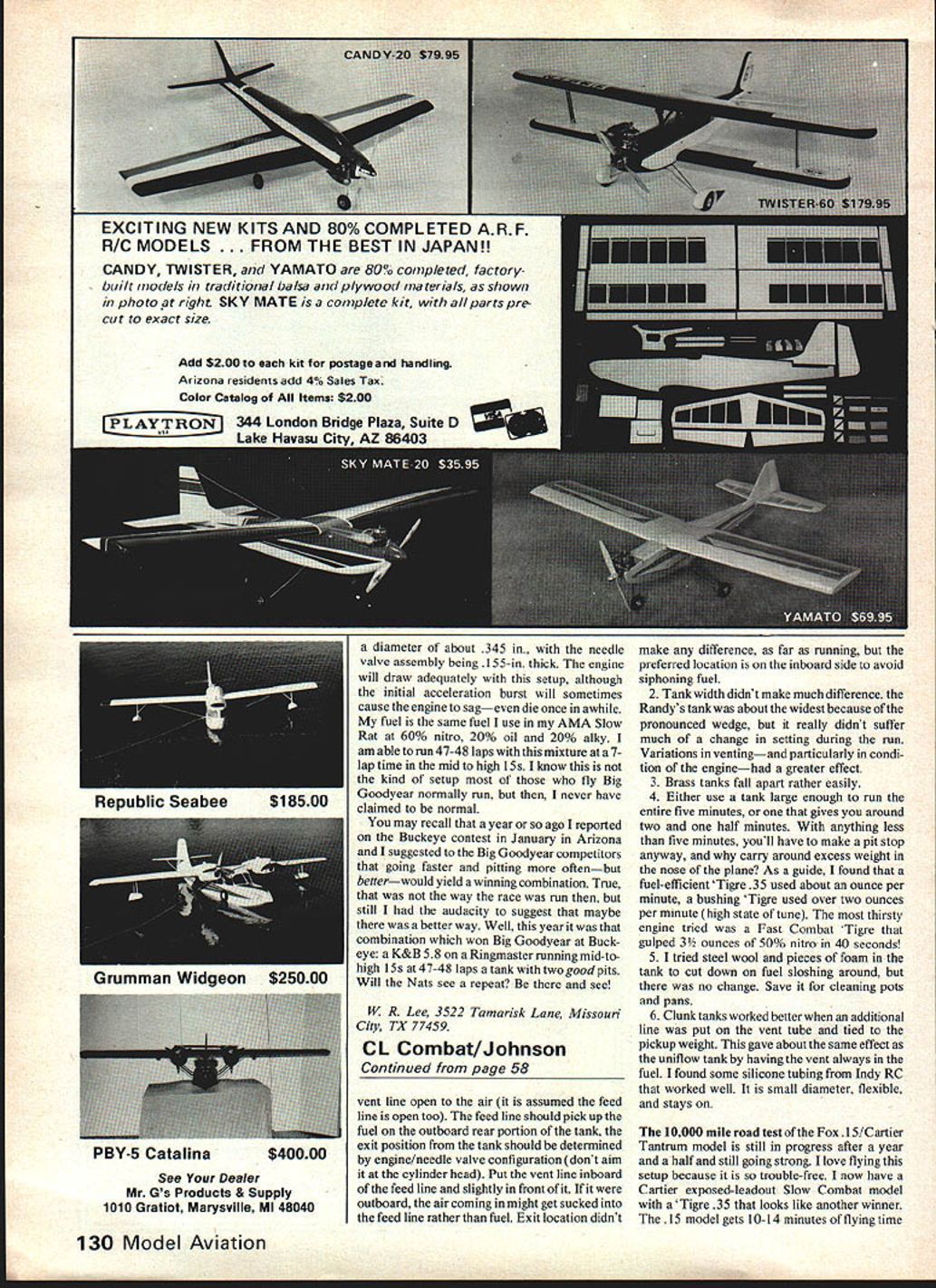
Big Goodyear was spawned in the Southwest and has become the most popular event flown at many contests in that area. For example, at Buckeye in January this year Big Goodyear claimed 18 entries compared to 10–12 for the other racing events. The event has also caught on in several other areas of the country — I've heard of it being flown as far away as the New England states.
Russ Brown of the Rocky Mountain Aeromodelers called to say they will sponsor two separate classes in Big Goodyear: Class I, open to any engine that satisfies the engine rules of the event; and Class II, restricted to front-intake, single-bypass (PDP i.e.) engines — the Fox Combat Special has been added to this class. For everybody's benefit, I am reprinting the existing rules for Big Goodyear as it will be flown at the Nats.
Big Goodyear — Purpose and Philosophy
Big Goodyear is intended as a racing event in which beginners may compete on a more-or-less even basis with more experienced competitors using models that resemble real airplanes. To that end, the philosophy of simplicity, realism, and readily available equipment has been adopted. The intent is that the airplane kit and the engine be built/used as they come out of the box. It is recognized that parts do break and that reasonable substitutions should be allowed.
Rules
- All regulations for AMA Rat Racing shall apply except as specified below.
- The airplane must be a commercially available profile kit having a side-mounted engine, a rudder, stab and elevator, a canopy, a minimum of 375 square inches of wing area, and a minimum of two-wheel landing gear as shown on the plans. Any size wheels may be used, and landing gear modifications shown on the plans are permitted (as long as at least two wheels are used).
- Contemporary building techniques and materials which do not change the design may be used to reinforce the strength of the model. Substituting wood, lengthening motor mounts, enlarging plywood doublers, and strengthening the bellcrank mount are all permitted. Sheeting the wing leading edge, unless called for in the plans, is not permitted.
- Planes should be brightly painted, and the canopy should be outlined or painted a contrasting color. No clear finishes are permitted.
- Planes must have racing numbers on each side of the fuselage or rudder, and on the upper left (inboard) wing.
- Engines shall be limited to commercially produced engines of maximum stock displacement of .36 cu. in. No destroked or debored .40s are permitted. No pressure systems or exhaust extensions are permitted. Mufflers may be used only with engines that are supplied with them.
- Tanks shall be limited to a maximum capacity of two ounces. Vents may be bent or relocated to take advantage of the airstream. Uni-flow tanks are permitted. Tanks must be filled through a vent having an outside diameter of no more than 1/8 in.
- No hot gloves or internal line connectors are permitted. Fuel shutoffs may be present on the aircraft but cannot be used during the course of the race. Use of a fuel shutoff during a race will result in disqualification. However, once the race is completed, the shutoff may be used to terminate the flight without penalty.
- Propellers shall be limited to any commercially available 9 in. diameter by 7 in. pitch size, and shall not be reworked except for balancing.
- Lines shall be stranded and have a minimum diameter of .018 in. The distance from the center of the airplane to the center of the handle shall be 60 ft ± 6 in. The control system shall be subjected to a pull test of 35 pounds.
- One pit stop is required.
Equipment, Fueling, and Setup Notes
The current hot setup in Big Goodyear is the Tune-Master .36 running on a Ringmaster. This engine gives very good range along with as much — or more — horsepower than any other engine available. The Ringmaster airframe just meets the rules for size and appears to be the trick plane to use. In particular, the current kit for the Ringmaster uses a more modern wing construction method than the original, including a sheeted leading edge rather than the solid "club" that the old kit had.
Because of the limited fuel capacity rule, fuel mixing is a definite part of this event. There are a number of chemicals that can help: some are readily available, others are not. Xylol is a reasonable range extender when used at about 10–15% of the fuel; it can be purchased as Cox #357 Thinner. Another useful chemical is ethanol (grain alcohol). Word from the Big Boys in Denver is that their fuel doesn't contain anything you can't buy in any hobby shop or liquor store.
My own setup in Big Goodyear is a Ringmaster with a K&B front rotor .58. I used the venturi from a K&B 3.5 U/C motor with a standard K&B spraybar needle valve in it — the venturi has the smallest diameter. The barrel itself is 5/8 in. diameter brass tubing which has been supported in the center of the 1/4-in. tubing by small rings of telescoped brass tubing of appropriate diameters to go from 5/8 in. to 1/4 in. This is simple and easy to duplicate. They were painted with Testor's enamel (steel metal gray). Although not foolproof, I have encountered no problems.
Nats — Judges and Scale Team
AMA racing events are enjoyable to compete in, but the Nats need event directors and judges for both flight and static. If you want to compete someday, the experience gained judging can be extremely important in developing competitive aircraft. Next year we will be selecting the Scale team for both Control Line and RC for the 1982 Scale World Championships, tentatively held in Russia; it is important to get qualified help for static and flight judging.
Anyone interested in helping should contact John Preston:
- 7012 Elvira Court, Falls Church, VA 22042
- Office phone: 703-532-2417
- Alternate phone: 301-492-6604
Transcribed from original scans by AI. Minor OCR errors may remain.

