
Control Line: Racing
Bill Lee
OVER THE LAST 10 or so years, the performance level of our racing aircraft has improved dramatically. Yet the equipment in use now is quite similar, in many cases, to what it was then. How come the performance increase?
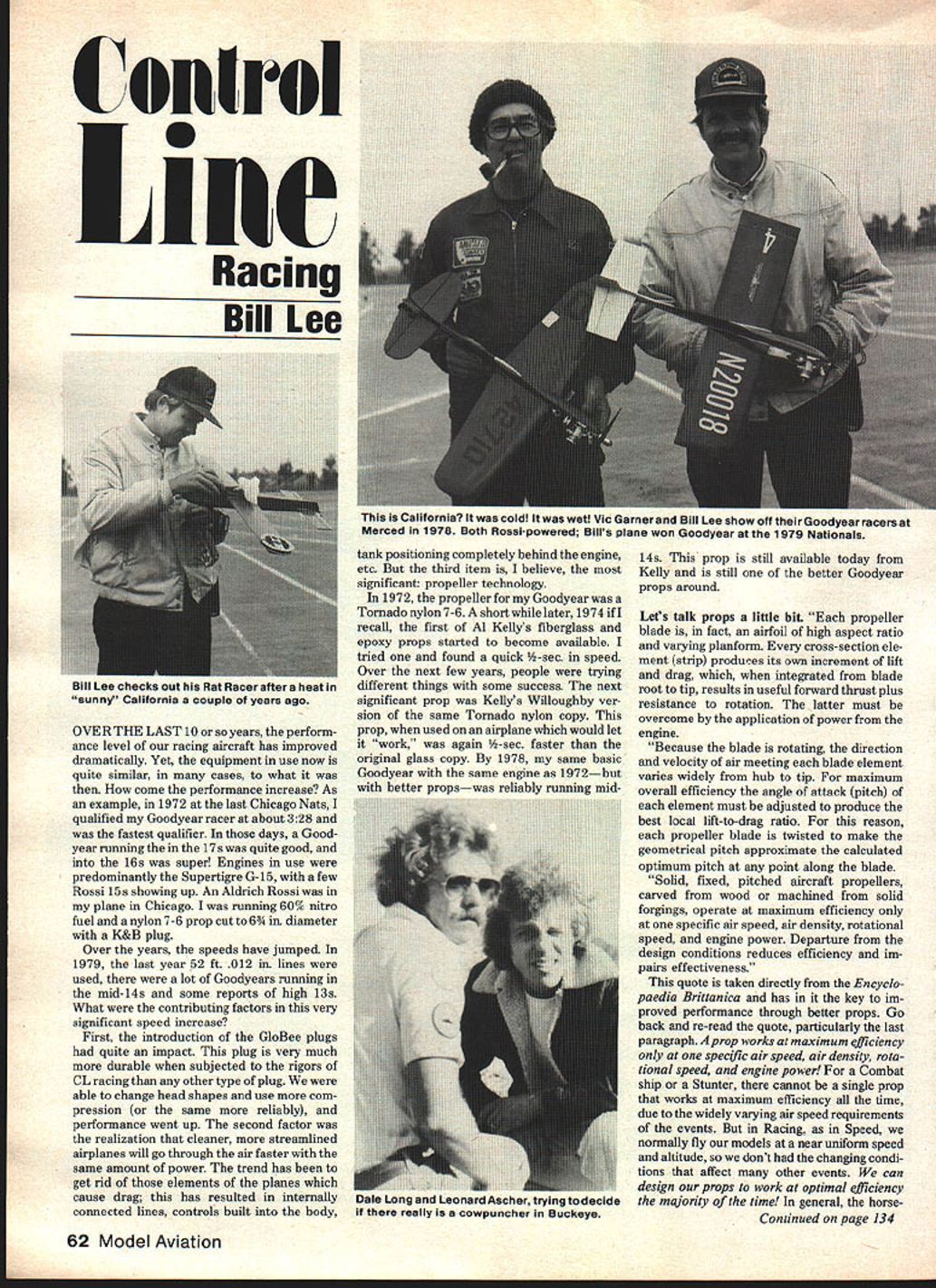
As an example, in 1972 at the last Chicago Nats, I qualified my Goodyear racer at about 3:28 and was the fastest qualifier. In those days, a Goodyear running in the 17s was quite good, and into the 16s was super! Engines in use were predominantly the Supertigre G-15, with a few Rossi 15s showing up. An Aldrich Rossi was in my plane in Chicago. I was running 60% nitro fuel and a nylon 7-6 prop cut to 6 1/4" diameter with a K&B plug.
Over the years, the speeds have jumped. In 1979, the last year 52 ft., .012 in. lines were used, there were a lot of Goodyears running in the mid-14s and some reports of high 13s. What were the contributing factors in this very significant speed increase?
Contributing factors
- The introduction of the GloBee plugs had quite an impact. This plug is much more durable when subjected to the rigors of CL racing than any other type of plug. We were able to change head shapes and use more compression (or the same more reliably), and performance went up.
- The realization that cleaner, more streamlined airplanes will go through the air faster with the same amount of power. The trend has been to eliminate those elements of the planes that cause drag; this has resulted in internally connected lines, controls built into the body, tank positioning completely behind the engine, etc.
- Propeller technology — I believe this is the most significant factor.
In 1972, the propeller for my Goodyear was a Tornado nylon 7-6. A short while later, about 1974, the first of Al Kelly's fiberglass-and-epoxy props started to become available. I tried one and found a quick 1/2-second improvement in speed. Over the next few years, people were trying different things with some success. The next significant prop was Kelly's Willoughby version of the same Tornado nylon copy. This prop, when used on an airplane which would let it "work," was again 1/2-second faster than the original glass copy. By 1978, my same basic Goodyear with the same engine as 1972—but with better props—was reliably running mid-14s. That prop is still available today from Kelly and is still one of the better Goodyear props around.
Propeller basics
Let's talk props a little bit. Each propeller blade is, in fact, an airfoil of high aspect ratio and varying planform. Every cross-section element (strip) produces its own increment of lift and drag, which, when integrated from blade root to tip, results in useful forward thrust plus resistance to rotation. The latter must be overcome by the application of power from the engine.
Because the blade is rotating, the direction and velocity of air meeting each blade element varies widely from hub to tip. For maximum overall efficiency the angle of attack (pitch) of each element must be adjusted to produce the best local lift-to-drag ratio. For this reason, each propeller blade is twisted to make the geometrical pitch approximate the calculated optimum pitch at any point along the blade.
Solid, fixed, pitched aircraft propellers, carved from wood or machined from solid forgings, operate at maximum efficiency only at one specific air speed, air density, rotational speed, and engine power. Departure from the design conditions reduces efficiency and impairs effectiveness.
This quote, taken from the Encyclopaedia Britannica, contains the key to improved performance through better props. Re-read the quote, particularly the last paragraph. A prop works at maximum efficiency only at one specific air speed, air density, rotational speed, and engine power. For a Combat ship or a Stunter, there cannot be a single prop that works at maximum efficiency all the time due to the widely varying air speed requirements of the events. But in Racing, as in Speed, we normally fly our models at a near-uniform speed and altitude, so we don't have the changing conditions that affect many other events. We can design our props to work at optimal efficiency the majority of the time! In general, the horsepower output and air density don't change by very much from one day to the next, so the two variables we have left are air speed and rotational speed, i.e., engine rpm.
Effective pitch and angle of attack
EP = S(1056) / R
where:
- S = airspeed in mph
- R = engine rpm
EP is the effective pitch in inches — the distance the plane moves in inches per revolution — and is what you would measure at all stations on the prop if you believed that the prop was flying at exactly 0.0 degrees with respect to the air as the plane moves forward and the prop turns.
If the prop were working at 100% efficiency at the rpm and air speed you have measured, then pitch measured on the prop should equal EP. But props need to work at some angle of attack to do the job, and the selection of that angle of attack is the key to better props for racing. An aeronautical engineer friend of mine told me one day that a Clark Y airfoil has its maximum lift/drag ratio when operating at an angle of attack relative to the path through the air of around 2.0 degrees. I looked at the shape of the blade airfoil I usually ended up carving, and decided that it was just what the doctor ordered. I didn't have the formulas necessary to convert that desired angle to inches of pitch, so I sat down and worked them out:
If S = air speed in mph and R = engine rpm, then EP = S(1056) / R
Let Q = radius in inches to station on prop (angle of blade)
Then α (in radians) = tan⁻¹(EP / (2πQ))
If A = desired angle of attack in degrees, then inches of pitch P at Q is: P = 2πQ · tan(α + Aπ/180)
These formulas let you calculate the inches of pitch required for a particular angle of attack. The value of Q depends on where you are measuring the prop in relation to the center. Most of us are probably using a Prather pitch gauge (certainly you need some sort of gauge to work on props), and the values of Q can be calculated as follows:
Let I = Prather station number Q = 0.3715 + I(0.4285) (Q in inches)
The formulas may look complex, but they can be programmed quite easily into a hand calculator. If you have access to some sort of computer, the program for calculating pitch as a function of the angle of attack can be easily written. I have a FORTRAN program to calculate these numbers, and if anyone is interested in it, drop me a line and I will send a copy in your SASE.
My efforts over the past year or so using this approach of pitching the props to have a constant angle of attack from hub to tip have yielded some very positive results. A revised Rat prop was a full 1/2-second faster than the same engine/fuel/plug using stock Kelly-Gillot 8-8. That same prop also helped my Slow Rat by 1/4-second, although later work yielded even better props for Slow. To date, I haven't been able to achieve much improvement with the Goodyears as compared to the Willoughby, which has very good pitch distribution to begin with.
W. R. Lee 3522 Tamarisk Lane Missouri City, TX 77459
Transcribed from original scans by AI. Minor OCR errors may remain.

