
Control Line RACING
Bill Lee
Laced bellcrank — safety warning
Over the course of the years I have written this column, I have tried to cover all facets of CL racing. Safety is one area where enough cannot be said. Over five years ago I published a warning about the so‑called "laced" method of leadout/bellcrank construction. I am going to repeat that warning here.
Several years ago there was a Rat kit produced called the Skat Rat. This model was one of the early standards in Rat — designed and flown by John Barr and Dick Morsikian. The plans illustrated a method of attaching the leadouts to the bellcrank by weaving flexible leadouts through the normal leadout holes and four additional holes drilled in the bellcrank. This is an unsafe method of attaching leadouts.
Consider what happens at the point where the leadouts enter the bellcrank when the controls are moved from up to down. The bend in the leadout wire as it goes across the bellcrank prevents the wire from rotating in the hole. The only thing left for the wire to do is bend. Given enough movements of the controls, the wire fatigues and breaks — almost always at a very bad time, usually in the air during a race.
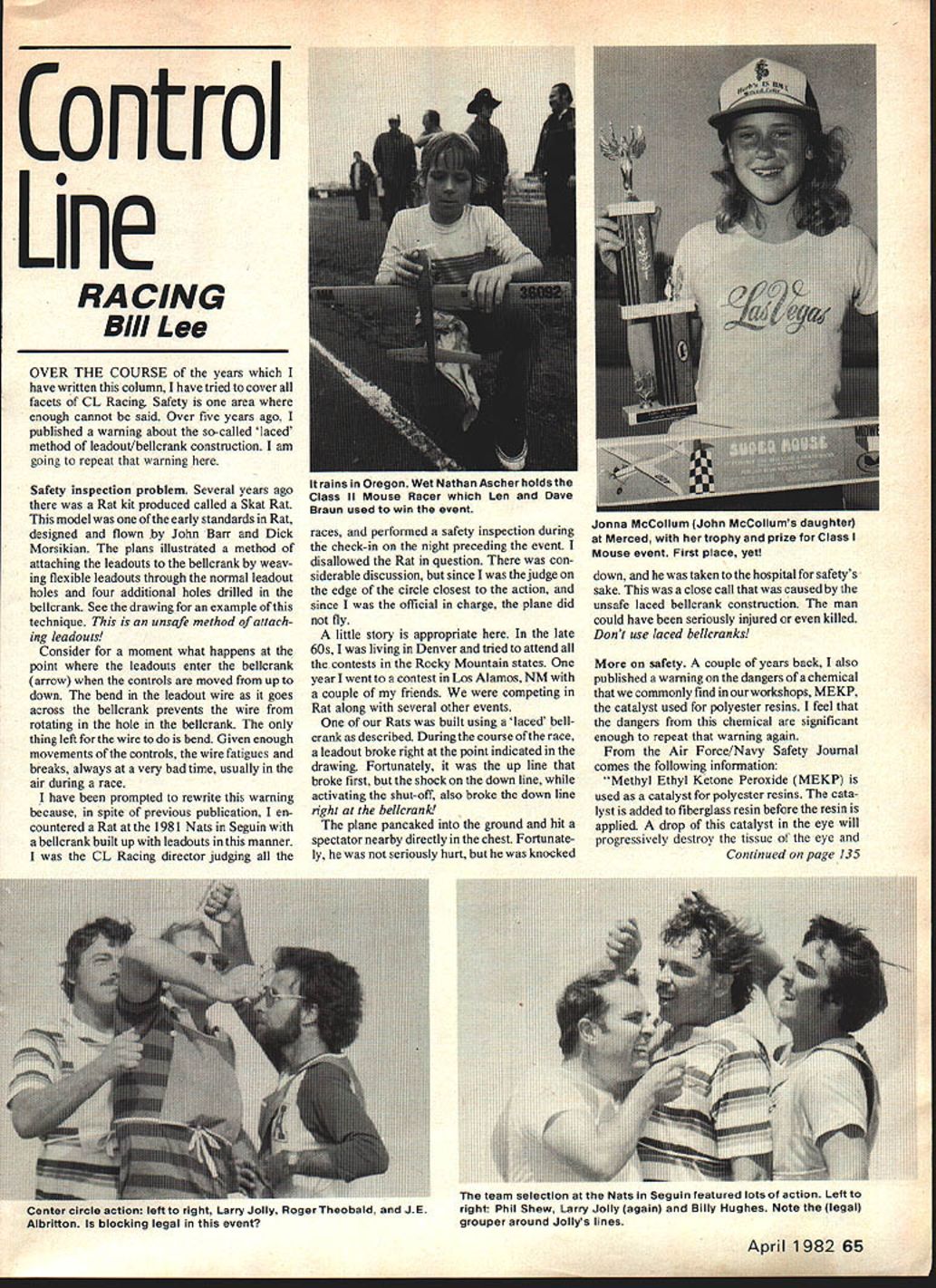
I was prompted to repeat this warning because, despite previous publication, I encountered a Rat at the 1981 Nats in Seguin with a bellcrank built with leadouts in this manner. I was the CL Racing director judging all the races and performed a safety inspection during check‑in on the night preceding the event. I disallowed the Rat in question. There was considerable discussion, but since I was the judge on the edge of the circle closest to the action and the official in charge, the plane did not fly.
A little story is appropriate. In the late ’60s, while living in Denver, I attended contests throughout the Rocky Mountain states. One year I went to a contest in Los Alamos, NM. One of our Rats was built using a laced bellcrank as described. During the race a leadout broke at the point indicated above. Fortunately it was the up line that broke first, but the shock on the down line, while activating the shut‑off, also broke the down line right at the bellcrank.
The plane pancaked into the ground and struck a spectator directly in the chest. Fortunately he was not seriously hurt, but he was knocked down and taken to the hospital for safety’s sake. This was a close call caused by unsafe laced bellcrank construction. The man could have been seriously injured or even killed. Don’t use laced bellcranks!
MEKP (Methyl Ethyl Ketone Peroxide) — eye and chemical safety
A couple of years back I published a warning on the dangers of a chemical commonly found in our workshops, MEKP, the catalyst used for polyester resins. The dangers from this chemical are significant enough to repeat.
From the Air Force/Navy Safety Journal:
Methyl Ethyl Ketone Peroxide (MEKP) is used as a catalyst for polyester resins. The catalyst is added to fiberglass resin before the resin is applied. A drop of this catalyst in the eye will progressively destroy the tissue of the eye and can result in blindness unless immediate action (within four seconds) is taken to wash the catalyst from the eye. Once the chemical has started destroying the eye, there is no known way of stopping the destruction or repairing the damage.
MEKP may also be present in paints and hole fillers; be sure to read labels thoroughly.
In tests using laboratory animals, MEKP in solutions of varying concentrations was found to cause eye problems ranging from irritation to severe damage. The maximum concentration producing no appreciable irritation was a solution containing only 0.6% MEKP. Material published on MEKP states that washing the eyes with water within four seconds after exposure prevented injuries in all cases.
A report of one case of MEKP eye exposure relates serious consequences. The accident occurred while fiberglassing a chair at home. Though the victim made every effort to wash his eyes, several minutes apparently elapsed before water was located. One eye was lost instantly; the other was lost over a period of eight years.
Wearing chemical safety goggles will prevent chemical eye injury. In industry, eyewash fountains or bottles are readily available wherever chemicals are used or handled. An eyewash bottle or a water hose without pressure attachments should be handy at home when working with hazardous chemicals. If eye exposure should occur, rinse the eye(s) immediately with water for at least 15 minutes and then obtain medical attention.
The cost of a pair of goggles is a very small price to pay when you consider that your eyesight is irreplaceable. MEKP is in most model‑building shops where polyester finishing resins are used. This advice is important and should be followed by every intelligent modeler.
One other aspect of MEKP that I have been warned about (and which I am not going to test) is that it will shock‑sensitize nitromethane. Many of us keep nitro in our shops for mixing fuel. Be very careful whenever any chemical is used.
Control line material — music wire vs stainless steel
The AMA rule book states: "All lines used to control flights shall be steel music wire or metal of equivalent strength." An aspect of CL racing that has worried me is that the control line wire commonly sold in local hobby shops is often stainless steel, not music (piano) wire.
Consulting any strength‑of‑materials handbook, you will find that stainless steel wire is only about 80% as strong as music wire. Is this a problem? It depends on the event.
- Goodyear: no problem. Rotation speeds on 60‑ft lines with .014 solid lines have more than enough safety margin.
- Slow Rat: marginal. Top competitors are turning speeds in excess of 130 mph with planes in the 2½‑lb area.
- Fast Rat: definitely a problem. Good Fast Rats run about 150 mph and generally weigh 2–2½ lbs. The safety margin on .018 music wire is not large, and using stainless wire cuts that margin by roughly 20%. Don’t use stainless steel wire for Fast Rat; use only piano (music) wire.
Be certain when you buy your lines that you know what you are getting. If in doubt, take along a magnet; it will attract music wire but not stainless steel.
What about the fun events? One event of concern is the ACLA Slow Rat as flown in the Southwest. That event allows .015 stranded lines and .40 engines on suction but limits fuel capacity to only 1 oz. Historically, speeds were kept low for fuel economy, but recent trends have seen ACLA Slow Rats at the 120 mph level with more pit stops. This leaves virtually no margin on .015 stranded lines.
Fortunately, the event also allows .014 solids which, when made from music wire, give more strength than the stranded .015s. But if the 20% penalty of stainless steel is applied, even the .014 solids are marginal. Again, if you can avoid stainless steel lines in favor of piano wire, do so. I know piano wire is more trouble to maintain because it will corrode, but that small effort is worth the extra margin of safety.
Recommendations
- Never use laced bellcrank construction for leadouts; use proper attachment methods that allow rotation and avoid bending fatigue at the bellcrank.
- Use chemical safety goggles when working with MEKP or similar catalysts. Keep an eyewash bottle or accessible water source nearby.
- If MEKP contacts the eye, rinse immediately with water (start within seconds if possible) and continue rinsing for at least 15 minutes; seek medical attention promptly.
- Store and handle chemicals carefully; read labels and be aware MEKP can sensitize nitromethane.
- Prefer music (piano) wire for control lines, especially in high‑speed events. Use a magnet to check wire type if uncertain.
- Maintain piano wire to avoid corrosion; the added safety margin is worth the effort.
Bill Lee 3522 Tamarisk Ln. Missouri City, TX 77459
Transcribed from original scans by AI. Minor OCR errors may remain.

