
Control Line: Racing
Bill Lee
Sources for Racing Specialty Equipment
A perennial problem is where to get the specialty equipment needed to fly competitive racing. Most local hobby shops don't even understand that model airplanes were meant to fly on wires, let alone race, so they rarely carry the small, specialty items we need.
I recently received a product list from a new source, Dick Tyndall in Highland Springs, VA. Dick has occasionally sent pictures and, to find he was producing specialty items, was especially pleasing. Items listed on Tyndall's price sheet include:
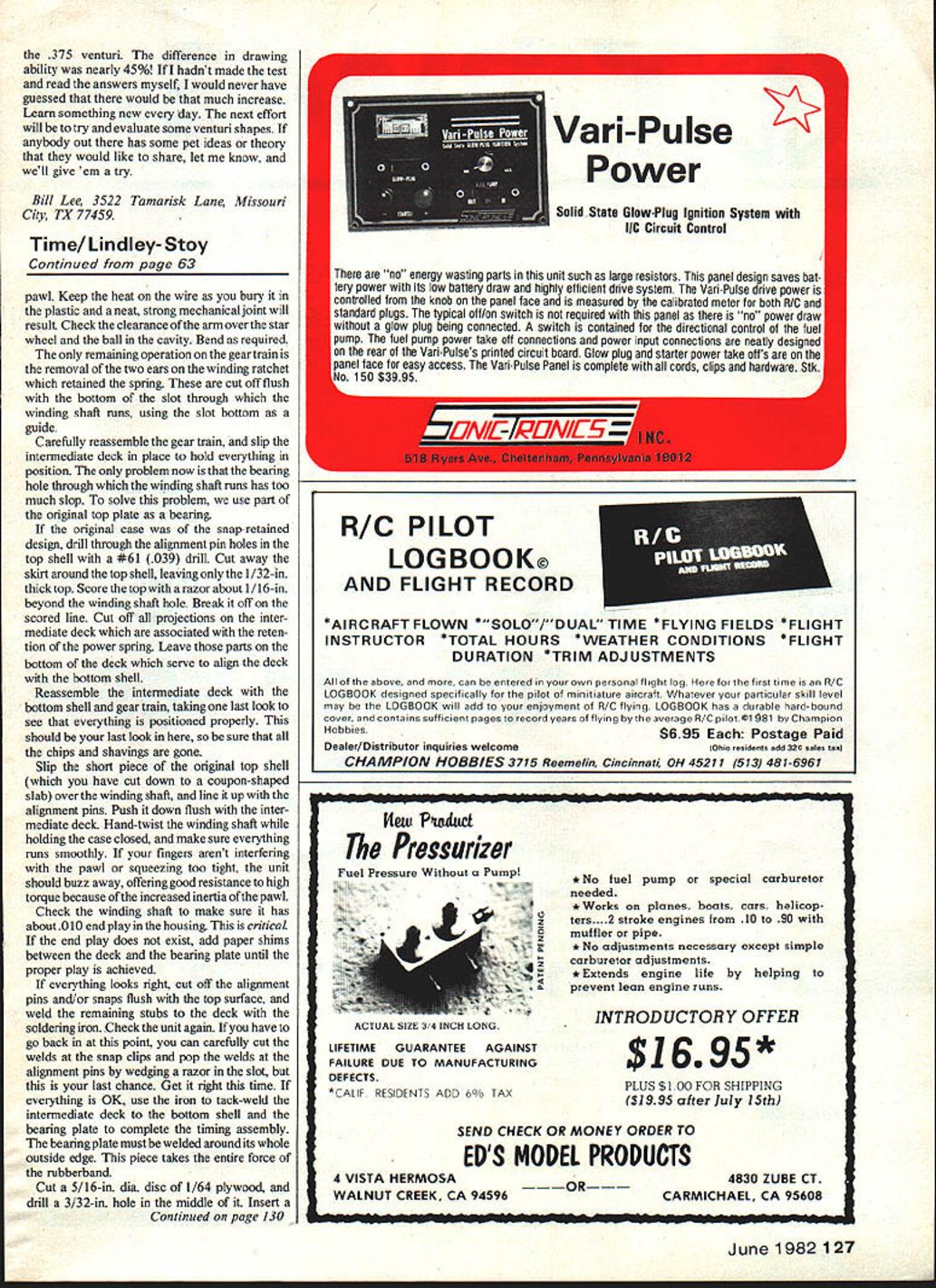
- Venturis for the Rossi .15 that allow a larger hole than the stock venturi. The "normal" size he sells is .312 in.; he will make them larger or smaller on demand. Venturi height is 1/2 in.
- Head inserts and a double-bubble combustion chamber with a 3° taper to the squish band (for the Rossi). Dick cuts the inserts for a long-reach plug and .102 in. insert depth, which yields about .002–.003 in. head clearance. Since this is a little tight, head shims are required to set the clearance to your desire; shims are available.
- A "Hot Thumb" for pitting: a plastic piece with battery contacts and a copper band so it can be worn on your left thumb. Contacts are arranged so you can grasp the top of the engine with your thumb while holding the model for pitting and the plug is instantly connected to the battery.
Workmanship on the sample items Dick sent was first class. To get his price list, send a SASE to: Virginia Craftsman, Inc. 348 Argyll Circle Highland Springs, VA 23075
1/2 A Mousers (Plans)
A couple of 1/2 A Mouser plans are available from Jim Ong: Jim Ong 8639 Ridgemont Pineville, LA 71360
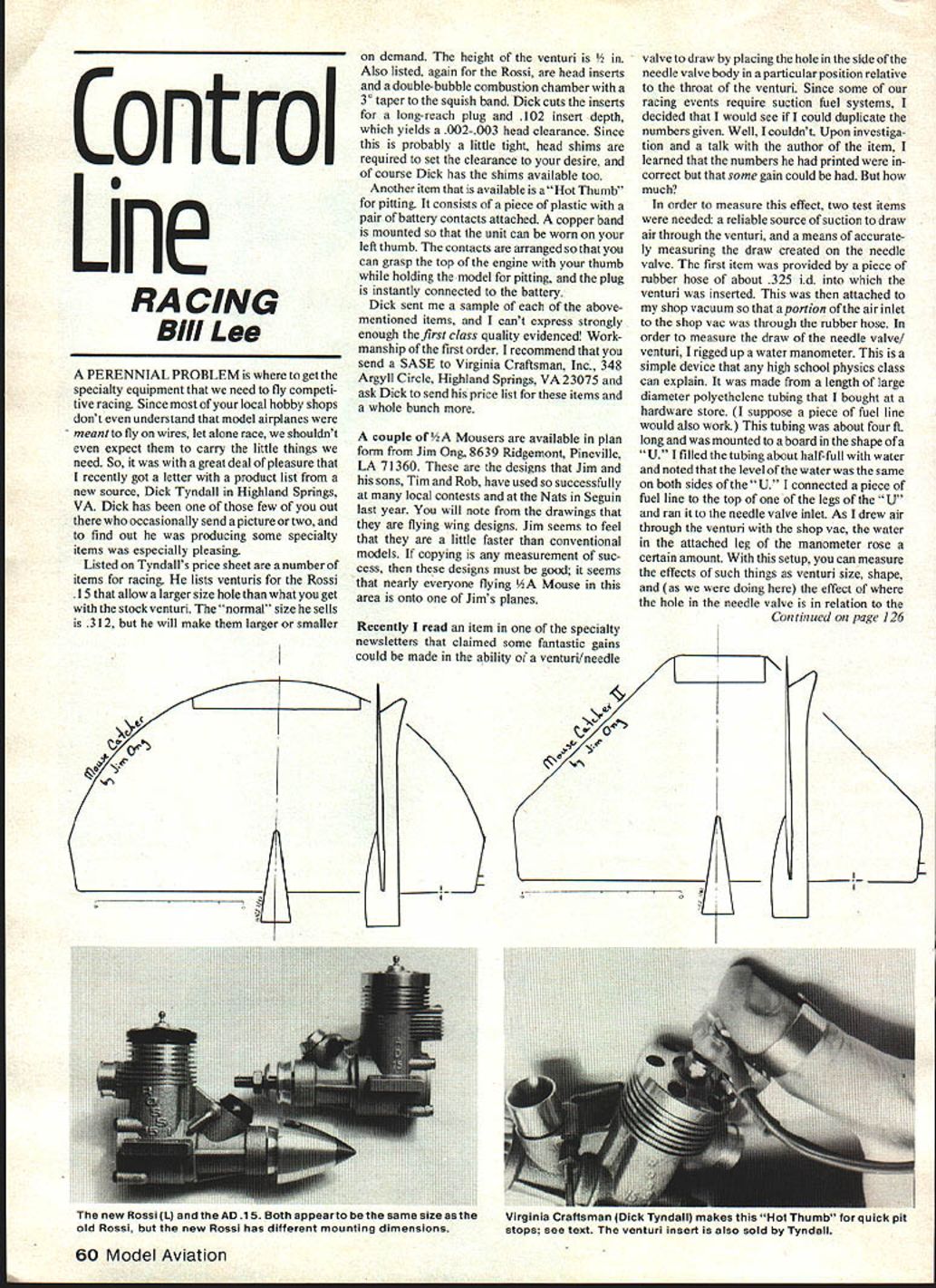
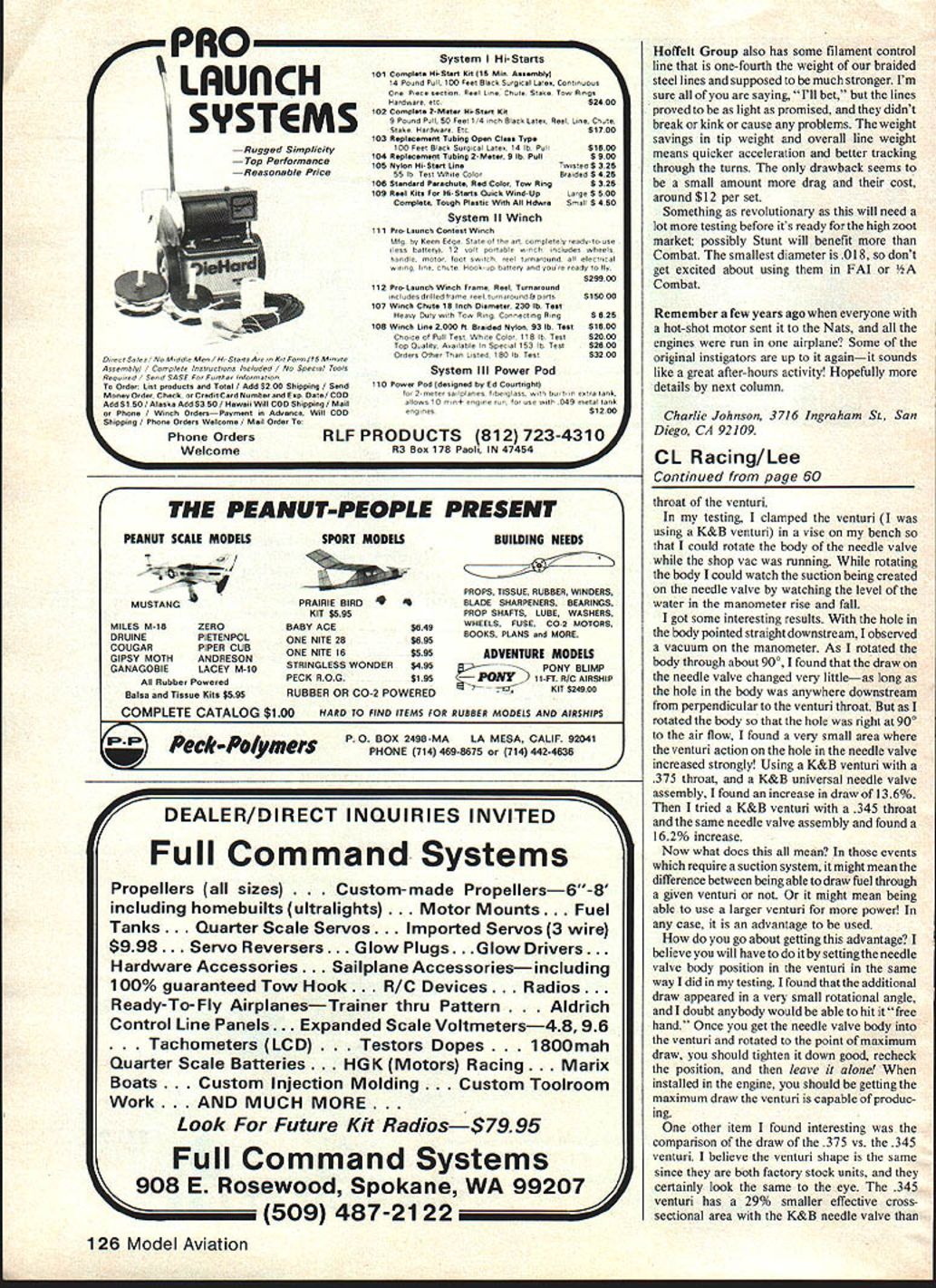
These are the designs Jim and his sons Tim and Rob have used successfully at many local contests and at the Nats in Seguin last year. They are flying-wing designs; Jim feels they are a little faster than conventional models. If copying is any measure of success, these designs must be good—many flyers in this area are using one of Jim's planes.
Venturi / Needle Valve Position: Background
I read a specialty newsletter item claiming significant gains in a venturi/needle valve's ability to draw fuel could be achieved by placing the hole in the side of the needle valve body in a particular position relative to the venturi throat. Because some racing events require suction fuel systems, I decided to test the claim and measure how much gain, if any, could be obtained.
Test Setup
Two things were needed: a reliable source of suction and a means to measure the draw on the needle valve.
- Suction source: a length of rubber hose about .325 in. internal diameter into which the venturi was inserted, attached to my shop vacuum so a portion of the shop vac inlet drew through the hose/venturi.
- Measurement: a water manometer made from a length of large-diameter polyethylene tubing mounted in a "U" shape on a board. The tubing was filled about half-full with water so the levels were equal initially. A piece of fuel line connected the top of one leg of the "U" to the needle valve inlet. As air was drawn through the venturi by the shop vac, the water in the attached leg rose; the rise measured the suction created.
Procedure
I clamped a K&B venturi in a vise so I could rotate the body of the needle valve while the shop vac ran. While rotating the needle valve body I watched the water level in the manometer to observe changes in suction as the hole in the needle valve body changed orientation relative to the venturi throat.
Results
- With the hole in the needle valve body pointed straight downstream, I observed a vacuum on the manometer.
- Rotating the body through about 90° produced very little change in draw as long as the hole was anywhere downstream from perpendicular to the venturi throat.
- When the hole was right at 90° to the airflow (perpendicular), there was a very small angular range where the venturi action on the hole increased strongly.
Measured increases in draw at that optimal position:
- Using a K&B venturi with a .375 in. throat and a K&B universal needle valve assembly: increase in draw of 13.6%.
- Using a K&B venturi with a .345 in. throat and the same needle valve assembly: increase in draw of 16.2%.
I also compared the two venturis: the .345 venturi has about a 29% smaller effective cross-sectional area with the K&B needle valve than the .375 venturi, yet the draw of the .375 was only 13.6% less (than the .345 in its optimal orientation). This suggests the .345 venturi may be more efficient than the .375.
Practical Implications
- For events requiring a suction system, the needle valve body position can be the difference between being able to draw fuel through a given venturi or not, or it may allow the use of a larger venturi for more power.
- The advantageous position appears in a very small rotational angle; it is unlikely anyone could find it by hand during normal assembly. Install the needle valve body in the venturi, rotate it to the point of maximum draw using a test setup (or measure in advance), tighten it down, recheck the position, and leave it alone.
- Jetting becomes more critical with suction systems; you may need different main jets to obtain the desired mixture.
Engine Setup for Suction Systems
The engine will draw fuel at high speeds even if it is not possible to get any measurable draw with a K&B-type venturi on the bench. The goal is to provide enough suction to pull fuel into the carburetor at the highest speeds you want the engine to run. You can do this by increasing venturi size or by setting the needle valve body position correctly as described above.
Closing
I was surprised by how much gain could be obtained by careful positioning of the needle valve body. My next effort will be to evaluate different venturi shapes. If anyone has pet ideas or theories they'd like to share, let me know and we'll give them a try.
Bill Lee 3522 Tamarisk Lane Missouri City, TX 77459
Transcribed from original scans by AI. Minor OCR errors may remain.

