
Control Line RACING
Bill Lee
Propeller news: Bob Lawrence, The Prop Shop
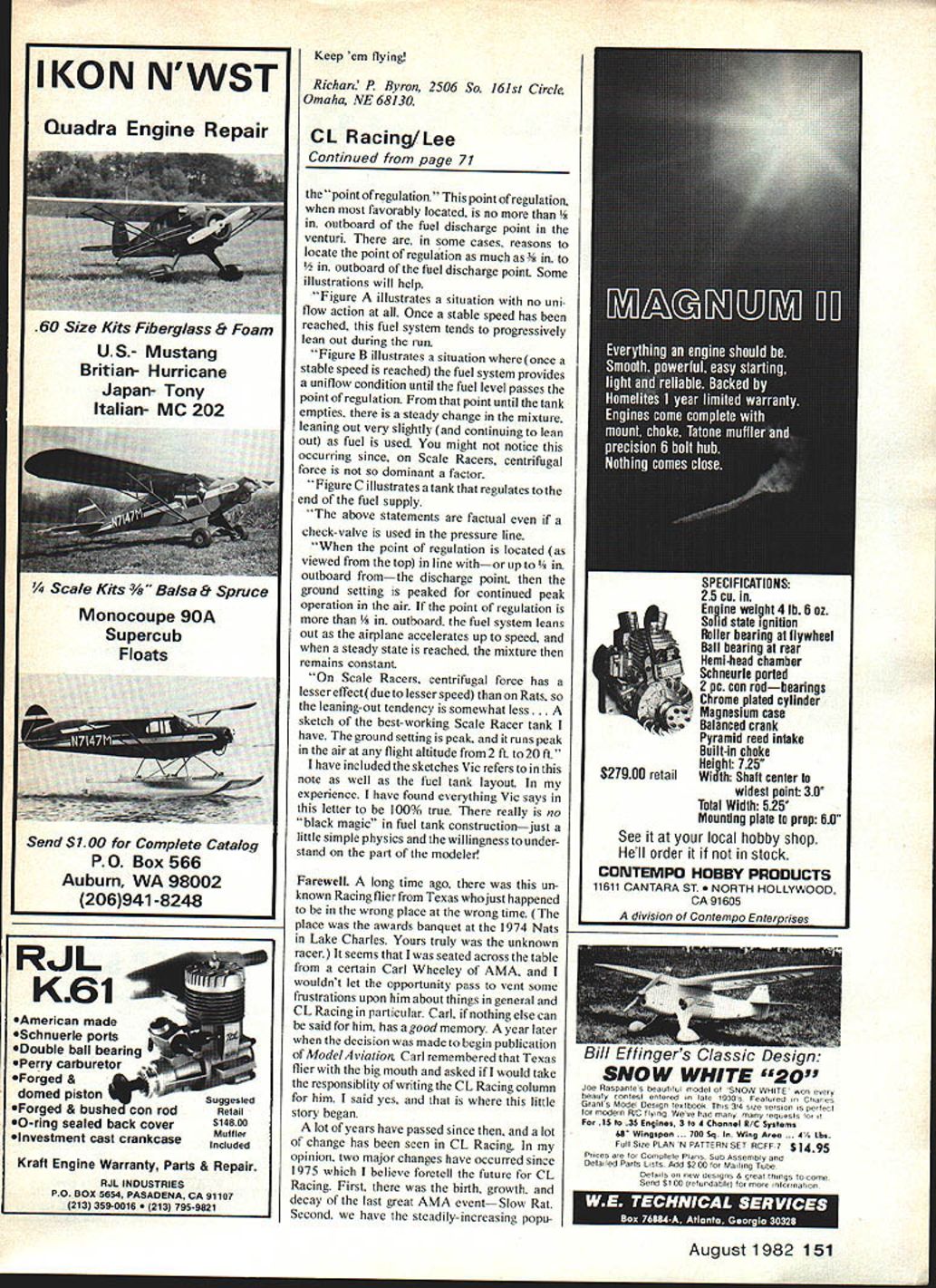
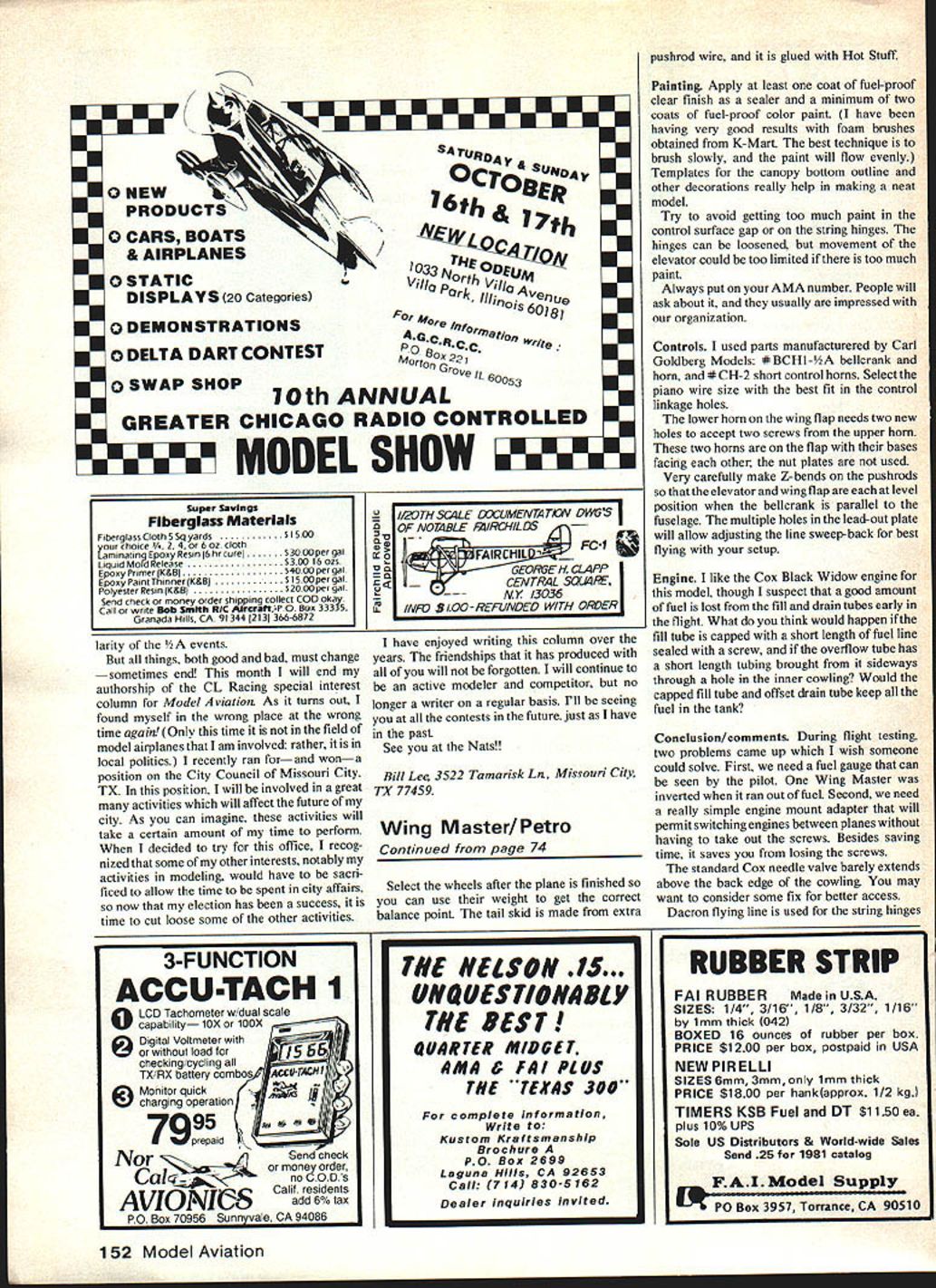
Recently I received information and pictures from a new source of props that I think all of you might want to consider: Bob Lawrence of The Prop Shop, 109 Emerald St., Broomfield, CO 80020. He is making a new line of fiberglass props that looks really great. He sent me a couple to evaluate (I'm still waiting for some time to do it). The most interesting thing about these props is the vortex tips he has cast into them.
Here are some quotes from Bob's letter: "…we make no claims, other than noise reduction, for the propellers with the vortex tips. However, in almost all cases, the vortex-tipped prop has shown itself to be more fuel-efficient in cruise, low-load situations and shows all indications of much greater thrust in high-load situations; faster acceleration from slow speeds and standing starts.…although we originally designed this prop for Control Line Racers, a lot of other types of competition flying could benefit even more.… The experience we've had at our altitude has been very encouraging. Our Racers picked up 3 to 5 tenths of a second over Kelly's and Gillott's. My Stunt ships show a decided improvement in speed bracketing, and the RC fliers we let try our props are driving me crazy with their demands for more."
Bob's list of props includes the standard sizes for Scale Racing (Goodyear), Rat, and Slow Rat, along with some larger sizes:
- 10-6
- 11-7
- 12-6
- three-bladed 10-6
Prices run from $5.49 for the 7-5.5, $7.95 for the 8-8 and 9-7, to $9.95 for the larger sizes. The three-blader is $14.95. If this interests you, contact Bob at the above address, or phone (303) 469-3928.
Fuel tanks (again)
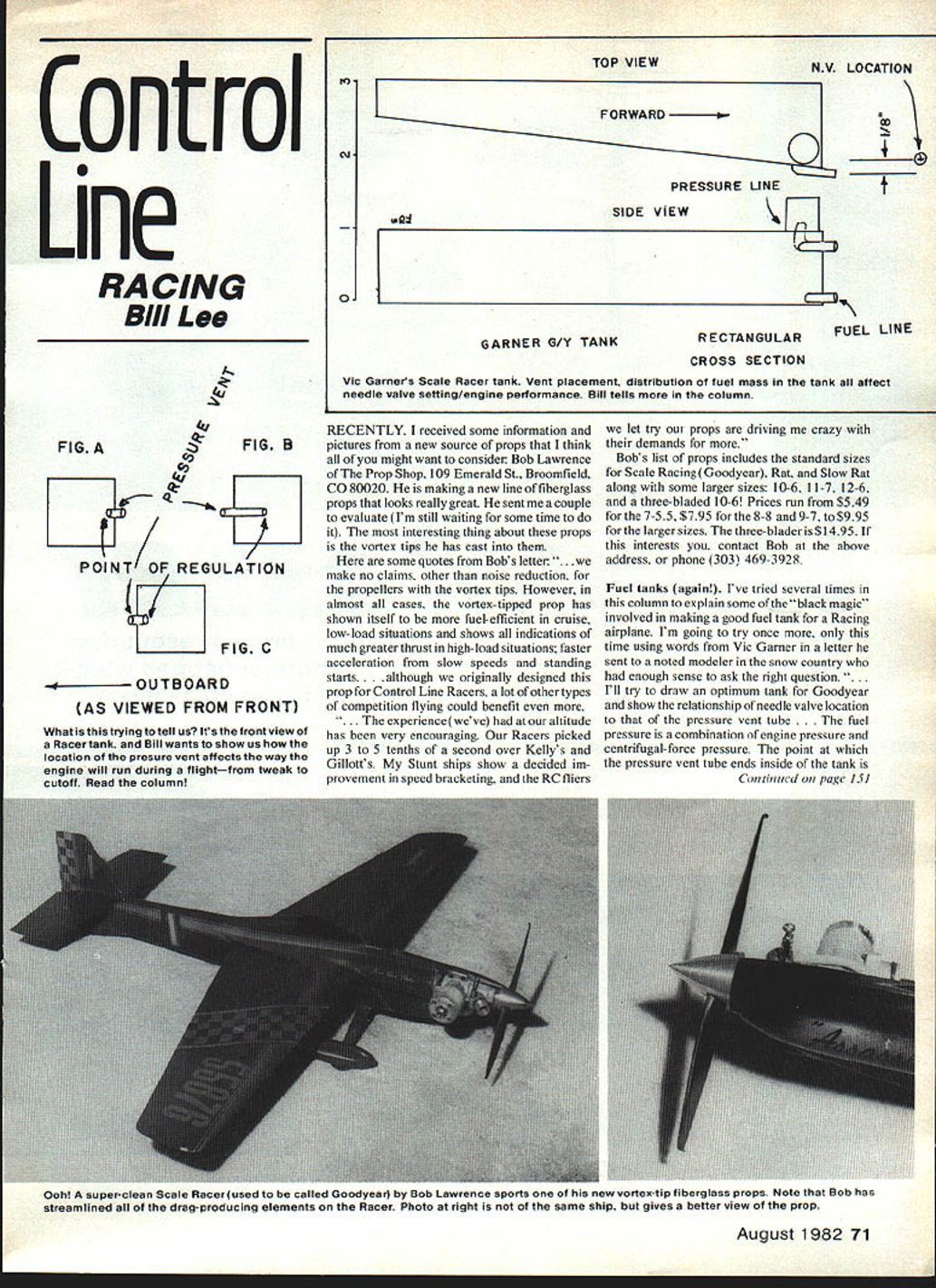
I've tried several times in this column to explain some of the "black magic" involved in making a good fuel tank for a Racing airplane. I'm going to try once more, only this time using words from Vic Garner in a letter he sent to a noted modeler in the snow country who had enough sense to ask the right question. I'll try to draw an optimum tank for Goodyear and show the relationship of needle-valve location to that of the pressure vent tube.
The fuel pressure is a combination of engine pressure and centrifugal-force pressure. The point at which the pressure vent tube ends inside the tank is the "point of regulation." This point of regulation, when most favorably located, is no more than 1/4 in. outboard of the fuel discharge point in the venturi. There are, in some cases, reasons to locate the point of regulation as much as 1/2 in. to 3/4 in. outboard of the fuel discharge point. Some illustrations will help.
- Figure A illustrates a situation with no uniflow action at all. Once a stable speed has been reached, this fuel system tends to progressively lean out during the run.
- Figure B illustrates a situation where (once a stable speed is reached) the fuel system provides a uniflow condition until the fuel level passes the point of regulation. From that point until the tank empties, there is a steady change in the mixture, leaning out very slightly (and continuing to lean out) as fuel is used. You might not notice this occurring since, on Scale Racers, centrifugal force is not so dominant a factor.
- Figure C illustrates a tank that regulates to the end of the fuel supply.
The above statements are factual even if a check valve is used in the pressure line.
"When the point of regulation is located (as viewed from the top) in line with — or up to 1/2 in. outboard from — the discharge point, then the ground setting is peaked for continued peak operation in the air. If the point of regulation is more than 1/2 in. outboard, the fuel system leans out as the airplane accelerates up to speed, and when a steady state is reached, the mixture then remains constant."
On Scale Racers, centrifugal force has a lesser effect (due to lesser speed) than on Rats, so the leaning-out tendency is somewhat less. A sketch of the best-working Scale Racer tank I have: the ground setting is peak, and it runs peak in the air at any flight altitude from 2 ft. to 20 ft.
I have included the sketches Vic refers to in this note as the fuel tank layout. In my experience I have found everything Vic says in this letter to be 100% true. There really is no "black magic" in fuel tank construction — just a little simple physics and the willingness to understand on the part of the modeler.
Farewell
A long time ago, there was this unknown Racing flier from Texas who just happened to be in the wrong place at the wrong time. (The place was the awards banquet at the 1974 Nats in Lake Charles. Yours truly was the unknown racer.) It seems that I was seated across the table from a certain Carl Wheeley of AMA, and I wouldn't let the opportunity pass to vent some frustrations upon him about things in general and CL Racing in particular. Carl, if nothing else can be said for him, has a good memory. A year later when the decision was made to begin publication of Model Aviation Carl remembered that Texas flier with the big mouth and asked if I would take the responsibility of writing the CL Racing column for him. I said yes, and that is where this little story began.
A lot of years have passed since then, and a lot of change has been seen in CL Racing. In my opinion, two major changes have occurred since 1975 which I believe foretold the future for CL Racing. First, there was the birth, growth and decay of the last great AMA event — Slow Rat. Second, we have the steadily increasing popularity of the 1/2 A events.
But all things, both good and bad, must change — sometimes end. This month I will end my authorship of the CL Racing special interest column for Model Aviation. As it turns out, I found myself in the wrong place at the wrong time again! (Only this time it is not in the field of model airplanes that I am involved; rather, it is in local politics.) I recently ran for — and won — a position on the City Council of Missouri City, TX. In this position I will be involved in a great many activities which will affect the future of my city. As you can imagine, these activities will take a certain amount of my time to perform. When I decided to try for this office, I recognized that some of my other interests, notably my activities in modeling, would have to be sacrificed to allow the time to be spent in city affairs, so now that my election has been a success, it is time to cut loose some of the other activities.
I have enjoyed writing this column over the years. The friendships that it has produced with all of you will not be forgotten. I will continue to be an active modeler and competitor, but no longer a writer on a regular basis. I'll be seeing you at all the contests in the future, just as I have in the past.
See you at the Nats!!
Bill Lee 3522 Tamarisk Ln. Missouri City, TX 77459
Transcribed from original scans by AI. Minor OCR errors may remain.

