
Control Line: Racing
John Ballard
Racing Propellers
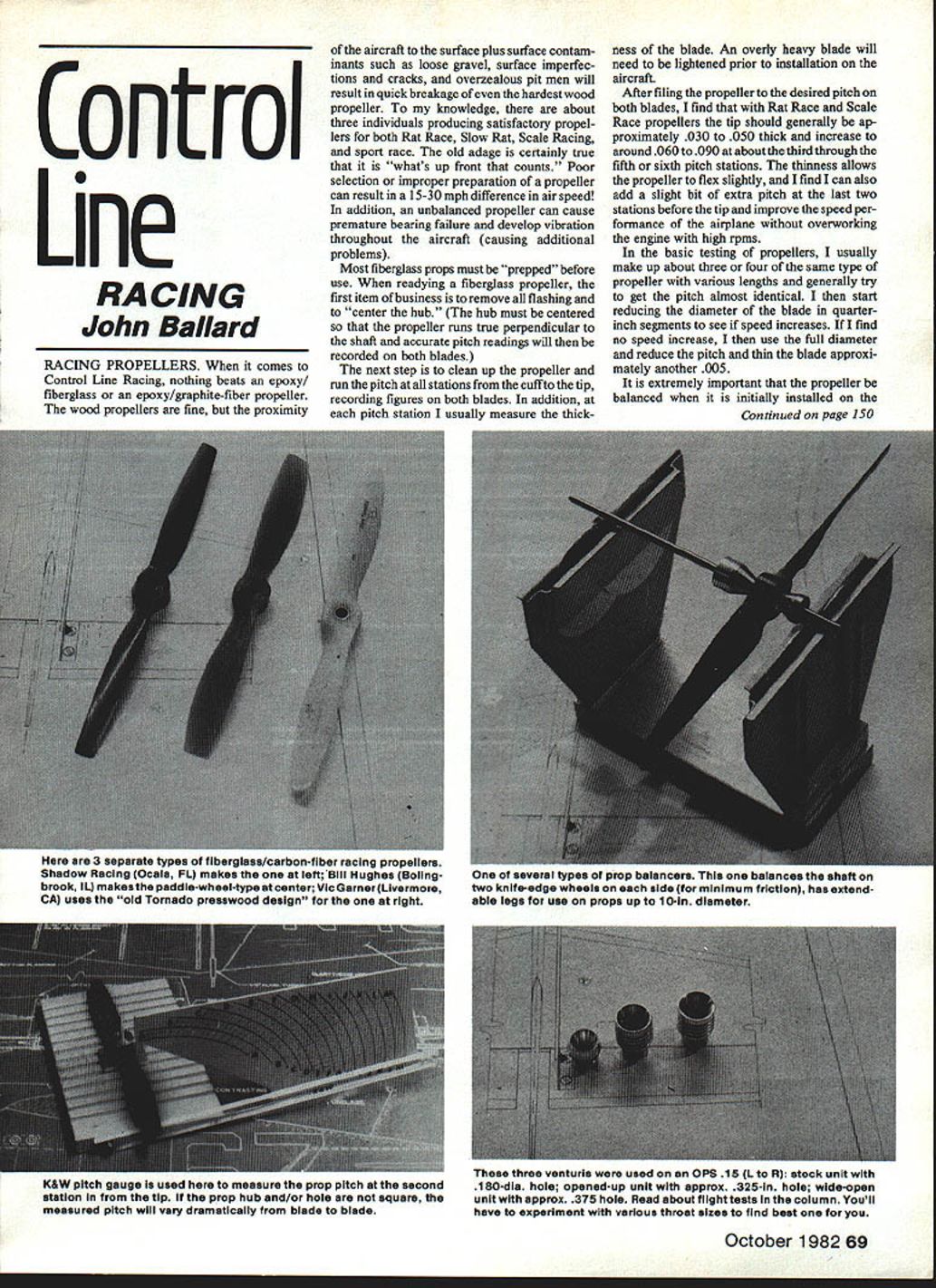
When it comes to Control Line Racing, nothing beats an epoxy/fiberglass or an epoxy/graphite-fiber propeller. Wood propellers are usable, but the proximity of the aircraft to the surface — plus surface contaminants such as loose gravel, surface imperfections and cracks, and overzealous pit men — results in quick breakage of even the hardest wood propeller. To my knowledge, there are about three individuals producing satisfactory propellers for Rat Race, Slow Rat, Scale Racing, and sport race. The old adage is certainly true that it is "what's up front that counts." Poor selection or improper preparation of a propeller can result in a 15–30 mph difference in airspeed. In addition, an unbalanced propeller can cause premature bearing failure and develop vibration throughout the aircraft (causing additional problems).
Propeller preparation steps:
- Remove all flashing and center the hub (the hub must be centered so the propeller runs true perpendicular to the shaft and accurate pitch readings will be recorded on both blades).
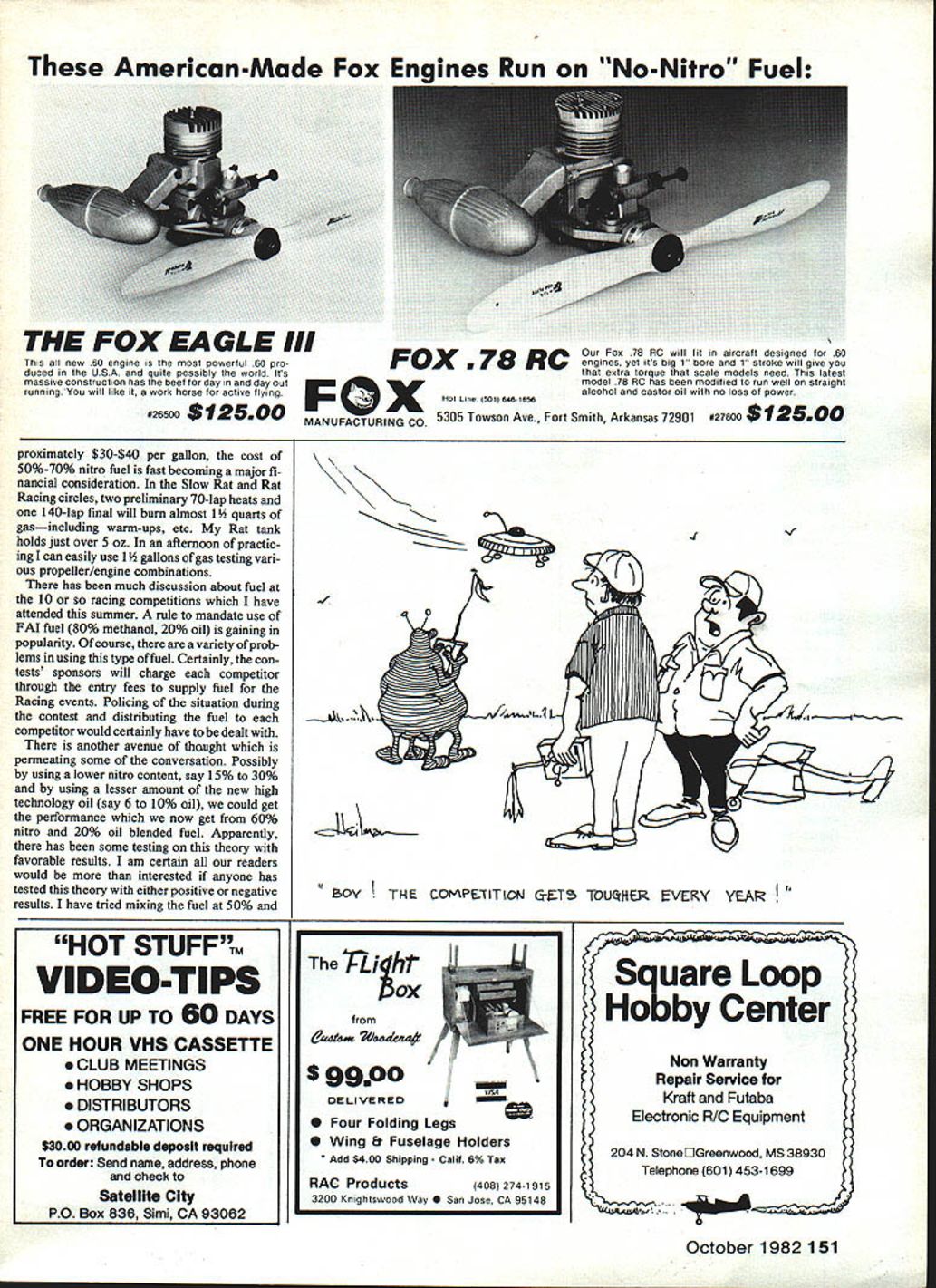
- Clean up the propeller and run the pitch at all stations from the cuff to the tip, recording figures on both blades.
- At each pitch station measure the thickness of the blade. An overly heavy blade will need to be lightened prior to installation.
After filing the propeller to the desired pitch on both blades, for Rat Race and Scale Race propellers I generally aim for:
- Tip thickness: approximately .030 to .050 inches.
- Mid-blade thickness: increase to around .060 to .090 inches at about the third through the fifth or sixth pitch stations.
The thin tip allows the propeller to flex slightly. I also add a slight extra pitch at the last two stations before the tip to improve speed performance without overworking the engine.
Propeller testing procedure:
- Make three or four props of the same type with various lengths, keeping the pitch almost identical.
- Reduce the diameter of the blade in quarter-inch segments to see if speed increases.
- If reducing diameter provides no speed increase, return to full diameter, reduce the pitch, and thin the blade approximately another .005 inches.
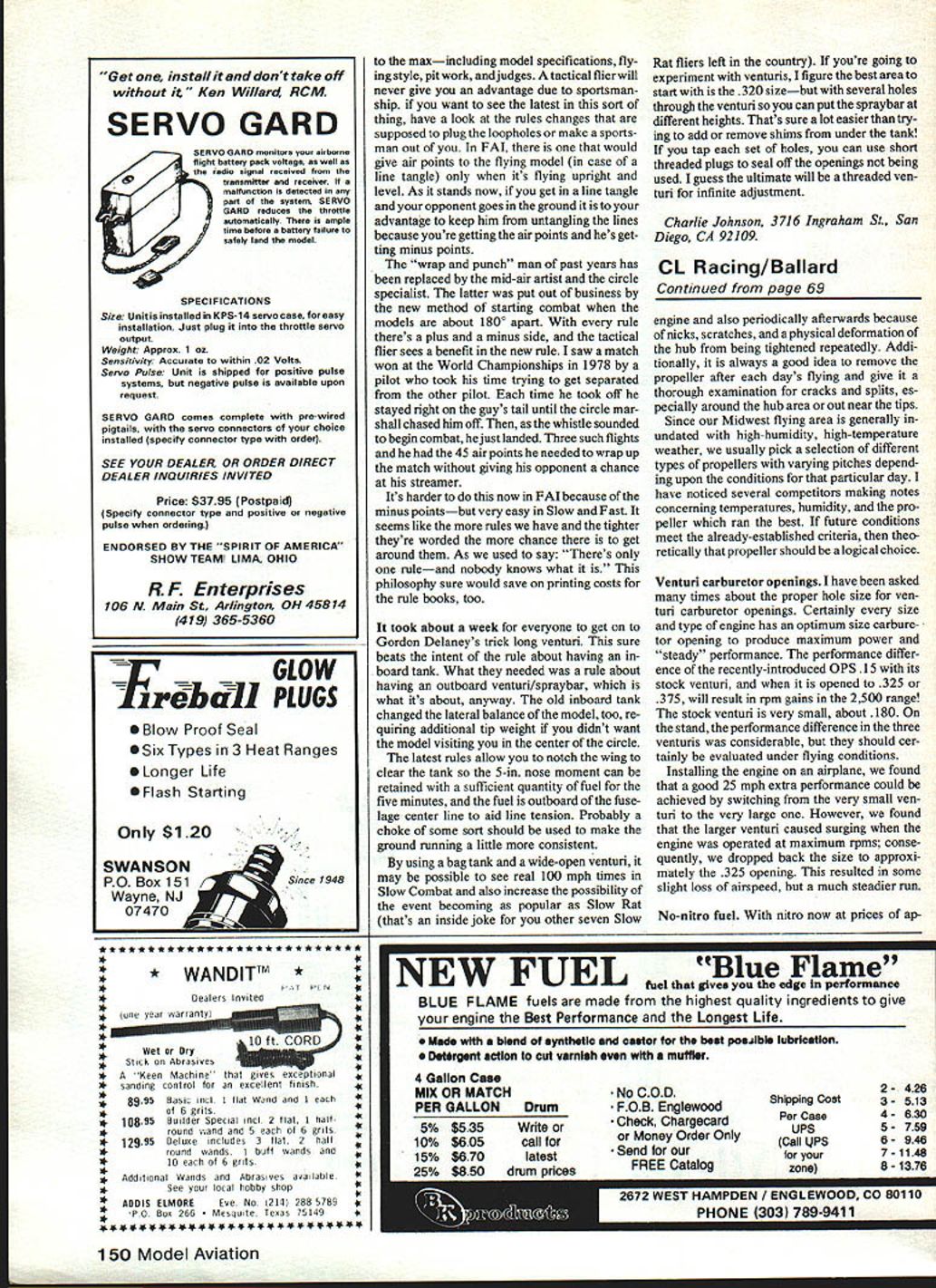
It is extremely important to balance the propeller when it is initially installed and periodically afterward because of nicks, scratches, and hub deformation from repeated tightening. Remove the propeller after each day's flying and thoroughly examine it for cracks and splits, especially around the hub area and near the tips.
Because our Midwestern flying area often has high humidity and high temperature, we select a range of propellers with varying pitches depending on daily conditions. Several competitors make notes concerning temperature, humidity, and which propeller ran best; if future conditions match those criteria, that propeller is a logical choice.
Venturi Carburetor Openings
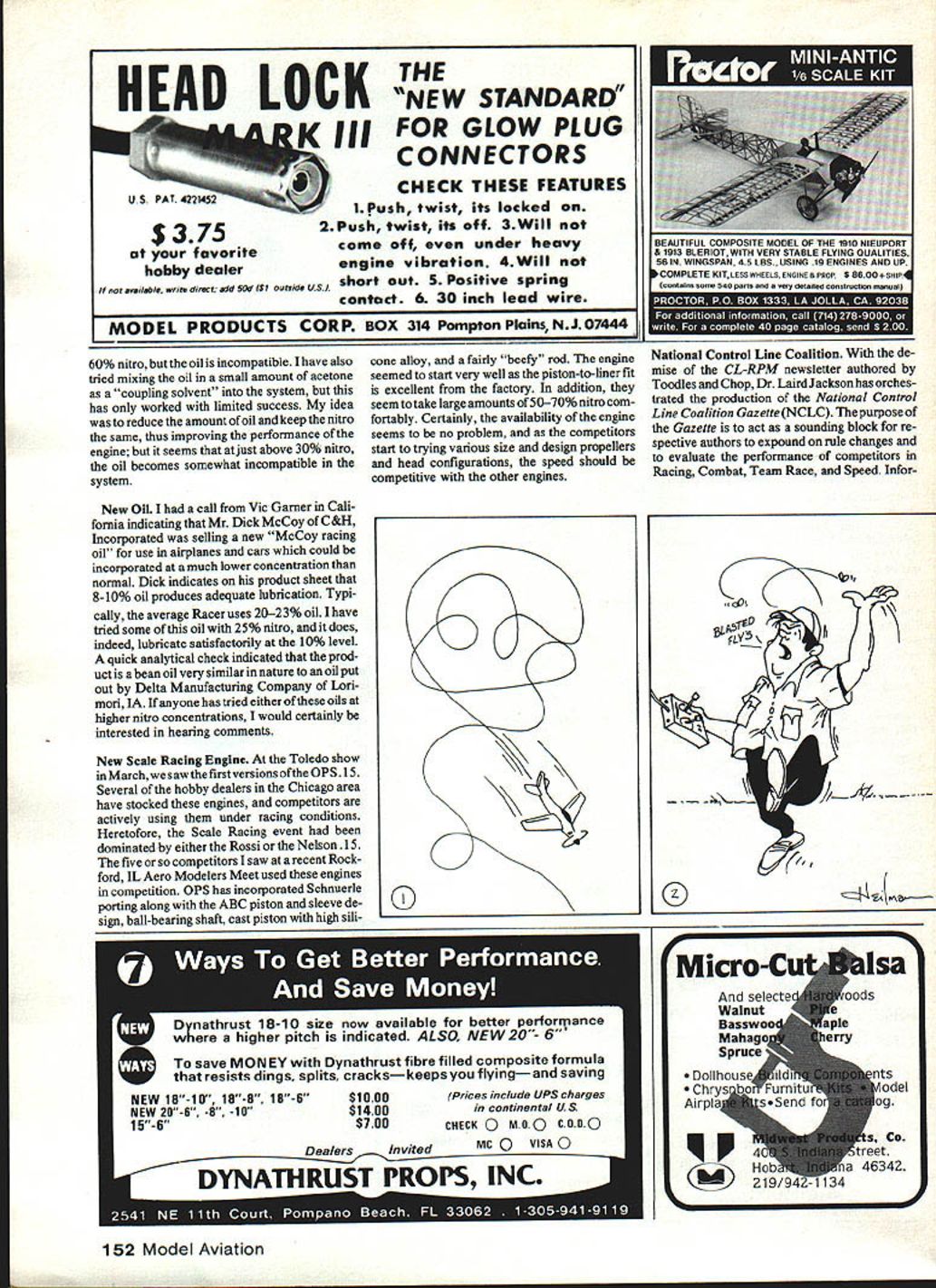
I have been asked many times about the proper hole size for venturi carburetor openings. Every engine size and type has an optimum carburetor opening to produce maximum power and steady performance. For example, the recently introduced OPS .15 twin with its stock venturi (about .180 inches) and when opened to .325 or .375 inches produced RPM gains on the order of 2,500 RPM. The performance difference among the three venturis was considerable, but they should be evaluated under flying conditions.
When installing the engine on an airplane, we found a roughly 25 mph gain by switching from the very small venturi to the very large one. However, the larger venturi caused surging at maximum RPMs, so we settled on a roughly .325-inch opening. This resulted in some slight loss of airspeed but a much steadier run.
No-nitro Fuel
With nitro now costing approximately $30–$40 per gallon, the cost of 50%–70% nitro fuel is a significant financial consideration. In Slow Rat and Rat Racing, two preliminary 70-lap heats and one 140-lap final will burn almost 1½ quarts of fuel — including warm-ups. My Rat tank holds just over 5 oz. In an afternoon of practicing I can easily use 1½ gallons of fuel testing various propeller/engine combinations.
There has been much discussion about fuel at the racing competitions I attended this summer. A rule mandating use of FAI fuel (80% methanol, 20% oil) is gaining popularity. Of course, using this type of fuel raises logistical issues: sponsors would likely supply the fuel through entry fees, and policing and distribution during the contest would need to be addressed.
Another idea being discussed is using lower nitro content (15%–30%) with a lesser amount of the new high-technology oil (6%–10%) to achieve performance similar to 60% nitro with 20% oil. Some testing on this theory has had favorable results. If anyone has tested this with positive or negative results, readers would be interested.
I have tried mixing fuels at 50% and 60% nitro, but the oil proved incompatible. I also tried dissolving oil in a small amount of acetone as a coupling solvent into the system, but that had only limited success. My original idea was to reduce the amount of oil and keep nitro the same to improve engine performance, but it seems that above about 30% nitro the oil becomes somewhat incompatible in the system.
New Oil
Vic Garner in California informed me that Mr. Dick McCoy of C&H, Inc. is selling a new "McCoy racing oil" for airplanes and cars which can be used at much lower concentrations than normal. Dick's product sheet indicates 8%–10% oil produces adequate lubrication. Typically, the average racer uses 20%–23% oil. I tried some of this oil with 25% nitro, and it did lubricate satisfactorily at the 10% level. A quick analytical check indicated the product is a bean oil very similar to an oil produced by Delta Manufacturing Company of Lorimor, IA. If anyone has tried either of these oils at higher nitro concentrations, I would be interested in hearing comments.
New Scale Racing Engine
At the Toledo show in March we saw the first versions of the OPS .15. Several hobby dealers in the Chicago area have stocked these engines, and competitors are actively using them under racing conditions. Previously, Scale Racing had been dominated by the Rossi or the Nelson .15. The competitors I saw at a recent Rockford, IL Aero Modelers meet used OPS .15s in competition.
OPS has incorporated Schnuerle porting along with an ABC piston-and-sleeve design, a ball-bearing shaft, a cast piston with high-silicon cone alloy, and a fairly beefy rod. The engine seems to start very well due to an excellent piston-to-liner fit from the factory, and they appear to tolerate large amounts of 50%–70% nitro comfortably. Availability does not seem to be a problem, and as competitors experiment with various propeller sizes, designs, and head configurations, speeds should become competitive with other engines.
National Control Line Coalition
With the demise of the CL-RPM newsletter by Toodles and Chop, Dr. Laird Jackson has organized the production of the National Control Line Coalition Gazette (NCLC). The Gazette is intended as a forum for authors to discuss rule changes and evaluate competitor performance in Racing, Combat, Team Race, and Speed. Information on the Gazette can be obtained by writing:
National Control Line Coalition 707 Second Street Davis, CA 95616
If any racers would like to see a subject discussed in this column, please contact me at:
John C. Ballard 10102 Kimberwick Dr. Louisville, KY 40223
Transcribed from original scans by AI. Minor OCR errors may remain.

