
Control Line: Racing
Bill Lee
I HOPE BY NOW you all have read the new Slow Rat rules that have become part of the AMA rule book. If not, they go something like this. Plane must be 300 sq. in. minimum with a 1 in. thick wing at all points except the last two inches of each tip, 24 in. prop hub to elevator hinge, fuselage length, canopy and rudder required, .36 cu. in. max displacement, engines suction only, landing gear required. Get the AMA rules for the details.
I don't know if you agree or disagree with the Slow Rat rules as they finally were passed. But at least there is now one set of rules that maybe can get enough nationwide backing to try and straighten out the can of worms that Slow Rat has been until now. I was the one who made the original rules proposal two years ago to try to get some order into the rules. The rules are very close to what we have been flying in Texas for the last several years and they do work if you give them a half a chance. Just because they are not exactly the same as what you may have been using in your area, don't knock them until you have tried them. And if you still want to Monday-morning quarterback, go right ahead. I've got a very thick skin and I do like to get letters indicating somebody reads this column once in a while.
All I can say is the rules cycle is on now; you have your chance to modify the Slow Rat rules if you will get up off your tail feathers and do something besides talk. A lot of griping and complaining doesn't change the situation one little bit. You have to put up or get it done or shut up the complaining. Every AMA member has the right to submit rules change proposals. If you don't like what others are doing, then try to pitch in and help rather than moan and groaning.
How Fast is Fast? One thing that runs through many letters I receive is "How do I get my Rat (Goodyear, etc.) to go?" Another thing I hear at contests, and at the local practice sessions, is all about that last super fantastic 11.0 second time that somebody's Rat turned yesterday but just won't quite do today. I'm convinced that there should be as many fast Rats as there are fast watches! Boy, the competition would really be great! But how fast do you really have to be to be a winner? Eleven seconds, 12 seconds? Surely, you have to be in the low 12s to turn those Nats winning times. Bull! Would you be satisfied to turn a 4:45 for 140 laps? Most of us would and it isn't in the airplane where you get those kind of times. It's on the ground, Turkey.
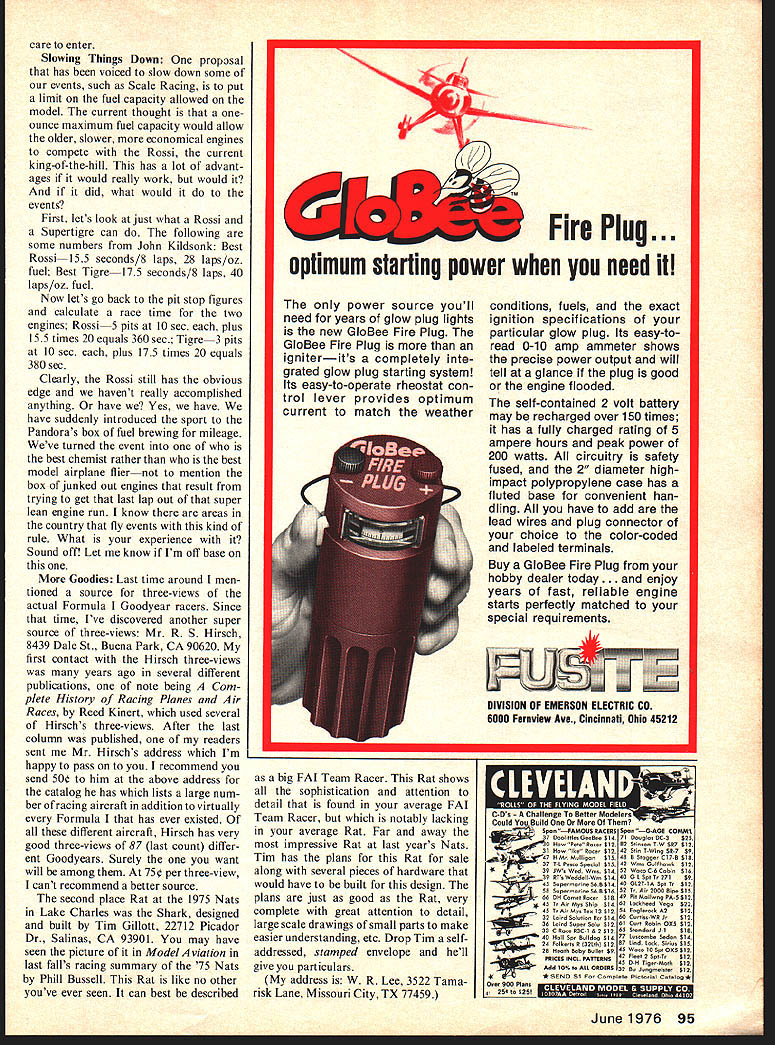
First, let's talk about how you measure the length of a pit stop. There is really only one way to do it to eliminate all the variables and guess-work. And that is you don't time the pit stop itself, you time a half mile (seven laps for Rat, eight for Goodyear) with the pit stop somewhere in the middle! The difference between that time and the time for a half mile without... (continued on page 94) a stop is what the pit stop cost you to make. This is the only method that takes into account the various factors which, individually, are impossible to measure, such as how fast the pilot can stop the model after he shuts off the engine, how fast the pit man can restart it, and how fast the model accelerates back to flight speed.
Now, what is a good pit stop? I'll tell you, measured with the above method, a good pit is ten seconds. An excellent pit stop is six to seven seconds. An average pit stop is probably in the vicinity of 15 to 20 seconds. And then there are those kind I seem to always be making that go on up from there. These values are not just idle speculation. I had a chance to time some fliers at the Nats while they were practicing. One Rat I recall was running 13.0 for seven laps and clocked 26.2 for seven laps with a pit stop in the middle. This was not a super fast stop since the fellows were only in practice but it is right in the middle of the ballpark.
Let's figure it out. Assume we have a Rat that will consistently turn 13.0 flat. That's right, 13 flat! That's for seven laps. Fourteen laps are 26 seconds; 140 laps in 260 seconds. That's 4:20. Now add in the time lost for two pit stops of 20 seconds (O.K., they're good pit stops) which gives us 4:40. Now add in what we lost on the start (about five seconds) and you have that 4:45 time I was talking about. And remember, there was a 13.0 flat Rat! So what is this I'm saying? Well, today the Rats may be a lot faster, the engines are more powerful, it's not the same event it was ten years ago. But one thing has remained constant ever since there was the first race a long time ago: it's on the ground! Any stock modern .40 in a decent pan-style Rat will turn 13 flat. Which leaves those trophy winning times completely on the shoulders of the pit stop. As a point of comparison, the Nats last year was won with a time of 4:35, or there about, and second place was around 4:41. Not far off our 4:45 that a 13-flat Rat can turn.
Now let's work it out for an 18.0-second Goodyear. That's for eight laps. Sixteen in 36 seconds, 160 in 360 seconds. Six minutes for air time on a 160-lap race. Now add in the 30 seconds for the lost time on the three pit stops, and five seconds for the start and you suddenly have a 6:35 final in Goodyear out of an 18-flat plane. The Nats last year was won by John Ballard at 6:31, again not far off from 6:35 from our terribly slow 18.0 Goodyear. Run 17 flat with good stops and you will be at 6:15. Super times are not far off as you may think they are, if you will only work on the pits and not worry so much about making that thing go that extra second faster! A 13-second Rat that is consistent, coupled with good pit stops that are consistently good, will win most contests you go to.
The real way to improve pit stops is practice. Work out some efficient system with your pitman and pilot. Don't change things around all the time. Learn to do the same operation every time, then practice that same operation over and over until it becomes automatic. Plan the system well and keep it simple. Use clear signals, have the pitman wear thin gloves, keep the plane standing on the ground with the wings level, keep the needle-valve location accessible, don't get in the habit of slipping the tank out of the plane, hold the plane steady, and don't fumble. A good practice is to have the pilot cut the engine first with a finger on the prop and then hand the airplane to the pitman who immediately flips the prop through and restarts the engine. The pitman should be able to rest the plane on his thigh or forearm and operate the starter with the other hand. A quiet, practiced, and smooth pit stop will beat a fast but sloppy pit stop every time. Slowing Things Down: One proposal that has been voiced to slow down some of our events, such as Scale Racing, is to put a limit on the fuel capacity allowed on the model. The current thought is that a one-ounce maximum fuel capacity would allow the older, slower, more economical engines to compete with the Rossi, the current king-of-the-hill. This has a lot of advantages if it would really work, but would it? And if it did, what would it do to the events?
First, let's look at just what a Rossi and a Supertigre can do. The following are some numbers from John Kildsork: Best Rossi—15.5 seconds/8 laps, 28 laps/oz. fuel; Best Tigre—17.5 seconds/8 laps, 40 laps/oz. fuel.
Now let's go back to the pit stop figures and calculate a race time for the two engines: Rossi—5 pits at 10 sec. each, plus 15.5 times 20 equals 360 sec.; Tigre—3 pits at 10 sec. each, plus 17.5 times 20 equals 380 sec.
Clearly, the Rossi still has the obvious edge and we haven't really accomplished anything. Or have we? Yes, we have. We have suddenly introduced the sort of Pandora's box of fuel brewing for mileage. We've turned the event into one of who is the best chemist rather than who is the best model airplane flier—not to mention the box of junked out engines that result from trying to get that last out of that super-lean engine run. I know there are areas in the country that fly events with this kind of fuel. What is your experience with it? Sound off! Let me know if I'm off base on this one.
More Goodies: Last time around I mentioned a source for three-views of some actual Formula I Goodyear racers. Since that time, I've discovered another super source of three-views: Mr. R. S. Hirsch, 8439 Dale St., Buena Park, CA 90620. My first contact with the Hirsch three-views was many years ago in several different publications, one of note being A Complete History of Racing Planes and Air Races, by Reed Kincet, which used several of Hirsch's three-views. After the last column was published, one of my readers sent me Mr. Hirsch's address which I'm happy to pass on to you. I recommend you send 50¢ to him at the above address for the catalog he has which lists a large number of racing aircraft in addition to all those different aircraft. (Hirsch also has over 800 three-views (last count) different Goodyears. Surely the one you want will be among them. At 75¢ per three-view, I can't recommend a better source.)
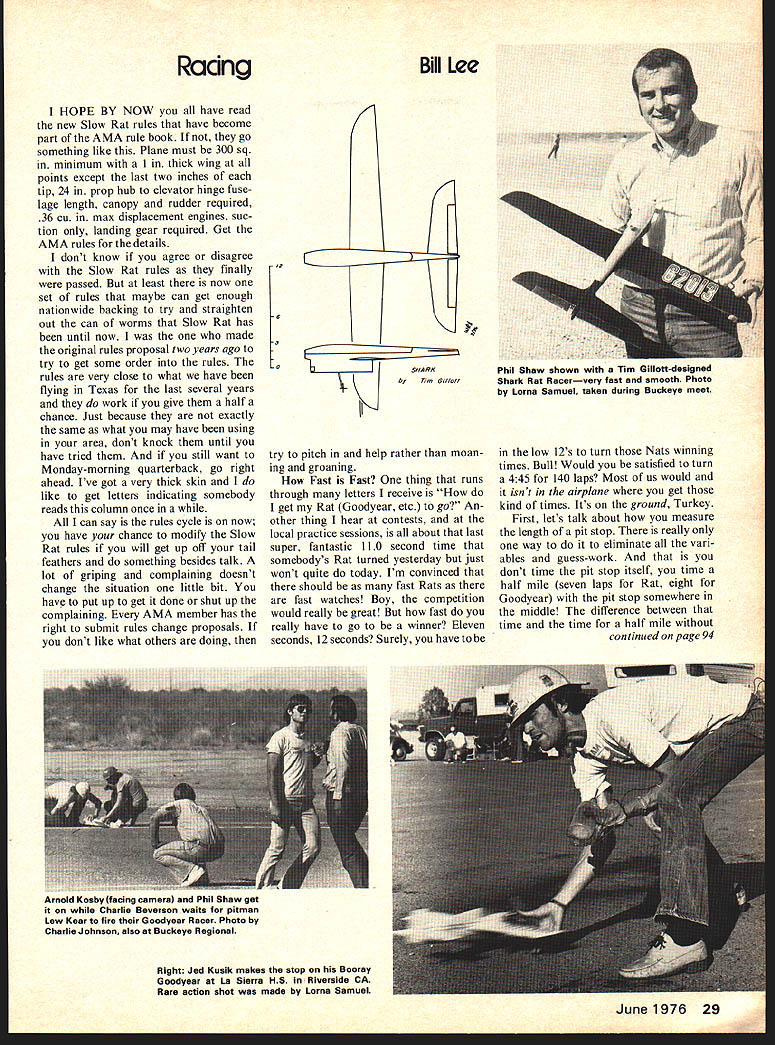
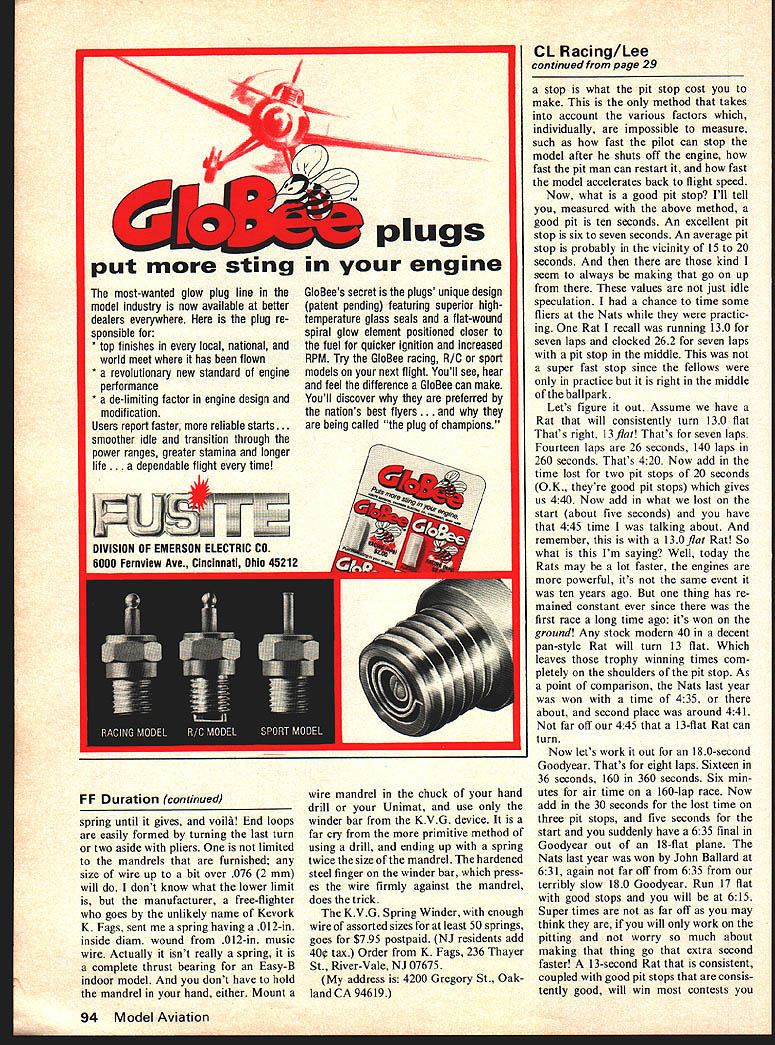
The second place Rat at the 1975 Nats in Lake Charles was the Shark, designed and built by Tim Gillott, 2712 Picarpo Dr., Salinas, CA 93901. You may have seen the picture of it in Model Aviation in last fall's racing summary of the '75 Nats by Phil Bussell. This Rat is like no other you've ever seen. It can best be described as a big FAI Team Racer. This Rat shows the sophistication and attention to detail that is found in your average FAI Team Racer, but which is notably lacking in your average Rat. Far and away the most impressive Rat at last year's Nats, Tim has the plans for this Rat for sale along with several pieces of hardware that would have to be built for this design. The plans are just as good as the Rat, very complete with great attention to detail, large scale drawings of small parts to make easier understanding, etc. Drop Tim a self-addressed, stamped envelope and he'll give you particulars.
(My address is: W. R. Lee, 3522 Tamarisk Lane, Missouri City, TX 77459.)
Transcribed from original scans by AI. Minor OCR errors may remain.

