
Control Line: Racing
John Ballard
Slow Rat
The telephone lines and the mail service have been kept busy with a variety of requests and opinions relative to rules proposals and personal views concerning the Slow Rat event. Basically, opinions seem to revolve around slowing the event to a reasonable speed at which the expertise required is within the average pilot's ability, and reducing the amount of "high-technology" equipment involving the fuel tank, fillers, fuel, and venturi combinations.
Several correspondents suggested lowering the nitro content of the fuel to either an 80/20 alcohol/oil blend (no nitro) or to about 10% nitro, with both fuels furnished by contest management. I have run most of my equipment on 10% nitro and on 80/20 blends and find the airspeed is only reduced by approximately one second per seven laps.
While this does slow the aircraft considerably, it still means these planes are traveling at roughly 120–130 mph. In my opinion, it would still take a pilot in the "professional" category to maneuver one of these aircraft.
Sport Race
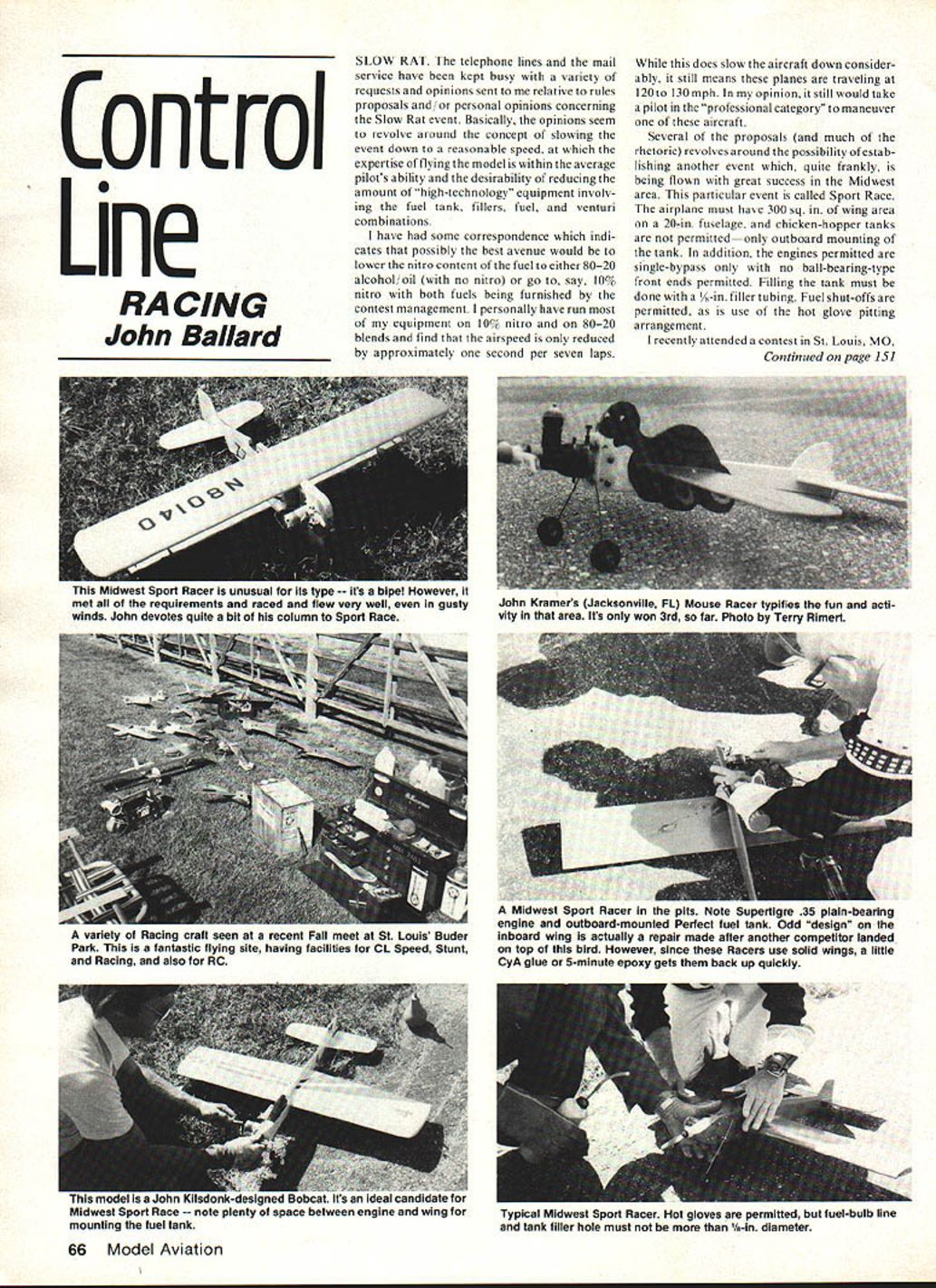
Several proposals and a lot of rhetoric have revolved around establishing another event that is already being flown with success in the Midwest: Sport Race. The Sport Race rules and practice I observed include:
- Airplane must have 300 sq. in. of wing area on a 20-inch fuselage.
- Chicken-hopper tanks are not permitted; only outboard mounting of the tank is allowed.
- Engines permitted are single-bypass only, with no ball-bearing-type front ends.
- Tank filling must be done with 1/8-inch filler tubing.
- Fuel shut-offs are permitted, as is use of the hot-glove pitting arrangement.
I recently attended a Sport Race contest in St. Louis, MO, directed by Gary Frost, which had 28 entries. The predominant engine was the Supertigre .35 plain-bearing engine, and airplane lap times were in the 19.5–23 second range. Heats are flown 100 laps with three pilots in a circle; with the large amount of racing I saw no line tanglements or problems in pitting.
At first glance, the difference between a "reduced" Slow Rat time of 14–15 seconds and a Sport Race time of about 20–23 seconds represents an enormous difference in airspeed. This increases the maneuverability of the Sport Race aircraft and makes for a more accessible and fun event.
There is an "unwritten law" in the development of this event that professional fliers generally do not enter. If such an event were ever made an official or provisional AMA event, I believe professionals should be excluded from competing. That limitation would promote the event, since the average modeler could construct and fly one of these airplanes without too much difficulty. It would also serve as a good starting ground for people who want to move up into the pro ranks.
Everyone I spoke with agreed on the need to bring new blood and competitors into Racing. Eliminating expert/professional entry in this event would help maintain it as a training ground for new pilots and pit crews. Frankly, I believe this was the original intent for Slow Rat; however, professionals soon took it over and entries dropped from the 25–40 category down to eight or ten. The event became so highly specialized that only a few people committed the time and equipment necessary to compete.
For information on Supertigre or PAMPA, contact Wynn Paul, 1640 Maywick Dr., Lexington, KY 40504.
Super-light Airplane Experience (Larry's Golden Bantam)
The combination of fuel and vibration is taking its toll on very light construction. After some repairs to the outboard wing (which broke in half after some hard landings—the leading and trailing edges were fractured and the whole wing folded) and after stiffening the fuselage and stabilizer, the plane now weighs in at 49 oz.
Larry admits he went all out to get a super-light plane, but there are inherent difficulties with extremely light construction. He spent a lot of time in the summer of 1982 repairing his plane when he could have been practicing. It was difficult to trim the airplane because of wing flex, stabilizer flex, and fuselage flex.
What can be learned from this analysis of a super-light airplane with a 750 sq. in. wing? Keep in mind the wing loading of this airplane is about 10.85 oz./sq. ft., compared with a "typical" Genesis by Bob Hunt at about 12.35 oz./sq. ft. and a "typical" Gieseke Nobler at 11.20 oz./sq. ft. The Supertigre engine is able to pull this airplane with relative ease; however, Larry admits he may have gone too far in striving for lightness. The stresses of performing the Stunt pattern may simply be too much for a plane like his Golden Bantam.
For 1983 Larry planned a new airplane with an added wing spar, 5/16-inch fuselage sides, and stiffer stabilizer construction. At the time of writing, the 1983 airplane was about five ounces heavier than the 1982 plane. He intends to use the same type of finish, so he could end up with a 750 sq. in. airplane that weighs about 54–55 oz., and this would still be competitive. He also built in six engine-mounting holes so he can interchange the Supertigre with the OS Max .45 without an unsightly gap at the nose ring. We'll see how Larry's new plane performs in the summer of 1983.
Mouse Racing
I have received several letters from modelers seeking a good, stable airplane for Mouse Racing. If you were at the Nats you may recall the heavy wind and its disastrous results for many Mouse Racers. One of my builder-designer colleagues, Vic Garner, had a Mouse that performed flawlessly even in heavy turbulence. He has prepared drawings for his design, and I built one for my 13-year-old son. The plane flies very well with a Cox Black Widow engine, has excellent stability in windy weather, and has smooth landing and takeoff characteristics.
Many Mouse Racing items—engine modification kits, wheels, bellcranks, flying wire, etc.—can be purchased from Kustom Kraftsmanship in Laguna Hills, CA. I will publish drawings of Vic's Mouse in a future column.
Terry Rimert (Baldwin, FL) wrote about Mouse Racing activity in Jacksonville, FL. He sent an example of the latest local design; it took third in their midsummer contest and was flown by John Kramer. You can tell this little speedster would certainly brighten up Racing circles.
John Ballard 10102 Kimberwick Dr. Louisville, KY 40223
Transcribed from original scans by AI. Minor OCR errors may remain.

