
Control Line: Racing
John Ballard
Use 10% Nitro?
I must say the response from Racing enthusiasts all over the country on the subject of limiting the nitro content of fuel has been overwhelming. I received over 50 written responses from Racers from almost every state. In addition, I received numerous long-distance phone calls with additional input. It seems that, in many areas of the country, the 10% nitro rule has been tried with great success.
I must admit that, in our Midwest area, it has not been tried; however, I notice that at the May 1 Control Line contest in St. Louis, all Racing events will be run with 10% nitro furnished by the contest management. Furthermore, at the May 31 annual contest held by the Chicago Treetown Club, all Racing events will use 10% nitro supplied at the site.
The Racing community as a whole supports the use of 10% nitro in all Racing events. I ran all my equipment on 10% nitro and found that, while it does reduce the airspeed, I am not sure whether the aircraft has been slowed down enough to allow the average or intermediate-level modeler the ability to "compete" realistically with the "professionals" flying in the same event.
Considerable rhetoric revolves around the classification system of Beginner, Intermediate, and Professional—or possibly only the two categories of Intermediate and Professional. This subject has been hashed and rehashed many times at the Racing-participant meetings at the Nats, in newsletters, and at various club meetings. I'm thinking about compiling all the input and probably the best procedure would be to itemize all the suggestions into outline form, print it in a future column, and ask for comments from the Racing competitors themselves. As a group, we can then initiate meaningful rule changes which will benefit the majority of Racing participants.
Cobra Rat Racer
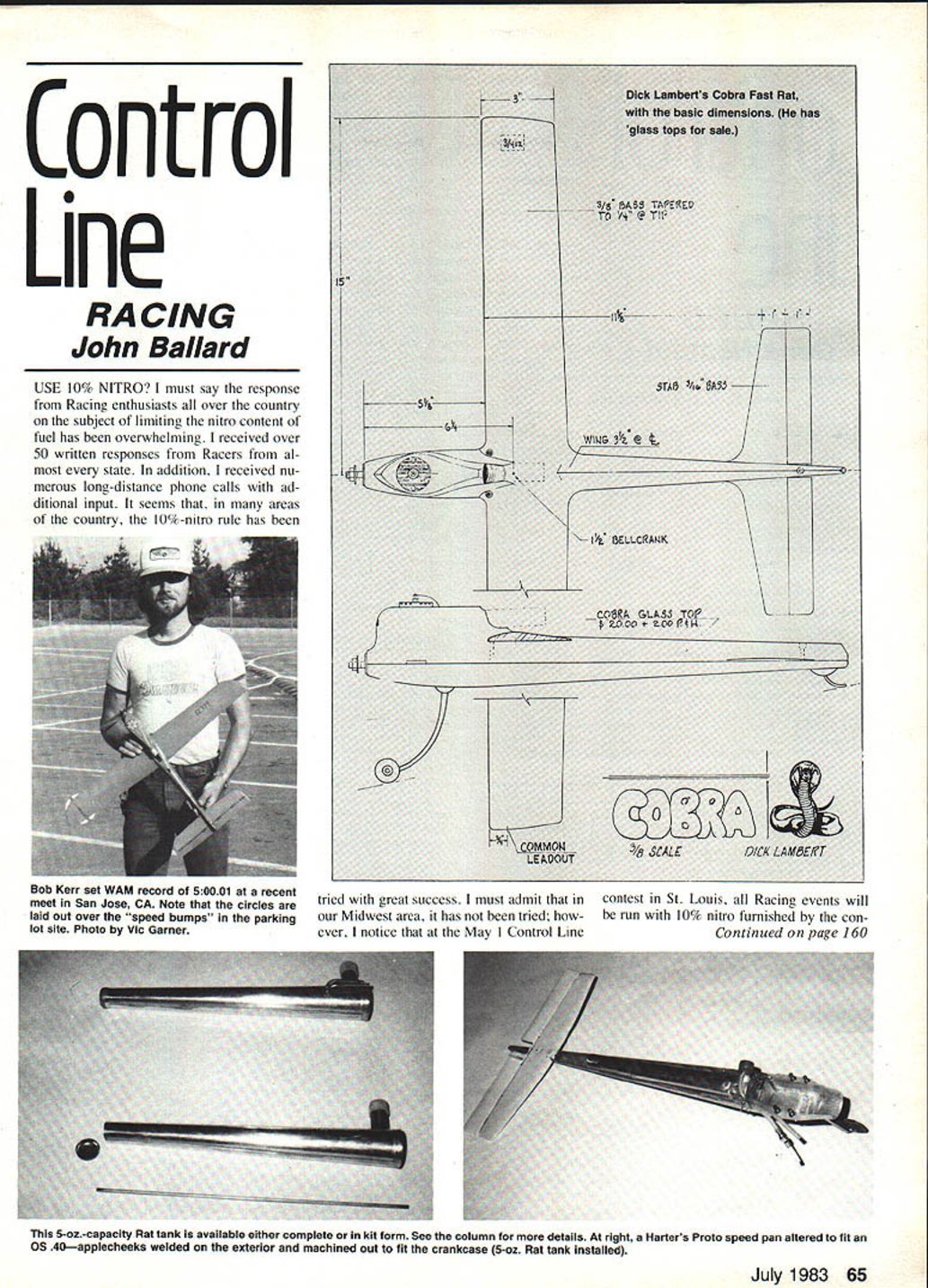
I have had several requests for measurements of Dick Lambert's recently designed Cobra racer, which was unveiled at the 1982 Lincoln Nats. Dick has made a drawing giving the basic measurements, which I've included in this month's column.
The Cobra flew well at the Nats, even in windy conditions, and it can be stopped in the required half-lap. Dick is also producing some glass tops which will accommodate the new OS .40 big-block engine and has a built-in exit hole for the muffler. The tops and any building tips required can be received from:
- Mr. Dick Lambert, 220 South Ridgewood, Port Orange, FL 32019.
New 5-oz. Rat Tank Available
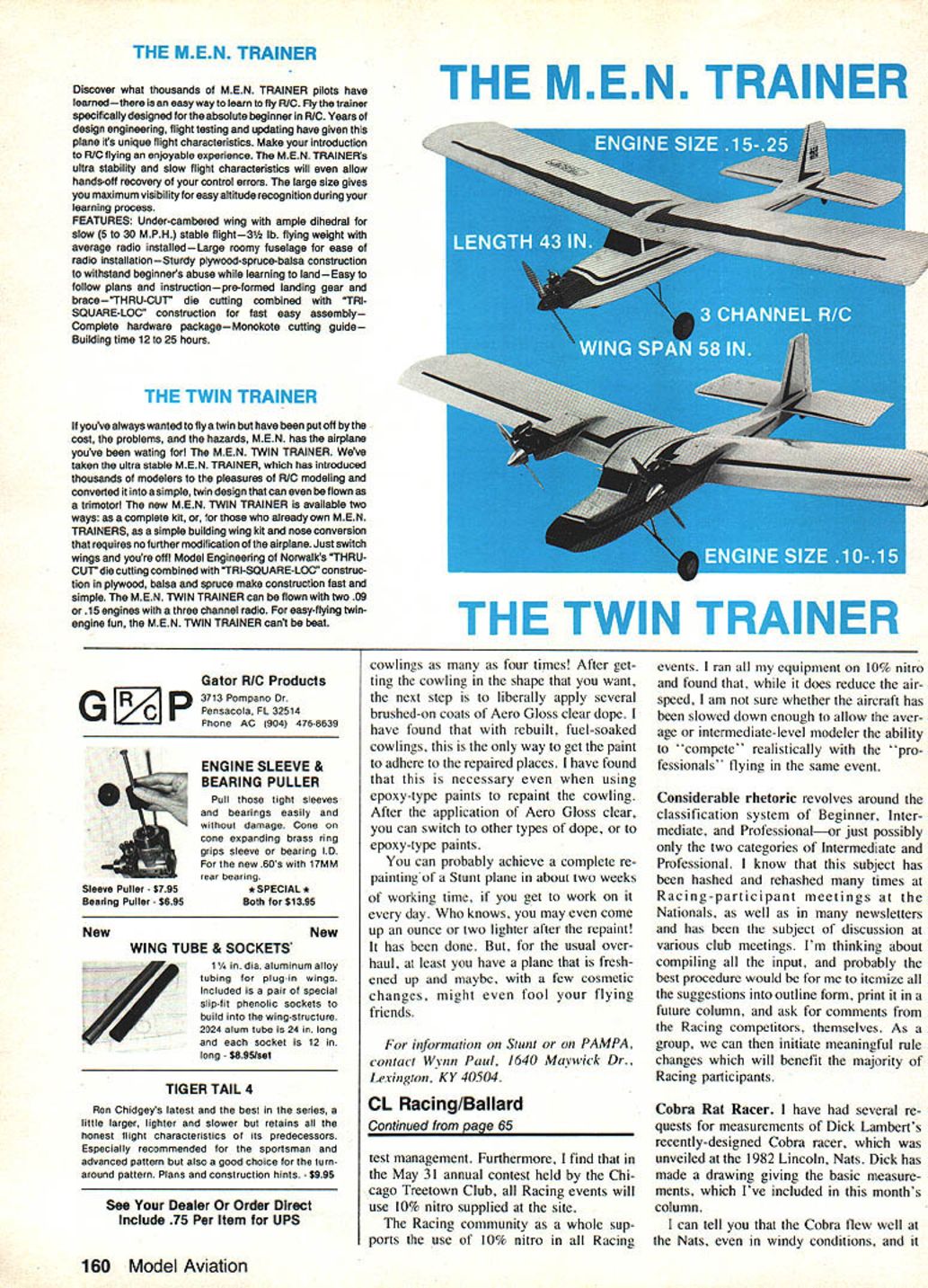
As all Rat Racing enthusiasts are aware, getting enough fuel to the new high-consumption racing engines has been a problem. In the past, we used a typical cylindrical tank or a homemade version thereof. A few years ago, Don's Custom Tanks brought out a "five-oz." Rat tank which, in actual volume measurement, was only approximately 4.24 oz. Many competitors took the old four-ounce cylindrical Rat Race tank, chopped off the rear of it, and added a portion of another tank to receive the full 4½ to 5½ oz. volume required to achieve a consistent engine run for 40–50 laps.
I understand that, due to much prodding by Larry Dziak, Don's has designed a new tank which is now in stock for shipment. The tank has a full five-oz. volume and is available in two models:
- Complete tank: Tubes are mounted, the complete tank at the rear, the pressure tube up at the front and stopping about 1/4 in. from the rear of the tank. This was a typical Racing setup for many years.
- Kit tank: No tubes positioned—only the fill-tube is soldered in place. You receive two pieces of brass tubing, and the rear end cap is left off so that the Racer may install the tubes as he sees fit.
This makes working on the tank much easier than before, when tubes had to be removed, holes plugged, and then resoldered. In addition, a new special "freeze-out plug" rear tank cap is used to give the rear of the tank more strength. The cap portion is heavier gauge metal, reducing vibration at the point of rear attachment to the pan.
Reworking Harter's Rat Pan to Accept the OS .40
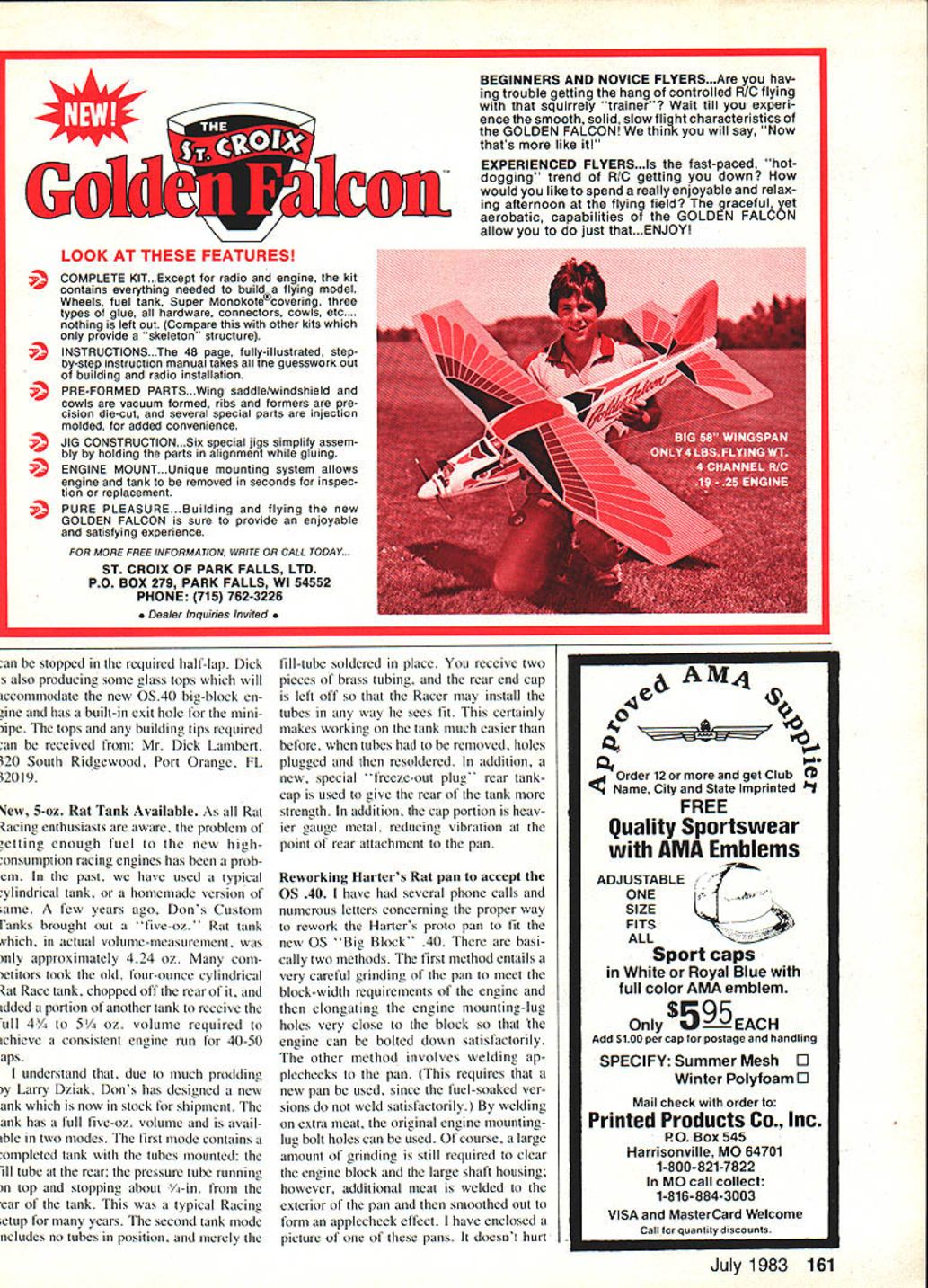
I have had several phone calls and numerous letters concerning the proper way to rework Harter's proto pan to fit the new OS "Big Block" .40. There are basically two methods:
- Grind and elongate: Carefully grind the pan to meet the block-width requirements of the engine, then elongate the engine mounting-lug holes very close to the block so that the engine can be bolted down satisfactorily.
- Weld angle blocks: Weld angle blocks to a new pan (do not use fuel-soaked pans, as they do not weld satisfactorily). By welding on extra material, the original engine mounting lug bolt holes can be used. A large amount of grinding is still required to clear the engine block and the large shaft housing; however, additional material is welded to the exterior of the pan and then smoothed out to form an apple-cheek effect.
It doesn't hurt to put in a new, thicker engine mount and rework the pan mount area to accept the engine. In my opinion, the welding method is the most satisfactory: it improves the performance and certainly strengthens the frontal area of the pan considerably. I have enclosed a picture of one of these pans.
California Racing Under Adverse Conditions
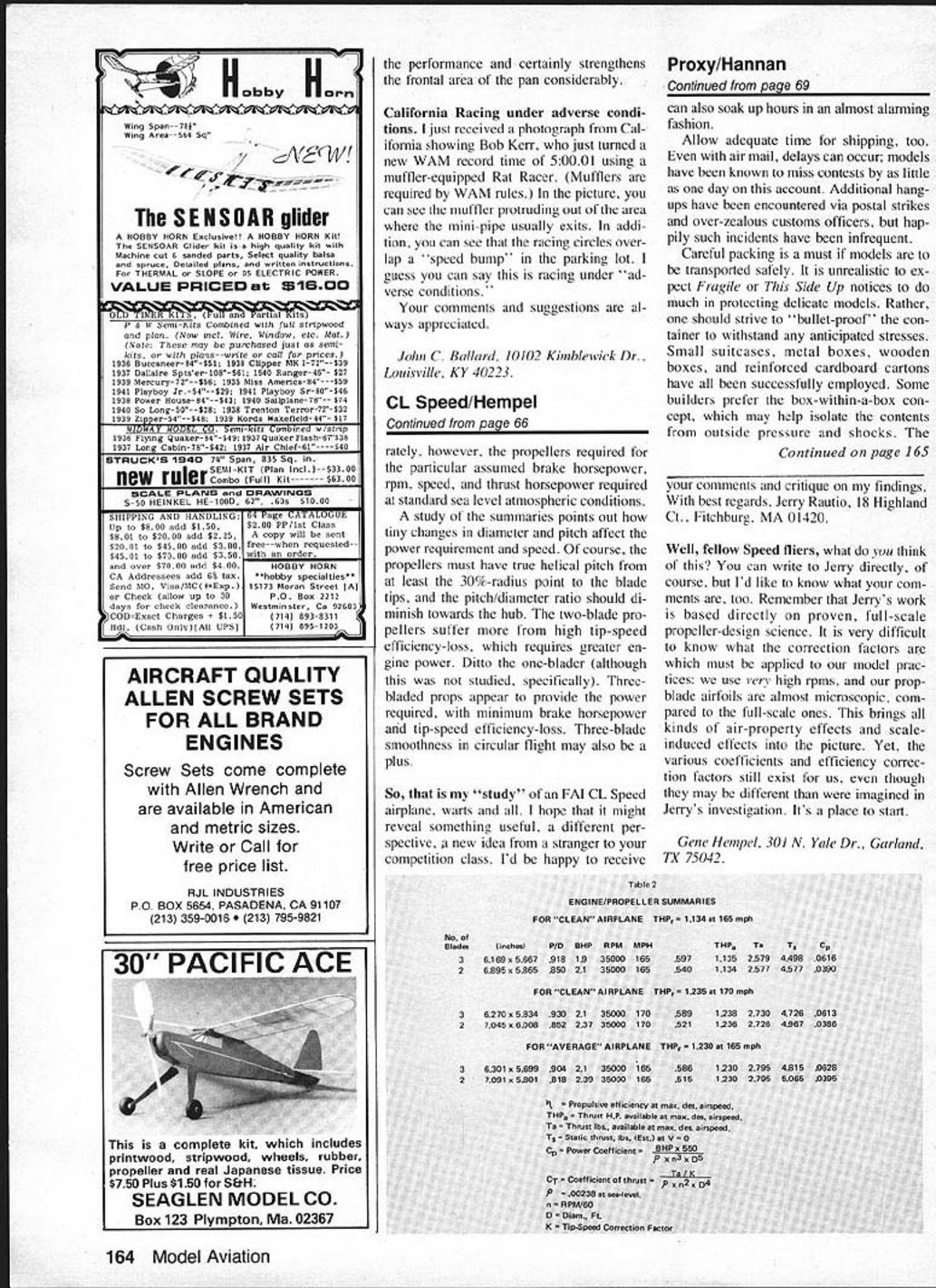
I just received a photograph from California showing Bob Kerr, who just turned a new WAM record time of 5:00.01 using a muffler-equipped Rat Racer (mufflers are required by WAM rules). In the picture, you can see the muffler protruding out of the area where the mini-pipe usually exists. In addition, the racing circles overlap a "speed bump" in the parking lot. I guess you can say this is racing under "adverse conditions."
Your comments and suggestions are always appreciated.
John C. Ballard 10102 Kimblewick Dr. Louisville, KY 40223
Transcribed from original scans by AI. Minor OCR errors may remain.

