
Control Line RACING
John Ballard
ROSSI .15 REWORK
I have had several letters asking about the crank pin replacement on the 10.5 mm Rossi .15 crank. I am sure many of you have had the same problem I have had with the pin shearing off or coming loose in the crank. I have a couple of the re-pinned crankshafts, and I have run one with excellent results.
Mr. Al Herda, 1417 N. Dunton, Arlington Heights, IL 60004, has been quietly doing these. He uses an electrical discharge machine (EDM) to make a new hole for the crank pin. He braze-welds a new high-speed pin, offset-grinds the new pin, and machines a new counterweight band and sweats it on the casing. In addition, he will overbore your crankshaft to any diameter and will guarantee no distortion. This certainly will rejuvenate the rather expensive crankshafts and put some of your "retired" Rossis back into service.
New small prop-holding fixture
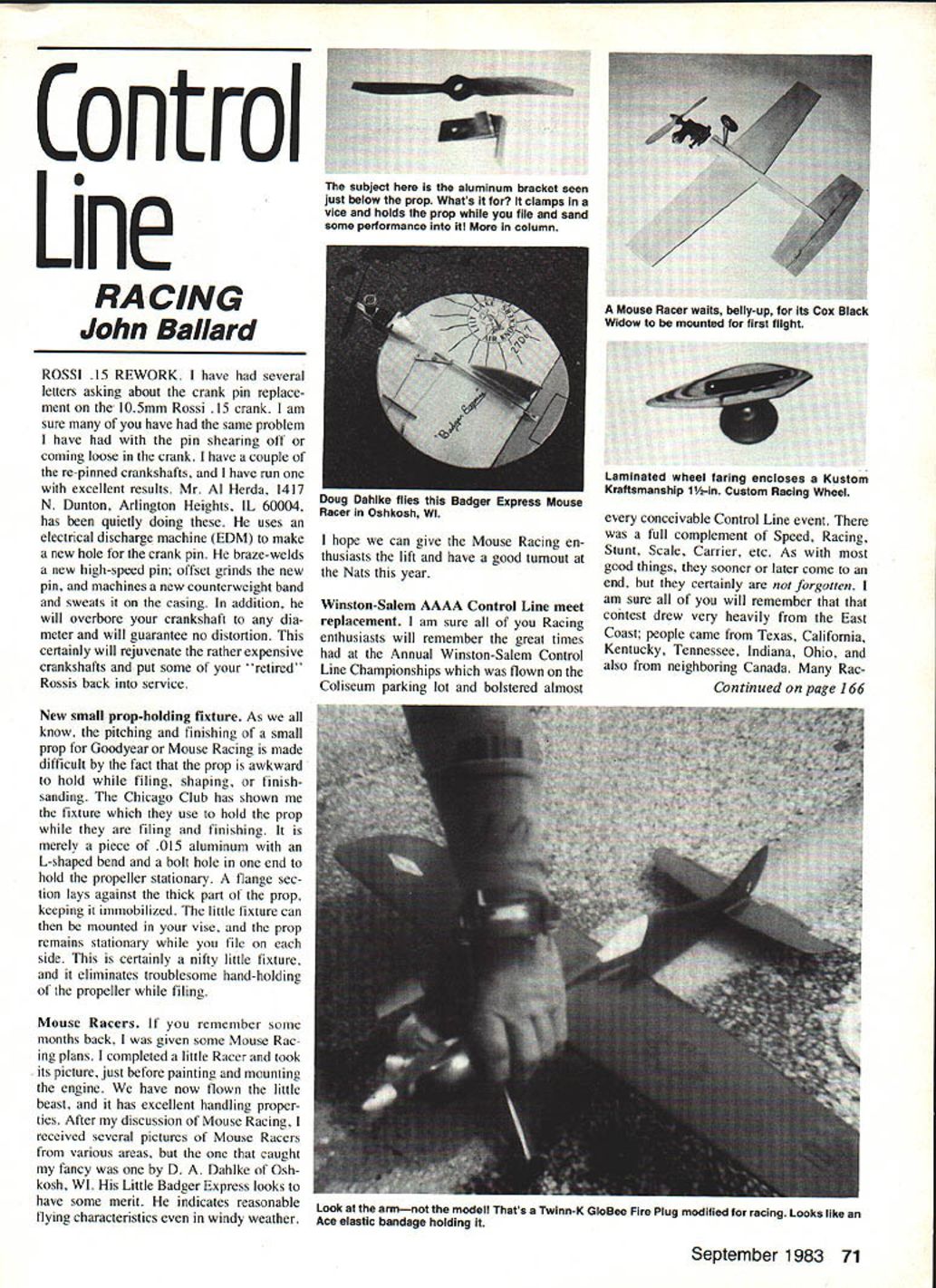
As we all know, the pitching and finishing of a small prop for Goodyear or Mouse Racing is made difficult by the fact that the prop is awkward to hold while filing, shaping, or finish-sanding. The Chicago Club has shown me the fixture they use to hold the prop while filing and finishing. It is merely a piece of .015 aluminum with an L-shaped bend and a bolt hole in one end to hold the propeller stationary. A flange section lays against the thick part of the prop, keeping it immobilized. The little fixture can then be mounted in your vise, and the prop remains stationary while you file on each side. This is a nifty little fixture and eliminates troublesome hand-holding of the propeller while filing.
Mouse Racers
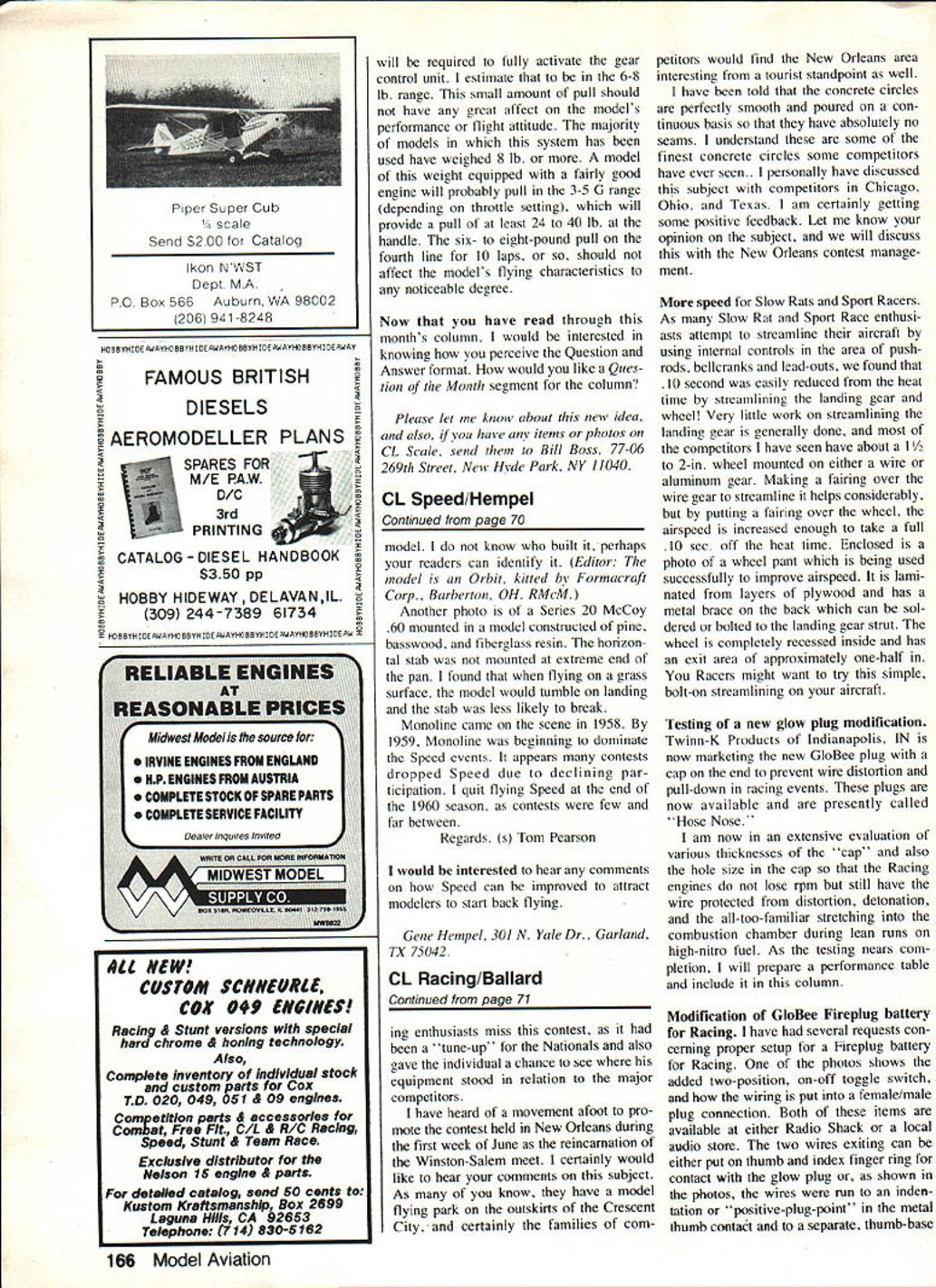
If you remember some months back, I was given some Mouse Racing plans. I completed a little racer and took its picture just before painting and mounting the engine. We have now flown the little beast, and it has excellent handling properties. After my discussion of Mouse Racing, I received several pictures of Mouse Racers from various areas, but the one that caught my fancy was by D. A. Dahlke of Oshkosh, WI. His Little Badger Express appears to have some merit and shows reasonable flying characteristics even in windy weather.
I hope we can give the Mouse Racing enthusiasts a lift and have a good turnout at the Nats this year.
Winston-Salem AAAA Control Line meet replacement
I am sure all racing enthusiasts will remember the great times had at the annual Winston-Salem Control Line Championships, which was flown on the Coliseum parking lot and featured almost every conceivable control line event. There was a full complement of Speed, Racing, Stunt, Scale, Carrier, etc. As with most good things, they sooner or later come to an end, but they certainly are not forgotten. That contest drew very heavily from the East Coast; people came from Texas, California, Kentucky, Tennessee, Indiana, Ohio, and also from neighboring Canada.
Racing enthusiasts miss this contest, as it had been a "tune-up" for the Nationals and gave individuals a chance to see where their equipment stood in relation to the major competitors.
I have heard of a movement afoot to promote the contest held in New Orleans during the first week of June as the reincarnation of the Winston-Salem meet. I certainly would like to hear your comments on this subject. As many of you know, they have a model flying park on the outskirts of the Crescent City, and the families of competitors would find the New Orleans area interesting from a tourist standpoint as well.
I have been told that the concrete circles are perfectly smooth and poured continuously so that they have absolutely no seams. I understand these are some of the finest concrete circles some competitors have ever seen. I have discussed this subject with competitors in Chicago, Ohio, and Texas and am getting positive feedback. Let me know your opinion, and we will discuss this with the New Orleans contest management.
More speed for Slow Rats and Sport Racers
As many Slow Rat and Sport Race enthusiasts attempt to streamline their aircraft by using internal controls in the area of pushrods, bellcranks, and lead-outs, we found that streamlining the landing gear and wheel can reduce the heat time by about 10 seconds. Very little work on streamlining the landing gear is generally done; most competitors use about a 1½- to 2-in. wheel mounted on either a wire or aluminum gear. Making a fairing over the wire gear helps considerably, but by putting a fairing over the wheel the airspeed is increased enough to take a full 10 seconds off the heat time.
A photo shows a wheel pant being used successfully to improve airspeed. It is laminated from layers of plywood and has a metal brace on the back which can be soldered or bolted to the landing gear strut. The wheel is completely recessed inside and has an exit area of approximately one-half inch. You racers might want to try this simple, bolt-on streamlining on your aircraft.
Testing of a new glow plug modification
Twin-K Products of Indianapolis, IN is now marketing the new GloBee plug with a cap on the end to prevent wire distortion and pull-down during racing events. These plugs are presently called "Hose Nose." I am conducting an extensive evaluation of various cap thicknesses and hole sizes in the cap so that racing engines do not lose rpm but still have the wire protected from distortion, detonation, and the all-too-familiar stretching into the combustion chamber during lean runs on high-nitro fuel. As testing nears completion, I will prepare a performance table and include it in this column.
Modification of GloBee Fireplug battery for Racing
I have had several requests concerning proper setup for a Fireplug battery for racing. One of the photos shows the added two-position on-off toggle switch and how the wiring is put into a male/female plug connection. Both of these items are available at Radio Shack or a local auto store. The two wires exiting the connector are attached to an indentation ("positive-plug-point") in the metal thumb contact and to a separate thumb-base contact. In use, the positive-plug contact is engaged first, and then the thumb is tilted back to touch the rear of the engine head, making contact. This eliminates the need to use two fingers for starting Slow Rat or Scale Race engines. For Rat Racers, the two-finger approach may work better. To prevent inadvertent grounding, the male plug can be pulled from its slot and the switch turned off or on as required.
A knee support band is used to hold the battery firmly on the arm. Many people also use a long length of elastic bandage wrapped and tied securely; however, the knee/leg support band seems to be the preferred item. In addition, the leg-support band is slipped underneath the voltage regulator and holds this little white arm in the correct position for whatever type of plug is being used in the engine.
As always, your comments are solicited and appreciated.
John C. Ballard 10102 Kimblewick Dr. Louisville, KY 40223
Transcribed from original scans by AI. Minor OCR errors may remain.

