
Control Line: Racing
John Ballard
CALCULATION of tank volumes. I have had several requests from racing enthusiasts for a way to calculate the volume of a fuel tank that has been constructed to fit in the available space on his aircraft. I know we have all done it at one time or another and later found it either had too low a volume or carried too much additional fuel, adding unneeded weight when the racer was put into competition.
The first item is to measure the volume of fuel your racing engine uses per minute. Obviously, we know approximately how long the races last; consequently, we must anticipate how much fuel the engine will use during the racing sequence. I first take the engine which I will ultimately use in my plane, mount it to a test stand, and using a tank of known volume, measure how much fuel is used per minute at racing rpm with an appropriate propeller.
I then prepare a tank using the available space on the aircraft and make a calculation of how much fuel that tank will hold, and how much leeway I can "build in" for an inconsistent needle setting, should I have to make an early pit stop during a race and yet have enough fuel to complete the next portion of the race.
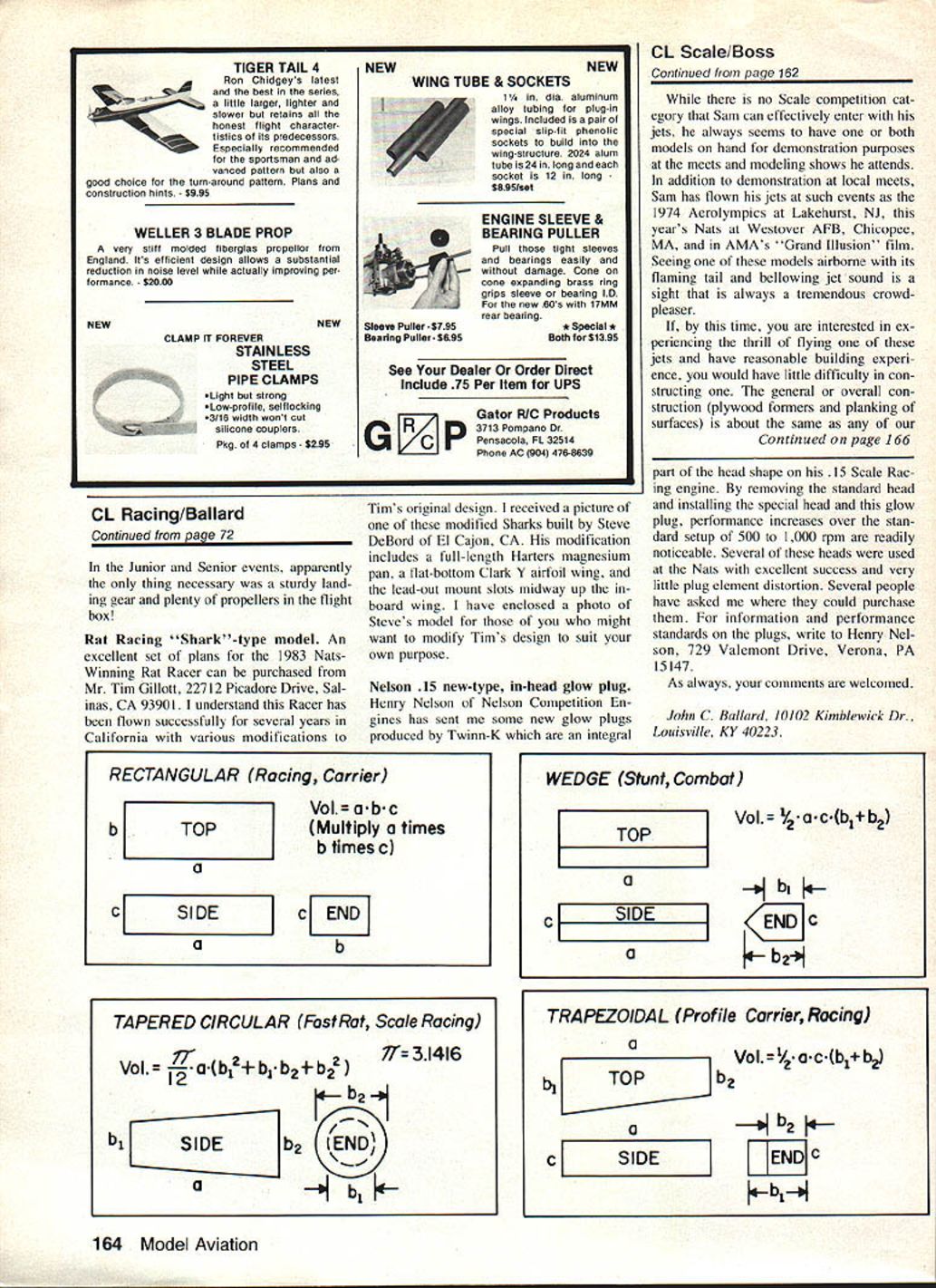
I observed with interest the Plane Talk newsletter from the Amarillo Planesman (edited by Mr. Galen B. Killion) in which he outlines four basic types of tanks—the rectangular, tapered-circular, wedge, and trapezoidal. He gives formulas for finding the volume of each type. I have been using these exact formulas for many years, and I thought I would include them in this month's column (for those of you who are interested). You'll find them at the very end of the column.
It is refreshing to find that many of these newsletters contain not just "club happenings" but also construction tips and methods concerning engine rework.
Quickie Rat. I have received a considerable amount of correspondence concerning a slower-speed, "fun rat race" event. This event, called "Quickie Rat," is flown mostly in Texas, but I have received letters from people all over the Midwest and even in California concerning its promotion at local contests. At a recent meet in Houston, TX, one of the most popular events was Quickie Rat, and Bill Lee has sent me photos showing a dozen or more of their popular Quickie Rat airplanes. One of the designs which appears to be fairly popular in the Houston area is called the Texas Tumbleweed. If I get some plans on this particular aircraft, I will be glad to print them here.
Quite frankly, I noticed a preponderance of this type aircraft in the Junior-Senior Rat Racing events at the Nationals. I observed the tank and engine setup, and apparently almost any type tank will work, as I saw the cylindrical Rat Race tank as well as the square wedge tank being used successfully. In the Junior and Senior events, apparently the only things necessary were a sturdy landing gear and plenty of propellers in the flight box!
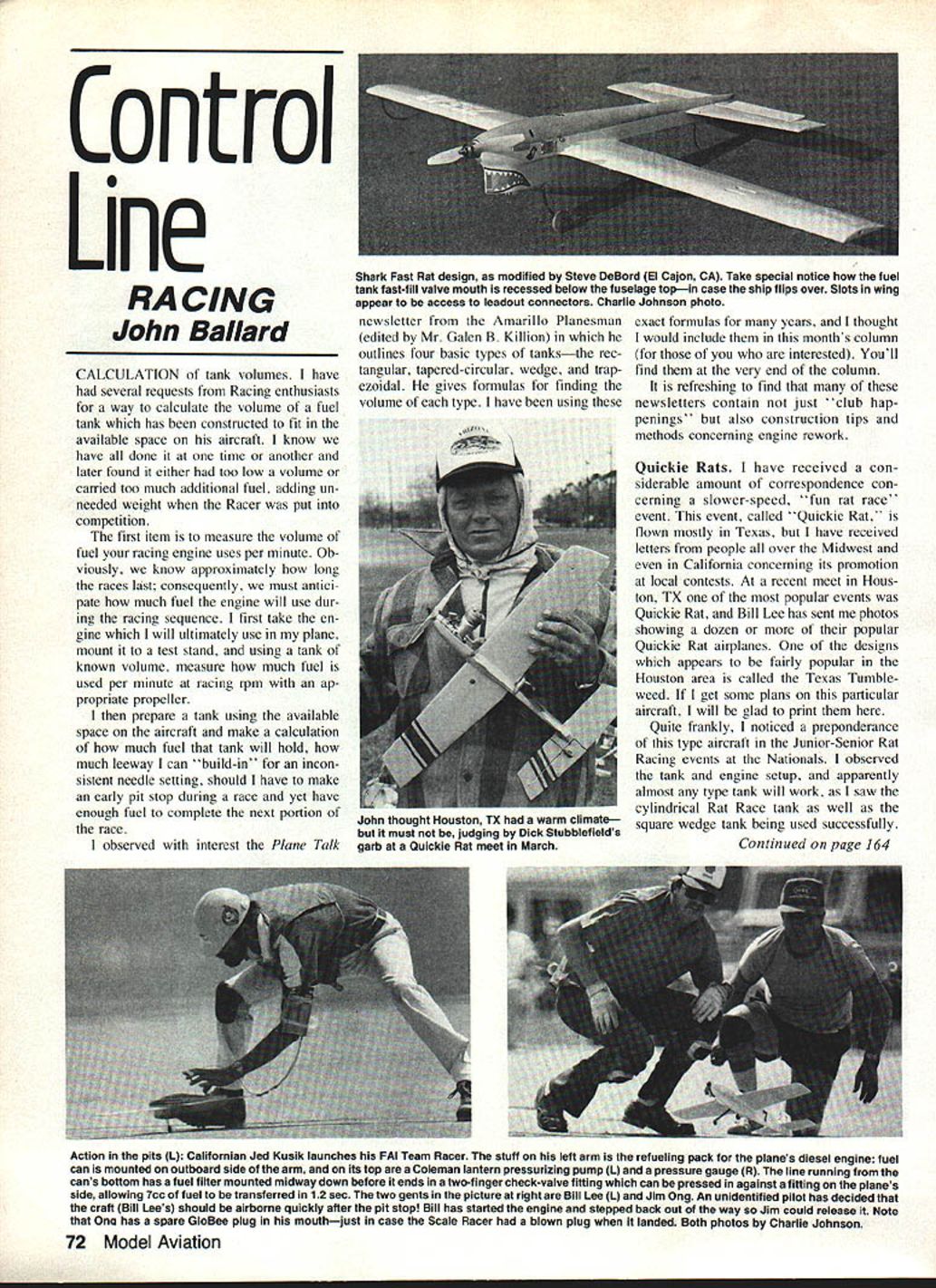
Rat Racing "Shark"-type model. An excellent set of plans for the 1983 Nats‑winning Rat Racer can be purchased from Mr. Tim Gillott, 22712 Picadore Drive, Salinas, CA 93901. I understand this racer has been flown successfully for several years in California with various modifications to Tim's original design. I received a picture of one of these modified Sharks built by Steve DeBord of El Cajon, CA. His modification includes a full-length Harters magnesium pan, a flat-bottom Clark Y airfoil wing, and the lead-out mount slots midway up the inboard wing. I have enclosed a photo of Steve's model for those of you who might want to modify Tim's design to suit your own purpose.
Nelson .15 new-type, in-head glow plug. Henry Nelson of Nelson Competition Engines has sent me some new glow plugs produced by Twinn-K which are an integral part of the head shape on his .15 scale racing engine. By removing the standard head and installing the special head and this glow plug, performance increases over the standard setup of 500 to 1,000 rpm are readily noticeable. Several of these heads were used at the Nats with excellent success and very little plug element distortion. Several people have asked me where they could purchase them. For information and performance standards on the plugs, write to Henry Nelson, 729 Valemont Drive, Verona, PA 15147.
As always, your comments are welcomed.
John C. Ballard 10102 Kimberwick Dr., Louisville, KY 40223
RECTANGULAR (Racing, Carrier)
Vol. = a · b · c (Multiply a times b times c)
- TOP dimensions: a by b
- SIDE dimensions: a by c
- END dimensions: b by c
WEDGE (Stunt, Combat)
Vol. = 1/2 · a · c · (b1 + b2)
- TOP length: a
- SIDE height: c
- END widths: b1 and b2
TAPERED CIRCULAR (Fast Rat, Scale Racing)
Vol. = (π/12) · a · (b1^2 + b1·b2 + b2^2) π = 3.1416
- TOP length: a
- SIDE tapers from b1 to b2
- END is circular with diameters b1 and b2 at respective ends
TRAPEZOIDAL (Profile Carrier, Racing)
Vol. = 1/2 · a · c · (b1 + b2)
- TOP length: a with end widths b1 and b2
- SIDE dimensions: a by c
- END widths: b1 and b2
Transcribed from original scans by AI. Minor OCR errors may remain.

