
Control Line: Racing
John Ballard
Slow Rat
SLOW RAT. The discussion of Slow Rat rules and the lack of participants at the Nats brought a large response in my mailbag. Heretofore, we have been mentioning the various "modifications" of Slow Rat flown in various localities around the country. I have received several letters illustrating rule modifications to the aircraft and engine, but also several requests on the type of tanks and proper pitting procedure for the Slow Rat.
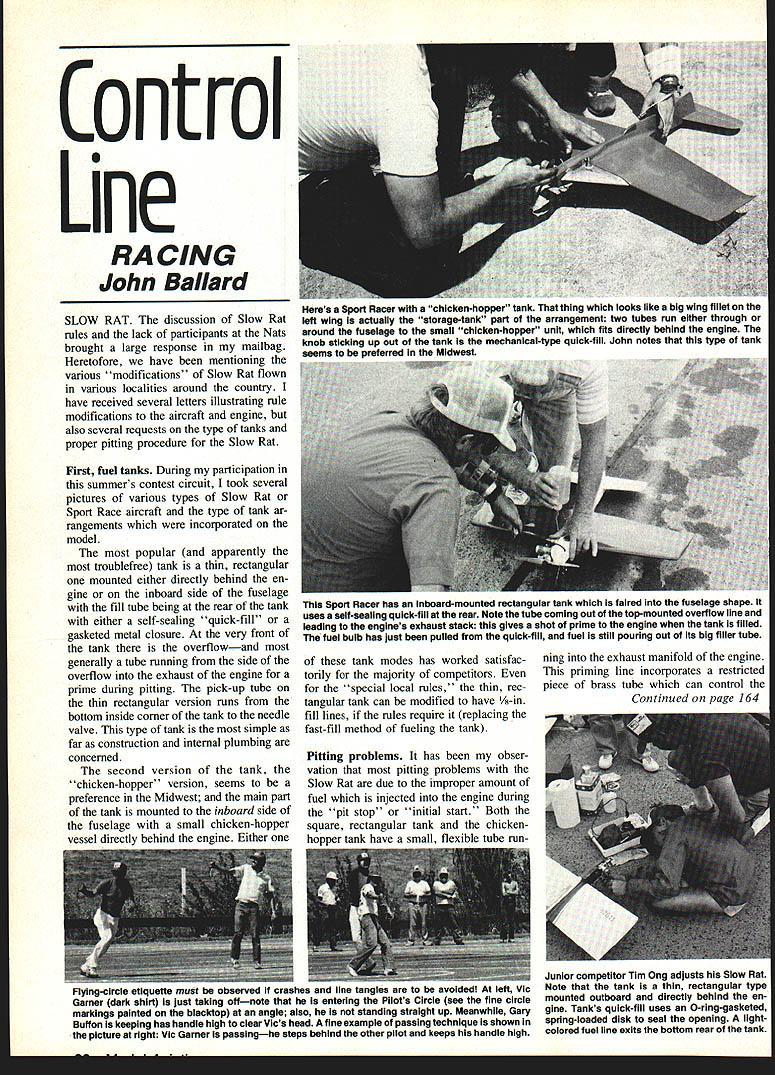
First, fuel tanks. During my participation in this summer's contest circuit, I took several pictures of various types of Slow Rat or Sport Race aircraft and the type of tank arrangements which were incorporated on the model.
- Thin rectangular tank: The most popular (and apparently the most trouble-free) tank is a thin, rectangular one mounted either directly behind the engine or on the inboard side of the fuselage with the fill tube being at the rear of the tank with either a self-sealing "quick-fill" or a gasketed metal closure. At the very front of the tank there is the overflow—and most generally a tube running from the side of the overflow into the exhaust of the engine for a prime during pitting. The pick-up tube on the thin rectangular version runs from the bottom inside corner of the tank to the needle valve. This type of tank is the simplest as far as construction and internal plumbing are concerned.
- Chicken-hopper tank: The second version of the tank, the "chicken-hopper" version, seems to be a preference in the Midwest; the main part of the tank is mounted to the inboard side of the fuselage with a small chicken-hopper vessel directly behind the engine. Either one of these tank modes has worked satisfactorily for the majority of competitors. Even for the "special local rules," the thin, rectangular tank can be modified to have 1/8-in. fill lines, if the rules require it (replacing the fast-fill method of fueling the tank).
Pitting problems
It has been my observation that most pitting problems with the Slow Rat are due to the improper amount of fuel which is injected into the engine during the "pit stop" or "initial start." Both the square, rectangular tank and the chicken-hopper tank have a small, flexible tube running into the exhaust manifold of the engine. This priming line incorporates a restricted piece of brass tube which can control the amount of fuel which the engine receives. This "prime tube" works independently of the fuel shutoff so that the fuel shutoff does not have to be open for the engine to receive a prime.
I think the majority of problems develop when the fuel shutoff is open during the filling process, allowing a large amount of fuel to be injected into the carburetor and/or intake, into the backplate (if the engine has a rear rotor) or into the front of the crankshaft (for front-intake engines), causing a flooded condition. By controlling the diameter of the prime tube leading into the exhaust of the engine, the amount of fuel administered for a typical engine start is kept very consistent. Of course, a good flipping wrist on the pitman and a good strong battery and glow plug are also necessary for one-flip pitting.
In addition, I find that one of the most important things for pitting the typical Slow Rat engine is compression which is at least "decent." If the engine comes in with low compression, it is invariably very difficult to get a one-flip pit, even though the squirt of fuel into the exhaust does tighten the piston-to-liner fit slightly. Extremely low compression on a hot engine seems to be the second most frequent problem affecting starting the typical engine used in Slow Rat or Sport Race.
Circle maneuvering (entering and exiting)
During my participation in the Fall contest schedule, I observed an unusually large number of line entanglements and/or handles being burnt up by one competitor, causing unfortunate crashes during a racing heat. This was most noticeable in the Junior and Senior competitions; however, it was a problem with some of the Open competitors, especially those involved in Sport Race or Mouse Race.
After the competitors cleaned up the remains, I quizzed them concerning what problem had caused the unfortunate crashes. I found the evidence was overwhelming that the pilot was watching his aircraft on takeoff and not maneuvering into the circle satisfactorily. This caused a confrontation, or bumping of the other pilot, or a line entanglement.
I found that none of the competitors involved in the incidents had been drawing standard AMA circles on their practice surface at home and practicing takeoffs and landings using the proper circle markings. In the case of the Juniors and Seniors, many of them had never flown on a properly marked circle, so that when they hit their fuel shutoffs or their engines ran out of fuel, they were remaining in the center of the circle and their planes were proceeding around the inner periphery of the landing circle.
By landing with the pilot near or in the center of the circle while another competitor is flying, it is very easy for the airborne contestant to entangle a foot in a set of lines. It also creates a dangerous situation for the pit people, who must run into the racing area to pull the plane out to the proper line while the other pilot is flying directly over one.
On one of my recent trips to California, I noticed some excellent circle markings; and while watching some of the other competitors, I attempted to photograph the proper way to exit and enter the Pilot's Circle. The pilot whose model is being launched must crouch outside the Pitting Circle and be slightly ahead of his airplane, so that when the engine starts, he can maneuver inside this line and enter the Pilot's Circle at an angle and not run directly into it, perhaps colliding with the other pilot and possibly causing two planes to be damaged. I might add that it is a mandate for the pilot in flight to keep an eye on the other competitor as the other competitor enters and exits the circle.
Quite obviously, you cannot fly safely at the contest level if you have never practiced using the proper circle markings. This came home most vividly with my young 12-year-old son as we tried to practice with a Sport Racer and a Mouse Racer without proper circle markings. Each and every landing on the plane was either way inside the circle or way outside the circle and caused the pit crew to "scamper around" to retrieve the model during pitting. After just an hour or two of practicing using the proper circle markings, I think the pilot becomes much more oriented with the circle markings, and landings and takeoffs during racing conditions are much smoother.
As always, your comments are solicited and appreciated.
John C. Ballard 10102 Kimblewick Dr. Louisville, KY 40223
Transcribed from original scans by AI. Minor OCR errors may remain.

