
Control Line RACING
John Ballard
Introduction
Improvement of airspeed is the subject this month. I have had several letters concerning the apparent inability of racing competitors to get their airspeeds up to competitive levels. Subsequent correspondence indicated that certain engine horsepower and propeller combinations are creating the proper thrust to achieve competitive velocities. What's holding them back? One major hindrance to airspeed is engine vibration.
We don't see much of this in the Rat Racing event since, I believe, all competitors are using Harter's magnesium pan, which virtually eliminates power-robbing engine vibrations. Unfortunately, our profile-style racers such as Slow Rat, Scale Racing, Sport Racing, Big Goodyear, etc., have the engine mounted on a wooden fuselage which—at best—has an aluminum or magnesium mounting plate to reduce vibration.
Motor Mount and Nose Length
I can recall many years ago (before Slow Rat became professional) that Sport Race enthusiasts were using the Sterling kits (such as the Mustang, Yak-9, and Ringmaster), the Veco Tomahawk, and the PDQ Circus Clown. We found that, even though the airplanes had a significant resemblance to each other, the Tomahawk and the Ringmaster seemed to have better airspeed than the other kits for racing applications. We found that the length of the fuselage from the front of the wing section to the front of the engine was the shortest of all kits for these two.
After much experimentation, we found that by extending the motor mount another three or four inches into the fuselage, additional airspeed could be realized from the same engine moved from plane to plane. The only difference was the shorter nose moment and the "beefed-up" engine-mounting area. This included replacing the 1/16-in. or 2-ply 1/8-in. plywood doublers with five-ply 3/32-in. plywood. When these modifications were incorporated in the other kits, their airspeeds increased also—but not as dramatically as the shorter-nose-moment models.
At first, there was reluctance to use the shorter-nose models because of the problem of getting a large enough fuel tank between the engine and the wing leading edge. As time went by, Veco came out with the profile-tank series, which improved this situation. Those Veco profile tanks also had a larger mounting area than the typical rectangular wooden tanks; consequently, the tank vibrated and foamed less when mounted on the profile fuselage.
Fuselage Stiffening and Vibration Control
The most vibration-sensitive racing aircraft are our Scale Race planes. The high-powered .15 engines used today cause enormous vibration; with ground rpm in the 22,000–27,000 range, it is easy for vibration (and, consequently, airspeed loss) to be generated.
Measures we have found effective:
- Use 1/2-in.-thick profile fuselages and 3/8 x 5/8 x 9-in. hard maple engine mounts.
- Select wood for the fuselage carefully; material quality is important.
- Replace thin doublers with stiffer plywood as noted above.
- Install an extremely stiff apple-cheek fairing on the opposite side from the engine, running down underneath and even on top of the wing section, to reduce vibration.
- Use two-component epoxy glue on the entire front section of the racer and then cover it with 1/2 to 1-oz. glass cloth to add further stiffening.
At several testing sessions I have found that the same engine, switched between otherwise identical aircraft, would lose from one to three seconds per seven laps merely because of fuselage vibration.
Pitting Procedures
Proper pitting procedures also improve race times. Fast pit stops are essential, including releasing the aircraft so that the pilot may merge into traffic without any slack in the lines or unfortunate tumbles of the aircraft due to the pitman's improper release.
Key points for pitmen:
- Maintain a straight line with the aircraft when releasing.
- Release the model perpendicular to the pilot (not pointed in toward the pilot or pointing toward the outside of the circle).
- Do not allow the model to be pointed away from the pilot at release; when the pilot starts to pull on the lines the model can be whipped back toward the pitman, causing slack in the lines and possibly forcing the safety pilot to catch the line or risking a flip over the prop.
- Use a "toe-in" method of aligning the pilot's circle for pit stops.
Starting Procedures
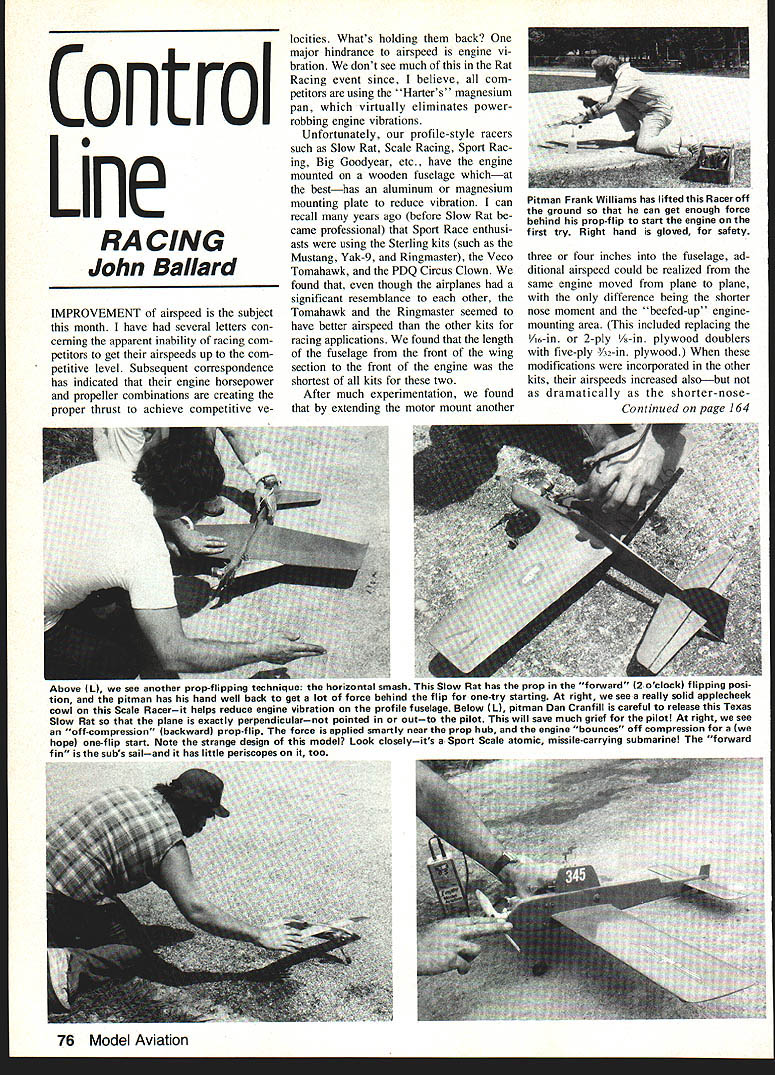
Many competitors have problems starting their racing aircraft either on the initial start or during pit stops. Assuming the engine has proper compression, the right amount of fuel, and a good glow plug and battery, other factors control those "one-flip starts."
If the aircraft is small and the landing gear somewhat short, it is often better to raise the aircraft off the surface so that the pitman can get a good swing at the propeller. For Slow Rat and Sport Race aircraft, we have found it beneficial to incorporate a slightly longer one-wheel gear assembly to allow the pitman to get enough force behind the prop-flip to start the engine on the first try, providing enough clearance to properly strike the propeller.
Starting methods:
- Forward flip: Set the compression so that one propeller blade is at the two o'clock position. Slap the propeller extremely hard to start the engine with one flip.
- Backward flip: Flip the engine backwards, striking the propeller very close to the hub. The propeller must be set horizontal (parallel to the ground) for this method to produce satisfactory results.
Also practice coordinated pitman–pilot timing so the pilot brings the plane in at substantial speed and gets it out of the pits and back into the air in the shortest possible time.
Practice and Circle Markings
Know the racing-circle markings. Many competitors do not mark off a standard circle to AMA specifications for practice. Often we fly in school parks and it is imperative to use either chalk or spray paint (if the owner will allow it) to mark off a proper center circle, landing circle, and pitting area.
Practicing under standard circle conditions improves the relationship between the pilot and pitman, since all landings and takeoffs are done in the same circle atmosphere that will be used in competition.
Conclusion
Thorough and complete practice, attention to fuselage stiffness and vibration control, correct motor mounting and nose length, proper pitting technique, and reliable starting procedures will all improve your race times.
As always, your comments are solicited and appreciated.
John C. Ballard 10102 Kimblewick Dr. Louisville, KY 40223
Transcribed from original scans by AI. Minor OCR errors may remain.

