
Control Line: Racing
John Ballard
Innovative equipment
As the contest season for racing is in full swing, many competitors have spent the winter engineering useful additions to their equipment.
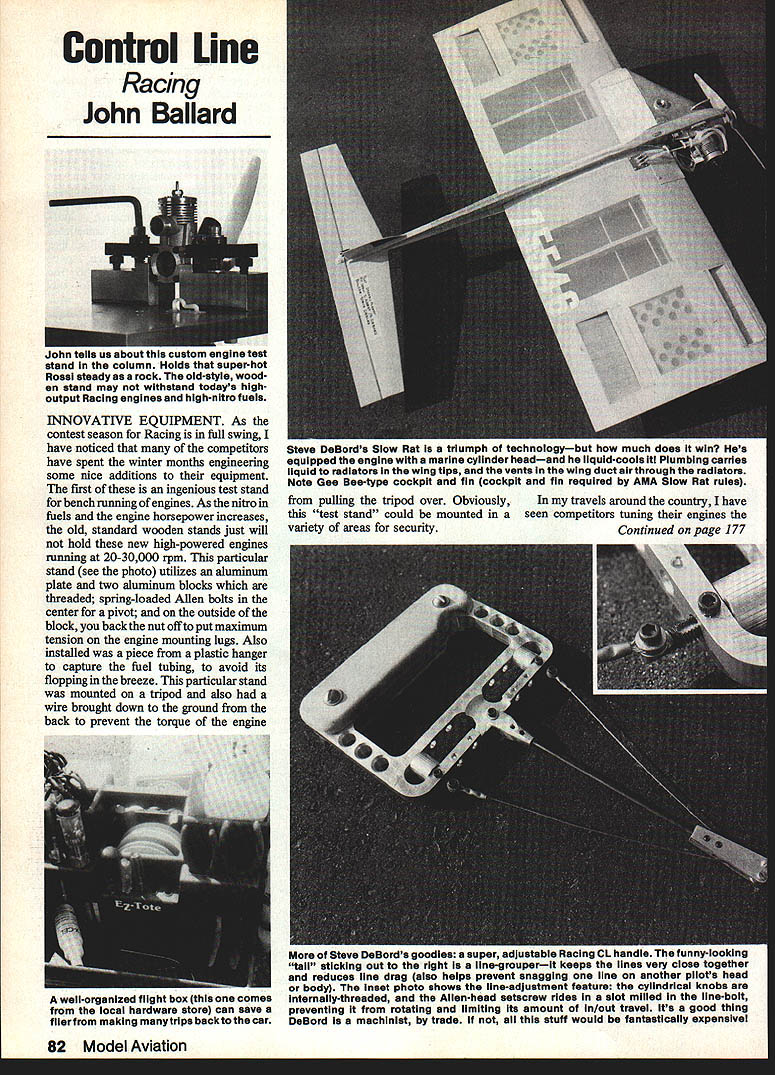
Test-stand for bench running engines:
- Problem: standard wooden stands cannot safely hold the new high-powered engines running 20-30,000 rpm.
- Features of the stand I observed: aluminum plate, two threaded aluminum blocks, spring-loaded Allen bolts with a center pivot, and a back nut to apply maximum tension to the engine mounting lugs.
- Added items: a plastic hanger piece to capture the fuel tubing so it won’t flop in the breeze; the stand was mounted on a tripod and had a grounding wire to prevent engine torque from tipping the tripod.
- Variations: stands mounted on small wooden step ladders with a concrete block or other heavy object on the back to prevent tipping; seat sections from sawed-off wooden chairs used as bases—the four legs keep the seat from tipping and are easy to carry in a car trunk.
- Practical tip: plastic fuel tanks can be mounted with rubber bands for on-site testing under local climatic conditions.
Other equipment:
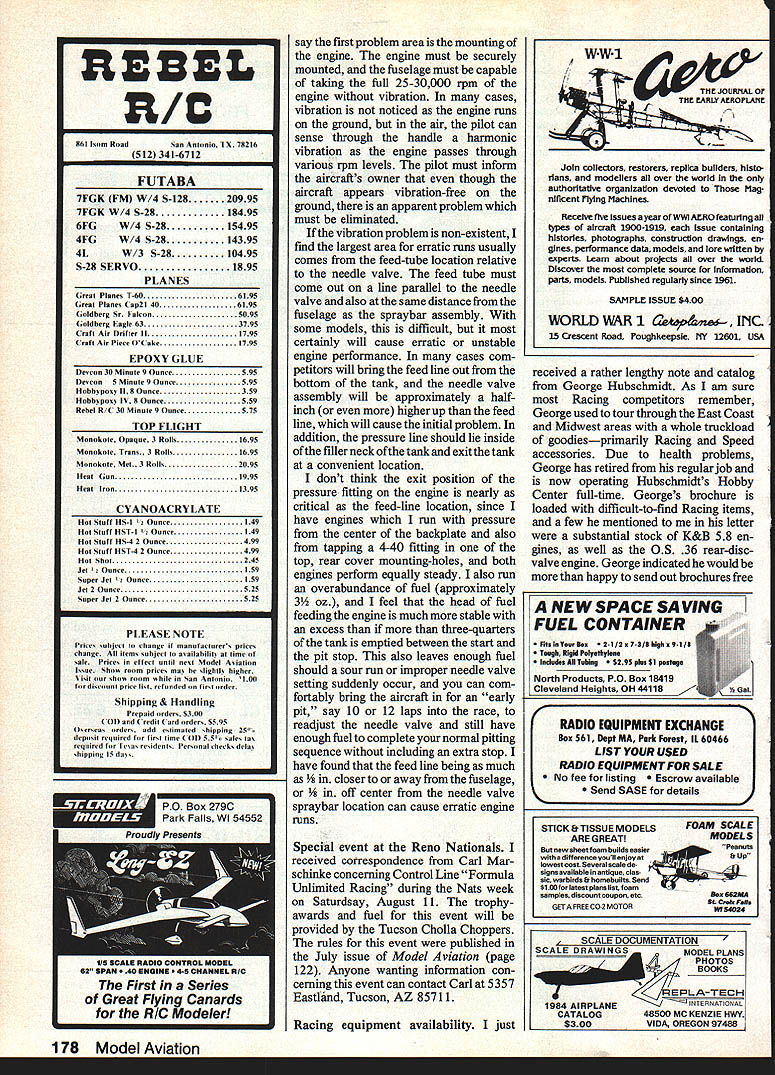
- Flying handle: a machined handle by Steve DeBord that fits the hand well and includes a threaded adjustment screw to correct slight elevator misalignment.
- Line grouper: also by Steve DeBord. In our tests grouping the lines at the wing entry improved airspeed by approximately 0.1–0.2 seconds per seven laps (assuming the lines enter the plane in a grouped position). Grouping wires at the handle helps but is less effective. Note that two lines exiting the wing at the line clips can slow a plane by as much as ~0.5 seconds per seven laps because maximum drag occurs near the aircraft.
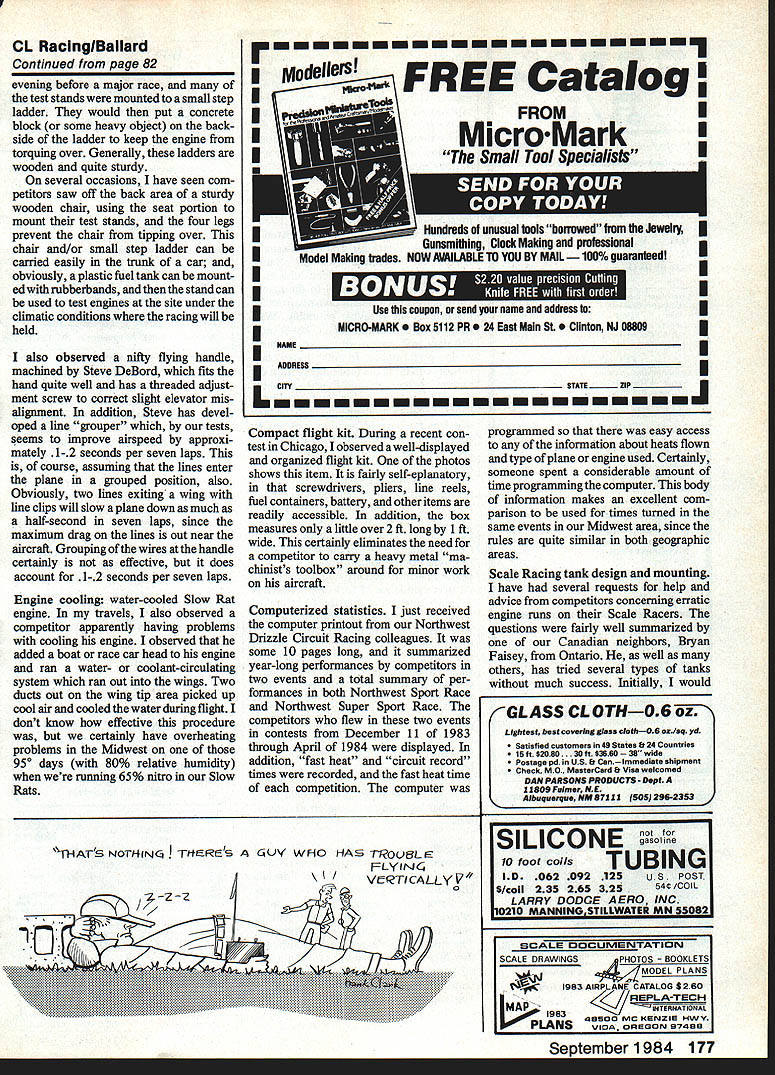
Engine cooling: water-cooled Slow Rat engine
I observed a competitor who appeared to have cooling problems add a boat/race-car head to his engine and run a water- or coolant-circulating system through the wings. Two ducts at the wingtip area picked up cool air and cooled the circulating liquid during flight. I cannot vouch for its overall effectiveness, but such measures may help during extreme conditions (e.g., 95°F with 80% relative humidity) when running high-nitro fuels in Slow Rats.
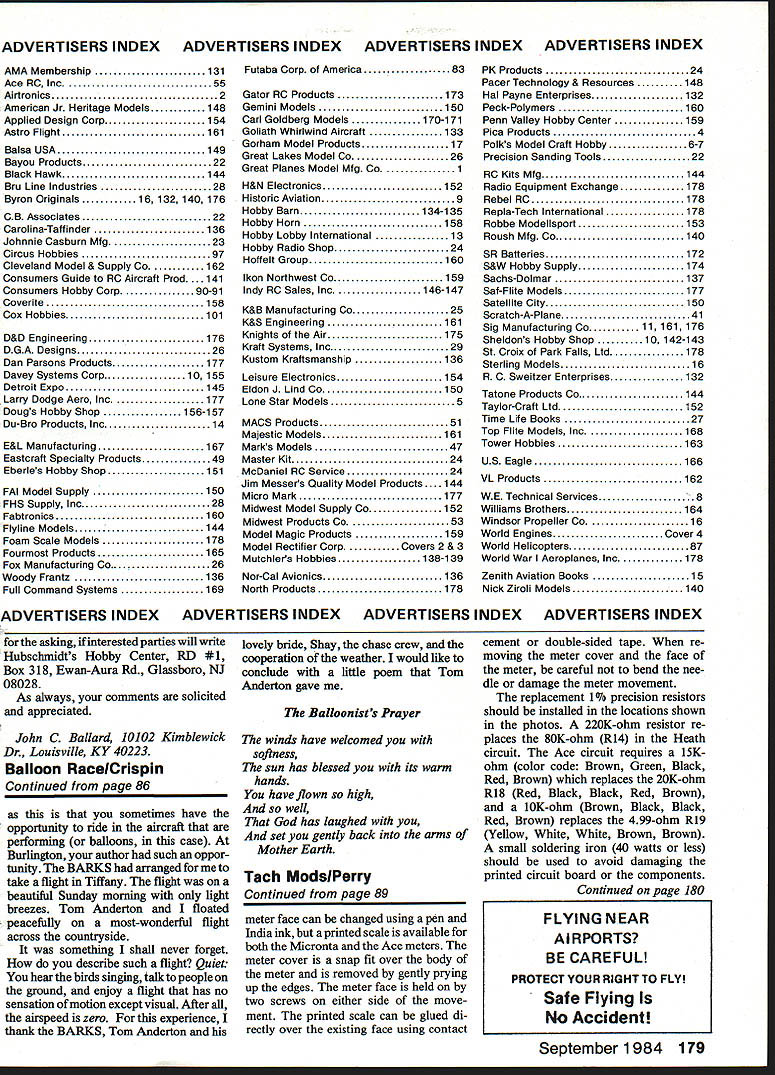
Compact flight kit
At a recent Chicago contest I saw a well-organized, compact flight kit. The box measured roughly 2 ft by 1 ft and contained the essentials in an accessible layout. Recommended items:
- Screwdrivers and pliers
- Line reels
- Fuel containers
- Battery
- Miscellaneous small tools and consumables
A small wooden box like this eliminates the need to carry a heavy machinist’s toolbox for minor field work.
Computerized statistics
I received a 10-page computer printout from our Northwest Drizzle Circuit racing colleagues summarizing year-long performances. It covered two events (Northwest Sport Race and Northwest Super Sport Race) and included:
- Competitors who flew in events from December 1, 1983, through April 1984
- Fast heat and circuit record times
- Fastest heat times for each competition
- Easy access to heat-by-heat information, plane and engine types (via the program)
This compiled data is an excellent comparison for times in our Midwest events where rules are similar.
Scale Racing tank design and mounting
Many competitors have reported erratic engine runs in Scale Racers. Based on questions (including input from Bryan Failey, Ontario), the main causes and solutions are:
- Engine mounting and vibration
- The engine must be securely mounted; the fuselage must tolerate full rpm (25-30,000) without vibration.
- Vibration may be subtle on the ground but evident in flight as harmonic oscillation felt through the handle. Pilots should report perceived vibration so it can be corrected.
- Feed-tube location relative to the needle valve
- The most common cause of erratic running is improper feed-tube placement.
- The feed tube should exit the tank on a line parallel to the needle valve and at the same distance from the fuselage as the spraybar assembly.
- Avoid bringing the feed line out of the bottom of the tank if the needle-valve assembly is significantly higher; even 1/8 inch of misalignment from the spraybar/needle valve can cause unstable performance.
- The pressure line should lie inside the filler neck and exit the tank at a convenient spot.
- Pressure fitting location
- The exit position of the pressure fitting on the engine is less critical; engines run steadily with pressure taken from the center of the backplate or from top rear cover mounting holes.
- Fuel quantity
- I prefer running with an abundance of fuel (about 3½ oz.). A fuller tank provides a more stable head of fuel and leaves margin for an early pit stop (e.g., 10–12 laps) to correct needle settings without requiring an extra stop.
Special event at the Reno Nationals
Control Line "Formula Unlimited Racing" was held during the Nats weekend on Saturday, August 11. Trophies and fuel for the event were provided by the Tucson Cholla Choppers. Rules were published in the July issue of Model Aviation (page 122). For information contact Carl Marschinke, 5357 Eastland, Tucson, AZ 85711.
Racing equipment availability
George Hubschmidt, formerly known for touring East Coast and Midwest areas with Racing and Speed accessories, has retired from touring and now operates Hubschmidt’s Hobby Center full time. His brochure includes many hard-to-find Racing items (notably a stock of K&B 5.8 engines and the O.S. .36 rear-discharge engine). George will send brochures free on request.
Transcribed from original scans by AI. Minor OCR errors may remain.

