
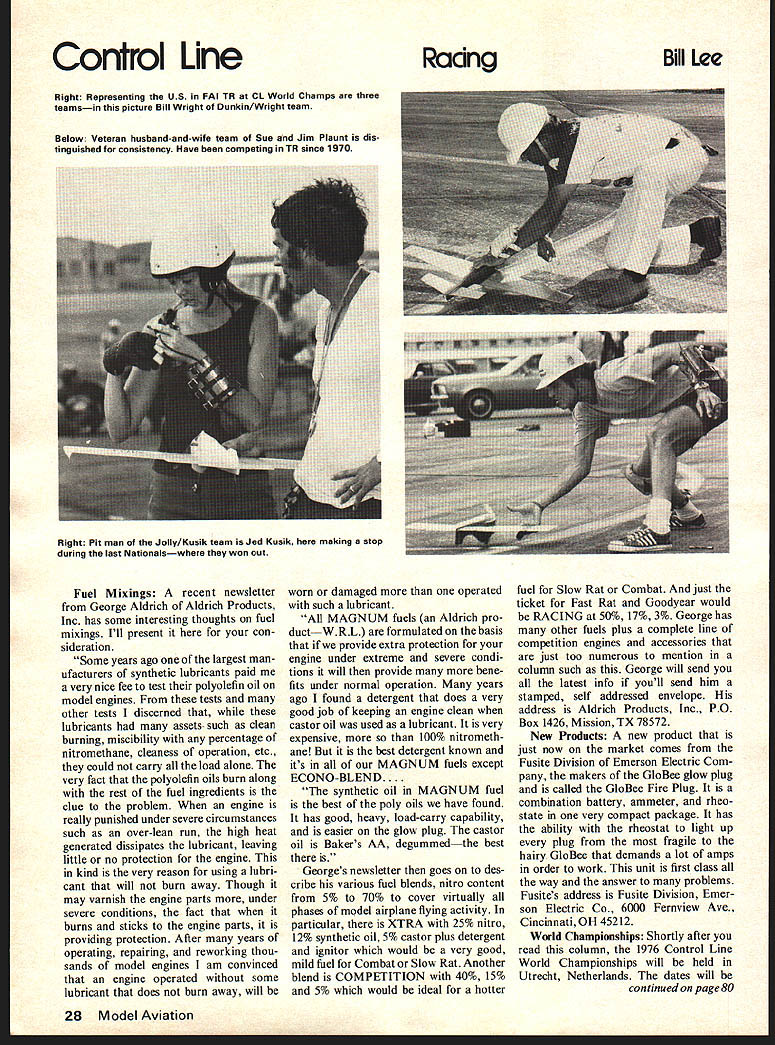
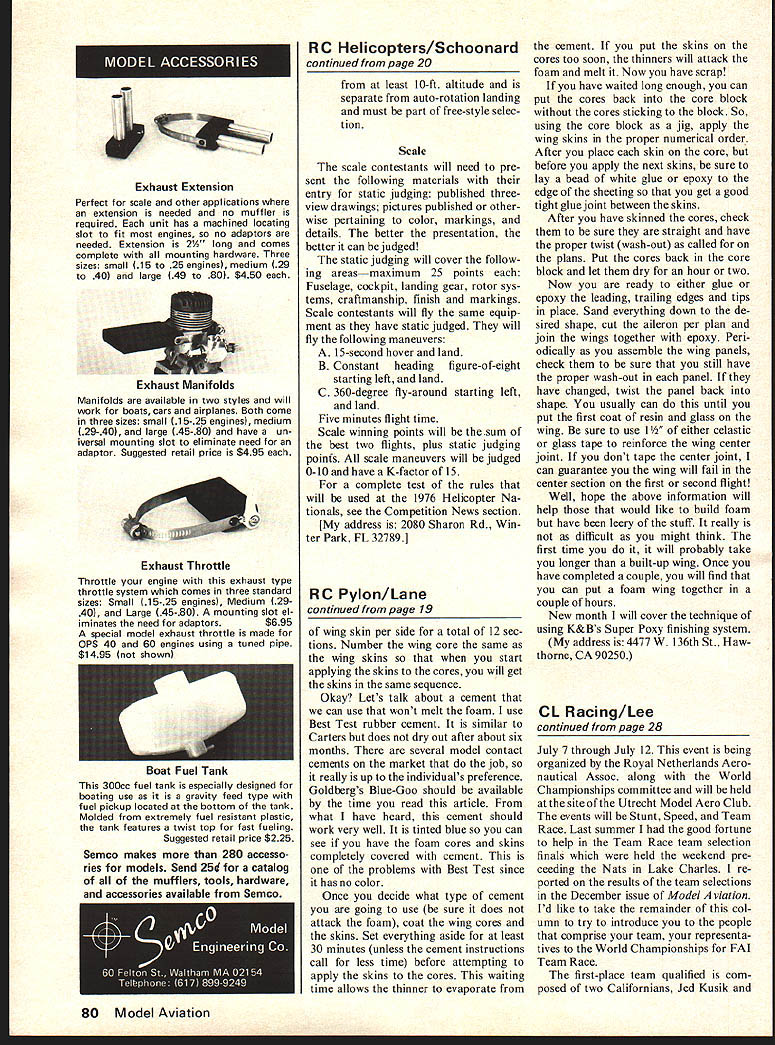
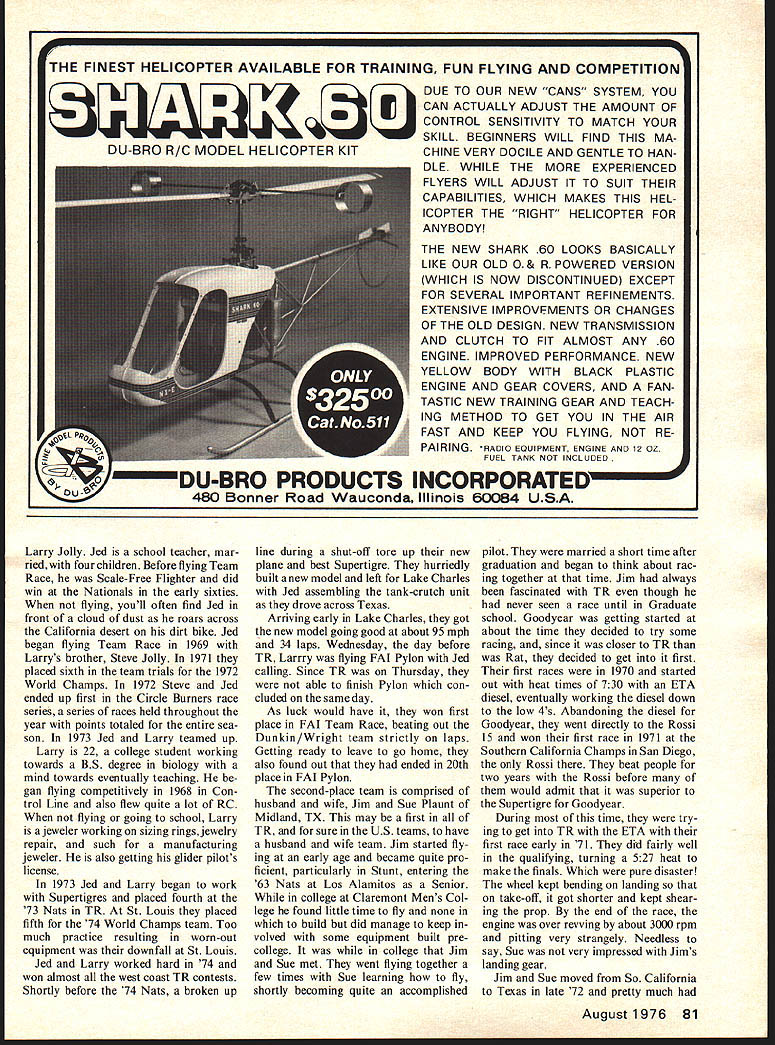
Control Line: Racing
Bill Lee
Fuel Mixings: A recent newsletter from George Aldrich of Aldrich Products, Inc. has some interesting thoughts on fuel mixings. I'll present it here for your consideration.
"Some years ago one of the largest manufacturers of synthetic lubricants paid me a very nice fee to test their polyolefin oil on model engines. From these tests and many other tests I discerned that, while these lubricants had many assets — such as clean burning, miscibility with any percentage of nitromethane, miscibility of operation, etc. — they could not carry all the load alone. The very fact that the polyolefin oils burn along with the rest of the fuel ingredients is the clue to the problem. When an engine is really punished under severe circumstances such as an over-lean run, the high heat generated dissipates the lubricant, leaving little or no protection for the engine. This is the very reason for using a lubricant that will not burn away. Though it may varnish the engine parts more under severe conditions, the fact that when it burns and sticks to the engine parts it is providing protection. After many years of operating, repairing, and reworking thousands of model engines I am convinced that an engine operated without some lubricant that does not burn away, will be worn or damaged more than one operated with such a lubricant."
"All MAGNUM fuels (an Aldrich product — W.R.L.) are formulated on the basis that if we provide extra protection for your engine under extreme and severe conditions it will then provide many more benefits under normal operation. Many years ago I found a detergent that does a very good job of keeping an engine clean when castor oil was used as a lubricant. It is very expensive, more so than 100% nitromethane. But it is the best detergent known and it's in all of our MAGNUM fuels except ECONO-BLEND."
"The synthetic oil in MAGNUM fuel is the best of the poly oils we have found. It is good, heavy, load-carry capability, and is easier on the glow plug. The castor oil is Baker's AA, degummed — the best there is."
George's newsletter then goes on to describe his various fuel blends, nitro content from 5% to 70% to cover virtually all phases of model airplane flying activity. In particular, there is XTRA with 25% nitro, 12% synthetic oil, 5% castor plus detergent — ignitor would be a very good mild fuel for Combat or Slow Rat. Another blend is COMPETITION with 40% nitro, 15% synthetic oil and 5% castor which would be ideal for a hotter fuel for Slow Rat or Combat. And just the ticket for Fast Rat and Goodyear would be RACING at 50% nitro, 17% synthetic oil, 3% castor. George has many other fuels plus a complete line of competition engines and accessories that are just too numerous to mention in a column such as this. George will send you all the latest info if you'll send him a stamped, self-addressed envelope. His address is Aldrich Products, Inc., P.O. Box 1426, Mission, TX 78572.
New Products: A new product that is just now on the market comes from the Fusite Division of Emerson Electric Company, the makers of the GloBee glow plug and is called the GloBee Fire Plug. It is a combination battery, ammeter, and rheostat, with the ability with the rheostat to light up every plug from the most fragile to the heavy GloBee that demands a lot of amps in order to work. This unit is first class all the way and the answer to many problems. Fusite's address is Fusite Division, Emerson Electric Co., 6000 Fernview Ave., Cincinnati, OH 45212.
World Championships: Shortly after you read this column, the 1976 Control Line World Championships will be held in Utrecht, Netherlands. July 7 through July 12. This event is being organized by the Royal Netherlands Aeronautical Assoc. along with the World Championships committee and will be held at the site of the Utrecht Model Aero Club.
The events will be the stunt, Speed, and Team Race. Last summer I had a good fortune to help in the Team Race team selection trials which were held the weekend preceding the Nats in Lake Charles. I reported on the results of the team selections in the December issue of Model Aviation.
I'd like to take the remainder of this column to introduce you to the people that comprise your team, your representatives to the World Championships for FAI Team Race.
The first-place team qualified is composed of two Californians, Jed Kusik and Bill Lee Jed is a school teacher, married, with four children. Before flying Team Race, he was a Scale-Free Flighter and did win at the Nationals in the early sixties. When not flying, you'll often find Jed in front of a cloud of dust as he roars across the California desert on his dirt bike. Jed began flying Team Race in 1969 with Larry's brother, Steve Jolly. In 1971 they placed sixth in the team trials for the 1972 World Champs. In 1972 Steve and Jed ended up first in the Circle Burners race series, a series of races held throughout the year with points totaled for the entire season. In 1973 Jed and Larry teamed up.
Larry is 22, a college student working towards a B.S. degree in biology with a mind towards eventually teaching. He began flying competitively in 1968 in Control Line and also flew quite a lot of R/C. When not flying or going to school, Larry is a jeweler working on sizing rings, jewelry repair, and such for a manufacturing jeweler. He is also getting his glider pilot's license.
In 1973 Jed and Larry began to work with Super Tigre and placed fourth at the '73 Nats in TR. At St. Louis they placed fifth for the '74 World Champs team. Too much practice resulting in worn-out equipment was their downfall at St. Louis. Jed and Larry worked hard in '74 and won almost all the west coast TR contests. Shortly before the '74 Nats, a broken up-line during a shut-off tore up their new plane and best Super Tigre. They hurriedly built a new model and left for Lake Charles with Jed assembling the tank-crutch unit as they drove across Texas.
Arriving early in Lake Charles, they got the new model going good at about 95 mph and 34 laps. Wednesday, the day before TR, Larry was flying FAI Pylon with Jed calling. Since TR was on Thursday, they were not able to finish Pylon which concluded on the same day.
As luck would have it, they won first place in FAI Team Race, beating out the Dunkin/Wright team strictly on laps. Getting ready to leave to go home, they also found out that they had ended in 20th place in FAI Pylon.
The second-place team is comprised of husband and wife, Jim and Sue Plaunt of Midland, TX. This may be a first in all of TR, and for sure in the U.S. teams, to have a husband and wife team. Jim started flying at an early age and became quite proficient, particularly in Stunt, entering the '63 Nats at Los Alamitos as a Senior. While in college at Claremont Men's College he found little time to fly and none in which to build but did manage to keep involved with some equipment built pre-college. It was while in college that Jim and Sue met. They went flying together a few times with Sue learning how to fly, shortly becoming quite an accomplished pilot. They were married a short time after graduation and began to think about racing together at that time. Jim had always been fascinated with TR even though he had never seen a race until in graduate school. Goodyear was getting started at about the time they decided to try some racing, and, since it was closer to TR than was Rat, they decided to get into it first. Their first races were in 1970 and started out with heat times of 7:30 with an ETA diesel, eventually working the diesel down to the low 4's. Abandoning the diesel for Goodyear, they went directly to the Rossi .15 and won their first race in 1971 at the Southern California Champs in San Diego, the only Rossi win. They beat people for two years with the Rossi before many of them would admit that it was superior to the Super Tiger for Goodyear.
During most of this time, they were trying to get into TR with the ETA with their first race early in '71. They did fairly well in the qualifying, turning a 5:27 heat to make the finals. Which were pure disaster! The wheel kept bending on landing so that on take-off, it got shorter and kept shearing the prop. By the end of the race, the engine was overheating from about 3000 rpm and pitting very strangely. Needless to say, Sue was not very impressed with Jim's landing gear.
Jim and Sue moved from So. California to Texas in late '72 and pretty much had to shut down their TR activity since Texas is not one of your TR hotbeds. All during '73 and '74 they raced Goodyear. Late in '74 they decided to make an effort for the '75 Team Trials and began scratching together a new plane and engine. They had a significant problem in that the nearest suitable practice site was a 200-mile one-way trip. Believe it or not, in the entire 14 months of preparation for the Trials in Lake Charles, they had to drive that 200 miles to either the Fort Worth or Dallas flying sites every time they wanted to practice or try-out anything new.
The Plaunts' preparations for the World Champs can best be summed up by quoting a part of a letter from Jim to me. "Our main concern is just a place to fly. We probably will not make many, if any, changes for the Champs for several reasons. One is that we may not be able to practice with no place to fly! Also, as you will find out, Sue and I are absolute beginners in TR compared with the rest of the Team... Going out on a limb with a bunch of new stuff would only foul us up. We actually have a lot more experience with Goodyear than in TR so we will stick with the stuff we know. Also, our lack of a flying site severely impairs our ability to try new things."
The third-place team is composed of Bill Wright and Jim Dunkin of Kansas City, MO. This is not the first time on this team for Bill and Jim. They represented us in 1968, 1970, and 1972. Bill is 41 years old, married, with two children. He is an advertising graphics designer. Bill has been flying model airplanes since he was five years old, getting into Control Line in 1949, flying, of all things, a 60 Speed job at the Olathe Nats. He has been mostly in Control Line with a small amount of Free Flight.
Bill started into Team Race in 1962 when he teamed up with Jim Dunkin. Their first contest was the 10th KOI in December 1963 where they took first place.
Jim is 36, single, and works for the Missouri State Highway Department as an inspector. He started flying in the late 50's, mostly in Control Line but, at one time, did own an indoor hand-launch glider record. Jim tells the story of how the '75 qualifying at Nats was a near disaster. "We creamed our best plane and Rossi in a contest in St. Louis two weeks or so before the trials. We had two other planes almost done but we didn't expect to have to use them. We had moved the shut-off refueler valve up to make it a little more accessible. In so doing, we also moved it back behind the motor plate. Unknown to us at that time, that put the filler tube for the tank in a low pressure area and caused us to run the engine much richer in order to draw against the slight vacuum. This cost us a bunch of laps and some speed. That was our main trouble at the Nats, coupled with a rebuilt engine (that was creamed in St. Louis) where the piston and sleeve were wearing out. We lucked out and made the team but adding some hot stuff to the fuel (for some extra speed but still short on laps) accelerated the demise of the engine until it was shot by Nats time. We spent most of the next two months trying to find the problem. Finally figured it out and moved the valves forward even with the leading edge of the wing on both planes. The laps came right back though the speed was down due to the engine not being as fast."
"At least the 'system' was back to normal and we could concentrate on the engine, prop, fuel combination and be able to tell what was going on." (My address is: 3533 Tamarisk Lane, Missouri City, TX 77459.)
Transcribed from original scans by AI. Minor OCR errors may remain.

