
Control Line: Racing
John Ballard
New K&B prototype .40 Rat and Formula "40" engine
I recently received a new prototype of K&B's .40 rear-valve racing engine. Careful observation shows special phenolic-cage bearings and the front housing permanently affixed to the case with epoxy. In addition, the cylinder timing is the same as Billy Hughes' Nats-winning K&B .40.
One significant change is the sub-crankcase pressure release: a small hole drilled in the rear of the crankcase just below the exhaust header. This reduces crankcase blow-by pressure and should improve performance. Weather this winter in the Midwest has been extremely cold, so I have not yet been able to compare this engine with my standard K&B .65 engines. I will run performance and inflight comparisons as soon as the weather cooperates.
Chicken-hopper tanks
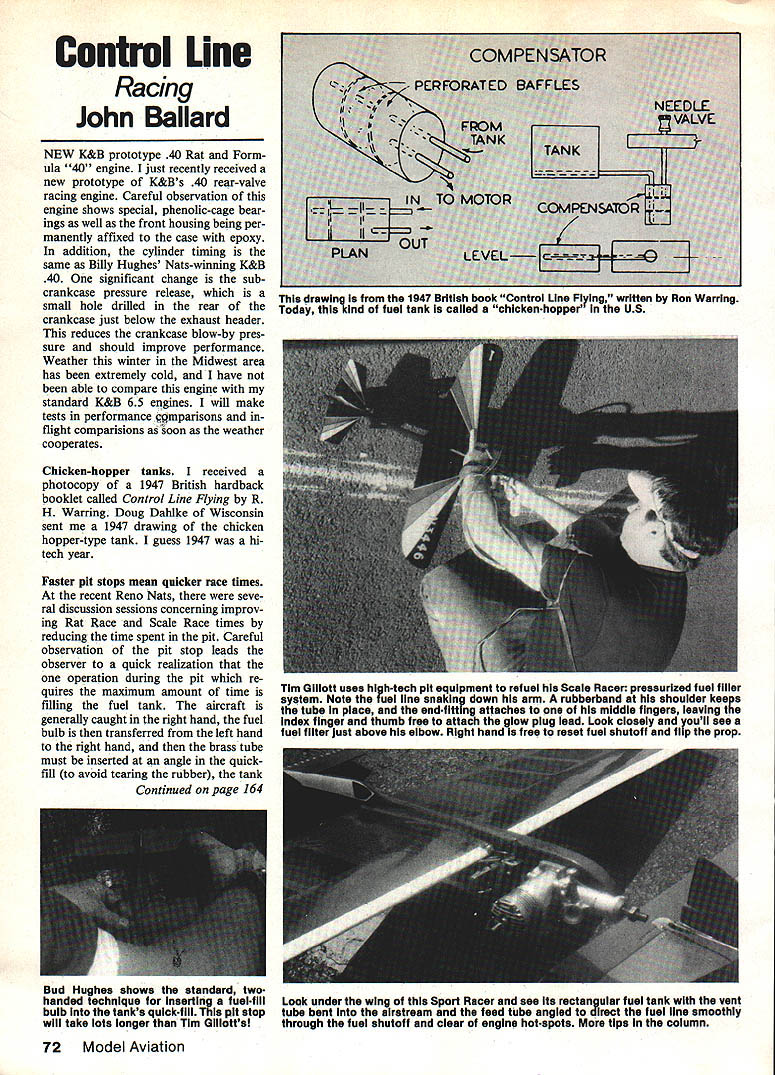
I received a photocopy of a 1947 British hardback booklet called Control Line Flying by R. H. Warring. Doug Dahlke of Wisconsin sent me a 1947 drawing of the chicken-hopper–type tank. I guess 1947 was a hi-tech year.
Faster pit stops mean quicker race times
At the recent Reno Nats there were several discussions about improving Rat Race and Scale Race times by reducing the time spent in the pit. Careful observation of the pit stop reveals that the operation requiring the most time is filling the fuel tank.
The aircraft is generally caught in the right hand, the fuel bulb is transferred from the left hand to the right hand, and the brass tube must be inserted at an angle into the quick-fill (to avoid tearing the rubber). When the tank must be filled, the tube is removed, the fuel bulb discarded, and the engine restarted. Apparently one to two-and-one-half seconds can be saved by using a pressure-refuel system.
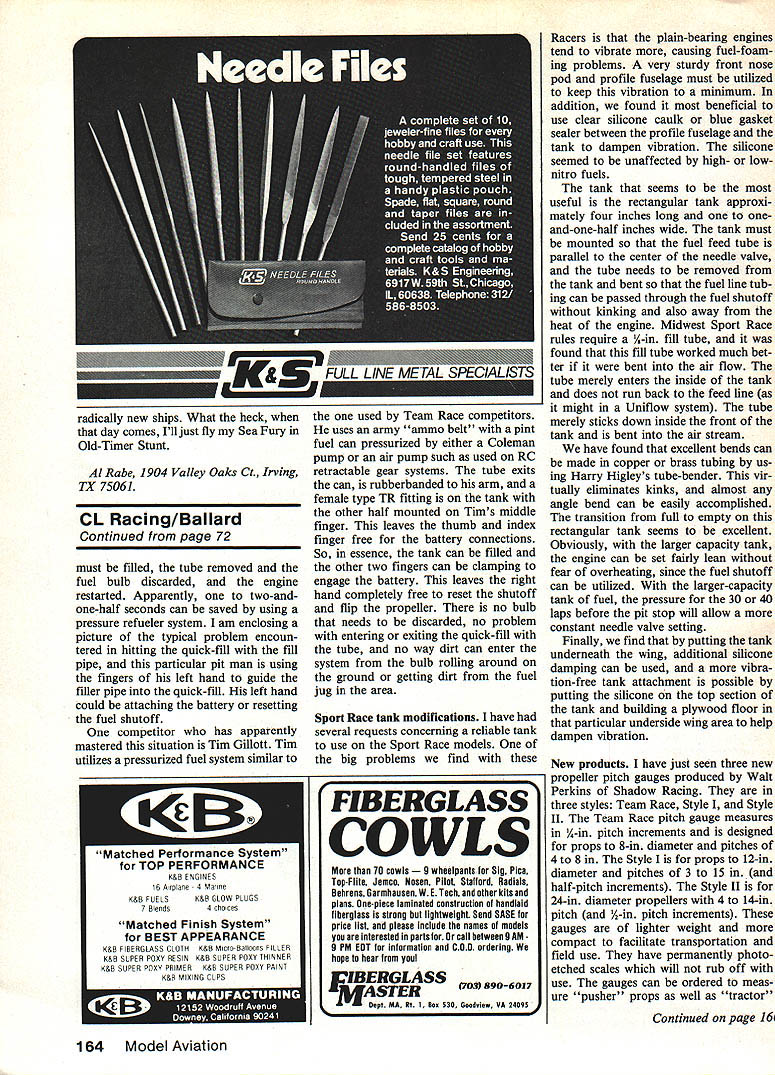
One competitor who has apparently mastered this situation is Tim Gillott. Tim uses a pressurized fuel system similar to those used by Team Race competitors. He uses an army "ammo belt" with a pint fuel can pressurized by either a Coleman pump or an air pump (such as those used on RC retractable gear systems). The tube exits the can, is rubber-banded to his arm, and a female TR-type fitting is on the tank with the other half mounted on Tim's middle finger. This leaves the thumb and index finger free for the battery connections.
In essence, the tank can be filled while the other two fingers are clamping to engage the battery. This leaves the right hand free to reset the shutoff and flip the propeller. There is no bulb to discard, no difficulty entering or exiting the quick-fill with the tube, and no way for dirt to enter the system from a bulb rolling on the ground or from the fuel jug.
Sport Race tank modifications
I have had several requests concerning a reliable tank for Sport Race models. One major problem is that plain-bearing engines tend to vibrate more, causing fuel-foaming problems. A very sturdy front nose pod and profile fuselage must be used to keep vibration to a minimum. In addition, we found it beneficial to use clear silicone caulk or blue gasket sealer between the profile fuselage and the tank to dampen vibration. The silicone seems unaffected by high- or low-nitro fuels.
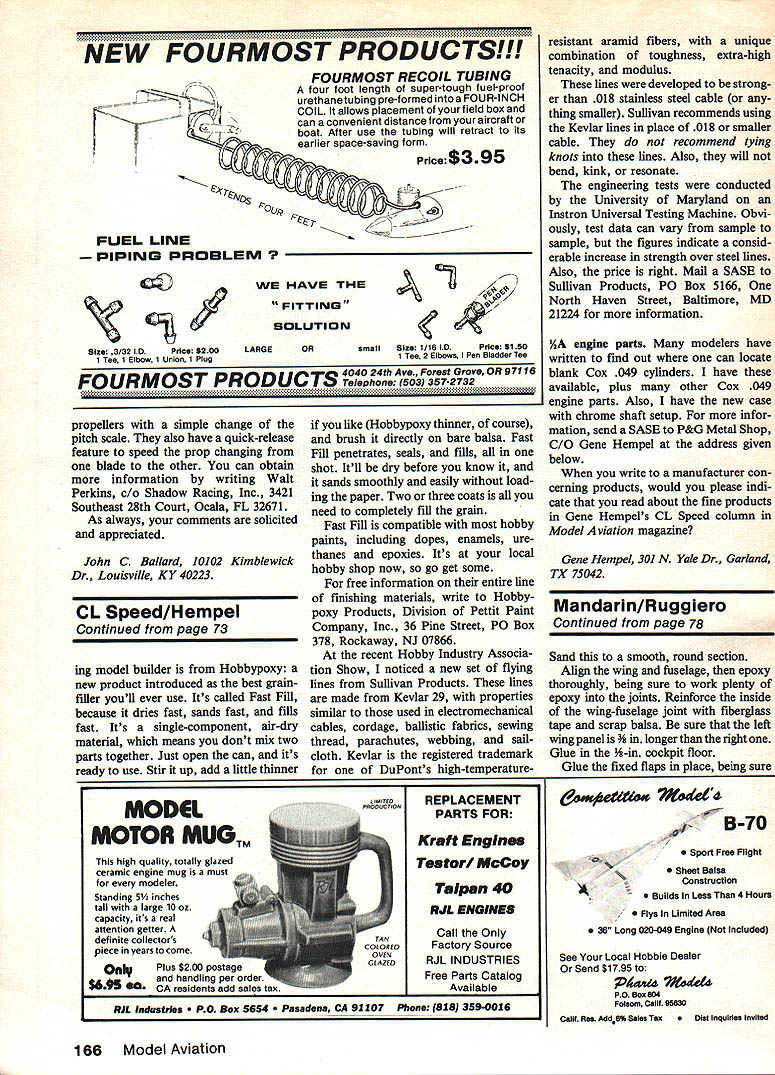
The most useful tank is a rectangular tank approximately four inches long and one to one-and-one-half inches wide. The tank must be mounted so the fuel feed tube is parallel to the center of the needle valve. The tube should be removed from the tank and bent so the fuel tubing can be passed through the fuel shutoff without kinking and kept away from engine heat.
Midwest Sport Race rules require a 1/4-inch fill tube, and we found this fill tube works much better if bent into the airflow. The tube merely enters the inside of the tank and does not run back to the feed line (as in a Uniflow system). The tube simply sticks down inside the front of the tank and is bent into the airstream.
We have found excellent bends can be made in copper or brass tubing using Harry Higley's tube bender. This virtually eliminates kinks and allows almost any angle to be achieved. The transition from full to empty on this rectangular tank seems excellent. With the larger-capacity tank, the engine can be set fairly lean without fear of overheating since the fuel is normally fully utilized. With the larger capacity, pressure during the 30 or 40 laps before the pit stop allows a more constant needle-valve setting.
Finally, by putting the tank under the wing, additional silicone caulking can be used and a more vibration-free tank attachment achieved. Place silicone on the top section of the tank and build a plywood floor in the underside wing area to help dampen vibration.
New products
I have just seen three new propeller pitch gauges produced by Walt Perkins of Shadow Racing. They are offered in three styles:
- Team Race: measures in 1/4-inch pitch increments; designed for props up to 8-inch diameter and pitches of 4 to 8 inches.
- Style I: for props up to 12-inch diameter and pitches of 3 to 15 inches (with half-inch pitch increments).
- Style II: for propellers up to 24-inch diameter and pitches of 4 to 14 inches (with half-inch pitch increments).
These gauges are lighter weight and more compact to facilitate transportation and field use. They have permanently photo-etched scales that will not rub off with use. They can be ordered to measure "pusher" props as well as "tractor" props with a simple change of the pitch scale. They also have a quick-release feature to speed the prop changing from one blade to the other.
For more information, write Walt Perkins, c/o Shadow Racing, Inc., 3421 Southeast 28th Court, Ocala, FL 32671.
As always, your comments are solicited and appreciated.
John C. Ballard 10102 Kimblewick Dr. Louisville, KY 40223.
Transcribed from original scans by AI. Minor OCR errors may remain.

