
Control Line: Racing
John Ballard
Cool Fuel
I have just finished flying in my third major contest which used the "10%-nitro rule" in all Racing events.
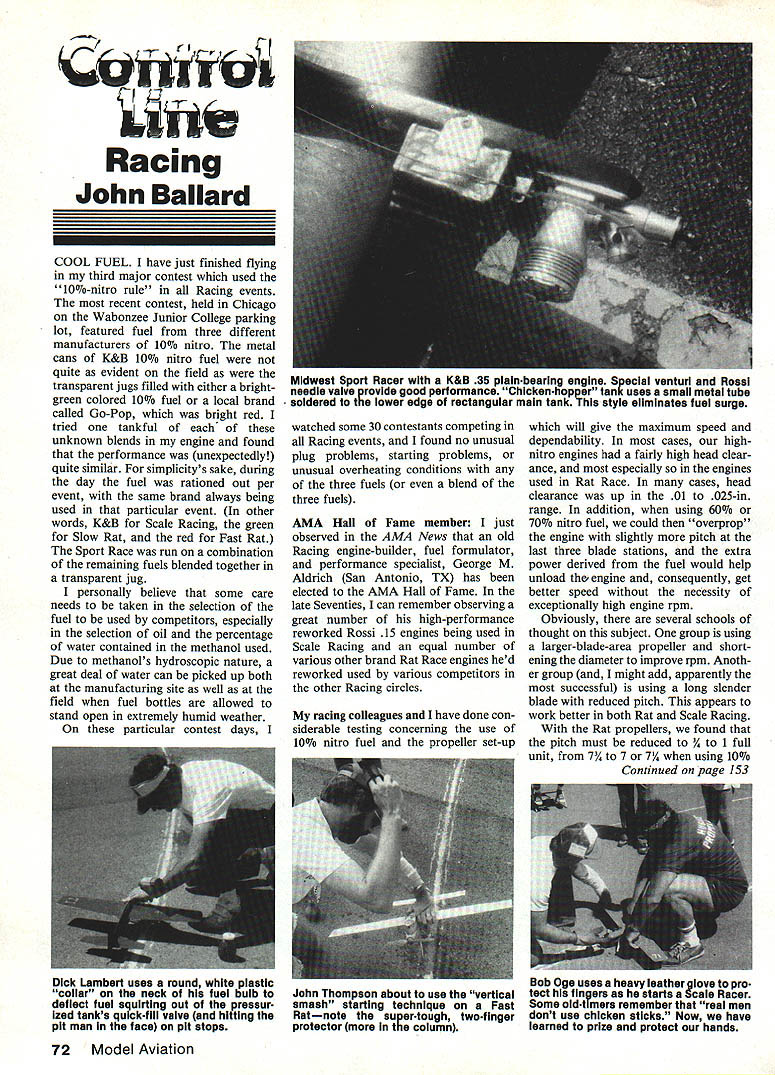
The most recent contest, held in Chicago on the Waubonsee Junior College parking lot, featured fuel from three different manufacturers of 10% nitro. The metal cans of K&B 10% nitro fuel were not quite as evident on the field as were the transparent jugs filled with either a bright-green colored 10% fuel or a local brand called Go-Pop, which was bright red. I tried one tankful of each of these unknown blends in my engine and found that the performance was (unexpectedly!) quite similar. For simplicity's sake, during the day the fuel was rationed out per event, with the same brand always being used in that particular event (in other words, K&B for Scale Racing, the green for Slow Rat, and the red for Fast Rat). The Sport Race was run on a combination of the remaining fuels blended together in a transparent jug.
I personally believe that some care needs to be taken in the selection of fuel to be used by competitors, especially in the selection of oil and the percentage of water contained in the methanol used. Due to methanol's hygroscopic nature, a great deal of water can be picked up both at the manufacturing site as well as at the field when fuel bottles are allowed to stand open in extremely humid weather. On these particular contest days, I watched some 30 contestants competing in all Racing events, and I found no unusual plug problems, starting problems, or unusual overheating conditions with any of the three fuels (or even a blend of the three fuels).
AMA Hall of Fame member
I just observed in the AMA News that an old Racing engine-builder, fuel formulator, and performance specialist, George M. Aldrich (San Antonio, TX), has been elected to the AMA Hall of Fame. In the late Seventies, I can remember observing a great number of his high-performance reworked Rossi .15 engines being used in Scale Racing and an equal number of various other brand Rat Race engines he'd reworked used by various competitors in the other Racing circles.
My racing colleagues and I have done considerable testing concerning the use of 10% nitro fuel and the propeller set-up which will give the maximum speed and dependability. In most cases, our high-nitro engines had a fairly high head clearance, and most especially so in the engines used in Rat Race. In many cases, head clearance was up in the 0.01 to 0.025 in range. In addition, when using 60% or 70% nitro fuel, we could then "overprop" the engine with slightly more pitch at the last three blade stations, and the extra power derived from the fuel would help unload the engine and, consequently, get better speed without the necessity of exceptionally high engine rpm.
Obviously, there are several schools of thought on this subject. One group is using a larger-blade-area propeller and shortening the diameter to improve rpm. Another group (and, I might add, apparently the most successful) is using a long slender blade with reduced pitch. This appears to work better in both Rat and Scale Racing. With the Rat propellers, we found that the pitch must be reduced 3/4 to 1 full unit (from 7 3/4 to 7 or 7 1/4) when using 10% nitro on both the SuperTigre X.40 and K&B .40. Apparently, the diameter can't go much over 7 1/2 to 7 3/4 inches. The thinner the blade, obviously, the longer it can go, and in some cases up to 8 1/4 inches, depending on blade size. The OS .40 apparently has a little more power with a lower nitro content, and the standard propeller, with pitch reduced about half a unit (from around 8 to around 7 1/2), seems satisfactory.
Another direct power improvement on 10% fuel can be realized by lowering the head clearance from the average of 0.02 to around 0.008–0.010. In addition, we find that, whether we use the standard "production heads" or a variety of the trick combustion chamber and insert heads, there is apparently little or no difference in the performance of the engine. Careful tachometer readings resulted in the exclusion of several of the extremely deep plugs (designed for plug-element protection), as the power with these large chambers would not develop on 10% fuel.
The Rossi .15, Cox .15, and the Nelson .15 seem to require at least 27,000 to 28,000 rpm on the flying prop. Obviously, this requires a reduced pitch; and, in most cases, the competitors have found that the longer, thinner blades with reduced pitch apparently give the best overall performance from fast acceleration to maximum terminal speed. In the past, the majority of propellers used approximately 5–5 1/4" pitch when burning 65% or 70% nitro. Now, with 10%, the pitches had to drop one full unit to around 4–4 1/2" with a small drop in diameter of approximately 1/8 to 3/16 in.
Obviously, with both Rat and Scale Racing, this fuel has obsoleted a variety of propellers — which is financially lucrative for the fiberglass or carbon-fiber prop manufacturers. I think that, in a short amount of time, we will see a variety of new designs and shapes of propellers to run with the 10% fuel. The majority of the Scale Racing engines are not nearly as sensitive as was Rat to the increased head clearance with the high-nitro fuels. Some slight performance improvement can be realized by dropping the head down to less than 0.010, generally in the 0.005 to 0.009 range. In addition, these engines seem to be able to respond to a slight increase in venturi size. Generally, venturi size has been in the 0.150 to 0.350 range, and it appears that 0.500 to 0.600 is now satisfactory (with a slight increase in performance over the smaller size of venturi).
I have been included on the mailing lists of several of the Control Line newsletters. The news on the Control Line flying is certainly positive, especially in the Racing, Speed, and Stunt areas. The Twelfth Annual Northwest Regional Control Line Championships was held in Eugene, OR, May 28–29 and had $2,000 in merchandise prizes. It had almost all Control Line events, including eight Racing events. I have had several requests from individuals from isolated areas wanting newsletters which they can subscribe to. The bulletin, Flying Lines, certainly fills the bill for Control Line fliers. You can write to the editor, John Thompson, at 1411 Bryant Avenue, Cottage Grove, OR 97424.
In addition, I noticed that the newsletter included the name of a supplier of hard-to-find Racing items. This was J & J Sales, 709 Crescent, Sunnyside, WA 98944. A complete listing of propellers, fuel, engine parts, etc., is in the J & J brochure produced by Joe Just.
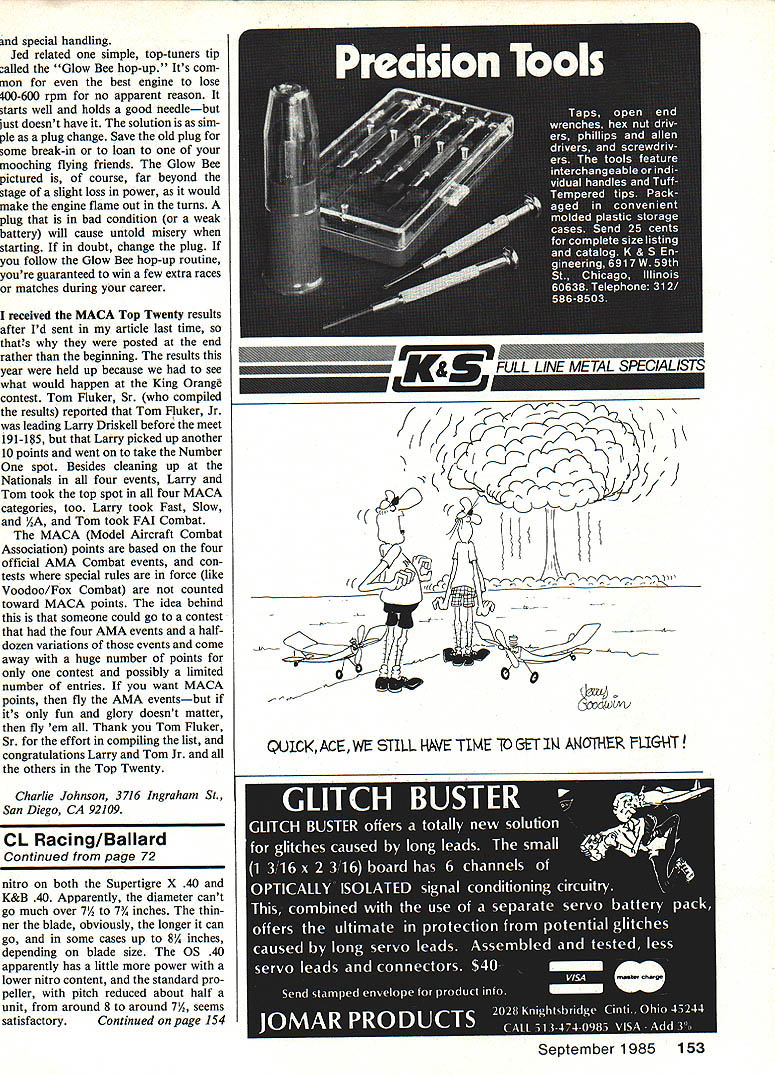
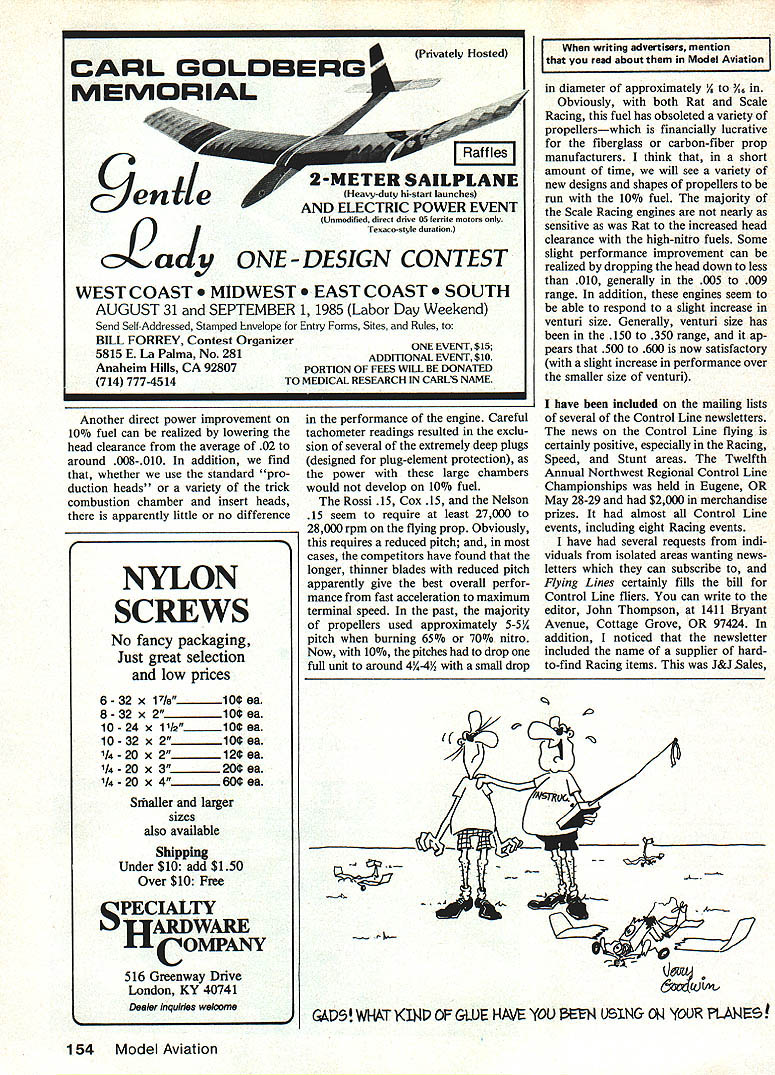
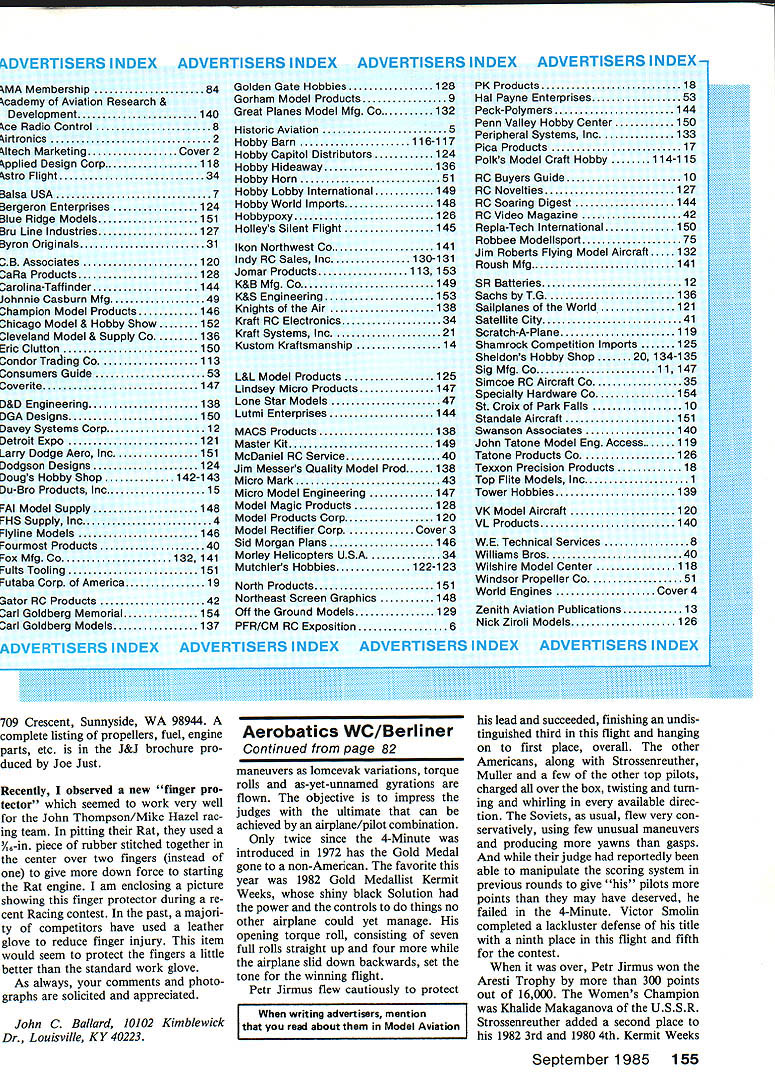
Recently, I observed a new "finger protector" which seemed to work very well for the John Thompson/Mike Hazel racing team. In pitting their Rat, they used a 1/16-in. piece of rubber stitched together in the center over two fingers (instead of one) to give more down force to starting the Rat engine. I am enclosing a picture showing this finger protector during a recent Racing contest. In the past, a majority of competitors have used a leather glove to reduce finger injury. This item would seem to protect the fingers a little better than the standard work glove.
As always, your comments and photographs are solicited and appreciated.
John C. Ballard 10102 Kimblewick Dr. Louisville, KY 40223
Transcribed from original scans by AI. Minor OCR errors may remain.

