
Control Line: Racing
John Ballard
Fuel Problems
The 10% nitro fuel rule has been in effect for approximately 10 months in the Midwest area. During that time product inconsistency has caused problems and racing events have been slowed by roughly one to two seconds over seven laps for Rat and Scale racing when contest‑supplied fuel is used.
At one recent contest we discovered, after analysis, that a manufacturer's "economy blend" used nitroethane instead of nitromethane. The fuel also contained approximately 6% water and oil of undetermined origin. Serious competitors spend considerable time tuning engines for maximum output; propeller testing, restarts, and speed measurements are based on a known 10% nitromethane blend. When management‑supplied fuel differs, severe starting problems and plug detonation can occur.
A vote of competitors at one event resulted in boxing personal 10% test fuels into two one‑gallon "official" jugs and using that mixture for the contest. Unfortunately, contest management will sometimes purchase hobby‑shop stock, so four gallons supplied may be two or three different brands. This forces competitors to scurry to find which brand starts and runs satisfactorily under the day's climatic conditions. For fairness the fuel should at least be the same brand, and some competitors bring their own 10% blends to the contest for use by all entrants.
Reuse and contamination
Reusing partially emptied jugs of fuel at later contests is another serious problem. At premier Midwest flying sites there may be three separate racing contests per year; unused fuel is often retained and brought out again. Open gallon jugs left in humid conditions can absorb large amounts of water and collect dust, grass, and other foreign material. I personally take remaining fuel from a contest, put it into a sealed container, and use it later as break‑in fuel or for sport flying.
A recent poll of Midwest competitors showed little objection to purchasing responsibly formulated fuel by adding a dollar or two per competitor to the entry fee to ensure one satisfactory brand of fuel. Sealed containers should be supplied at racing events.
Recommendations
- Purchase a single, responsibly formulated brand of contest fuel and supply it in sealed containers.
- Avoid mixing different brands in the same event.
- Do not reuse open jugs across contests; store leftover fuel in sealed containers for non-competitive use.
- Allow competitors to contribute verified personal test fuel when necessary, but standardize whenever possible.
Propeller Reevaluation
The mandatory switch to 10% nitro has rendered many hand‑molded, meticulously prepared propellers obsolete, especially in Scale and Rat racing. Scale racers who ran 60–70% nitro and dropped to 10% saw heavily pitched propellers (7×5 and 7×5A) become totally unsatisfactory, with an rpm loss of about 3,000 when moving from 70% to 10% nitro.
Many fiberglass and carbon‑fiber props were originally finished products whose pitch depended on very thin blade sections, leaving little material for repitching. Scale racers needed completely new propeller designs with much lower pitch. Fiberglass/carbon copies of the Taipan 7×5 were found to have enough blade area to be repitched to approximately 7×4 to 7×4½, saving considerable testing time.
Both FAI Combat competitors and RC Quarter Midget racers have spent significant time testing propellers for maximum rpm; RC Quarter Midget racing has had fuel restrictions for some time. A few competitors purchased very low‑pitched free‑flight props in the 7×3½ to 7×4 pitch range; careful engine workups produced dramatically improved rpm and airspeeds.
Rat engine specifics
- The .40 Rat engine saw a less dramatic reduction in airspeed and rpm than Scale Racing but still required a complete propeller evaluation.
- With 55–65% nitro, racers used 7½ to 8‑inch pitch props to allow the engine to unload in the air. With only 10% nitro the engine would not unload satisfactorily and airspeed dropped considerably.
- Fiberglass Rat race propellers have sufficient blade area to change pitch to roughly 6½ to 7½. The OS .40 Pylon engine was capable of pulling a 7½‑pitch prop, while K&B .40 and ST .40 engines required about 7 to 7½.
- A blade diameter of approximately 8 inches was found satisfactory. Small‑blade‑area propellers tended to develop the highest airspeed.
Field Safety
Racing speeds for both Slow Rat and Rat classes are 120–140+ mph, so intense field safety is paramount.
- Starting judges use battery‑operated "bullhorns" for clear instructions.
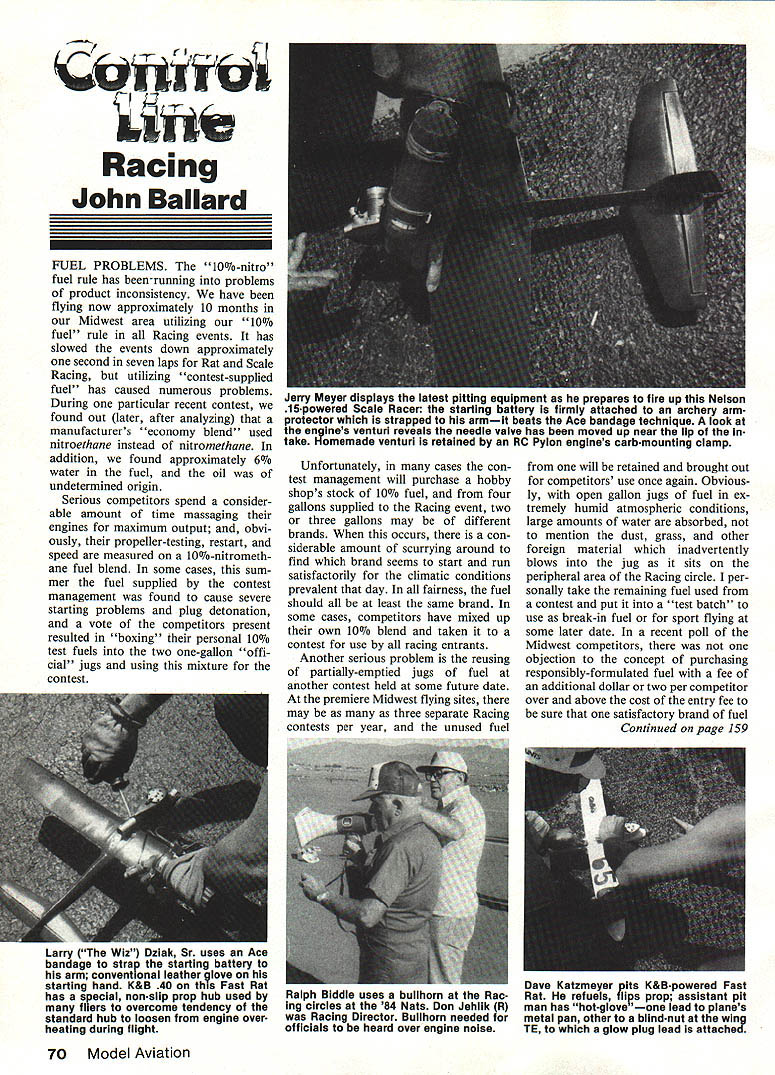
- Competitors have devised ways to protect arms from heavy starting batteries and fingers from spinning fiberglass and carbon‑fiber props: archery arm supports converted to battery holders, archery finger protectors, and padded gloves with the thumb and first two fingers intact while the third and fourth fingers are cut off for freer movement during plug changes or wrench use.
- Clearly visible circle markings are mandatory to give pilots a reference point and to mark a safe pit area where models can be stopped, refueled, and take off without being endangered by other aircraft. One effective material is white plastic lawn edging cut into 6‑inch sections and inserted into the ground; the white hoops are visible to pilot and pit man even in low sun conditions.
Transcribed from original scans by AI. Minor OCR errors may remain.

