
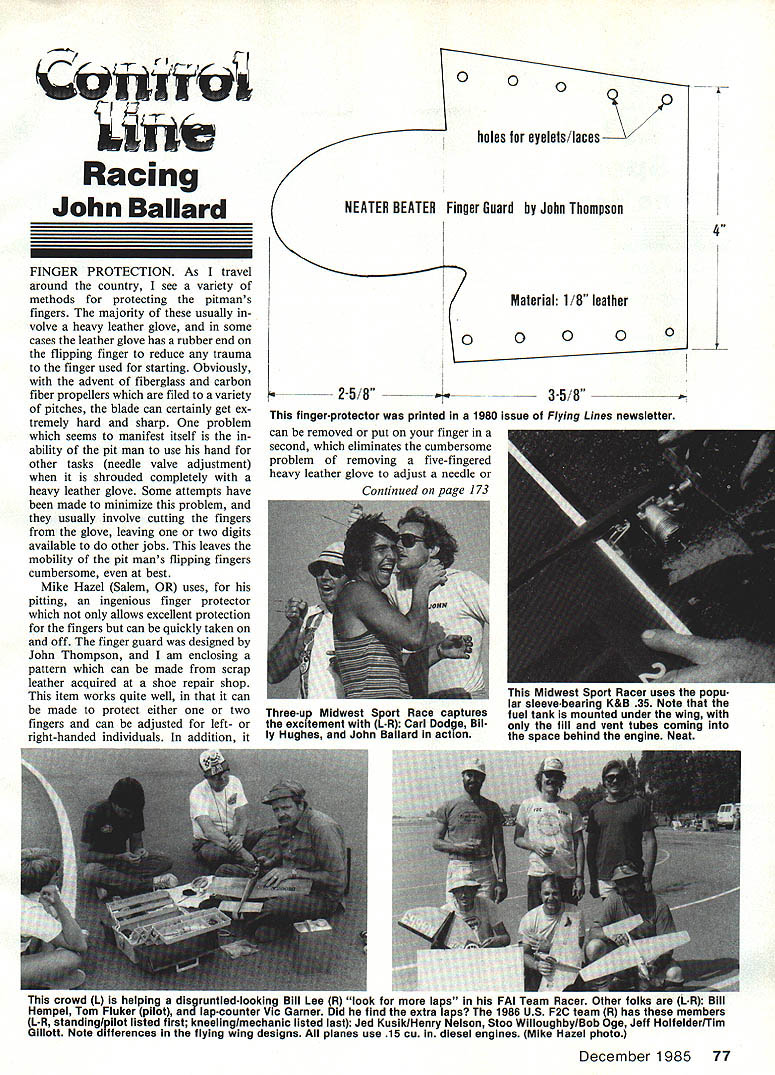
Control Line: Racing
John C. Ballard
Finger Protection
As I travel around the country, I see a variety of methods for protecting the pitman's fingers. The majority involve a heavy leather glove; in some cases the leather glove has a rubber end on the flipping finger to reduce trauma to the finger used for starting. With the advent of fiberglass and carbon-fiber propellers, which are filed to a variety of pitches, the blade can become extremely hard and sharp.
One problem that manifests itself is the inability of the pit man to use his hand for other tasks (needle-valve adjustment, etc.) when it is shrouded completely with a heavy leather glove. Some attempts to minimize this problem involve cutting the fingers from the glove, leaving one or two digits available to do other jobs. This, however, leaves the mobility of the pit man's flipping fingers cumbersome at best.
Mike Hazel (Salem, OR) uses an ingenious finger protector for pitting that allows excellent protection and can be quickly taken on and off. The finger guard was designed by John Thompson; a pattern can be made from scrap leather acquired at a shoe repair shop. This item works well: it can be made to protect either one or two fingers, can be adjusted for left- or right-handed individuals, and can be removed or put on in a second. This eliminates the cumbersome problem of removing a five-fingered heavy leather glove to adjust a needle or make other minor adjustments.
Mike made a drawing and instructions which he published in the Northwest Control Line Model Aviation Flying Lines newsletter back in 1980. Several racing enthusiasts in the Midwest have tried these and found them much better than other finger-protection methods they had previously used.
Team Racing
The U.S. FAI Team Races were held in California, and several excellent performances were turned in by the teams of Jeff Holfelder/Tim Gillott, Jed Kusik/Henry Nelson, and Bob Oge/Stew Willoughby. Qualifying times were in the 3:38 range. Let's hope our F2C team does well at the World Championships.
700-lap Midwest Sport Race
Various regions throughout the United States have different rules for "Sport Racing." The majority either specify a kit airplane with a specific engine and tank, or set reasonable specifications for the plane, tank, and engine. In our Midwest area, the largest participative event is Sport Racing. The rules are fairly specific: engines must be sleeve-bearing, unmodified, and the profile-mounted tank is allowed only a 1/4-inch fill tube.
It is amazing to see how these planes have become more sophisticated over the years, with modifications to the profile tank. Since there are no propeller restrictions, a large amount of work is done to improve the engine. The most successful airplanes tend to have a thick, built-up wing (about 1/2 inch thick), a long fuselage to avoid being nose-heavy, and the favored engine is the K&B .35 sleeve-bearing.
The K&B .35 engines are produced by K&B Manufacturing and have a floating Dykes piston ring, an excellent double-bushed rod, and the old-style baffled piston. With minor refitting and an excellent ring seal, they perform well on 10% nitro fuel. Typical lap times are between 15.5 and 17.5 seconds, with the majority of airplanes around the 17-second level.
Once a year the Chicago area holds a 700-lap Sport Race event. Generally, large profile tanks will run approximately 80 laps, so about eight or nine pit stops are required. Racing three-up is a lot of fun, and reduced speeds cause no major problems. Races are generally won or lost by the team best able to avoid burned-out plugs and execute excellent pit stops.
We finished the final 700-lap races here in September, and the winning time was just around 33 minutes. I recommend this Sport Race event to anyone with racing interest in local clubs, since it brings out a lot of competitors who might be eliminated by more sophisticated racing events. Stranded or solid .014 wires are permitted.
One very positive advantage to long races is the practice the pilot and pit man receive from working together as a team for 700 laps.
Plug Problems
With the reduction in nitro in fuel, we are seeing far fewer glow-plug problems with racing engines. In the past, seals blew out; wires became distorted or broke, causing pitting problems and erratic running. At a recent Midwest contest in Sugar Grove, IL, I found Rat, Goodyear, and Slow Rat competitors using the K&B IL plug as well as Fireball standard plugs.
Most competitors in Rat and Scale Racing still use the Glo-Bee 11 or 4L, but with some minor modifications the standard plugs may be used. We have found that using a heat-curable, two-component epoxy resin in the seal area of both Fireball and K&B plugs helps the post and/or seal remain intact even after an overly-lean run on 10% nitro. The main caveat is proper rheostat adjustment on the Glo-Bee fireplug battery so that the elements on the K&B and Fireball plugs are not burned out by setting the battery too high.
Events / Announcements
Richard Bynum (Scottsdale, AZ) reports that the annual Buckeye Southwest Regionals will be held January 18–19, 1986 at Buckeye Airport. This meet will feature the majority of racing events, including:
- Rat
- Slow Rat
- Scale Racing
- ACLA Slow Rat
- Mouse
- Formula Unlimited Racing
I have attended this meet; anyone interested in flying during the winter months will find it an excellent racing contest.
As always, your comments and suggestions are solicited.
John C. Ballard 10102 Kimblewick Dr. Louisville, KY 40223
Transcribed from original scans by AI. Minor OCR errors may remain.

