
Control Line: Racing
John Ballard
Winter building and reader mail
WINTER months in the Midwest area bring our engine-testing and flying to a halt. The short days and low temperatures keep us inside doing our winter building projects. Several readers from Chicago, Cleveland, Detroit, and Wisconsin have written me concerning their building projects and possible information on various products.
Product: Pettit Fast Fill
One product earning creditable mention when finishing my new Goodyear and Sport Race airplanes for 1986 is the product introduced last year by Pettit. Fast Fill was brought out almost a year ago, and Kenneth Williams, Hobbypoxy sales manager, wrote me asking for my opinion of the product. It was extremely light weight and filled well, but I felt it sanded hard. Apparently other people thought so too. Early this year he sent me a letter and another sample of the product saying they had improved Fast Fill to incorporate better sanding properties. The new product has the same good filling and light weight and now sands much easier.
Sport Race — wing problems and causes
This summer, flying Midwest Profile Sport Race, I found a couple of tips that apparently are mandatory for building these extremely light, .35 sleeve-bearing-powered aircraft. On several occasions I have noticed competitors having problems with their built-up wing cracking or splitting on the outboard or inboard side—and, in longer races, the wing may fall off and foil an otherwise excellent run.
The majority of people are making a built-up airframe with a quarter- or half-inch leading edge and covering it with MonoKote or some other type of shrinkable covering. The problem begins when these sleeve-bearing engines develop a considerable amount of vibration, causing small cracks or delaminations to form in the covering around the center-section planked areas. With the exhaust running over the outboard planked area, that area can quickly become fuel- and oil-saturated and lose strength, resulting in lost or broken wings.
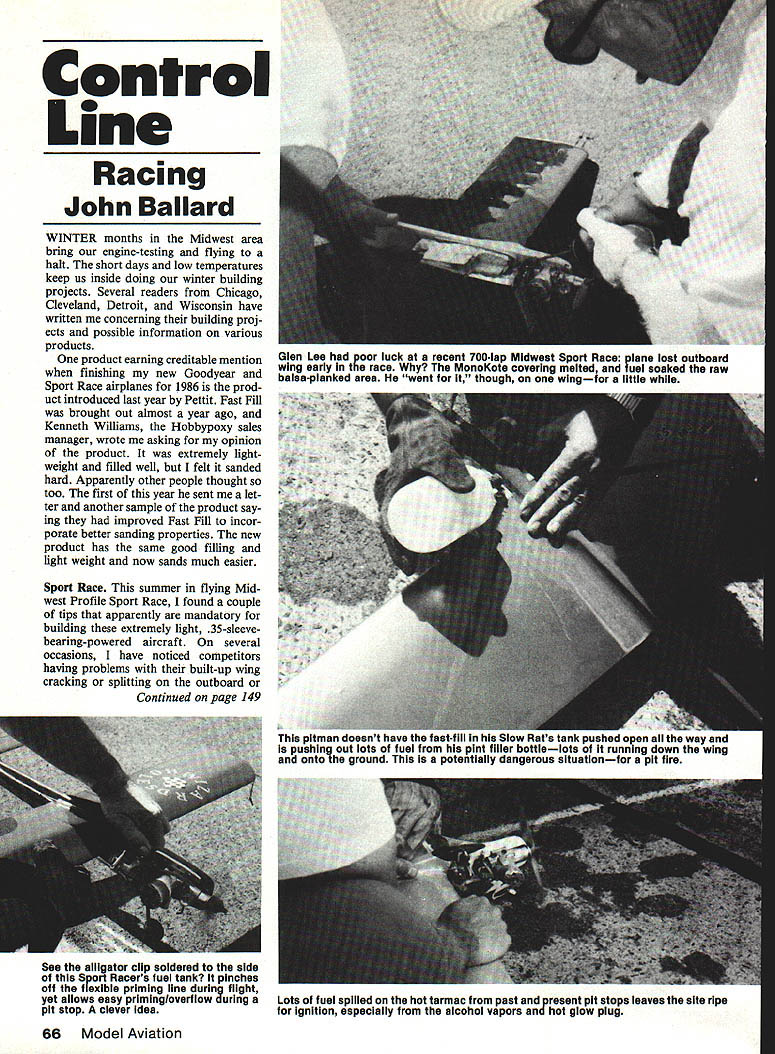
In addition, the low-nitro (3%–5%) fuel increases the potential flammability because of its large percentage of methanol. I am enclosing a picture of Glen Lee's Sport Racer taken during a 700-lap race in which, on one of the pit stops, the engine caught the airframe on fire for just a second or two. The MonoKote covering burned away, and on his next pit stop one alligator clip soldered to the side of the tank pinched off the flexible priming line during flight yet allowed easy priming/overflow during pit stop — a clever idea.
Glen Lee had poor luck in that recent 700-lap Midwest Sport Race when his plane lost the outboard wing early in the race. The MonoKote covering had melted and the fuel-soaked raw balsa-planked area burned through the wing for a short distance. There was a lot of fuel on the ground — perhaps a bottle had been opened all the way and fuel was running down the wing — a dangerous situation for a pit fire. Fuel spilled on hot tarmac near pit stops leaves the site ripe for ignition, especially alcohol vapors combined with a hot glow plug.
Coating recommendation: thinned two-component epoxy
I have found that applying a two-component epoxy, thinned 25–50% with solvent and brushed over the planked wing area and out about three to four ribs from the center section, reduces the amount of fuel and oil intrusion; consequently, the airframe strength is maintained. This is especially desirable when shrinkable wing coverings are used, since those coverings do not penetrate the wood's surface like a two-component epoxy would. When these coverings have a tendency to peel back or are melted from a slight fire or heat, there is then virtually no protection of the wood.
This thinned-down, clear, two-component epoxy can also be used for coating the profile fuselage and tail surfaces. By thinning the product, you get very little build-up on the wood surfaces; consequently, excellent adhesion with the shrinkable covering is maintained.
Safety first: pit fires and fuel spills
You will remember that Jerry Meyer had a rather serious fire during the Slow Rat racing event at the 1985 Nats. This was the result of spilled raw fuel on the airframe, an extremely hot Glo-Bee battery, and a large amount of spilled fuel on the tarmac around the pit area. I have enclosed a picture of a Slow Rat being fueled from a pint plastic bottle with the tank filler not fully pushed down. The overflow of raw fuel is running down the inboard wing. This enormous amount of fuel plus the fuel on the ground underneath the plane can easily be ignited on a hot day with a well-charged Glo-Bee battery.
In another picture, you can see the large amount of fuel spilled on the ground in the vicinity of the pit man and starting area. With the fuel on the aircraft and on the ground, the vapors can be ignited easily. The majority of Slow Rat and Sport Race aircraft have an automatic priming system which basically is a portion of the overflow from the tank. This prime almost always goes into the exhaust port area with the piston closed, thus allowing a large amount of fuel to be in the exhaust region; so when a hot battery is applied, a fire can easily result.
Safety reminders:
- Avoid overfilling tanks and ensure fillers are fully seated when pouring fuel.
- Keep spilled fuel off the airframe and tarmac; clean up immediately.
- Be cautious with hot batteries near fuel-soaked areas.
- Consider routing exhaust away from fuel-soaked wood and coverings.
Priming methods and Rat Racers
In the case of the Rat Racers, the quick fills are usually found in the body portion of the aircraft; consequently, the amount of fuel over the rear of the plane during filling is minimized. In addition, the majority of engines are rear-exhaust types, and most competitors use the mini-pipe, which directs the exhaust away from the airframe. One of the best ways to prime a Rat engine is to tilt the airplane forward and squirt a small amount of fuel into the pipe, allowing it to run down into the exhaust port of the engine. This pipe eliminates the majority of fire hazard at the exhaust stack and directs the oil, heat, and residue away from the fuel tank area.
Special priming on a uniflow tank
I have noticed several Sport Race enthusiasts utilizing a uniflow tank arrangement with an added overflow tube which allows priming of the engine. An ingenious method is used by exiting a tube from virtually any upper portion of the tank and mounting an alligator clip on the side of the tank, pinching the flexible line which leads to the exhaust prime tube. While filling the tank, the alligator clip is pressed with the finger, thus opening up the overflow and allowing the air to escape from the tank as well as priming the engine. When priming is finished, the alligator clip is then mashed shut, and the system becomes sealed except for the uniflow tube pointing out into the airstream. I am enclosing a photo showing this alligator clip in the closed position.
Engine mounting and vibration
Another area of note is the large aluminum mounting plate used on the sleeve-bearing K&B .35. Without ball bearings in the case, engine vibration is a definite problem, and an extremely strong fuselage section and mounting plate must be incorporated or your engine runs will be rough and airspeed reduced.
As always, your comments are appreciated.
John C. Ballard 10102 Kimblewick Dr. Louisville, KY 40223.
Transcribed from original scans by AI. Minor OCR errors may remain.

