
Control Line: Racing
John Ballard
Overview
Midwest Sport Race has become one of the most popular and hotly contested Control Line events in our area. After studying newsletters from around the country, it’s clear that the "Big Goodyear" and Sport Race variations are extremely popular in many regions.
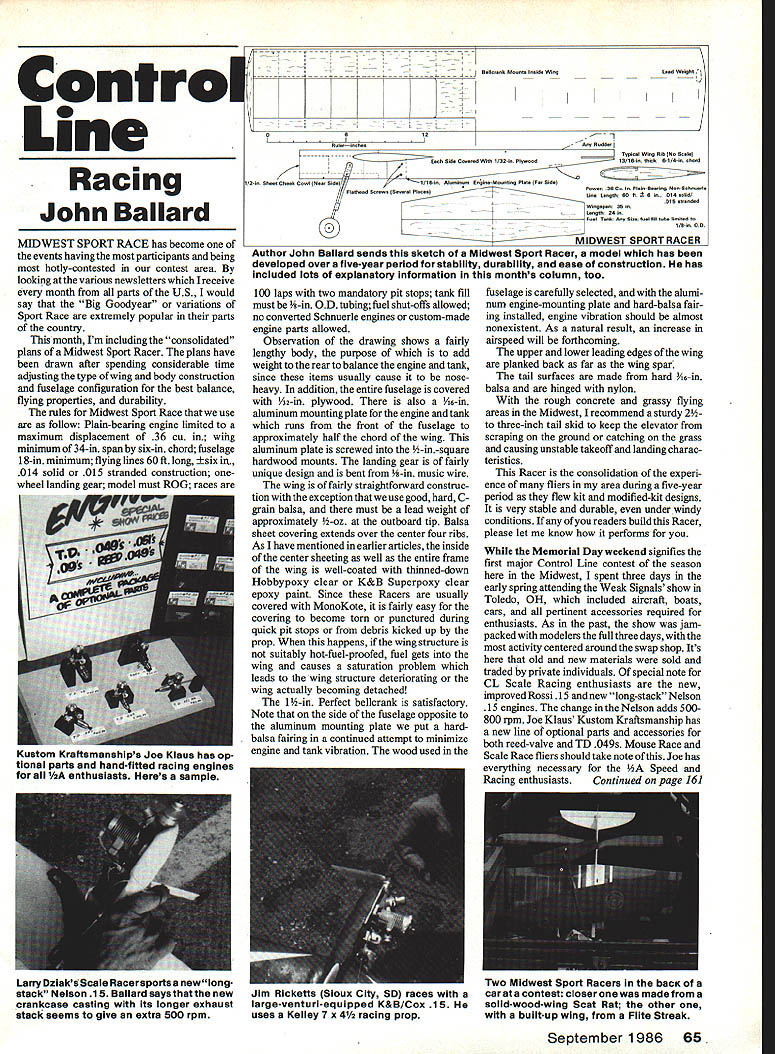
This column presents consolidated plans for a Midwest Sport Racer developed over a five-year period for balance, flying characteristics, durability, and ease of construction. The design reflects adjustments to wing and body construction and fuselage configuration based on many fliers’ experience.
Midwest Sport Racer — Rules
The Midwest Sport Race rules we use are as follows:
- Plain-bearing engine limited to a maximum displacement of .36 cu. in.
- Wing minimum: 34 in. span by 6 in. chord
- Fuselage minimum: 18 in.
- Flying lines: 60 ft. long
- Line construction: .014 solid or .015 stranded
- One-wheel landing gear
- Model must ROG (rise off ground / ready-to-go)
- Races: 100 laps with two mandatory pit stops
- Tank fill: 1/2-in. O.D. tubing
- Fuel shut-offs allowed
- No converted Schnuerle engines or custom-made engine parts allowed
Design Summary and Purpose
- The fuselage is fairly lengthy to add rear weight for balance. Engines and tanks tend to make models nose-heavy, so the extended body shifts the center of gravity rearward.
- The entire fuselage is covered with 1/16-in. plywood for strength and durability.
- A 1/16-in. aluminum engine/tank mounting plate runs from the front of the fuselage to approximately the half-chord of the wing. This plate is screwed into 3/8-in. square hardwood mounts.
- A hard-balsa fairing is fitted on the side of the fuselage opposite the aluminum plate to further minimize engine/tank vibration.
- Landing gear is a unique bent design made from 3/32-in. music wire.
- The design emphasizes low vibration and careful wood selection to maximize speed and longevity.
Wing Construction
- The wing is straightforward but uses hard C-grain balsa for strength.
- Outer panels must have a lead weight of approximately 1/2 oz at each outboard tip.
- Balsa sheet covering extends over the center four ribs.
- The upper and lower leading edges are planked back to the wing spar.
- The inside of the center sheeting and the entire wing frame should be well coated with thinned-down HobbyPoxy clear or K&B Superpoxy clear epoxy paint.
- Rationale: Racers are often covered with MonoKote, which can be punctured during quick pit stops or by debris from the prop. If the wing structure is not hot-fuel-proofed, fuel can saturate and deteriorate the wing, potentially causing detachment.
Tail Surfaces and Skid
- Tail surfaces are made from hard 1/16-in. balsa and are hinged with nylon.
- For rough concrete or grassy flying areas, use a sturdy 2- to 3-inch tail skid to prevent the elevator from scraping the ground or catching grass, which can cause unstable takeoffs and landings.
Controls and Hardware
- A 1/8-in. "Perfect" bellcrank is satisfactory for this design.
- With the aluminum engine-mounting plate and hard-balsa fairing installed and with carefully selected fuselage wood, engine vibration should be almost nonexistent, which typically yields increased airspeed.
Performance and Durability
- This Racer consolidates five years of local experience flying kit and modified-kit designs. It is notably stable and durable, even in windy conditions.
- If you build this Racer, please let the author know how it performs for you.
Events, Shows, and New Equipment
- Memorial Day weekend marks the first major Control Line contest of the season in the Midwest.
- The Weak Signals show in Toledo, OH (early spring) featured aircraft, boats, cars, and accessories. As usual, the swap shop was heavily active for three full days with private individuals selling and trading new and used materials.
- Notable new products:
- Rossi .15 (improved)
- Nelson long-stack .15 — the new long exhaust stack appears to add about 500–800 rpm.
- Joe Klaus (Kustom Kraftsmanship) offers a new line of optional parts and accessories for reed-valve and TD .049 engines — useful for Mouse Race and Scale Race fliers and 1/2A Speed/Racing enthusiasts.
Recent Contests and Observations
- So far this year contests have included: Sport Race, "B" Race, Rat Race, Scale Race, and Profile/CL Speed.
- The largest meet was the 20th Annual Tree Town Modelers' AAA meet (May 25) at Waubesa College in Sugar Grove, IL, with unusually high entries in all Racing events. Several entrants drove over 600 miles one-way to attend.
- Highlights:
- Jim Ricketts (Sioux Falls, SD) and his son showed impressive performances in Rat and Scale Racing.
- Larry Dziak used a new Nelson long-stack .15 and reported roughly a 500 rpm gain, though loose mounting bolts affected his result.
- Competitive ground rpm for props this season has been about 25,000–26,000 rpm.
- Many pilots used inexpensive 7 x 4 graphite-filled Grish props (about $0.80) as a cost-effective alternative to $5–$10 custom fiberglass props.
Notes and Recommendations
- Hot-fuel-proof the wing (inside center sheeting and wing frame) with epoxy to prevent fuel damage.
- Balance the model by adding rear fuselage length and using the aluminum mounting plate plus a hard-balsa fairing to minimize vibration.
- Use quality, hard C-grain balsa for wing panels and select fuselage woods carefully for durability.
- Reinforce hardware mounts (engine, tank, gear) and check fasteners before events to avoid failures.
If you build this Midwest Sport Racer, the author would appreciate feedback on how it flies and performs in your conditions.
Transcribed from original scans by AI. Minor OCR errors may remain.

