
Control Line: Racing
Bill Lee
A COUPLE of columns ago, I took a couple of good shots at some racing events that I know are popular in several areas of the country; specifically, limited capacity events. I said, in effect, that this was not the way to go and pleaded for those who disagreed with me to write and let me know if I was off base. The response wasn't overwhelming. Two letters. One came from George Caldwell of Walkersville, MD. George supports the concept of limited capacity events. George is also a member of the Racing Advisory Committee. I really expected to hear from the RAC members. The fact that they are on the RAC generally means they are not hesitant to air their views and will generally sit down and write when necessary. I mean, that's why they were asked to be part of the RAC in the first place; they weren't afraid to contribute. The other letter was a beaut! Came from James Van Sant of Penndel, PA. Let me quote some pieces of Jim's letter.
"First, slowing the event down is not the intent of 1-oz. Goodyear. It is to give many types of motors a chance, not just one (Rossi) ... the diesel also. It puts much value on the pit stops and plane.
"The Goodyear with it came about because an event was needed to lead more people into Team Race, and it has helped. Did you know B Team Race, the first UC racing event, was patterned after Goodyear racing, full-size? B was a good event (with bad rules that never got changed) and is still flown around the world but not in this country.
"The one thing that I have not done is ruin a motor from a lean run. That is, if my shut-off was working. You know a lean run is a hot run and starting is not good, and you must start again without a blown plug.
"One thing I have seen happen is that everyone who has flown the 1-oz. version for any time will go like this: Glow, it's easy, or seems so. Then they will try the diesel. That looks easy. Just watch it drone on (want to bet?). Try fuel. Different types are tried. Why not? What kind of race is it if all the planes are the same, motor and fuel and prop?
"To sum it up, for 1-oz. Goodyear, the winner of this event has to have a plane-motor-prop-fuel combo, plus pit work and flying. Sounds like FAI doesn't it? But it is true how AMA looks the same at first glance, but the choice is very small. In fact, at the '75 Nats what was flown? A couple of different planes, all motors the same, except a very few and they didn't stand a chance. Props? Well, it was glass and a 7/6 cut to get the right rpm. Fuel? As much nitro as you can stand. Pit and flying are the same except maybe AMA is too fast for some. It takes a good flier even now. And the entries in AMA are going down around here. The handwriting is on the wall: change or go like Rat, B Team Race, etc.
I think Jim makes a lot of sense. Two basic ideas: first, that there are many ways to competitive flying for the 1-oz. event; and second, that the event is a natural feeder into FAI Team Race.
But what about some of the other limited-capacity events that are being flown in this country? I know from the newsletters I get that limited-capacity Slow Rat is flown in the Great Southwest (AZ, CA, NM) and maybe elsewhere. Do you people who fly it think it should be made a National event? Seems like any event would go over if given enough exposure. Come on, guys, get on the stick: contribute! What is "Big Goodyear"? How does it compare with the Formula 400 Goodyear that has already been proposed to the RAC?
This whole diatribe might seem like a bad case of "not invented here" showing through. I hope I don't leave you with that impression. Limited-capacity converts are fun. I flew a version of Slow Rat over five years ago when I lived in Denver that was limited capacity — two-ounce tanks, 40% on suction, two-wheel gear, etc. And I had all kinds of fun.
What I am trying to get at is this: unless somebody steps up and takes responsibility for organizing, promoting and writing rules for these kinds of events, they will remain local curiosities. The RAC can propose rules, but the people who fly the events must provide the impetus and the practical input. If there is enough interest and a set of reasonable, workable rules, the event will grow.
So, to summarize: yes, limited-capacity events can be a useful and fun part of control-line racing. Yes, they can serve as a stepping stone to Team Race. But no, they will not flourish without active support from participants — organizers, promoters and flyers alike. If you want these events to become more than local anomalies, do something about it.
LITTLE RAT
Early in June, I had the opportunity to go out to Midland in west Texas to the AAA contest held there. One event that they had turned out to be one of the most competitive and popular was one they called "Little Rat." Basically, the rules were as follows:
- Plane must be of profile construction.
- All controls must be externally mounted on the model.
- Maximum engine size is .35 cu. in.
- No hot goggles allowed.
- 60' lines, .018 diameter, stranded allowed.
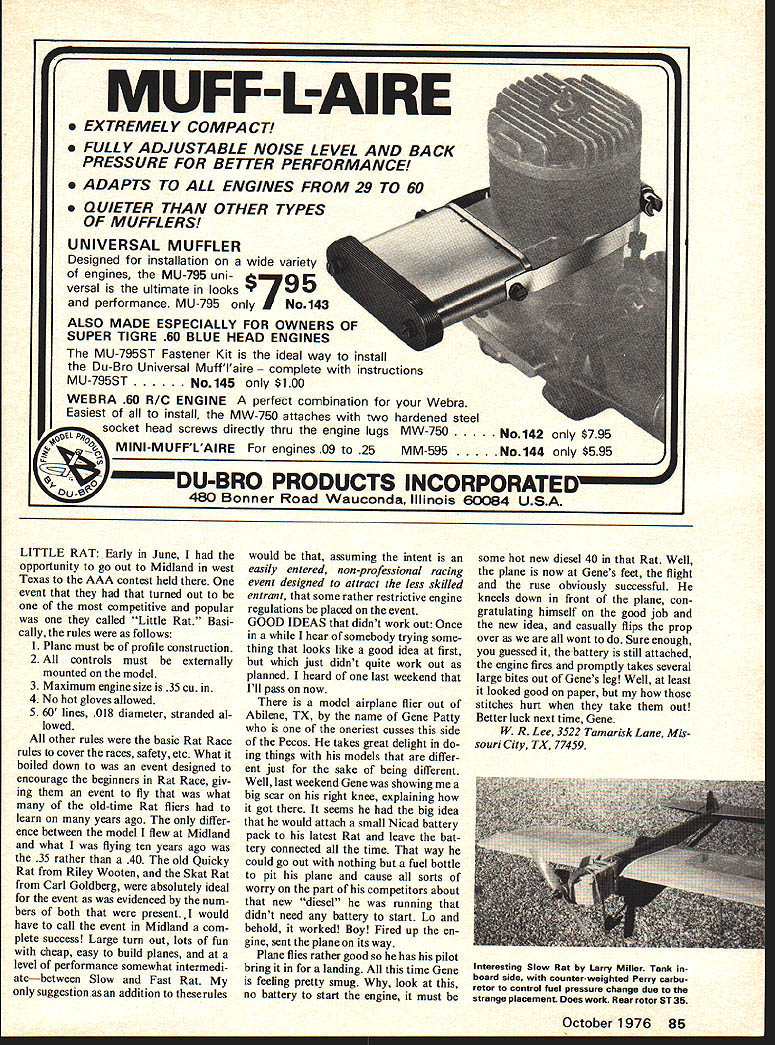
All other rules were the basic Rat Race rules to cover the races, safety, etc. What it boiled down to was an event designed to encourage the beginners in Rat Race, give them an event to fly that was what many of the old-time Rat fliers had to learn on many years ago. The only difference between the model I flew at Midland and what I was flying ten years ago was the .35 rather than a .40. The old Quickie Rat from Riley Wooten, and the Skat Rat from Carl Goldberg, were absolutely ideal for the event as was evidenced by the numbers of both that were present. I would have to call the event in Midland a complete success! Large turn out, lots of fun with cheap, easy to build planes, and a level of performance somewhat intermediate—between Slow and Fast Rat. My only suggestion as an addition to the results would be that, assuming the intent is an easily entered, non-professional racing event designed to attract the less skilled entrant, that some rather restrictive engine regulations be placed on the event.
GOOD IDEAS that didn't work out: Once in a while I hear of somebody trying something that looks like a good idea at first, but which just didn't quite work out as planned. I heard of one last weekend that I'll pass on now.
There is a model airplane flier out of Abilene, TX, by the name of Gene Patty who is one of the eeriest cusses this side of the Pecos. He takes great delight in doing things with his models that are different just for the sake of being different. Well, last weekend Gene was showing me a big scar on his right knee, explaining how he got there. It seems he had the big idea that he would attach a small Nicad battery pack to his latest Rat and leave the battery connected all the time. That way he could go out with nothing but a fuel bottle to pit his plane and cause all sorts of worry on the part of his competitors about that new "diesel" he was running that didn't need any battery to start. Lo and behold, it worked! Boy! Fired up the engine, sent the plane on its way.
Plane flies rather good so he has his pilot bring it in for a landing. All this time Gene is feeling pretty smug. Why, look at this, no battery to start the engine, it must be some hot new diesel 40 in that Rat. Well, the plane is now at Gene's feet, the flight and the ruse obviously successful. He kneels down in front of the plane, congratulating himself on the good job and the new idea, and casually flips the prop over as we are all wont to do. Sure enough, you guessed it, the battery is still attached, the engine fires and promptly takes several large bites out of Gene's leg! Well, at least it looked good on paper, but my how those stitches hurt when they then take them out! Better luck next time, Gene.
W. R. Lee, 3527 Tamarisk Lane, Missouri City, TX, 77459.
Transcribed from original scans by AI. Minor OCR errors may remain.

