
Control Line: Racing
John Ballard
Overview
Racing for 1986 is finally winding down, and after all that was involved I think it was a very successful year. The Midwest saw improved contestant participation, with many new modelers entering Sport Racing and Big Goodyear events.
Two major events that appear to be growing are Scale Racing and the Midwest Sport Race. Each Midwestern contest this summer had a minimum of 12–20 entrants in those events. Participant levels in Rat and Slow Rat remained about the same as last year; the sophisticated equipment required and the need for experienced pilots limit new entrants in those classes.
Finale: 700-lap Sport Race
September brings a slight color to the trees in the Midwest and also signifies the grand finale of Sport Racing in the form of a 700-lap event. This year it was flown in the Chicago area.
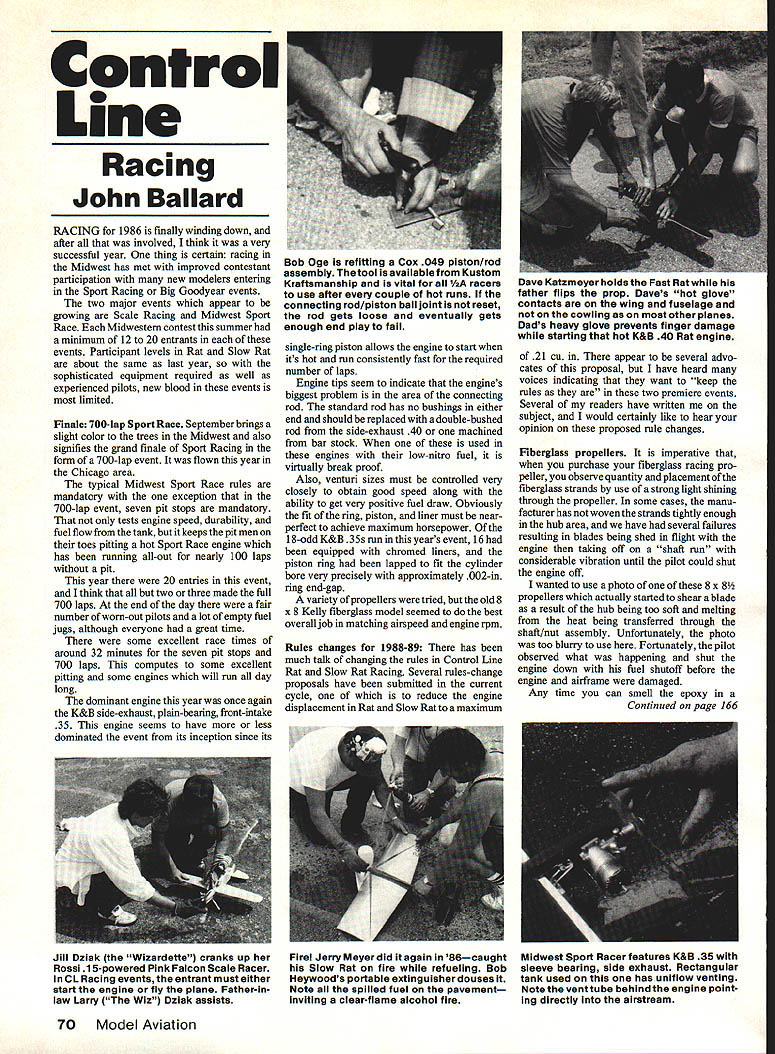
Typical Midwest Sport Race rules apply, with one mandatory exception for the 700-lap event: seven pit stops are required. That not only tests engine speed, durability, and fuel flow from the tank, but it keeps the pit crews on their toes pitting a hot Sport Race engine that has been running all-out for nearly 100 laps between stops.
This year there were 20 entries; all but two or three completed the full 700 laps. At the end of the day many pilots were worn out and there were a lot of empty fuel jugs, but everyone had a good time. Some excellent race times—around 32 minutes including seven pit stops—were recorded, indicating superb pitting and engines capable of running all day.
Engines and setups
The dominant engine this year was once again the K&B side-exhaust, plain-bearing, front-intake .35. This engine has dominated the event since its inception: its single-ring piston allows the engine to start when hot and run consistently fast for the required number of laps.
Tips and observations:
- The engine's biggest problem area is the connecting rod. The standard rod has no bushings at either end and should be replaced with a double-bushed rod (for example, from the side-exhaust .40) or one machined from bar stock. With a double-bushed rod and low-nitro fuel, these engines are virtually break‑proof.
- Venturi sizes must be controlled closely to obtain good speed while maintaining a very positive fuel draw.
- The fit of piston ring and cylinder liner must be near perfect to achieve maximum horsepower. Many of the K&B .35s in the event used chromed liners and piston rings lapped to fit the cylinder bore precisely, with approximately .002-inch ring end-gap.
- A variety of propellers were tried; the 8x8 Kelly fiberglass prop seemed to do the best overall job matching airspeed and engine rpm.
Rules changes for 1988–89
There has been much discussion about changing rules in Control Line Rat and Slow Rat racing. Several proposals have been submitted in the current cycle, including one to reduce engine displacement in Rat and Slow Rat to a maximum of 21 cu. in. There are advocates both for change and for keeping the current rules. Several readers have written in on the subject; I would welcome more opinions on these proposed rule changes.
Fiberglass propellers
When purchasing a fiberglass racing propeller, inspect the quantity and placement of the fiberglass strands by holding the prop up to a strong light. Some manufacturers have not woven strands tightly enough in the hub area, which has caused hub failures and blades being shed in flight. This can allow the engine to run on the shaft with considerable vibration until the pilot shuts it off.
If you can smell epoxy the prop is getting hot and should be removed from service. Any sign of hub softness, strand separation, or heat transfer through the shaft/nut assembly warrants immediate retirement of the propeller.
Transcribed from original scans by AI. Minor OCR errors may remain.

