
Control Line: Racing
John Ballard
Proposed rule changes
Proposed rules would put limitations on Fast and Slow Rat by limiting engine displacement to .21 cu. in. This situation has produced a flurry of letters and telephone calls; 95% of them want the engine sizes in these two events to remain as they presently stand.
The Control Line Racing group from the San Diego, CA area summarized most people's feelings by indicating: please keep 40-sized Rat alive, since they think it is worth the effort just for the excitement of an expert-only, 150+ mph premier Racing event.
Whittier contest results
Howard Shahan sent Racing results from the October 18–19 CL contest held in Whittier, CA. He indicates the contest drew approximately 60 entries in Racing. The events were:
- Mouse II
- Northwest Sport Race
- Fast Rat
- Scale Race
- Big Goodyear
- Slow Rat
Some excellent times were turned in Fast Rat in the two-up finals, with first place won by Shahan/Fogg with 4:44 for 140 laps after qualifying (70 laps) at 2:18. Scale Race was won by the Akre team at 6:24. These are very good times for our Western colleagues, who indicated that many contestants came from Canada and Texas to compete.
K&B/Cox .15 Conquest engine rework
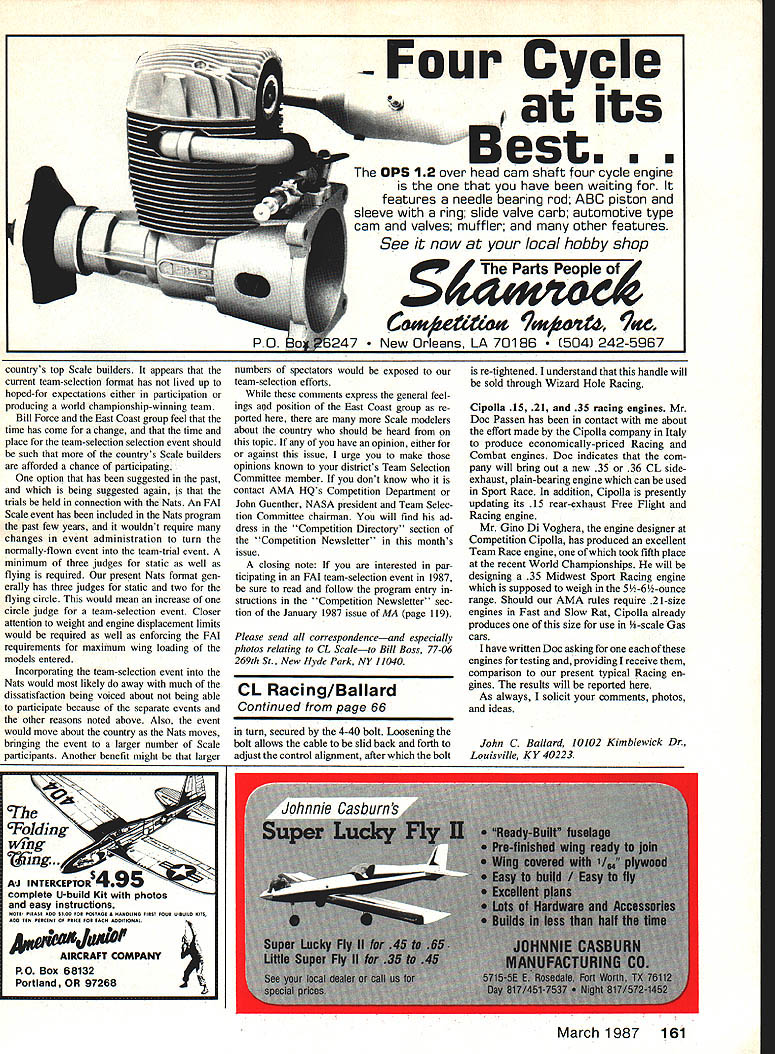
I have had several letters requesting information on reworking the Cox .15 since it is such an economically priced racing engine. I recently received one of these engines that had been modified by Ron Young, Performance Engines. The modifications were extensive and interesting:
- Cylinder block mounting-bolt holes countersunk so the block is bolted directly to the crankcase before the head is attached.
- Cylinder head/clamp ring rotated 45° and new holes drilled and tapped into the top of the cylinder block for head-mounting bolts.
- This eliminates the usual hassle when removing the cylinder head to change gaskets or alter head clearance, and reduces the need for many shims between the upper cylinder and block area.
- Fitted with a Ron Young custom ABC piston and liner assembly.
- Head modified to accept a Nelson racing plug.
- Crankshaft heat treated; threaded nose removed. Front of shaft drilled and tapped and fitted with a removable stud.
- Ron offers two crankshafts: a standard one and another with a larger internal intake passage, claimed to increase RPMs by about 500.
Photos show first-class workmanship. They were sent by Leo Wittenberg of the F-M Skylarks Model Club in Fargo, ND, who campaigned the engine for an entire year with excellent results and no failures.
Fiberglass propeller failures
Since most of the Racing fraternity uses fiberglass or carbon-fiber props, it is important that quality control of these units be watched closely.
During the recent '86 Nats at Lake Charles, LA, extremely hot air temperatures were probably a cause of several propeller failures in the Fast Rat and Slow Rat events. The majority of the props that failed were commercially produced units. In a couple of cases I saw competitors who had produced their own molds and props experience the propeller coming loose on the shaft. This situation occurs most frequently with the larger Rat/Slow Rat engines. The heat generated in the shaft area can cause immediate softening of an ill-prepared prop hub.
Close observation of competitors' failed propellers should alert an individual that the failure is common to a particular brand of prop; other propellers of that brand could be suspect for hub softening or shedding of blade area.
Recommendations and observations:
- Any freshly prepared "trick-pitched" propellers should receive a test-stand trial run on a good, hot-running engine.
- After a careful inspection of hub and blades following the test, it is then safer to try the prop in flight.
- Some props show evidence of not curing satisfactorily—caused by lack of oven-baking or using an inappropriate catalyst-resin mixture.
- Proper amounts of glass cloth and/or carbon fiber must be used to add hub area and dimensional stability under heat stress. Propeller manufacturers generally weigh the cloth and roving amounts to obtain maximum stability of the cured unit.
I have seen sad results of blade/hub softening during a race; the prop loosens its grip on the engine's prop hub, allowing the engine to run free ("shaft run") in flight. The consequence is losing the race and an expensive Rat engine.
Custom-made control handles
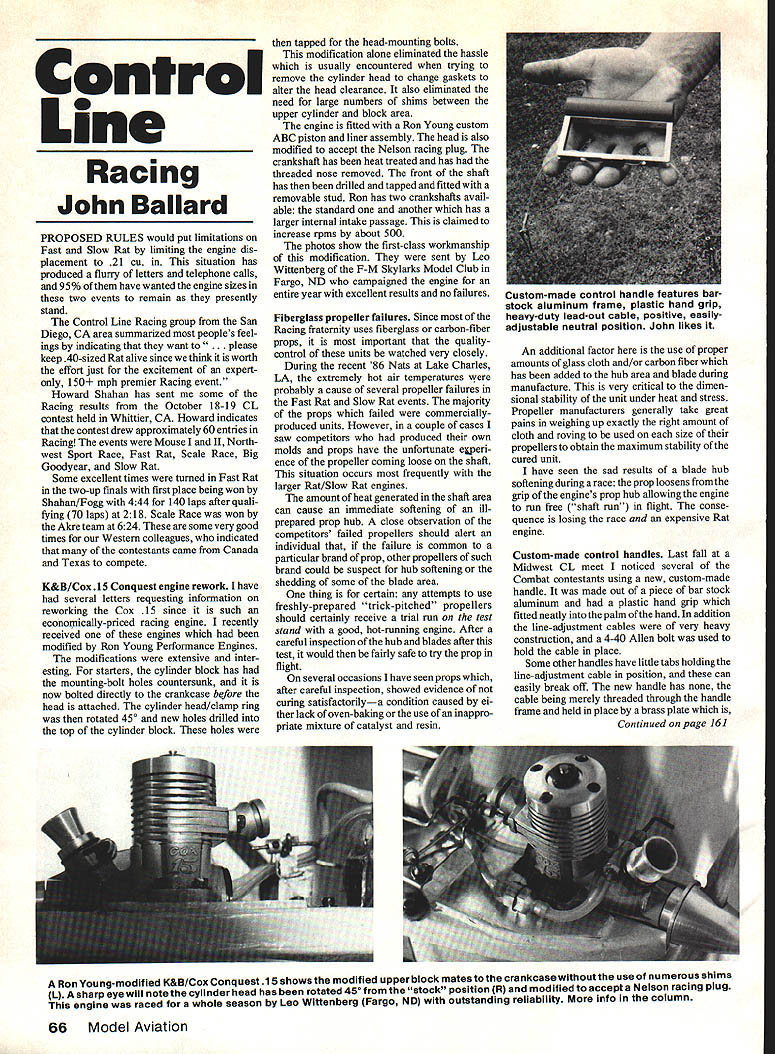
Last fall at a Midwest CL meet I noticed several Combat contestants using a new custom-made handle. It was machined from bar stock aluminum and had a plastic hand grip fitting neatly into the palm. The line-adjustment cables were of heavy construction, and a 4-40 Allen bolt was used to hold the cable in place.
Some other handles have little tabs holding the line-adjustment cable in position; these can easily break off. The new handle has no tabs—the cable is merely threaded through the handle frame and held in place by a brass plate, in turn secured by the 4-40 bolt. Loosening the bolt allows the cable to be slid to adjust control alignment; the bolt is then re-tightened. I understand this handle will be sold through Wizard Hole Racing.
Cipolla .15, .21, and .35 racing engines
Doc Passan has been in contact with me about Cipolla in Italy producing economically priced Racing and Combat engines. Doc indicates the company will bring out a new .35 or .36 CL side-exhaust, plain-bearing engine usable in Sport Race. In addition, Cipolla is updating its .15 rear-exhaust Free Flight and Racing engine.
Gino Di Voghera, the engine designer at Cipolla, has produced an excellent Team Race engine—one of which took fifth place at the recent World Championships. He will be designing a .35 Midwest Sport Racing engine expected to weigh in the 5½–6¼ ounce range. Should AMA rules require .21-size engines in Fast and Slow Rat, Cipolla already produces one of that size for use in 1/4-scale gas cars.
I have requested one of each of these engines for testing. Providing I receive them, I will make comparisons to our present typical Racing engines and report the results here.
As always, I solicit your comments, photos, and ideas.
John C. Ballard 10102 Kimblewick Dr. Louisville, KY 40223
Transcribed from original scans by AI. Minor OCR errors may remain.

