
Control Line
Racing
John Ballard
Noise problems
Noise problems in racing events is my key topic this month. Over the past few months I have received several letters and inquiries asking for suggestions to abate noise pollution from control line racing aircraft. If we ignore complaints from the public, law-enforcement officials will follow, and your club or racing fraternity can lose another flying site.
As our towns and cities grow larger, formerly rural concrete or asphalt schoolyards become surrounded by shopping centers and housing subdivisions with single- and multiple-family dwellings. Noise complaints soon eliminate the use of such sites for model aircraft. Since decently surfaced flying sites for racing are extremely limited, affirmative action must be taken to minimize noise levels.
Mufflers
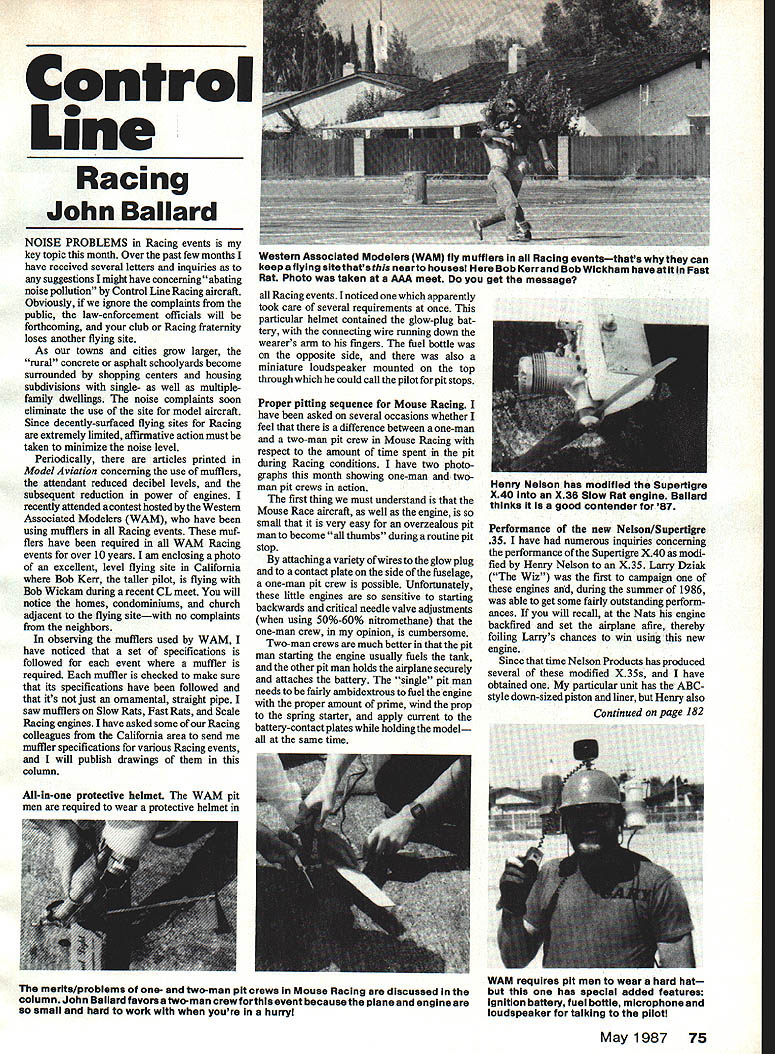
Periodically, Model Aviation prints articles about the use of mufflers, the attendant reduced decibel levels, and the subsequent reduction in engine power. I recently attended a contest hosted by the Western Associated Modelers (WAM), who have required mufflers in all racing events for over 10 years. I saw mufflers on Slow Rats, Fast Rats, and Scale Racing engines.
I have asked some of our racing colleagues from California to send muffler specifications for various racing events, and I will publish drawings of them in this column.
All-in-one protective helmet
The WAM pit men are required to wear a protective helmet in all racing events. I noticed one helmet that apparently took care of several requirements at once. This particular helmet contained the glow-plug battery, with the connecting wire running down the wearer’s arm to his fingers. The fuel bottle was on the opposite side, and there was also a miniature loudspeaker mounted on the top through which he could call the pilot for pit stops.
Proper pitting sequence for Mouse Racing
I have been asked on several occasions whether there is a difference between a one-man and a two-man pit crew in Mouse Racing with respect to the amount of time spent in the pit. I have two photographs this month showing one-man and two-man pit crews in action.
The first thing to understand is that the Mouse Race aircraft and engine are so small that an overzealous pit man can easily become “all thumbs” during a routine pit stop. By attaching a variety of wires to the glow plug and to a contact plate on the side of the fuselage, a one-man pit crew is possible. Unfortunately, these little engines are so sensitive to starting backwards and to critical needle-valve adjustments (when using 50%–60% nitromethane) that, in my opinion, the one-man crew is cumbersome.
Two-man crews are much better: the pit man who starts the engine usually fuels the tank, and the other pit man holds the airplane securely and attaches the battery. The single pit man needs to be fairly ambidextrous to fuel the engine with the proper amount, prime the engine, wind the prop, apply the spring starter, and apply current to the battery contact plates while holding the model—all at the same time.
Performance of the new Nelson/Supertigre .35
I have had numerous inquiries concerning the performance of the Supertigre X.40 as modified by Henry Nelson to an X.35. Larry Dziak (“The Wiz”) was the first to campaign one of these engines and, during the summer of 1986, was able to get some outstanding performances. You will recall that at the Nats his engine backfired and set the airplane afire, thereby foiling Larry’s chances to win using this new engine.
Since that time Nelson Products has produced several modified X.35s, and I have obtained one. I find that the engine turns approximately 800–900 more rpm on the same propeller than the good OS .35/19 Slow Rat engine. The starting capabilities of the engine, as well as its durability, seem to be excellent. I ran mine for about 30 minutes on two Slow Rats and found that its performance is at least equal to the OS .35.
Unfortunately, people who have built their planes to fit the OS or K&B .35 will have to make some extensive modifications to their engine-mounting plates as well as to the locations of the mounting-bolt holes. The Supertigre is, of course, a heavier engine than the OS .35, and the bolt-hole patterns of the two engines are completely different. In most cases I would suggest buying a complete engine-mount top end for your existing model—or building a new cowl and firewall to utilize the Nelson-modified Supertigre X.35. As the racing season unfolds this year, I will keep you informed as to the performance of these custom-made ST X.35 Slow Rat engines.
Pro-Grip control handle
In my March column I showed a picture of a special handle then being used in a Combat circle. Many racing competitors showed interest in this heavy-duty unit, but I did not know the name of the manufacturer at that time. For those who are interested, the handle is a Pro-Grip control line handle produced by Sagan Industries, Inc., 16-34 35th Street, Long Island City, NY 11106. You can buy them direct for $14.95 plus $3.75 shipping and handling, or they should be available at your local hobby shop.
As always, your comments and photographs are solicited and appreciated.
John C. Ballard 10102 Kimblewick Dr. Louisville, KY 40223
Transcribed from original scans by AI. Minor OCR errors may remain.

