
Control Line: Racing
John Ballard
Team Racing (FAI F2C)
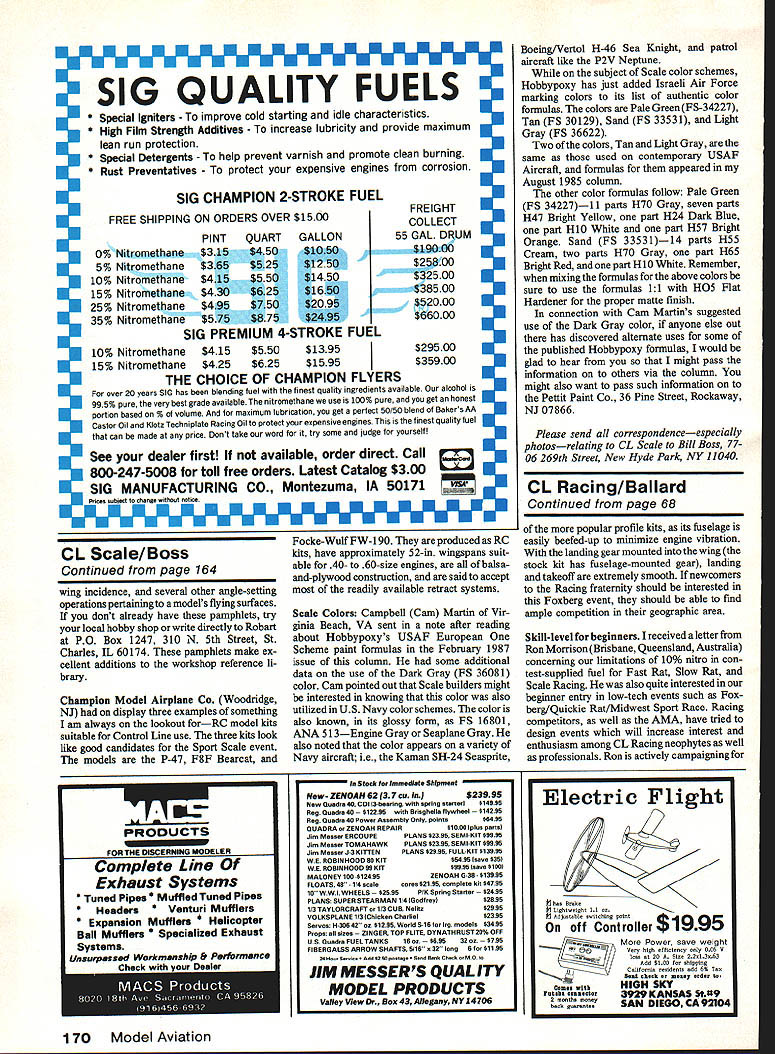
Let's talk about the FAI event, F2C. I received sketches of the seven most popular team racers used by the Soviet F2C team from Steve Buso (Poughkeepsie, NY). The drawings were supplied by Karl Plotsinsh, and I'm sharing one of them with you this month (I'll save another for next time).
Since there were seven different models, if you'd like to see all of them you'll have to drop me a line and ask for copies. I would be happy to supply them to you. Of course, the drawings have Russian notes, but the metric sizes and measurements can be converted easily with the aid of a metric-system conversion chart. (I'm sure that John Ballard would appreciate your including a stamped, self-addressed envelope—SASE—with your request for copies of the drawings. RMcM.)
Southwest Regionals (January 17–18, 1987)
The Southwest Regionals were held January 17–18, 1987, in Tucson, AZ. I received several calls and a newsletter from the Cholla-Choppers club concerning this control line meet held in warm, sunny Tucson—though the weather surprised everyone.
On Saturday, January 17 the paved racing circle was found to be covered with a one-inch layer of snow with glare ice underneath. It took several hours of concentrated effort by all racing contestants to broom and dry the circle. Apparently, that weekend established an all-time record low for that date in the Tucson area, and the highs for both Saturday and Sunday were only in the forties.
Event winners:
- AMA Slow Rat: Bill Lee — 6:41.4
- Scale Racing: Bill Lee — 6:32
- Fast Rat: Bob Fogg (Fogg–Shahan team) — 4:51.08
Fox/Goldberg Sport Racing
There has been a definite upswing in CL racing with the inclusion of this event at control line meets, and participants seem to be coming out of the woodwork. The event is successfully flown in Houston, Chicago, and Brantford, Ontario, Canada. Average entries are 10 to 15, and the competition is exciting. With the Fox engine, airplane speeds are easily controlled by the average pilot.
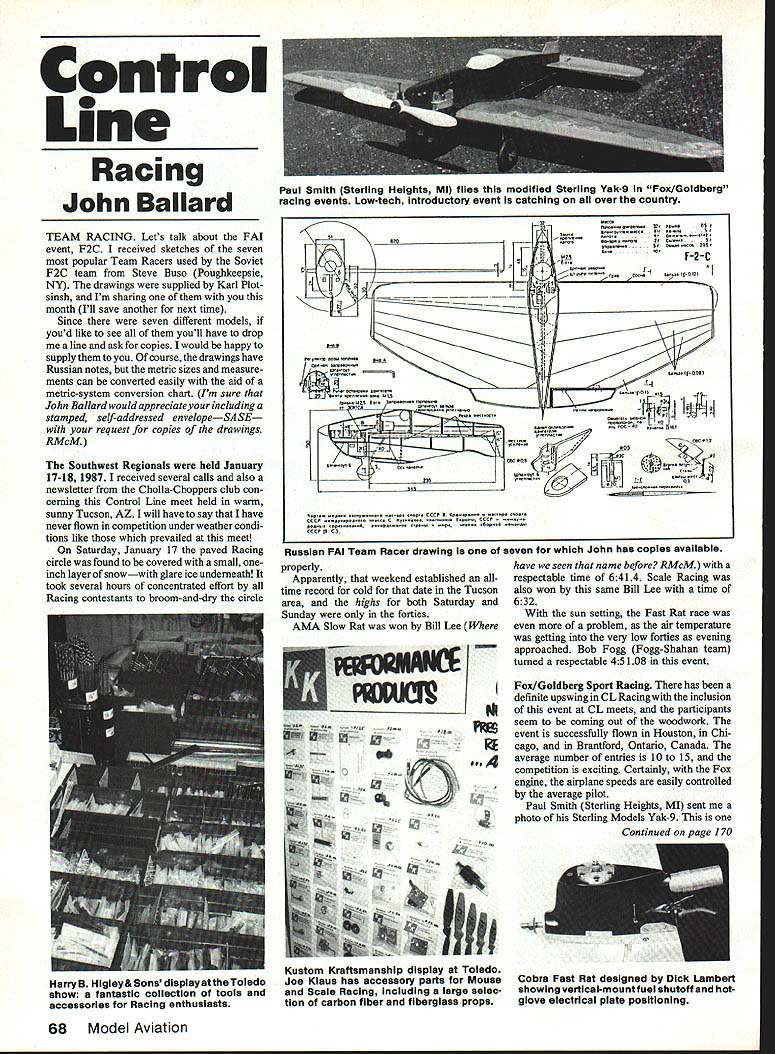
Paul Smith (Sterling Heights, MI) sent a photo of his Sterling Models Yak-9. This is one of the more popular profile kits, as its fuselage is easily beefed up to minimize engine vibration. With the landing gear mounted into the wing (the stock kit has fuselage-mounted gear), landing and takeoff are extremely smooth. Newcomers to the racing fraternity interested in this disk-type event should be able to find ample competition in their area.
Skill Level for Beginners
I received a letter from Ron Morrison (Brisbane, Queensland, Australia) concerning our limitation of 10% nitro in castor-based fuel for Fast Rat, Slow Rat, and Scale Racing. He was also quite interested in our beginner entries in low-tech events such as Box Rat, Quickie Rat, and Midwest Sport Race.
Racing competitions, as well as the AMA, have tried various speed and design events to increase interest and enthusiasm among CL racing neophytes as well as professionals. Ron is actively campaigning for fuel restrictions as well as airframe and engine limitations for Australian racing competitors.
Fuel Shutoff and Hot-Glove Mounting-Plate Location
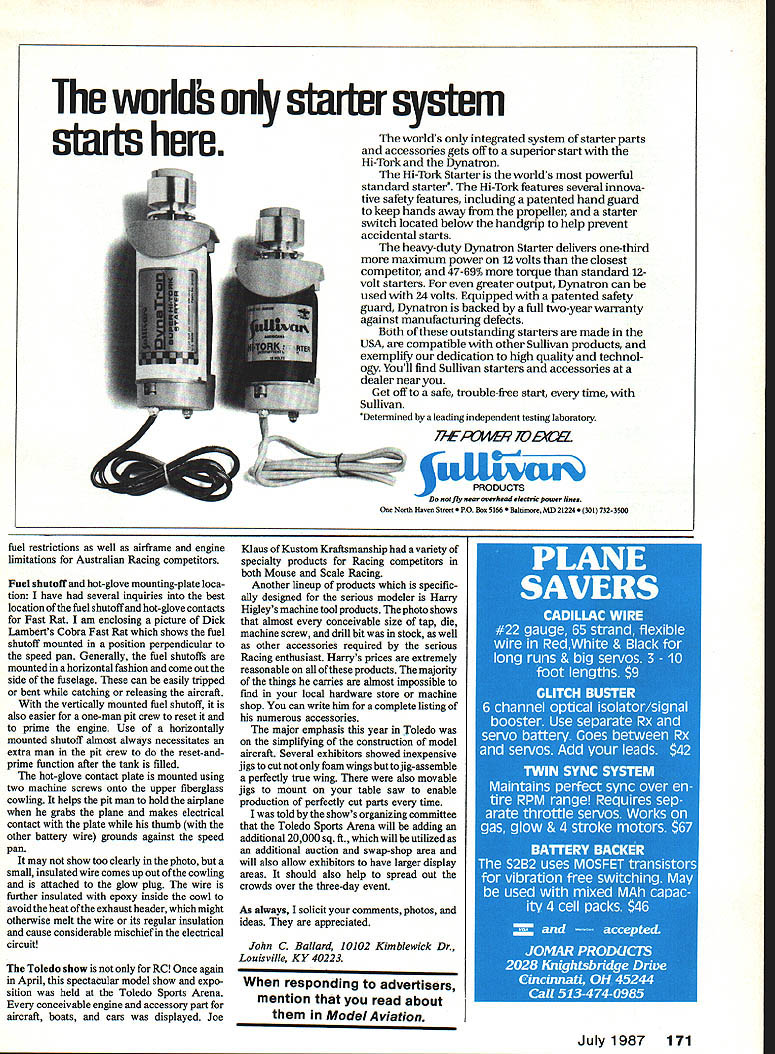
I have had several inquiries into the best location for the fuel shutoff and hot-glove contacts for Fast Rat. I am enclosing a picture of Dick Lambert's Cobra Fast Rat which shows the fuel shutoff mounted in a position perpendicular to the speed pan. Generally, fuel shutoffs are mounted horizontally and exit the side of the fuselage; these can be easily tripped or shut while catching or releasing the aircraft.
With the vertically mounted fuel shutoff, it is also easier for a one-man pit crew to reset it and to prime the engine. Use of a horizontally mounted shutoff almost always necessitates an extra man in the pit crew due to the reset-and-prime function after the tank is filled.
The hot-glove contact plate is mounted using two machine screws to the upper fiberglass cowling. It helps the pit man hold the airplane when he grabs it and makes electrical contact with the plate while the other battery wire grounds against the speed pan.
A small insulated wire comes up out of the cowling and is attached to the glove plug. The wire is further insulated with epoxy inside the cowl to avoid the heat of the exhaust header, which might otherwise melt the wire or its insulation and cause mischief in the electrical circuit.
Toledo Show
The Toledo show is not only for R/C! Once again in April, this spectacular model show and exposition was held at the Toledo Sports Arena. Every conceivable engine and accessory for control line, R/C aircraft, boats, and cars was displayed. Joe Klaus of Kustom Kraftsmanship had a variety of specialty products for racing competitors in both Mouse and Scale Racing.
Another lineup of products specifically designed for the serious modeler is Harry Higley's machine tool products. Almost every conceivable size of tap, die, machine screw, and drill bit was in stock, as well as other accessories required by the serious racing enthusiast. Harry's prices are extremely reasonable; many of the items he carries are almost impossible to find in local hardware stores or machine shops. You can write him for a complete listing of his accessories.
I was told by the show's organizing committee that the Toledo Sports Arena will be adding an additional 20,000 sq. ft., to be used as extra auction and swap-shop area and to allow exhibitors larger display areas. It should also help spread out the vendors over the three-day event.
Closing
As always, I solicit your comments, photos, and ideas. They are appreciated.
John C. Ballard 10102 Kimblewick Dr. Louisville, KY 40223
Transcribed from original scans by AI. Minor OCR errors may remain.

