
Control Line: Racing
John C. Ballard
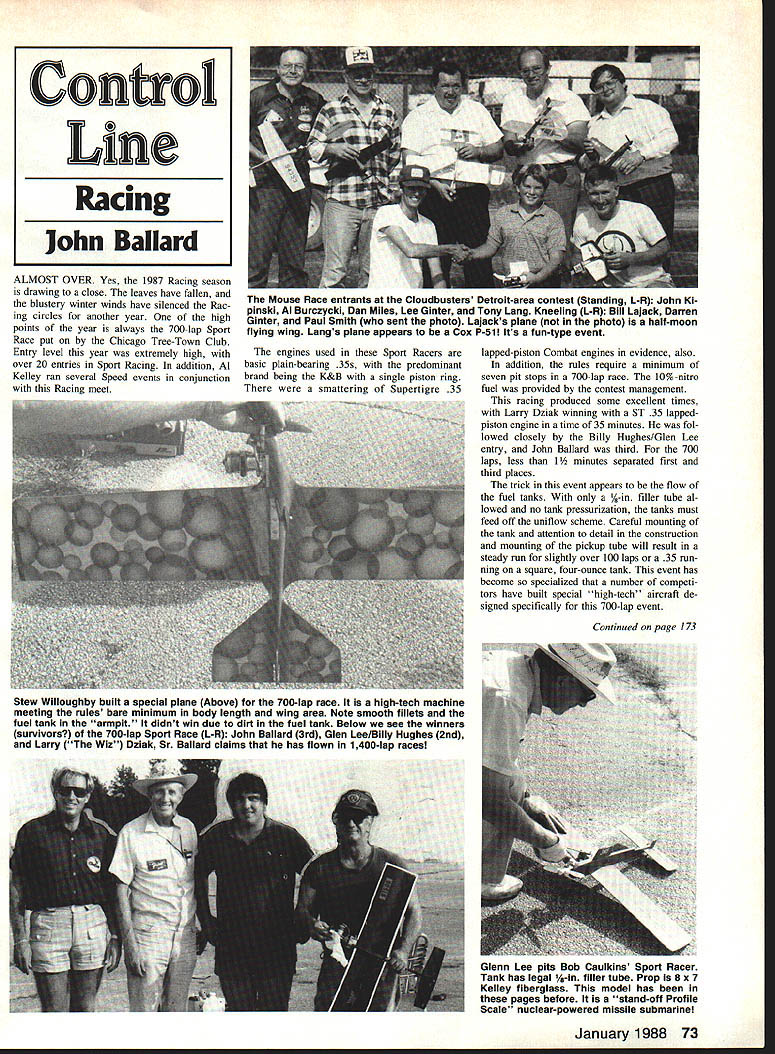
700-lap Sport Race (Chicago Tree-Town Club)
Almost over. The 1987 racing season is drawing to a close. The leaves have fallen, and the blustery winter winds have silenced the racing circles for another year. One of the high points of the year is always the 700-lap Sport Race put on by the Chicago Tree-Town Club. Entry level this year was extremely high, with over 20 entries in Sport Racing. In addition, Al Kelley ran several speed events in conjunction with this racing meet.
The engines used in these Sport Racers were the basic plain-bearing .35s, with the predominant brand being the K&B with a single piston ring. There were a smattering of Supertigre .35 lapped-piston Combat engines in evidence as well.
The rules required a minimum of seven pit stops in a 700-lap race. The contest management provided 10% nitro fuel.
This racing produced some excellent times. Larry Dziak won with a .35 lapped-piston engine in a time of 35 minutes. He was followed closely by the Billy Hughes/Glen Lee entry, and John Ballard was third. For the 700 laps, less than 1.5 minutes separated first and third places.
The trick in this event appears to be the flow of the fuel tanks. With only a 5/8-in. filler tube allowed and no tank pressurization, the tanks must feed using an uniflow scheme. Careful mounting of the tank and attention to detail in the construction and mounting of the pickup tube will result in a steady run for slightly over 100 laps on a square four-ounce tank. This event has become so specialized that a number of competitors have built special "high-tech" aircraft designed specifically for the 700-lap event.
Racing in St. Louis
Racing in the St. Louis area is once again on an upswing. Contest Director Gary Frost had the first contest there in quite some time on October 4. It was a thorough success, and he plans two contests for 1988: the first Sunday in May and the first Sunday in October.
Gary promoted his contest with both telephone calls and letters. His effort was rewarded with competitors from three states, and Mike Greb came all the way from Texas to fly Scale Race plus Fast and Slow Rat. The concrete circles at Buder Park are topnotch.
Results:
- Scale Race: Bob Oge — 6:05.07
- Fast Rat: Larry Dziak, Jr. — 4:51.65
- Slow Rat: Larry Dziak, Jr. — 6:04.12
- Sport Race: Larry Dziak (senior) — 4:56.4
Gary is also planning a series of speed contests to be run in conjunction with the 1988 racing meets. Speed pilots will want to put the St. Louis contests on their calendars.
Detroit area — Cloudbusters Club revival
The Cloudbusters Club from Detroit, MI, has had a revival in racing. The Detroit area was extremely strong in racing events from 1962 through the early 1970s, when Combat more or less replaced them. Now, Paul Smith and his colleagues have rejuvenated racing in that area.
The Cloudbusters had a control-line racing contest on September 27 at the Ford axle plant in Sterling Heights which featured Mouse Racing and a type of Sport Racing they have called Slow Combat. I am enclosing a photograph of Paul's group taken during the September 27 meet.
Rat/Scale Race control wire construction
We have had several requests concerning the proper method of making up the ends on the control lines for these events. The best method for wrapping is found in the AMA rule book in the "Control Line General" section, Figure No. 1 or No. 2, which shows the proper construction of wire ends on solid-strand control wires.
My personal practice:
- I buy the typical spindle/spool-and-wire kits but do not use the included wire — it is a little too thick.
- I use slightly thinner wire (about .005 in. smaller diameter), made from fine copper wire from an electrical shop.
- I double-wrap the overlap with closely spaced turns of the copper wire for at least one inch.
- Instead of soldering these wire-end wrappings, I use one-hour (slow-cure) epoxy glue. In the past I have had several wires break from soldering, so epoxy seems to work very well: there is no heat stress to the wire from soldering, and with clear epoxy the wires can be visually inspected each time they are used.
To avoid kinking lines in their plastic storage reels:
- Install a 7/16-in.-long 2-56 bolt through the side of the reel (head on the inside) near the line slot.
- Use the protruding end as an anchor for the line clips as you wind up the lines.
This eliminates the need to bend the lines through the slot to hitch the line clips to the built-in plastic tabs.
As always, your comments and photos are solicited.
John C. Ballard 10102 Kimblewick Dr. Louisville, KY 40223
Transcribed from original scans by AI. Minor OCR errors may remain.

