
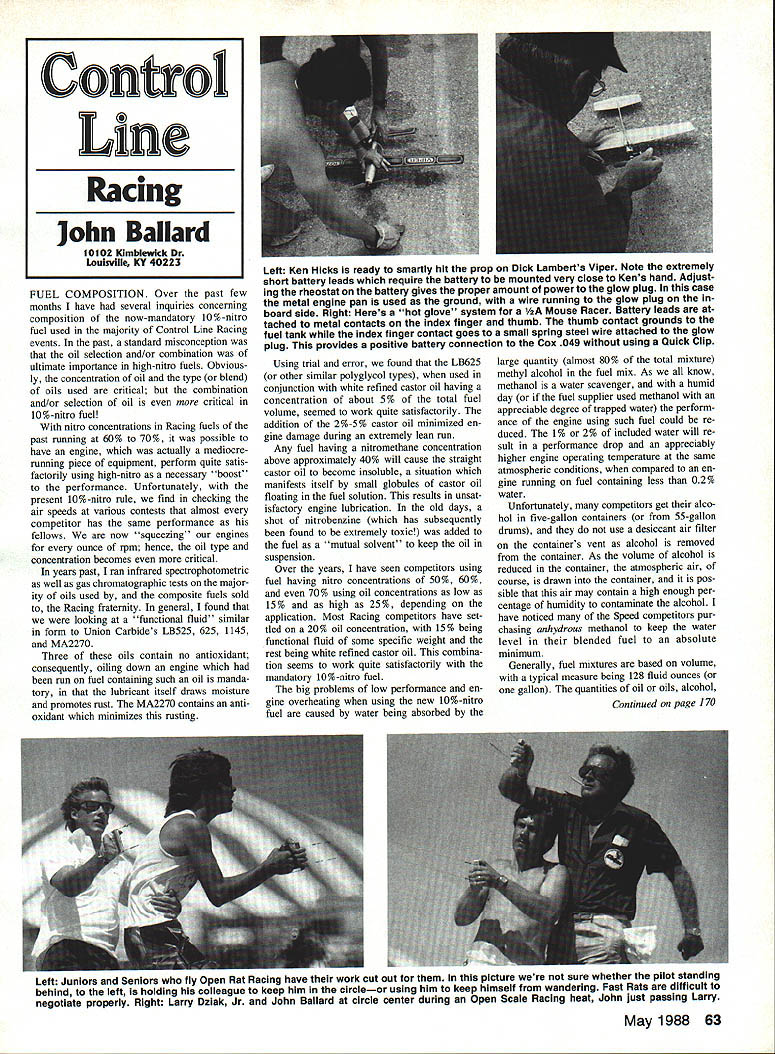
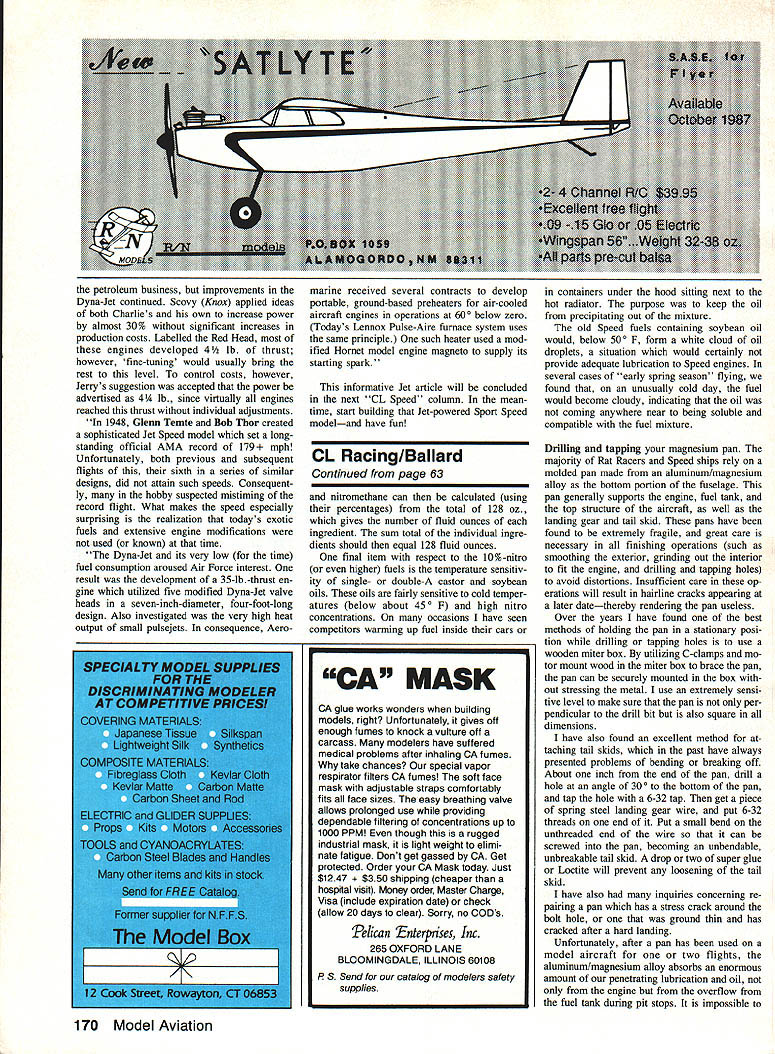
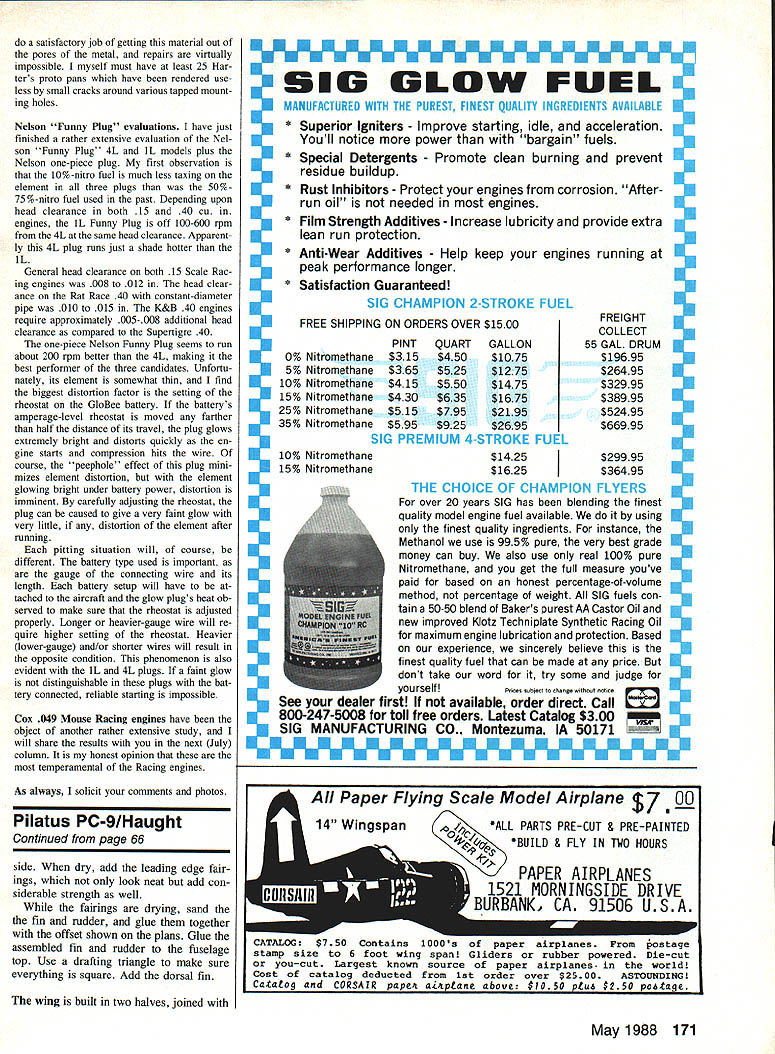
Control Line: Racing
John Ballard 10102 Kimblewick Dr. Louisville, KY 40223
Fuel Composition
Over the past few months I have had several inquiries concerning the composition of the now-mandatory 10% nitro fuel used in the majority of Control Line Racing events. In the past, a standard misconception was that oil selection and/or combination was of ultimate importance in high-nitro fuels. Obviously, the concentration of oil and the type (or blend) of oils used are critical; but the combination and/or selection of oil is even more critical in 10% nitro fuel.
With nitro concentrations in Racing fuels of the past running at 50%–70%, it was possible for an engine that was actually mediocre to perform quite satisfactorily using high nitro as a "boost." Unfortunately, with the present 10% nitro rule, air speed checks at various contests show that almost every competitor has roughly the same performance as his fellows. We are now squeezing our engines for every ounce of rpm; hence, oil type and concentration become even more critical.
Years ago I ran infrared spectrophotometric and gas chromatographic tests on the majority of oils used and on composite fuels sold to the Racing fraternity. In general, I found we were looking at a functional fluid similar to Union Carbide's:
- LB-525
- LB-625
- LB-1145
- MA-2270
Three of these oils contain no antioxidant; consequently, oiling down an engine that had been run on fuel containing such an oil is mandatory, because the lubricant itself draws moisture and promotes rust. MA-2270 contains an antioxidant which minimizes rusting.
Using trial and error, we found that LB-625 (or other similar polyglycol types), when used in conjunction with white refined castor oil at about 5% of the total fuel volume, worked quite satisfactorily. The addition of 2%–5% castor oil minimizes engine damage during an extremely lean run.
Any fuel having a nitromethane concentration above approximately 40% will cause straight castor oil to become insoluble; this manifests as small globules of castor oil floating in the fuel, resulting in unsatisfactory engine lubrication. In the old days, a shot of nitrobenzene (subsequently found to be extremely toxic) was added as a mutual solvent to keep the oil in suspension.
Over the years I have seen competitors using 50%–70% nitro fuels with oil concentrations ranging from 15% to 25%, depending on application. Most Racing competitors have settled on a 20% oil concentration, with 15% being functional for some specific weights, the rest being white refined castor oil. This combination seems to work quite satisfactorily with the mandatory 10% nitro fuel.
The big problems of low performance and engine overheating when using the new 10% nitro fuel are caused by water being absorbed by the large quantity (almost 80% of the total mixture) methyl alcohol (methanol) in the fuel mix. Methanol is a water scavenger, and with a humid day—or if the fuel supplier used methanol containing an appreciable degree of trapped water—the engine's performance is reduced and it will run hotter compared to fuel containing less than 0.2% water.
Many competitors get their alcohol in five-gallon containers or from 55-gallon drums and do not use a desiccant air filter on the container vent as alcohol is removed. As the volume of alcohol in the container is reduced, atmospheric air is drawn in, and that air may contain enough humidity to contaminate the alcohol. Speed competitors have been known to purchase anhydrous methanol to keep the water level in their blended fuel at an absolute minimum.
Fuel mixtures are generally based on volume, with a typical measure being 128 fluid ounces (one gallon). The quantities of oil or oils, alcohol, and nitromethane can then be calculated (using their percentages) from the total of 128 oz., which gives the number of fluid ounces of each ingredient. The sum total of the individual ingredients should equal 128 fluid ounces.
One final item with respect to 10% nitro (or higher) fuels is the temperature sensitivity of single- or double-A castor and soybean oils. These oils are fairly sensitive to cold temperatures (below about 45°F) and high nitro concentrations. On many occasions I have seen competitors warming fuel inside their cars or in containers under the hood next to the hot radiator to keep the oil from precipitating out of the mixture.
Old Speed fuels containing soybean oil would, below 50°F, form a white cloud of oil droplets, a situation which would certainly not provide adequate lubrication to Speed engines. On unusually cold spring days the fuel would become cloudy, indicating the oil was not soluble and compatible with the fuel mixture.
Drilling and Tapping for Magnesium Parts
The majority of Rat Racers and Speed ships rely on a molded pan made from an aluminum/magnesium alloy as the bottom portion of the fuselage. This pan generally supports the engine, fuel tank and landing gear and is the primary structural member in the aft portion of the model. Care must be taken when drilling and tapping holes in this material to avoid hairline cracks and distortion that can render the pan useless.
One of the best methods I have found to hold the pan stationary while drilling or tapping is to use a wooden miter box. By utilizing C-clamps and a motor mount block in the miter box to brace the pan, the pan can be securely mounted without stressing the metal. Use an extremely sensitive drill to ensure the pan is perpendicular to the drill and square in all dimensions.
An excellent method for attaching tail skids (a frequent problem) is:
- About one inch from the end of the pan, drill a hole at an angle of 30° to the bottom of the pan.
- Tap the hole and install a short length of threaded rod as a mounting stud.
- Use a small piece of spring wire for the skid, bend and thread one end to screw onto the stud, and secure with a drop of Loctite or epoxy.
This yields a strong, replaceable skid that will absorb shock and is easily serviced in the field.
Regarding repairs: once a pan has been used on a model that has suffered one or two hard landings, the aluminum/magnesium alloy often absorbs oil and cutting fluid from the engine area and from fuel overflow during pit stops. It is virtually impossible to get this material out of the pores of the metal, and repairs are frequently unsuccessful. I myself have at least 25 Harter proto pans rendered useless by small cracks around tapped mounting holes.
Nelson "Funny Plug" Evaluations
I have just finished an extensive evaluation of the Nelson "Funny Plug" 4L and IL models, plus the Nelson one-piece plug. My first observation is that 10% nitro fuel is much less taxing on the element in all three plugs than the 50%–75% nitro fuels used in the past.
Depending on head clearance in both .15 and .40 cu. in. engines, the IL Funny Plug is off 100–600 rpm from the 4L at the same head clearance. Apparently the 4L runs just a shade hotter than the IL.
Typical head clearances:
- .15 Scale Racing engines: .008–.012 in.
- Rat Race .40 with constant-diameter pipe: .010–.015 in.
- K&B .40 engines require approximately .005–.008 in. additional head clearance compared to Super Tigre .40.
The one-piece Nelson Funny Plug seems to be about 200 rpm better than the 4L, making it the best performer of the three candidates. Unfortunately, its element is somewhat thin, and the biggest distortion factor is the setting of the rheostat on the Globe battery. If the battery's amperage-level rheostat is moved any farther than half its travel, the plug glows extremely bright and distorts quickly as the engine starts and compression hits the wire. The "peephole" effect of this plug minimizes element distortion, but with the element glowing bright under battery power, distortion is imminent. By carefully adjusting the rheostat, the plug can be caused to give a very faint glow with very little, if any, distortion after running.
Each pitting situation will be different. The battery type used is important, as are the gauge of the connecting wire and its length. Each battery setup must be attached to the aircraft and the glow plug's heat observed to make sure the rheostat is adjusted properly. Longer or heavier-gauge wire will reduce the amount of rheostat required to heat the plug; lower-gauge and/or shorter wires will have the opposite effect. This phenomenon is also evident with the IL and 4L plugs. If a faint glow is not distinguishable in these plugs with the battery connected, reliable starting is impossible.
Cox .049 Mouse Racing Engines
Cox .049 Mouse Racing engines have been the object of another rather extensive study; I will share the results in the next (July) column. It is my honest opinion that these are the most temperamental of the Racing engines.
As always, I solicit your comments and photos.
Transcribed from original scans by AI. Minor OCR errors may remain.

