
Control Line: Racing
John Ballard 10102 Kimblewick Dr. Louisville, KY 40223
Texas Quickie Rat
I have received photographs, contest flyers, and reports of Racing activity throughout the U.S. that now include Quickie Rat. The event was developed by the Texas racing contingent and has been refined for some years. Regular readers might remember the unofficial Quickie Rat event at the 1986 Nats, which attracted upwards of 20 entries.
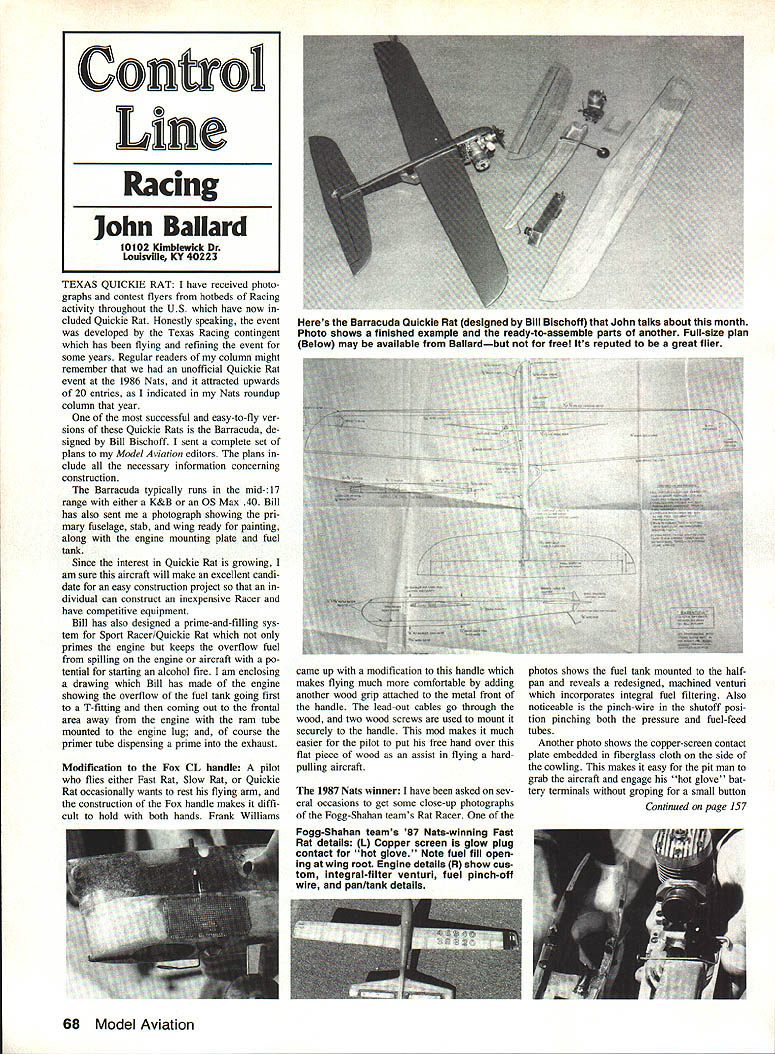
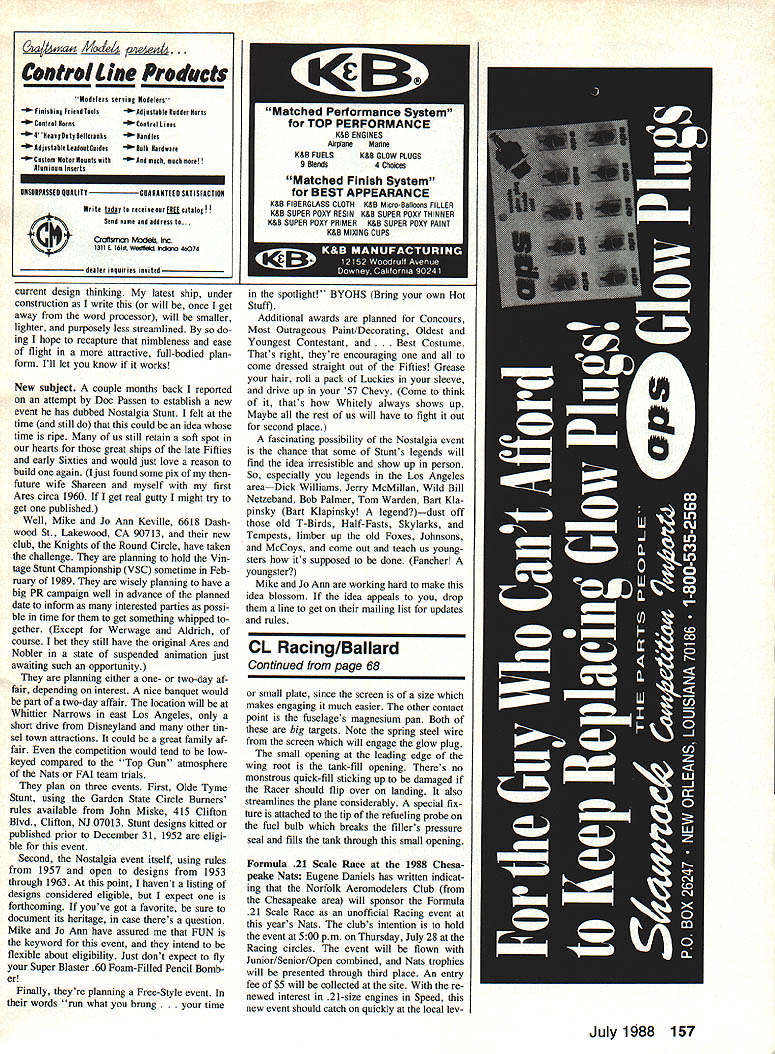
One of the most successful and easy-to-fly Quickie Rats is the Barracuda, designed by Bill Bischoff. Bill sent a complete set of plans to Model Aviation; the plans include all necessary construction information. The Barracuda typically runs in the mid-17-second range using either a K&B or an OS Max .40. Bill also sent photographs showing the primary fuselage, stab, and wing ready for painting, along with the engine mounting plate and fuel tank.
Since interest in Quickie Rat is growing, the Barracuda makes an excellent candidate for an easy construction project: an inexpensive racer that can be competitive.
Prime-and-Filling System (Sport Racer / Quickie Rat)
Bill Bischoff also designed a prime-and-filling system for Sport Racer/Quickie Rat models. It primes the engine and routes overflow fuel so it does not spill on the engine or airframe, reducing the potential for an alcohol fire. The overflow from the fuel tank goes to a T-fitting, then out forward to the frontal area away from the engine; the ram tube is mounted to the engine lug. The primer tube dispenses the prime into the exhaust.
Modification to the Fox CL Handle
Pilots flying Fast Rat, Slow Rat, or Quickie Rat sometimes want to rest their flying arm, but the Fox handle construction makes two-handed holding difficult. Frank Williams developed a modification: add another wood grip attached to the metal front of the handle. The lead-out cables pass through the wood grip, which is secured with two wood screws. This makes it easy for the pilot to place the free hand over the wood as an assist when flying a hard-pulling aircraft.
1987 Nats Winner — Fogg-Shahan Team Rat Racer
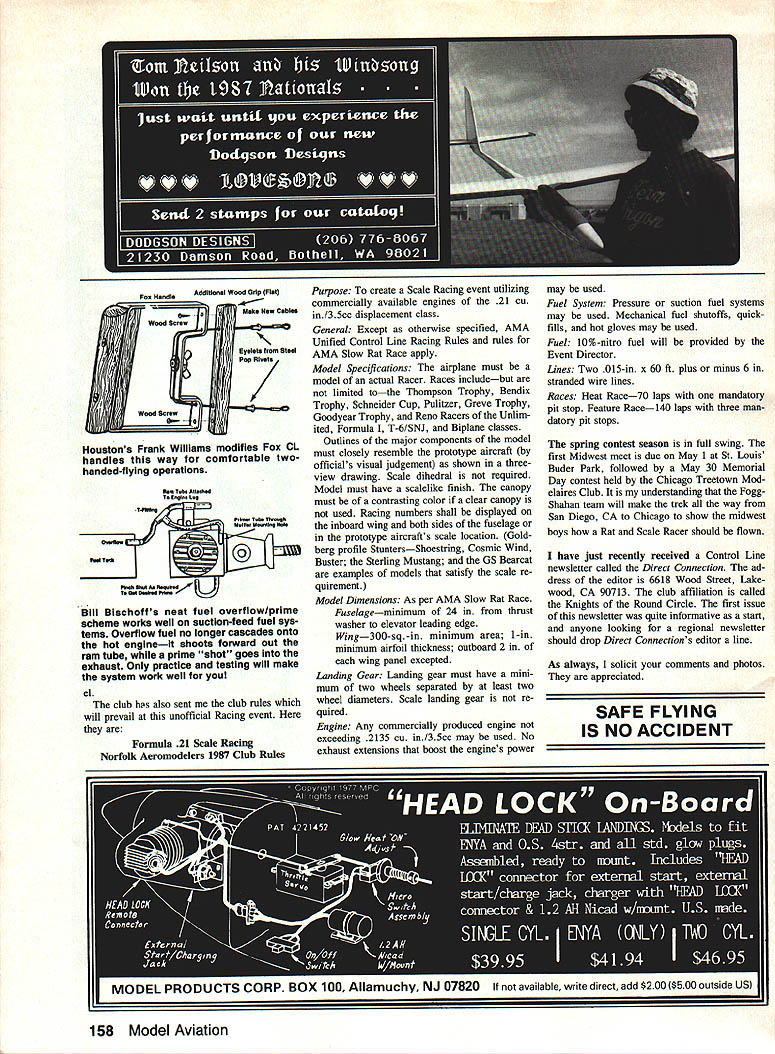
I was asked to get close-up photos of the Fogg-Shahan team's Rat Racer. Photos show:
- The fuel tank mounted to the magnesium half-pan.
- A redesigned, machined venturi that incorporates integral fuel filtering.
- A pinch-wire in the shutoff position that pinches both the pressure and the fuel-feed tubes.
- A copper-screen contact plate recessed in fiberglass cloth on the side of the cowling, providing a large, easy target for hot-glove battery terminals. The spring steel wire from the screen will engage the glow plug.
- A small tank-fill opening at the leading edge of the cowling — no large quick-fill protrusion to be damaged if the racer flips on landing. A special fixture attached to the tip of the refill-filler tube on the fuel bowl breaks the filler's pressure seal and fills the tank through this small opening.
Current Design Thinking
My latest ship, under construction as I write this (or will be, once I get away from the word processor), will be smaller, lighter, and purposely less streamlined. By doing so I hope to recapture nimbleness and ease of flight in a more attractive, full-bodied planform. I'll let you know if it works!
Vintage Stunt / Nostalgia Stunt — Vintage Stunt Championship (VSC)
A couple months ago I reported on Doc Passen's attempt to establish Nostalgia Stunt. Mike and Jo Ann Keville (6618 Dashwood St., Lakewood, CA 90713) and their new club, the Knights of the Round Circle, have taken the challenge. They plan to hold the Vintage Stunt Championship (VSC) in February 1989 at Whittier Narrows in east Los Angeles — a short drive from Disneyland and other attractions. They plan a big PR campaign to give interested parties time to prepare. The event could be a great family affair with a low-key competitive atmosphere.
They plan three events:
- Olde Tyme Stunt: Using Garden State Circle Burners rules (available from John Miake, 415 Clifton Blvd., Clifton, NJ 07013). Stunt designs kitted or published prior to December 31, 1952 are eligible.
- Nostalgia Event: Using 1957 rules and open to designs from 1953 through 1958. Document the design's heritage in case of questions. The organizers emphasize FUN and plan flexibility on eligibility.
- Free-Style: "Run what you brung."
They may hold a one- or two-day affair depending on interest; a banquet would be part of a two-day event. If interested, contact Mike and Jo Ann to get on their mailing list for updates and rules.
Formula .21 Scale Race at the 1988 Chesapeake Nats
Eugene Daniels reports that the Norfolk Aeromodellers Club will sponsor the Formula .21 Scale Race as an unofficial racing event at the 1988 Nats. The plan is to hold the event at 5:00 p.m. on Thursday, July 28 at the racing circles. Junior, Senior, and Open will be combined; Nats trophies will be presented through third place. An entry fee of $5 will be collected at the site. With renewed interest in .21-size engines in Speed, this event should catch on at the local level.
Norfolk Aeromodellers 1987 Club Rules — Formula .21 Scale Racing
Purpose:
- To create a Scale Racing event utilizing commercially available engines of the .21 cu. in. / 3.5 cc displacement class.
General:
- Except as otherwise specified, AMA Unified Control Line Racing Rules and rules for AMA Slow Rat Race apply.
Model Specifications:
- The airplane must be a model of an actual racer. Races include — but are not limited to — the Thompson Trophy, Bendix Trophy, Schneider Cup, Pulitzer, Greve Trophy, Goodyear Trophy, and Reno Races of the Unlimited, Formula 1, T-6/SNJ, and Biplane classes.
- The outline of the major components of the model must closely resemble the prototype aircraft (by officials' visual judgment) as shown in a three-view drawing. Scale dihedral is not required.
- Model must have a scale-like finish. The canopy must be a contrasting color if a clear canopy is not used.
- Racing numbers shall be displayed on the inboard wing and both sides of the fuselage or in the prototype aircraft's scale location.
- Examples of acceptable models: Goldberg profile Stunters—Shoestring, Cosmic Wind, Buster; the Sterling Mustang; and the G-S Bearcat.
Model Dimensions:
- As per AMA Slow Rat Race.
Fuselage:
- Minimum of 24 in. from thrust washer to elevator leading edge.
Wing:
- 300 sq. in. minimum area; 1-in. minimum airfoil thickness; outboard 2 in. of each wing panel excepted.
Landing Gear:
- Landing gear must have a minimum of two wheels separated by at least two wheel diameters. Scale landing gear is not required.
Engine:
- Any commercially produced engine not exceeding .2135 cu. in. / 3.5 cc may be used.
- No exhaust extensions that boost the engine's power may be used.
Fuel System:
- Pressure or suction fuel systems may be used.
- Mechanical fuel shutoffs, quickfills, and hot gloves may be used.
Fuel:
- 10% nitro fuel will be provided by the Event Director.
Lines:
- Two .010-in. x .60 ft. (plus or minus 6 in.) stranded wire lines.
Races:
- Heat Race — 70 laps with one mandatory pit stop.
- Feature Race — 140 laps with three mandatory pit stops.
Spring Contest Season
The spring contest season is in full swing. The first Midwest meet is May 1 at St. Louis' Buder Park, followed by a May 30 Memorial Day contest held by the Chicago Treetown Modelers Club. I understand the Fogg-Shahan teams plan to travel from San Diego to Chicago to show how Rat and Scale Racers should be flown.
Direct Connection Newsletter
I recently received a Control Line newsletter called Direct Connection. Editor address: 6618 Wood Street, Lakewood, CA 90713. The club affiliation is Knights of the Round Circle. The first issue is informative; anyone looking for a regional newsletter should contact the editor.
As always, I solicit your comments and photos. They are appreciated.
Transcribed from original scans by AI. Minor OCR errors may remain.

