
Control Line: Racing
John Ballard 10102 Kimblewick Dr. Louisville, KY 40223
LITTLE QUICKIE construction
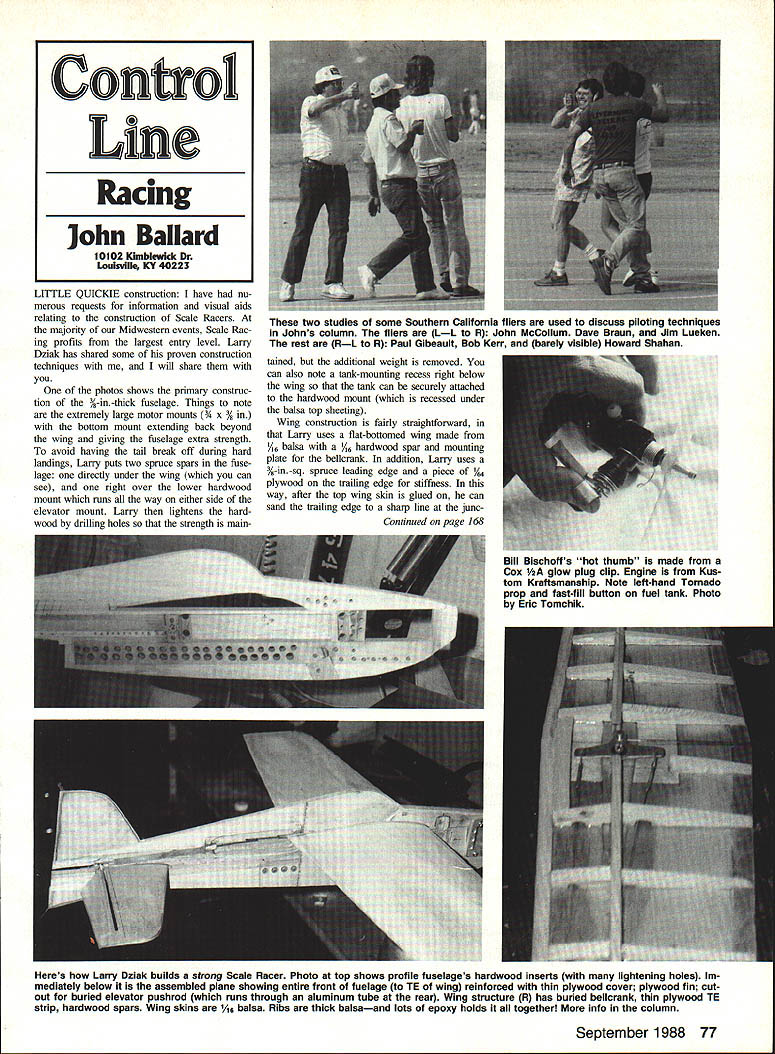
I have had numerous requests for information and visual aids relating to the construction of Scale Racers. At the majority of our Midwestern events, Scale Racing provides one of the largest entry-level fields. Larry Dziak has shared some of his proven construction techniques and photos; the highlights are summarized below.
Construction highlights
- Fuselage: 3/16-in.-thick balsa. Note the very large motor mounts (3/4 x 3/8 in.), with the bottom mount extending back beyond the wing to give the fuselage extra strength and help prevent tail breakage during hard landings.
- Spars: Two spruce spars in the fuselage — one directly under the wing and one above the lower hardwood mount that runs to either side of the elevator mount.
- Lightening: Larry lightens hardwood parts by drilling holes to remove unnecessary weight while maintaining strength.
- Tank mount: A recess for the fuel tank is located right below the wing so the tank can be securely attached to the hardwood mount, which is recessed beneath the balsa top sheeting.
- Wing: Flat-bottom wing made from 1/16-in. balsa with a 1/8-in. hardwood spar and a hardwood mounting plate for the bellcrank. A 3/16-in.-sq. spruce leading edge and a strip of 1/64-in. plywood on the trailing edge provide stiffness. After the top skin is glued on, sand the trailing edge to a sharp line at the junction.
- Bellcrank and controls: The bellcrank is set off center so the pushrod comes down the centerline of the wing — necessary for internally mounted elevator controls. The pushrod passes through the fuselage sides in an aluminum tube; the elevator horn is attached just below the stab.
- Covering: Apply 1/8-in. plywood over the entire front section of the wing back to almost the rear of the wing where shown in the photos for added strength.
These techniques emphasize accurate alignment and good technique for control system installation.
Engine selection and preparation
Engine selection and preparation are the heart of a competition setup. Current Speed engines are all fundamentally competitive in basic design — the days of a single "Speed secret" are long past. The real fundamentals to a strong engine are:
- A free-running crankshaft with good bearings
- A properly fitted piston and sleeve
- A good cylinder head fit
- An accurately fitted, free-running disk rotor (for rear-intake engines)
If these basics are right and the engine receives the correct amount of fuel, it will make competitive power. The equipment and shop processes required to check and, if necessary, correct these items are beyond this article; there are engine-tuning specialists who will set up an engine for you. In my experience, engines are generally pretty close out of the box; specialists are most useful when a rebuild is needed.
Commonly used Speed engines
- A/FAI Speed: OPS .15; Rossi .15 Mk III; K&B/Cox .15 Conquest; Supertigre X-15 RI (current AMA class record-holder)
- B Speed: OPS .29; Supertigre X-29 (current AMA class record-holder); K&B .49 RI; K&B .65 (used in some setups)
- C Speed: OS .65 VR (ducted fan); Picco .65 (ducted fan); Rossi .65 (ducted fan)
- F-40 Speed: OS 40 VR-P; K&B .65; Picco 40 RI/RE; Supertigre X-40 RI (current AMA class record-holder)
- Jet Speed: Dyna-Jet (current AMA class record-holder)
Fuels
For piston engines the three basic fuel ingredients are methanol, nitromethane and oil. For jets the basics are nitromethane and propylene oxide. Typical fuel formulas:
- Break-in / test / F-40: 40% methanol; 40% nitromethane; 20% oil (10% synthetic + 10% castor)
- Contest piped engines, classes A and B: 15% methanol; 65% nitromethane; 20% oil (17% synthetic + 3% castor)
- Contest class D: 0–5% methanol; 75–80% nitromethane; 20% oil (17% synthetic + 3% castor)
- Jet: 50% nitromethane; 50% propylene oxide
Recommendations
- Where possible, use less than 20% oil in piston-engine fuels; many setups run satisfactorily with less oil.
- The smallest mistake (for example, setting the needle too lean) can result in engine damage.
- I recommend using a mix of castor and synthetic oils; the castor provides extra protection, especially to the connecting rod/crankpin bearing.
Jets
Jets are somewhat different from reciprocating classes. The Dyna-Jet is essentially the primary engine for Jet Speed and has remained largely unchanged for many years. In the Jet class, more of the "Speed secret" traditions survive. If Jet is your preferred class, consider following the trainer route used for reciprocating classes — for example, using the Phire Kart trainer published in this column (August 1986).
Half-A glow plug clip
A useful "hot thumb" clip can be made quickly and inexpensively by soldering a brass strip to a standard Cox 1/4-in. glow plug clip. Solder a washer to the brass strip to provide a positive location for the plug's center post; an added brass strip can aid in locating the plug. This unit works well for Scale Racing and Mouse events.
Performance results
Recent meet results from California:
- Scale Racing: 1st Mike Shanal — 5:57.10; 2nd Bill Lee — 6:11.84
- Rat Race: 1st Vic Garner — 4:30.92; 2nd — 5:05.13 (Shana-Fog times)
AMA Slow Rat:
- Fox/Repp team — 8:10.20; 2nd Bill Lee — 8:17.78
West Coast / Sebree Hayes Memorial Meet at Melrose:
- Scale Racing: 1st Vic Garner — 6:13.50; 2nd Mike Shanal — 6:21.90
- Rat Race: 1st Bob Fogg — 4:46.84; 2nd Howard Shahan — 4:50.60
- Slow Rat (spark): 1st Vic Garner — 6:08.03; Fox/Repp team — 6:35.60
Good piloting techniques
During "three-up" flying, pilot positioning and hand placement are important for clean passes and minimal time loss. If you come up behind another pilot to pass, raise your flying hand up near your head as you bring your airplane over; this brings the airplane over quickly and reduces the time required to make the pass. Keeping your arm low while attempting a pass tends to slow the aircraft, force you to fly a larger circle, and add unnecessary tenths of a second to your time.
Membership and resources
The best investment for someone starting in Speed is to join the North American Speed Society. It publishes a quarterly newsletter, Speed Times, which is an excellent source of information on design, engine setup, and suppliers.
Membership (Open) is $20/year. Address: North American Speed Society Box 82294 North Burnaby, B.C. Canada V5C 5P7
Many thanks to Bill Nusz for taking the time and effort to supply the photos and observations used here.
Have fun — fly Speed!
Transcribed from original scans by AI. Minor OCR errors may remain.

